
Bittermelons and Brownies: How to Eat Brownies

Brownies represent the alter ego of bittermelons. Instead of embracing the bitter, brownies challenge us to endure the abundance of sweetness.  Brownies with a hint of roasted bitterness and bittermelon bhaji with a hint of roasted sweetness operate like a dynamic gastronomic yin-yang. Most taste and encounters with others happen within this range. Sweetness and bitterness, ease and effort, are encounters that asks us to notice our repulsion and attraction to things. Life happens between tastes of bittermelons and brownies, between bitter medicine and sweet poison.

I have yet to meet a person who hates brownies. Unlike bittermelon, brownies are not an acquired taste. The sweet, moist and dense brownie conquers and overcomes bitterness unlike bittermelon bhaji that celebrates it. The beloved brownie does not have the unpleasant bitterness of a thing that cleanses the human liver or the risk of a thing that boils over and requires unpleasant cleanup, like dal.  There are ways to make an experience of brownies, unpleasant. Just imagine biting into a brownie and hearing an unwelcomed crunch, maybe of an errant eggshell shard.

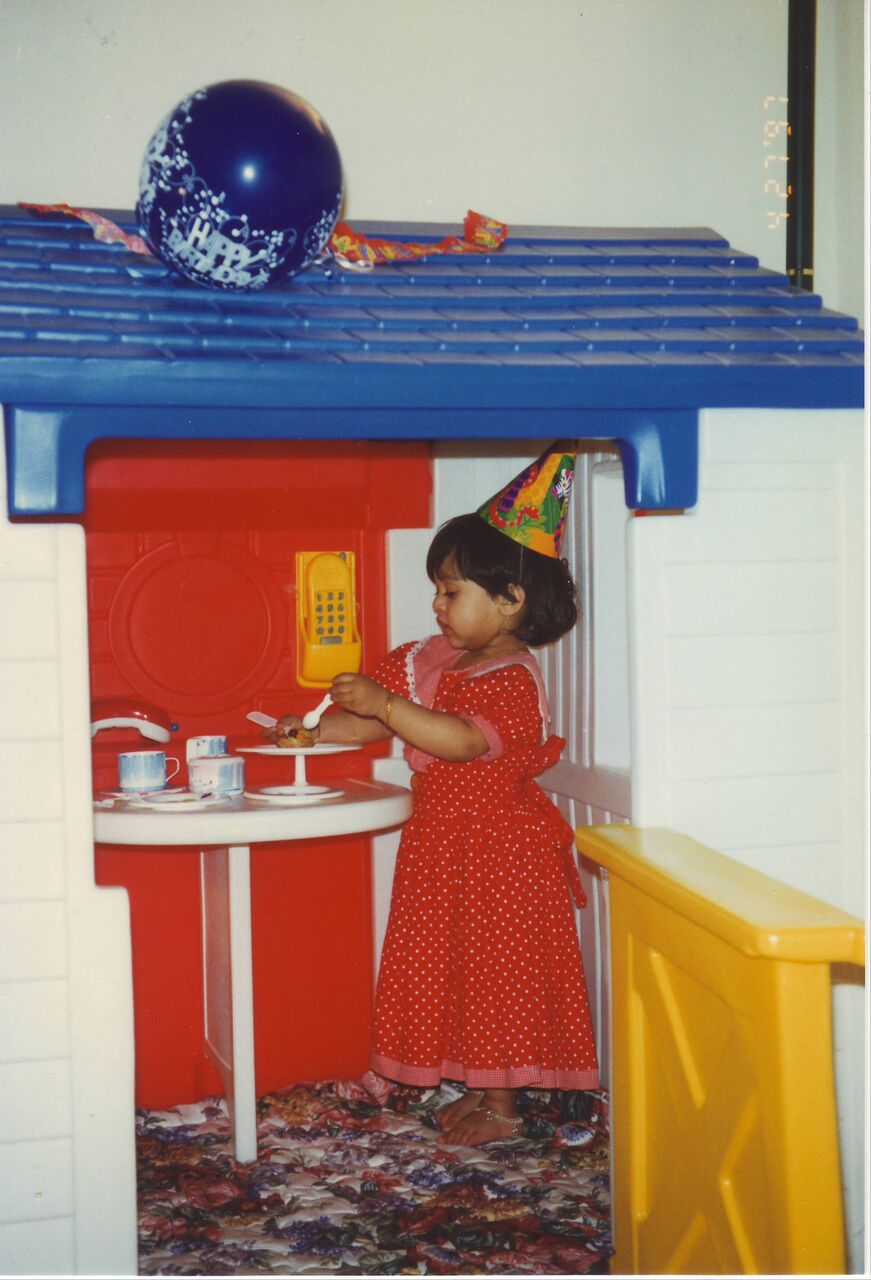
Broken off into small bites with hot coffee or cold milk, or spooned from a bowl, warm and draped in melting vanilla ice cream, casual or elegant, there is no wrong way to eat a brownie. A miracle food in my house, brownies are one of the few foods celebrated by all members of my chopped and blended family.  In the past, in addition to special occasion dessert, a squat tower of brownies served as the platform for birthday candles, as well as traveled, boxed, to school as birthday treats instead of cupcakes.

Brownies represent a magical definition-defying confection between cake and candy. A small square aims to deliver big taste for the elegant and casual American diner. Dense and moist enough to be picked up and bit into without an uncivilized shower of cake crumbles, brownies exist for a society on the go and perfectly represents a designed American cultural experience.   In fact, the brownie was invented as a portable dessert for the ladies meeting at Chicago’s Palmer house to discuss the Chicago World’s Fair. Today a “to-go” version of this confection at the Palmer House comes boxed and wrapped with a ribbon. The packaging also includes a brief history and the original recipe. The taste can be described as dense yet delicate, with a texture between fudge and cake that melts in your mouth. The walnuts that give the confection texture compose the top layer and are coated with a light glaze. The recipe says it’s an apricot glaze but a fruity taste is hardly noticeable.

I chose Michael Ruhlman’s,  Make Ahead Brownies recipe as a guide for Atiya’s 15th birthday brownie for two reasons:  he claims the recipe is as “easy to make as pancakes” and his recipe yields a big half sheet pan. I quickly learned that the abundant size came with other considerations. For example, an equally big bowl and muscles are needed for mixing. I tried mixing the batter in the stand mixer while pouring the melted butter. I ended up with a melted butter shower all over the countertops and floors. It was a messy unpleasant clean up.

The next time I baked these brownies, I learned my lesson and stirred the batter in my largest bowl with my very own elbow grease. This was one of the few cooking instances where technology did not enhance the experience. Beware of technological shortcuts.

The brownies are wonderful: intensely chocolaty, fudgy, dense and delicious at any temperature.

I love the simplicity of the measurements that can be easily halved by the math-challenged like me. Look to Ruhlman’s recipe for details and his introductory narrative.

Ingredients (the amounts are NOT gentle suggests)

  • 2 cups flour

I have Pillsbury brand flour, last year 2016 Gold Brand flour was recalled due to e.coli. How does e.coli get into flour? We take the neutrality of flour as a given. Consider the dangers of anything processed.

  • 2 cups cocoa powder

I was sad but not surprised to learn of chocolate’s high carbon footprint. I used Hershey cocoa power and have no idea about the environmental and social impact of their chocolate sourcing or production.

  • 1 teaspoon salt

The power of salt, like water, can easily be overlooked. It makes me think of the fairytale about a king who asked his three princesses, “How do you love me?” To his satisfaction the first answered, “Like honey, father,” and the second answered, “like sugar, father.” To his great disappointment the youngest princess answered, “like salt, father.” Years later when she served him a meal without any salt, the king understood the value of salt.

  • 8 eggs

There are so many fun books dedicated to eggs now. This recipe comes for Michael Ruhlman’s Egg: A Culinary Exploration of the World’s most Versatile Ingredient.

  • 4 cups sugar

In addition to the notorious history of sugar production tied to slave labor, the detrimental role of sugar for human health, makes it a treat with a high cost.

  • 4 teaspoons vanilla extract

What a magical ingredient! Every time I open a jar, I have to take a whiff of the sweet spice.

  • 1 pound (4 sticks) of butter

How many cups of milk does it take to make a stick of butter? This is definitely a luxurious recipe. One I probably would not make in Dhaka, unless there was a super special occasion like a birthday.

  • 2 cups of chocolate chips

Chocolate chips have an odd birth after the 1938 invention of the chocolate chip cookie at the Toll House Inn by Ruth Wakefield. Legend has it that WWII soldiers from Massachusetts shared their care package cookies with their fellow soldiers and the cookie became popular on warfront and then the home front.

Mix dry ingredients. I like to add two teaspoons of espresso powder.

Mix eggs, sugar and vanilla. Add the melted butter in a small steady stream while whisking or the eggs will get scrambled. You may have to take breaks. I did.

Add dry to wet. Mix gently scraping the sides and the bottom of the bowl.

Pour batter on a parchment lined baking sheet. Bake at 350 degrees for 20-25 minutes.

The sheet of brownie emerges from the oven, unconvincingly done, gooey and soft. The surface will still look wet and slightly cracked. The best thing to do is let it cool. If you cut into it, the chocolate will ooze. This is the HARDEST part about this recipe: waiting. After what seems like an eternity your cooled and better yet, chilled brownie will be easier to cut into squares. Eat, share and freeze for later.

The simple sweet has a complex and even bitter history that reaches back to the chocolate of the Aztecs and forward to a group of women discussing the Chicago World’s Fair to introduce America’s productive power to the world. The story of the brownie is deeper than its shallow flat form. The brownie eaten at birthdays, received in care packages, shared with friends, eaten alone in consolation becomes a part of your story. The decadent and luxurious confection between cake and candy comes at a high cost to the environment and to your health. Brownies only make sense when shared with others as a treat, in small bites of unhealthiness to celebrate the dark sweetness of living.

How to eat brownies?  Make a lot; share even more, like any guilty pleasure.
Bittermelon and Brownies: How to Eat Bittermelons

No taste assaults us more than bitterness. Unlike our mammalian instinctive attraction to sweetness, a love for bitter is learned. It used to be standard practice that every Bengali mid-day meal would begin with bittermelon. Bengali children learn to swallow bitterness, some eventually grow to enjoy it but at some point all have to learn how to endure it. “It will clean your blood,” promised adults. The magical medicinal properties were supposed to offer redemption. From the bittermelon, I learned that things have properties and abilities beyond my experience. Apparently the unpleasant properties in my mouth accompany pleasant and beneficial properties for my body. There is more to what I taste.

In addition to the narrative of healing there were also a threat of future sweetness denied.  “You must eat the bitter to enjoy the sweet,” was not an abstract lesson. Strangely both my daughters enjoy bittermelon bhaji despite my continued aversion. Perhaps the narratives had stronger hold on them or maybe they inherited a high tolerance for bitterness from their father. Beyond the cultural narrative, bittermelon remains more than a vegetable for human consumption, more than all its qualities and properties of bitter, bumpy, seedy, green, organic, domesticated, transported, cultivated, eaten etc. Bittermelon represents a location in existence, in geography, in cultural narrative. When we invite the bitter-melon into our shopping cart, cooking pot and stomach attracted by its potential healing and nourishing powers, we also invite all the other factors that made the bittermelon possible. The bittermelon and I find each other as locations of existence, worlds colliding, along with the worlds of pots, refrigeration, trucks, grocery stores, Asia, Ayurveda, markets, plastic bags, oil, spices, salt, plates, earth, rain etc.

Ingredients (all quantities are gentle suggestions)

  • 2 Bittermelons
  • 2 small red potatoes (enough to be equal the sliced bittermelon)
  • 1 small onion
  • 1-teaspoon turmeric
  • ½ -teaspoon chili powder
  • Salt to taste
  • 3- tablespoons oil, vegetable, canola whatever you have.

1. Collect Ingredients.

You can usually find it in any Asian grocery store in the U.S. (to my surprise our local Kroger started carrying the strange vegetable among other distant geographical things). I wonder about the following questions: Doesn’t this counter the slow food local food movement? Is it wrong to eat Bitter-melon in the U.S. where it is not grown? Where does turmeric grow? Are onions and potatoes local? How are these ingredients grown? What is their history? How did people start eating bitter-melon anyway? How far is your grocery store? How are you getting there? What makes it possible for all the ingredients to be available? What makes it possible to gather all the ingredients on my counter? How many grocery trips? How many farmers, carriers, clerks, and stockers?

Or keep the seeds, your choice.

2. Slice the prickly bittermelon in half lengthwise. Scoop out seeds using a spoon. Thinly slice each half. This might be a good time to use a mandolin. Massage the sliced bittermelon with a generous palm full amount of salt. Let slices sit and sweat for at least a half an hour. Then wash and rinse the sliced bittermelon with cold water, a few times. Let rest in colander and dry. The salt draws out the bitterness. This strange process can be emotionally instructive. As if, we need to draw out bitter emotions in order to wash it away. What happens when salt meets the bitter-melon? What is that relationship about? Similarly, kale, another bitter vegetable, needs to be massaged with oil in order to make edible raw. Does this make kale related to bitter-melon? This process of salting, resting, rinsing and resting (again) takes time and energy but makes the dish taste roasted and experienced instead of angry and bitter. The encounter of Lisa and the Bitter-melon requires a lot of preparation.

3. Julienne potatoes.  Keep skin on. The red potatoes hold on to their structure despite the stir-frying. Yellow or russet potatoes, although delicious, fall apart and are best saved for mashed potatoes. Neutral buttery potatoes have the magical power to temper the bitter and bulk up the dish with smooth sweetness. How does a potato grow in darkness? What is the relationship between the earth and the potato?

4. Thinly slice onion. Consider the all the things involved. Knife, cutting board, onion, hands, eyes, tears, kitchen, house, suburb etc. All these things come together in a particular way for the new thing “thin onion slices.”

5. Heat oil in a large saute pan so you don’t suffocate the vegetables. A crowded pan will make the slices steam and become soggy, instead of developing the delicious roasty bits on the edge. I too feel steamy and soggy when faced with a crowded room. Add sliced onion, turmeric, chili power and salt. Saute until your nose detects the slight roasting of the spices as they merge into the hot oil as one complex flavor.  Onions will become soft. Add a teaspoon of water if the spices begin to stick or burn.

6. Add bittermelon and potatoes. Toss and sauté on high heat until all the vegetables are coated in the spiced oil. As the vegetables begin to soften, lower heat to a simmer, place lid on pan and let the now roasted vegetables continue to soften in the steam, about 10 minutes. If the vegetables are old and dry, having traveled the world to get to your kitchen, the bhaji may need a tablespoon or two of water to help steam and soften.

7. Once vegetables soften, raise heat and fry once more without lid. This will dry and roast the now tender vegetables allowing the spiced oil to cling. Do not stir so much that the vegetable break up into a mush. The pieces of potato and bitter melon should keep their form. Restless stirring does not make things cook faster.

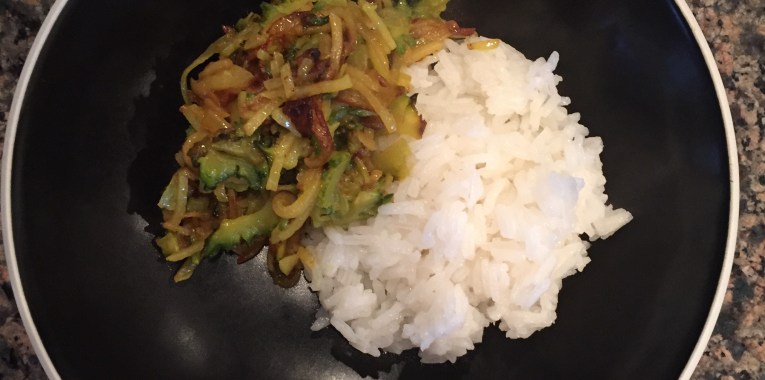
8. Serve with steaming hot plain white rice. This will probably feed 4-6 depending on your love of bitterness.

All this is only part of the story about when bitter-melon and I meet. As the bhaji enters my internal system it begins to remake me, as I had remade it. The mechanics of that internal world is a mystery to me. Even if someone were to explain the all the narratives of nutrition, digestion, biological structure and systems, it still would not begin to explain the existence of the grown, hollowed, sliced, salted, fried and digested vegetable. Everything has mysterious existential depth, even bitter things.

Bittermelons and Brownies: A recipe to grow myself

Everyday I find myself astonished and humbled by the infinite recipes for eating and living. My experience in architecture, philosophy, yoga and food has blended into a strange kaleidoscopic lens adjusting awareness, responsibility and joy in every interaction. I see cooking as transformative, as an event that helps me to take the other in, to consume, to enjoy and to cherish. My revised recipe for living now involves three considerations borrowing from yoga mindfulness and object oriented philosophy.

 (X)  Everything is a location in existence.

You, as a thing, are a dynamic location. You are a unique point in the stippled picture of the universe, never isolated, always responding. As is, everything else.

I borrow this from the practice of yoga that warns us against the misguided and egocentric belief that we are proudly autonomous or sadly disconnected.

X+  Everything is more than it appears.

You, as a thing, are more than your actions, emotions, body, race, religion, thought, features, likes, dislikes, you and everything you think you know is more than your assessment. You are hidden. As is, everything else.

Object oriented thinking and Graham Harman taught me to celebrate the darkness and depth of things. There is a philosophical generosity in accepting the unknown and resisting the drive for full disclosure.

 X + ( –X)  Everything is conditioned on what it is not.

Food is the visceral example of this. What is not you, sustains you. You are weird. As is, everything else.

Timothy Morton, the author of the Poetics of Spice (2006), Dark Ecology  (2016) and much more in between, talks about the “weird,” turning, twisting, looping non-linear causality and coexistence of things.

You, as a thing, are as a location in existence, more than what you seem and are conditioned by everything that is not you, and everything you encounter does the same.

Everything is a Point. Hidden. Weird.  Including, you. And, me.

Thing: {(X), X+, [X+(-X)]}

Keep reading. This is the master recipe I’ll be using in all food stories to come and to help me care about things I don’t understand. Let me tell you how to eat bittermelons and brownies, and a few things in between.

Bittermelons and Brownies – A recipe for growing Atiya

To my younger daughter Atiya, adjusting to a new chopped and blended family; I suggested four specific strategies beyond the injunction to be a strong independent woman. While Amani was born as I completed my degree in architecture where strength and uniqueness were primary virtues, Atiya was born during my graduate work in philosophy. In utero, she quietly listened to lectures on Hegel’s Phenomenology of Spirit, Aristotle’s Physics and Kant’s Third Critique. Her childhood rules reflect an awareness of time, a categorical responsibility and a sense of everything having a place. Six-year-old Atiya followed these four rules:

  1. Show up on time
  2. Finish what you start
  3. Clean up after yourself
  4. Keep your hair out of your face

It was a way to help her understand the importance of presence, engagement and responsibility. These were general rules applicable to many situations that helped her understand my expectations and helped me nag less.  The fourth rule “keep hair out of your face” was a later amendment, as her hair grew longer than her patience to care for it. Atiya is one of the most punctual, hard working, responsible and bright-faced women I know.

Amani and Atiya, you are both far better versions of me. Please don’t let my recipes limit you. I write these stories and recipes to help you write your own, not to follow mine. The recipe for growing girls has served you well but now is inadequate. You have both grown beyond simple slogans or prescriptions.

Bittermelons and Brownies: Introduction

Introduction: There are no recipes for Living

I begin with a disclaimer. I don’t follow recipes and nor do I expect you to. It is ironic of me to write a “cookbook.” I prefer expressed irony to hidden hypocrisy.  Irony is funny, inquisitive and open to other perspectives. Hypocrisy is not. These loose “recipes” are simply ways to remember that everyday we can be mindful and creative just by thoughtfully eating something.

I’m old enough to have experienced tectonic shifts in my own perspective. For me, in my 20s, self-sufficiency had been the mark of an adult.  In my 30s, as a mom and academic, productivity and efficiency had become my mantra. Now well into my 40s, I am the happiest I’ve ever been having shed my attachment to productive autonomy. Surely my thoughts at the moment are marked by where I am, a proud mom watching her baby fly. So take my words with a healthy dose of questioning and adjust to taste. Like people, recipes evolve.

Recipe for Growing Amani

When Amani was little she often heard me say “be a strong independent woman.” I may have been channeling my grandmother. Named after the Mughal emperor Akbar, Akbarunessa had a hard coating of authority about her, having lost her father and then her husband young. My grandmother cooked for herself, in a makeshift kitchen built into a corner of a long and wide veranda. In her little pot, the growing Dhaka city converged. She had two small gas burners and a sink not much larger than a loaf of bread. The old ice-crusted refrigerator stood awkwardly out of place in an adjoining bedroom. Her veranda kitchen hovered over a bed flowers and faced a garden complete with mango trees and flowering pulmeria.

The long winding and wrap-around veranda also held an easy chair, where she would recline and read with a cup of tea perched on the armrest. She spent her mornings hovered over her paring knife and vegetables. In the afternoon she would have lunch and then rest while listening to the radio. At four o’clock, she would make herself tea and wait for my aunts and mom to visit. At dusk she would water her garden with her metal watering can. Dinner at eight would be leftovers from lunch, carefully reheated over the stove in her tiny garden kitchen to the soundtrack of crickets. Her day ended by turning off the television and covering it with a large lace doily.

My seven-year old-self found this semi-solitary day lived by the beat of cooking and eating, strange and magical. She did all this in her corner of a large shared house surrounded by an even larger garden complete with mango, guava, papaya, eucalyptus, limes, roses, gardenia, jasmine and more. My uncle, her youngest and his family lived on the same floor as she did and we along with my mom, her eldest, lived on the second floor. It was a full house with at least two more large kitchens. But, my grandmother for whatever reason chose to cook and feed herself. I don’t know the history of the tiny makeshift veranda kitchen. I felt lucky on the occasions she invited me to eat lunch with her. For a no-nonsense stoic family figurehead, she was a surprisingly delicate cook. She cooked with calm, deliberate motions. Dare I say, she found cooking pleasurable. The only thing I didn’t like when I ate with her was the necessary Bengali first course:  bitter-melon bhaji and rice. It was the angry gatekeeper to a delicious fish or chicken curry to come. I still don’t like bitter melon but I have the fondest of memories around it.

Bad experiences don’t necessarily evolve into bad memories.

Thinking back, her odd self-feeding ritual despite being surrounded by family reads like a radical feminist effort to be self-sufficient. Maybe, for her, cooking was a statement of independence. Maybe it was a way to remain active and creative? I will never know.

I imagine for a little girl, “be a strong independent woman” seemed a harsh dictate. Amani, my first-born, is one of the most independent thinking, resilient and driven women I know.

How to Eat Bittermelons and Brownies – Recipes from a Philosopher Mom (Preface)

I wrote the first few chapters of “How to Eat Bittermelons and Brownies – Recipes from Philosopher Mom,” in anticipation of my first-born, Amani’s college graduation. As I prepare for my last-born, Atiya’s high school graduation this school year, I thought it would be therapeutic for me to add to the previous cookbook. In a way this is an ongoing story of grown and change. I imagine adding more, as more degrees, moves, homes, partners, life events and unfortunate losses are added to our collective lives. More than anything in the world, I enjoy mothering these two strong, smart, kind women. This is my way of loving them as they grow beyond the reaches of my wings.

I’ll share my journey here with you. Here is the preface from a few years ago:

Preface

“Amani cries everyday during lunch,” said the preschool teacher. Strange for a kid who loves to eat, I thought. Sensing my disbelief, Mrs. Mala asked that I visit during lunchtime to help solve the mystery. The next day I hid behind a curtain while the four-year olds were served lunch, as if waiting for frogs to sing or something magical to happen. It didn’t. Amani didn’t cry.

Later when asked, little Amani explained that Mrs. Mala wanted her to finish her lunch everyday. The thought of having to finish food she didn’t enjoy made her cry and she was scared of Mrs. Mala’s disapproval.

Later the “scary” teacher gave her two bracelets and all was forgiven.

We have all been at a table feeling forced to finish something we don’t enjoy. Whether the force comes from a looming authority, a sense of guilt or a sense of civility. Maybe with self-awareness that feeling of force, inevitably experienced, can diminish into either willful acceptance or rejection, instead of anxiety. Food as a way to digest and share our days becomes an emotional, physical and social barometer of our lives.

As my little Amani graduates college and enters adulthood, sometimes life will serve her dishes she doesn’t like or want to finish, literally and metaphorically. I won’t be there hiding behind the curtain to support her choice. Instead, I send her into the world with recipes about eating life with awareness, responsibility and joy.

Amani, my baby, may you always eat well.

Amani “Cooking”