
Fishing for Joy: A Personalized Restaurant Rating System (PRE-9)

I remember very little about that childhood trip from Dhaka to Rajshahi, except for how a piece of turmeric stained white flaky fish glistening in the sunshine transformed atmospheric overwhelm into delicious comfort. Fresh caught Rui fish skillfully hacked into thick steaks, generously slathered in red-yellow speckled spices, dropped into pans of sputtering hot mustard oil before being unceremoniously delivered to the backseat window of our Toyota. At that moment, the bustle of a crowded ferry crossing over the Jamuna River receded as all my greedy attention converged onto a taste that carried my senses inward and allowed me to swallow the chaos like a goddess. Since then, every bite of seasoned fried fish opens an emotional escape hatch from the restless boredom of waiting under a blanket of thick humid heat vaporizing into rancid smells. Retrospectively, belatedly, by surprise I recognize myself in that memory. That savored piece of fish flavors all my bites by comparison. Only now, I see it as a memorable event of self-soothing joy. The remembered satisfaction of my 10-year-old self fortifies my tastebuds with the possibility of a deliciously defiant celebration of difficult circumstances. In therapeutic terms, my fried-fish memory is an empowering and embodied resource of joy.

A Yelp review of this intimate gastronomically induced “everything-everywhere-all-at- once” happy place is shockingly inadequate. At the same time, heavily reviewed establishments can also become equally hidden by the burden of spot-lit conceptual overexposure. In both cases, the charge of meaning falls on the restaurant alone: the chef, the staff, the servers, the space, the food. The depth of experience that I bring as an eater remains unaccounted in the reduction to seemingly objective stars guiding other eaters. As I am guided by others or guide others, “I” disappear. No doubt, crowdsourcing to identify a potentially pleasurable gastronomic experience in unfamiliar territory can be deeply satisfying. If over a 1000 people bestowed a restaurant with 4 stars, the collective choice conjures an aura of objective truth. The restaurant might be good, but can it host transformative joy for me?

When I want to know a restaurant I follow reviews, when I want to connect with others, I add my review. When I want an opportunity to understand myself, I am called to craft my own review. The truth of each restaurant experience is a matching game between my personal rating and the ratings offered by others. And so, unique experiences deserve subjective AND objective approaches that speak intimately and publicly, at the same time. My mouth is a crossroad where I meet myself in taste and meet others in words. Savoring my piece of fish, I welcome the outward noise from which it is caught, dressed, prepared, and served, and follow it inward through my senses and into its future incarnations and connections by comparison and expression. This delicious and deliberate internal journey becomes the “this reminds me of …..” connection with others. In this way, I bring my childhood experience on the riverbank to translate into fried fish with my fellow architecture students in the mountains of Mexico, fried fish at a roadside eatery with my parents between Mecca and Medina, or Mahi fish tacos at my local North Carolina taco stand with my family. The quality of one food experience reveals itself only in the context of all my food experiences. Each bite evokes all bites, like an omniscient tasting power practiced through wide deliberate eating. Savoring and swallowing a bite is the ultimate embodied act of integrating familial, cultural, historical, and political experiences. This may be why hunger strikes have been historically used to reject undigestible familial and social conditions.

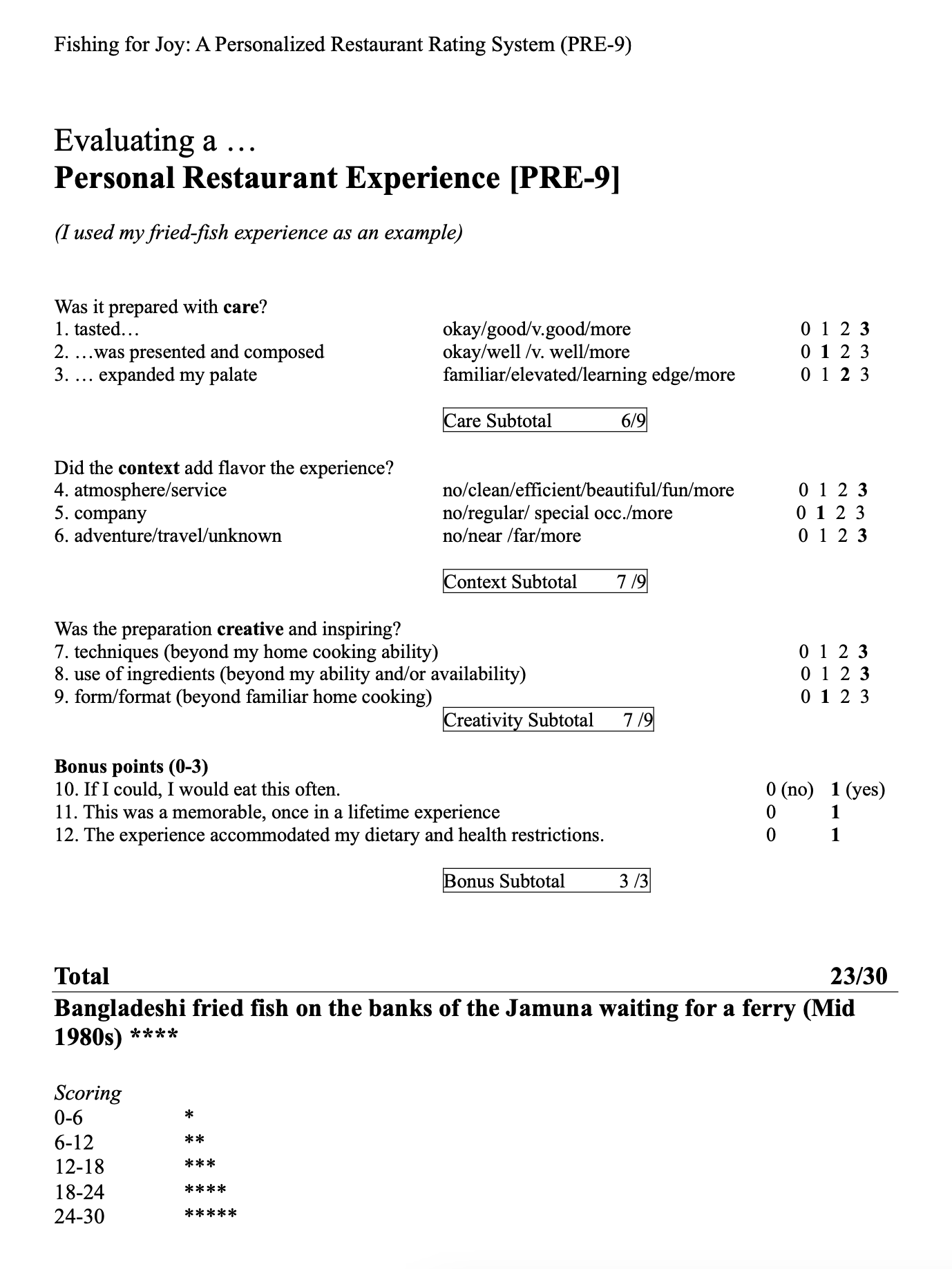
To discover and seek out more transformative fried-fish moments, I rely on my grief and anxiety counseling background. In my field of practice there are examples of measures that objectively rate subjective emotional experience, like satisfaction, depression, anxiety, self-worth etc. To fully appreciate the value of my childhood riverbank fried fish I borrowed the PHQ-9 format that measures depression. It seemed poetically justified to honor the format that identifies isolating depression to help identify connecting joy. The PHQ-9 measures sleep, energy, appetite, concentration, movement, pleasure as well as suicidal thoughts. Anhedonia, a symptom of depression is when what previously brought you joy no longer does so. Imagine having your favorite meal and feeling numb. I hope you don’t recognize this feeling, if you do, please stop reading and reach out. To identify the opposite state of anhedonia, the state of joy and pleasure fully experienced and expressed, a different scale would be needed. To measure my Personal Restaurant Experience (PRE-9) I identified my highest food values: care, context, creativity. Your criteria for gastronomic joy will be different. Other criteria can be leftover potential, zero waste, local, affordable, region specific, history specific, sustainable, strong aversions, strong preferences, dietary restrictions, etc. The scale gives me an instrument of mindful deliberation that can stretch the range of restaurant considerations from humble street food to Yelp-celebrated based on my own criteria for joy.

As an avid home cook, I value care taken to prepare a meal. Underdone, overcooked, under seasoned, over seasoned, poor ingredients or sloppy plating indicate a sad lack of care and pride in the preparation. My riverbank fried fish was prepared with skill evident in the efficiency of the whole process from carving to serving. As a design sensitive soul, I taste the context and environment just as much as the flavors. On the criteria of context my fish-fry was both a product of hustling context and a daringly delicious escape from it. Ideally, a restaurant meal would go beyond my own cooking abilities and knowledge, the skills and use of ingredients would inspire me, and the format would joyfully surprise me. The best meals challenge my assumptions about everything, surprise me, teach me, elevate me, and empower me to see the potential of humble things celebrated with careful joy. The bonus points of my rubric account for how the gastronomic experience serves joy in general. If the experience was memorable, repeatable, and invited me to follow the taste in my mouth and find the words to share that taste, it was worthy.

In retrospect, the piece of turmeric stained fried fish challenged me to accept the savory gift of nourishment within an unsavory crush of restless waiting. It had enticed me out of the protective shell of the car back seat and helped me experience feeling trapped as a sensational adventure instead. Transformative dishes open me to myself and my world, an ultimate act of embodied self-awareness that digests life itself. The PRE-9 expresses my deliberated search for joy through food and invites you to do the same. It prompts us to seek out universe-condensing bites of existence as antidotes to anhedonia particularly when life feels overwhelming.

Here are two no-recipe recipes: One for Bangladeshi Mach Bhaja (spice-fried fish) and one for a personalized evaluation of a restaurant experience.

Mach Bhaja [Fish Fry]

  1. Preferably a fatty big river fish but any fish works: tilapia, flounder, salmon, cod.
  2. Preferably steaks but filet is fine too. Scored skin on the filets offer extra flavor.
  3. Preferably fresh wet spices. A paste of turmeric powder, Kashmiri chili powder and salt works. Choose any spice combination and amount that settles your soul.
  4. Preferably mustard oil but olive oil or canola are fine too.
  5. Paint fish pieces with spices. Let the painted fish rest for up to an hour.
  6. Heat enough oil to cover the bottom of the pan until shimmering hot.
  7. Turn the vent on high. Without the benefit of an open sky and bustling market, the smells of hot mustard oil, spice, and fried fish can linger like guests past their welcome.
  8. Carefully place fish pieces in hot oil. Do not overcrowd the pan. If you do, you won’t get the roasted spice sear, fish will boil instead. Because of the water and spices, the fish will angrily splatter. Use a splatter screen or risk oil scars. Just assume there will be clean up afterwards.
  9. Lower heat to medium, let fish hard sear on one side. Flip and sear other side. In Bangladesh, fish tends to be cooked almost like meat. You are welcome to gently lift and place the fish onto paper towels to soak up the excess oil or serve with the clinging spiced oil. In Bangladesh, the spiced oil is a welcome sauce to coat and flavor the accompanying rice. To the Western palate accustomed to soft, poached, flaky salt- water fish, the hard fried fish may feel overcooked and oily.
  10. Eat immediately with steaming hot white rice, green chilies, and lime wedges.
Bites of Singapore

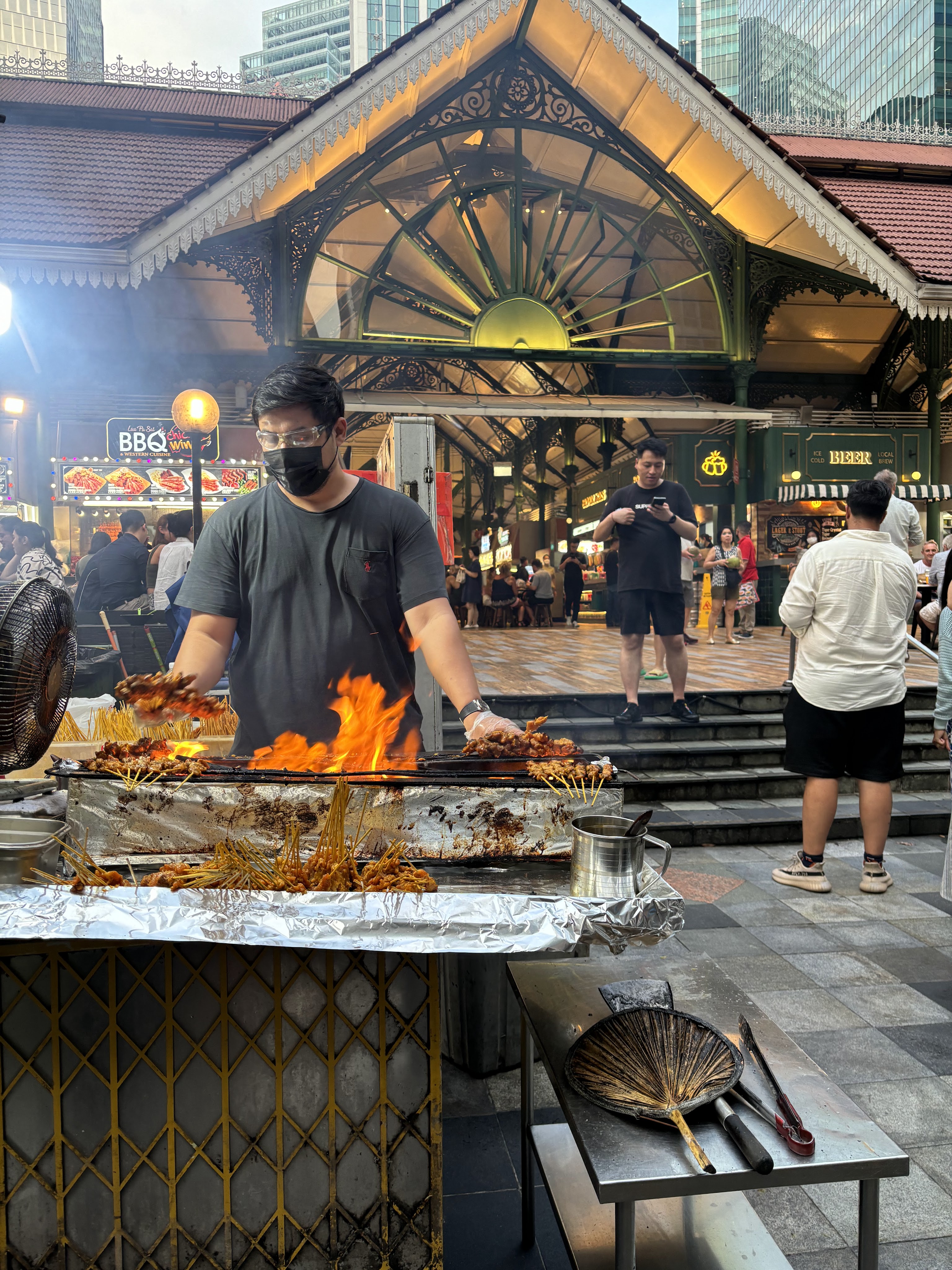
The street across from the Hotel Telegraph transformed into a bustling market dedicated to satay in the evening. Lines formed, chairs and tables were set, fires raged, meats marinated. In Singaporean style the experience was both highly organized and energetic. We descended from our third floor room before six pm to find patrons already waiting for their orders, a growing line and menus being inspected. As we approached with obvious confused looks on our faces, we were offered a menu of three satay options: shrimp, beef or chicken in various combinations and sizes. After we ordered, we received a buzzer to alert us when our food was ready. A 45-minute wait was suggested. While we waited we found an empty table at a place with the chilli crab just beyond the steps. It arrived quicklky after ordering a medium crab: succulent, spicy, spectacular. It was a treat that required eating armor in the form of plastic gloves and a ton of napkins. So very worth it. We were sopping up the spicy sauce with piping hot buns when our buzzer rang.

We scurried down the steps to find two spots in the long communal tables before collecting our tray of grilled and spiced meats. The tables were full and customers crammed without panic. It was a beautiful night in the city, under the stars dipping our sticks of satay into the sauce. So simple in form and so complex in flavor. I enjoyed the chicken the most.

Our mouths were still burning from the chilli crab, when glistening egg tarts called to us with promise of sweet relief. The tarts did not disappoint. Flaky pastry, still warm from the oven, the custard was barely set. We tried both the original and the salted egg. It demanded a delicate and quick gesture to guide the generous bite of delight into my mouth. My gesture wasn’t as delicate and refined as I wanted it to be. Regardless, it was a eyes-roll-back-in-disbelief moment of sheer eggy goodness. A moment of perfection that I am doomed to search for endlessly. I’m okay with that.

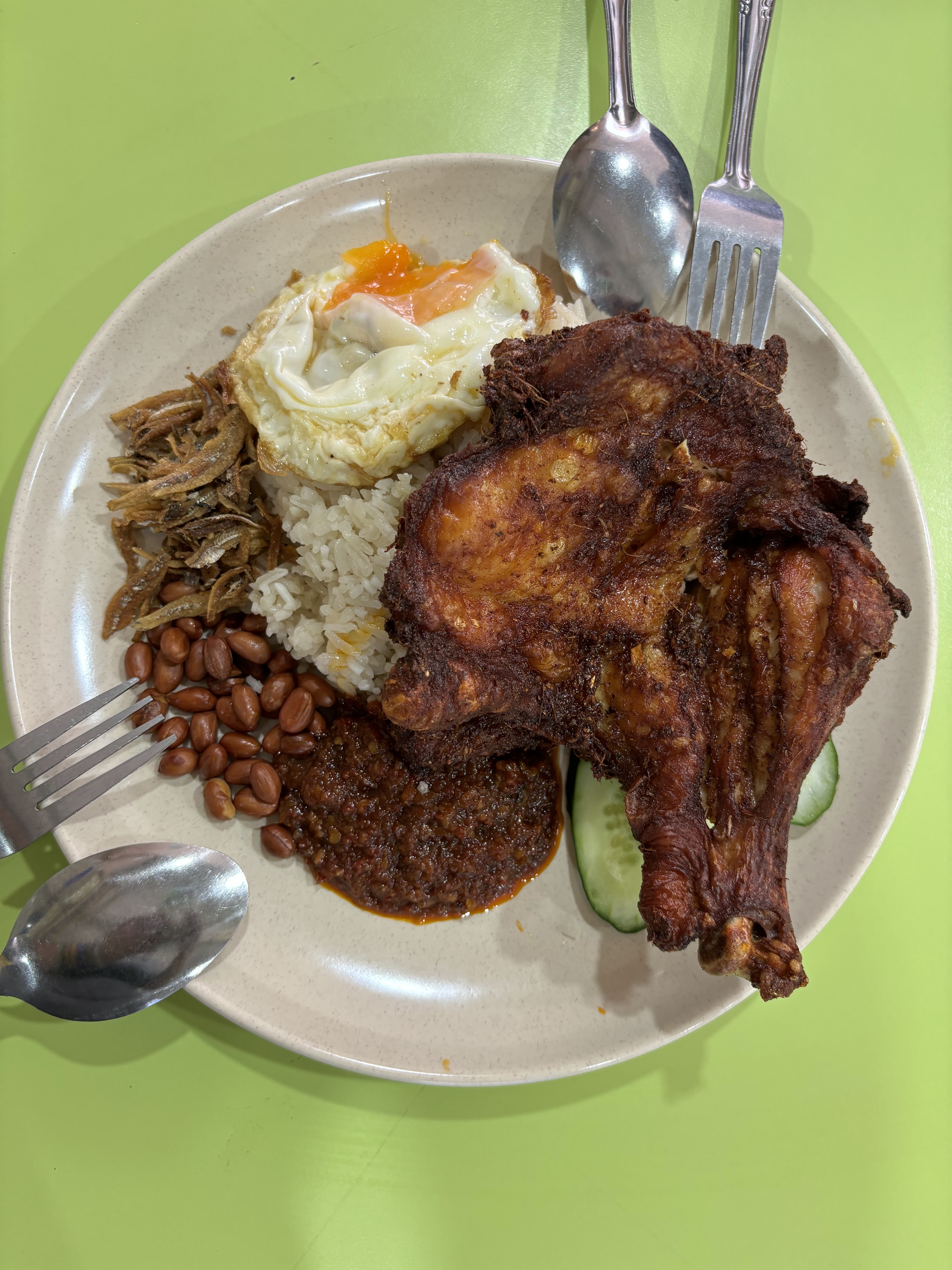
One of the most memorable dishes that I tried for the first time was Nasi Lemak. Malaysian coconut milk rice, fried crispy anchovies, toasted peanuts, cucumber, sambal and “spicy wife” roasted chicken. The chicken had a crispy coating of spice and tender juicy meat inside. The fried anchovies, peanuts and rice with a touch of the sambal was a flavor and texture dream team. These flavor combinations were unfamilar to me. I’m so glad that is no longer the case. I will be dreaming and searching for this dish from now on.

We tried two versions of carrot cake – Chai Tow Kway. Flavorful, soft, chewy and roasty all at the same time. The one with dark soy sauce was more caramelized. It was a hearty dish of radish (daikon) cakes cut into dumpling size, stir fried with eggs, green onions and seasoning sauces.

Yes, durian was sampled. For me the experience was mixed: the texture is delightfully and surprisingly fluffy, the intense sweetness morphed somehow into a savory funk that compares to no other taste. It is a singular taste experience. Many other dishes were sampled. All pried open the world of flavor a bit more with each bite and sip: grass jelly drink, fish soup, noodles with gravy and meats, pandan waffle and more.

Rojak is said to represent the cultural diversity of Singapore (last image). A sweet savory, fruit, vegetable dish infused with lime and shrimp paste. The one we tasted at Old Airport Road Food centre was covered in nuts. It was a collision of everything. Is it a snack, a meal, a dessert? It defies categorical definition and so philosophically my favorite even if gastronomically a challenge. I’ll be thinking about this one for a long time. Sometimes food preferences translate easily, sometimes acquired tastes confront us, sometimes unfamiliar combinations of familiar tastes shift our perspectives, sometimes familiar foods in unfamiliar places surprise us (we had the best room service veggie and regular burger with fries at the Telegraph Hotel). Eating through Singapore was an adventure and awakening into the ever expanding possibilities of multiculturalism in practice.

Where the Crawdads Sing – A story of grits to polenta

[spoiler alert: if you haven’t read the book or seen the movie stop now]

What if grits play the role of barometer for character development in the coming-of-age mystery drama novel (now a movie) Where the Crawdads Sing by Delia Owens?

Following this suspicion, I searched the book’s index for “grits”: It shows up 52 times. This number includes the 2 times “grit” is referenced in her character. Seems poetically appropriate that Kya’s character of survival and self-preservation would reveal grit, through grits.

Let’s look at the story through the perspective of grits in 5 quotes…

“Kya was very hungry. For breakfast she’d boiled grits with soda crackers stirred in because she didn’t have any salt. One thing she already knew about life: you can’t eat grits without salt.”

Left alone at age 7 the challenge to feed herself fuels the story arc. Modifying the recipe for grits to include crackers with salt shows Kya’s resourcefulness.

“In a few days she got the hang of fixing grits, although no matter how hard she stirred, they lumped up some. The next week she bought backbones—marked with a red tag—and boiled them with grits and collard greens in a mush that tasted fine.”

Kya continues to adapt her grits recipe to become inclusive of any surplus flavor while working to smooth the texture.

“She lived on dried fish, mussels, oysters. Grits and greens.”

This menu defines Kya’s childhood between what she could gather herself and the grits she bought at the store. Her complete dependence on coastal North Carolina for food, safety, and learning makes her a creature of the marsh: the marsh girl.  

“Each morning they rose at dawn and, while Tate percolated coffee, Kya fried corn fritters in Ma’s old iron skillet—blackened and dented—or stirred grits and eggs as sunrise eased over the lagoon.”

Further along the storyline, her recipe evolves to include more ingredients and skills, as she shares her meals with Tate.

“Almost every shop had a special table displaying the books by Catherine Danielle Clark ~ Local Author ~ Award-Winning Biologist. Grits were listed on the menus as polenta in mushroom sauce and cost $6.00.”

Towards the end of the book, grits are no longer food for survival and becomes food for adoring fans and travelers to the area.

In contrast, notice the use of “grit” in the book to highlight a decisive moment of loss,

“Dug sweaty cheese from her bag. Then slumped on the floor and ate mindlessly, touching her bruised cheek. Her face, arms, and legs were cut and smeared with bloody grit. Knees scratched and throbbing. She sobbed, fighting shame, suddenly spitting the cheese out in a chunky, wet spray.”

Grit and grits, strength in the face of loss, and food for survival implicate each other in the book. Unfortunately, grits as a character barometer in the book Where the Crawdads Sing was lost in the movie.

Maybe have a bowl of grits to make up for the omission after watching the movie.

More about grits here: https://islandlifenc.com/a-guide-to-southern-grits/

Today is the first day of Hispanic Heritage, why not combine the stories of survival in a bowl?

Here is a recipe for creamy grits from one of my favorite cookbooks, Turnip Green and Tortillas: A Mexican Cook Spices up the Southern Kitchen.

1-quart heavy cream

1 cup quick grits (not instant)

¼ cup sugar

1½ teaspoons salt, plus additional as desired

Bring the cream to a boil in a large saucepan over medium-high heat. Watch carefully so it doesn’t boil over. While continually whisking, add the grits and cook, whisking, for 5 minutes. Add the sugar and salt and cook, whisking frequently, for an additional 5 to 10 minutes, until the grits are tender. Serve hot.

The cookbook also offers a lighter version and a blue cheese version. I know adding cream to grits can be controversial.

Make grits the way you want when summoning your grit. What food would you choose to be the barometer of your evolution?

Wishing you a full bowl,

Hungryphil

Owens, Delia. Where the Crawdads Sing. Penguin Publishing Group. Kindle Edition.

Hernandez, Eddie; Puckett, Susan. Turnip Greens & Tortillas: A Mexican Chef Spices Up the Southern Kitchen (p. 175). HMH Books. Kindle Edition.

A watched pot (turtle nest) boils in Oak Island

A volunteer waved us left as we approached the tiny runway shaped to help guide baby turtles towards the sea. During our evening walks we noticed these small runways lined with green edges, centers brushed smooth carefully made ready for turtle nests incubating in the warm July sand past 50 days.  

“They’re coming. Please walk over and behind.” The excitement of new life. A small group of people composed of “nest mothers”, volunteers, and the vacationing and local curious was hovering over the patch of sand with a square grate the size of a doormat. The patch had a small crack where the sand caved in the size of my hand. This was an indication of restlessness, cracking, and movement below. The crowd of children, adults and more volunteers grew on either side of the runway as the sun began to set. We all waited. And waited. So did the turtles. They were waiting for the sand to cool as a sign of the waning sun that would make it easier to hide from predators. As the sun dipped, they rose and boiled like small dark shadows rising out of the growing hole in the ground.

Am I seeing this? The instinct is to shed light on this miracle. But light is exactly what they are avoiding. Light disorients budding life. They turn away and go in the wrong direction. “They have been listening to the ocean this whole time, they know to move towards the sound,” a volunteer explained while encouraging us to use our “inside voices” so the turtles can hear the ocean calling them. Or is it the magnetic pull? The ocean is like the mother’s heartbeat for a human baby emerging out of a uterine water sac. The baby moves towards the light, and a turtle also moves towards the moonlight on the water. Lights on the beach confuse them, they move in the wrong direction away from the water and into the grips of a predator. The beauty of turtles rising together. This I’ve learned affords survival of the species, many are sacrificed to predators so a few can live and serve a larger commitment to life. We humans have so much to learn from these tiny dark, squiggly, directed shadows. We can stand by, watch, guide, and mostly care enough to stay out of their way and keep other humans from staying out of their way…waving them to go around or stop shining light on the fragile eyes looking for the ocean. It is a practice of humble awe. A gentle suggestion that perhaps we are not the center of all life.

Sea turtles are a protected species. The Oak Island Turtle Protection Program is on a mission to monitor and protect the sea turtles and to foster community-based conservation…basically to wave us away from trampling the turtles and to welcome us to come close without shining light and with hushed reverence. In the three weeks of living here sitting on the sand alongside the turtle runway was the first and most satisfying sense of community I have experienced. No power, monetization, or exclusivity. The simplicity of a random community of curious humans channeling and watching small shadows scurry to glistening dark waves. It was magnificent.

The turtles are protected from industrial pollution and natural predators. We are among that list of natural predators. In my efforts to learn about the region I now call home, I researched a few cookbooks available at the local library. One of the cookbooks entitled “The Beachcomber’s Handbook of Seafood Cookery” by Hugh Zachary (1969) shares a Sea Turtle Stew recipe. The author prefaces the recipe with a story about gathering eggs from the beach, a culture of turtle hunting, followed by a plea.  He writes,

“I saw a couple of huge loggerheads that had been killed, wantonly killed, on Long Beach, not for their meat, but just for the fun of killing something so large, apparently. I like turtles. I like turtles better than I like some people – namely people who would kill a big loggerhead just for the experience. Loggerhead turtles are a vanishing breed. It’s fun to go turtle hunting during a full moon in a warm month on a nice night. It’s an interesting experience to find a big turtle on her nest and watch her lay eggs and cover them with her awkward, instinctive, and utterly laborious movements. My sympathy goes out to the big beast who comes out of her natural element to try to fight the odds against the survival of her species.

Let’s don’t eat loggerheads.”

Zachary, Hugh. (1969) The Beachcomber’s Handbook of Seafood Cookery. Kingsport Press: Tennessee.

On the margins of this recipe page, the library added a note about the law protecting sea turtles.

from the Beachcomber’s Handbook of Seafood Cookery (1969)

We humans can be both predators and conservators, vicious and curious. Sitting there watching the baby turtles a representation of life itself flapping, flailing, scurrying, blind and confused, I was reminded of the choice. As food curious as I am, I am okay letting turtle meat remain a mystery. I don’t know what my line is for eating other living beings, is it endangered animals? Or like Mr. Rogers who avoided anything that had a mother? Eat flesh out of necessity or politeness? Practice a generally plant-based diet? I don’t have my own answer, let alone have one for you. All I can say is that I hope to be aware of and own my choices today. Tomorrow may be different. Last evening it felt good to be among a community of humans who chose to stand together and aside watching life emerge out of a dark small crack in the earth.

Thank you baby turtles. I hope you live a long life and return to this beach as a place of safety and care. We’ll wait for you.

For lunch today, cereal with frozen blueberries sounds refreshing.

Wishing you thoughtful eating,

hungryphil

Food Poem – Ode to Chocolate by Barbara Crooker

I hate milk chocolate, don’t want clouds
of cream diluting the dark night sky,
don’t want pralines or raisins, rubble
in this smooth plateau. I like my coffee
black, my beer from Germany, wine
from Burgundy, the darker, the better.
I like my heroes complicated and brooding,
James Dean in oiled leather, leaning
on a motorcycle. You know the color.

Oh, chocolate! From the spice bazaars
of Africa, hulled in mills, beaten,
pressed in bars. The cold slab of a cave’s
interior, when all the stars
have gone to sleep.

Chocolate strolls up to the microphone
and plays jazz at midnight, the low slow
notes of a bass clarinet. Chocolate saunters
down the runway, slouches in quaint
boutiques; its style is je ne sais quoi.
Chocolate stays up late and gambles,
likes roulette. Always bets
on the noir.
From the Writer’s Almanac 4/11/2022

Sounds brave to taste the “cold slab of a cave’s interior, when all the stars have gone to sleep.” I might add ..when all the stars have gone to sleep over the ocean as I let a piece of dark chocolate with sea salt melt in my mouth. What is your favorite kind of chocolate?

Recipe – Egg Curry

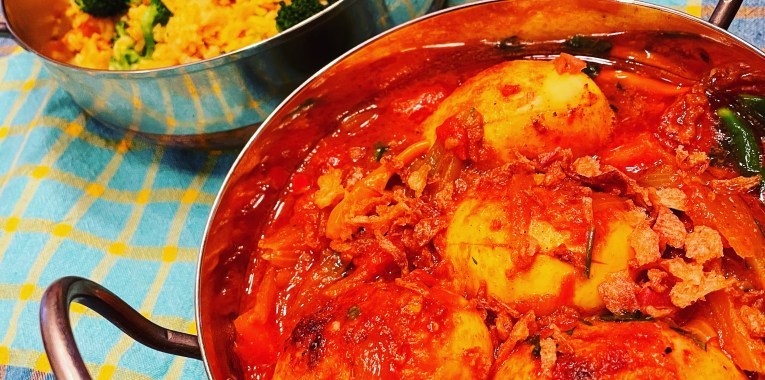
Good for a Cold Day Tomato Onion Egg Curry
  • 4 eggs
  • 3-4 Tbs oil
  • 1 Cinnamon stick
  • 2 Cardamom pods
  • 1 medium onion sliced
  • 1-1/12 teaspoons of turmeric and chilli powder
  • 3/4 teaspoons of cumin and coriander
  • 1/2 teaspoon of fresh grated ginger
  • 1 garlic clove crushed
  • 1 chopped tomato
  • cilantro, fried onions, green chillies and garam masala to sprinkle
  1. Bring 4 eggs and enough water to cover to rolling boil. Turn off. Cover. Let sit for 15 minutes. Drain. Peel. Dust with 1/2 teaspoon each of turmeric and chili powder.
  2. Fry eggs in 2 tbs oil. There will be agressive popping sounds and splaterring. Stand back. Fry until surface acquires color and texture. Remove from pan with slotted spoon and set aside.
  3. In the same pan, add more oil if needed, add cinnamon and cardamom. Fry sliced onions until soft.
  4. Add ginger, garlic, salt, tumeric, chili powder, cumin and coriander with a 1/2 cup of water and 1/2 chopped tomato. Cook 10 mintues until tomatoes break down and forms cohesive sauce. Allow oil to separate in order to roast the spices and flavor the oil.
  5. Return eggs to pan. Add another 1/2 cup of water to create a gravy. More if you like it thinner. Simmer on low for 5 minutes.
  6. Garnish with chopped cilantro, garam masala, green chillies and fried onions (store bought is fine).
  7. Serve and enjoy with khichuri or plain rice. With the gentle heat, a hint of cinnamon, and chili-ginger heat, this was perfect to warm up on a cold snowy day.

Like most intuitive home-cooks I feel challenged by measurements and exact timings. Please use this recipe as loose guidance and inspiration, comment below with specific questions and I’ll attempt to answer.

Food Poem – Recipe for a Salad by Sydney Smith

To make this condiment, your poet begs
The pounded yellow of two hard-boiled eggs;
Two boiled potatoes, passed through kitchen-sieve,
Smoothness and softness to the salad give;
Let onion atoms lurk within the bowl,
And, half-suspected, animate the whole.
Of mordant mustard add a single spoon,
Distrust the condiment that bites so soon;
But deem it not, thou man of herbs, a fault,
To add a double quantity of salt.
And, lastly, o'er the flavored compound toss
A magic soup-spoon of anchovy sauce.
Oh, green and glorious! Oh, herbaceous treat!
'T would tempt the dying anchorite to eat;
Back to the world he'd turn his fleeting soul,
And plunge his fingers in the salad bowl!
Serenely full, the epicure would say,
Fate can not harm me, I have dined to-day!

“Recipe for a Salad” by Sydney Smith. from the Writer’s Almanac 2/3/2022

I love the part about the onion, lurking in the bottom, animating the whole 🙂

May you be serenely full,

Hungryphil

Food Poem – Everybody Made Soups by Lisa Coffman

After it all, the events of the holidays,
the dinner tables passing like great ships,
everybody made soups for a while.
Cooked and cooked until the broth kept
the story of the onion, the weeping meat.
It was over, the year was spent, the new one
had yet to make its demands on us,
each day lay in the dark like a folded letter.
Then out of it all we made one final thing
out of the bounty that had not always filled us,
out of the ruined cathedral carcass of the turkey,
the limp celery chopped back into plenty,
the fish head, the spine. Out of the rejected,
the passed over, never the object of love.
It was as if all the pageantry had been for this:
the quiet after, the simmered light,
the soothing shapes our mouths made as we tasted.

Lisa Coffman, “Everybody Made Soups” from Less Obvious Gods. From Writer’s Almanac 2/2/2022

Wishing you warm “quiet afters” on this snowy day in the Midwest,

Hungryphil

Food Poem – In the Produce Aisle by Kirsten Dierking

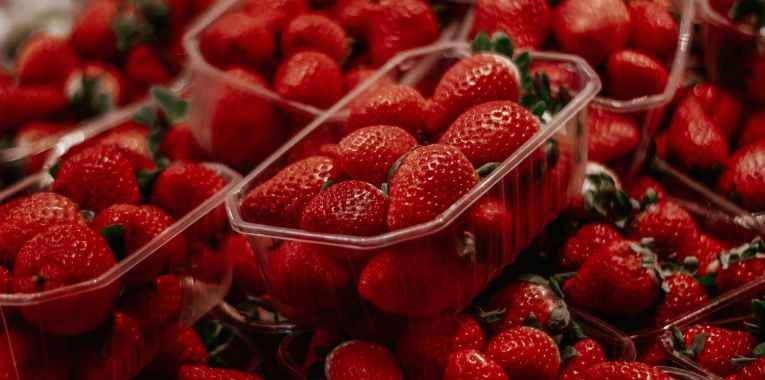
In the vivid red
of the fresh berries,
in the pebbled skin
of an emerald lime,
in the bright colors
of things made
to be transitory,
you see the same
loveliness
you find in your own
delicate flesh,
the lines fanned
around your eyes
charming like
the burnish
of plums,
your life like
all the other
fragile organics,
your soft hand
hovering over
the succulent apple,
you reach for it,
already transforming.

Kirsten Dierking, “In the Produce Aisle”  from Northern Oracle. © 2007 Kirsten Dierking published by Spout Press. From 1/5/2022 The Writer’s Almanac

Food Poem – Jack Kerouac

“The world you see is just a movie in your mind.
Rocks don't see it.
Bless and sit down.
Forgive and forget.
Practice kindness all day to everybody
and you will realize you’re already
in heaven now.
That’s the story.
That’s the message.
Nobody understands it,
nobody listens, they’re
all running around like chickens with heads cut
off. I will try to teach it but it will
be in vain, s’why I’ll
end up in a shack
praying and being
cool and singing
by my woodstove
making pancakes.”

from https://www.goodreads.com/work/quotes/1354192-the-portable-jack-kerouac