Futurist Summer Recipe – Thomas Marinetti

Summer luncheon for painters and sculptors

After a long period of rest, a painter or sculptor who wants to take up his creative activities again at three o’clock on a summer afternoon may vainly try to excite his artistic inspiration with a succulent — traditional meal.

Weighed down, he would then have to walk to digest it and beset by cerebral anxieties and pessimism would end up wasting the whole day loitering artistically without creating any art.

Instead a meal may be served to him made up of pure gastronomic elements: a bowl of good tomato soup, a big yellow polenta, a heap of green salad, not dressed and not on a plate, a bowl full of olive oil, a bowl full of strong vinegar, a bowl full of honey, a big bunch of red radishes, a mass of white roses complete with thorny stems.

As the spirit moves him, without plates or cutlery, and continually refusing to follow the usual nervous habits which crop up, he assuages his hunger while looking at Umberto Boccioni’s picture of ‘The Football Player’.

Formula by the Futurist Aeropoet Marinetti

Dedicated to my exceptionally talented artist friends. I would make you a “meal of pure gastronomic elements” any day.

Wishing you happy summer,

Hungryphil


Wobblyogi Wednesday: Jon Kabat-Zinn

Here is a food poem from third century China referenced in Jon Kabat-Zin’s book, Wherever you go, there you are: Mindfulness Meditation in Everyday Life:

Prince Wen Hui’s cook

Was cutting up an ox.

Out went a hand,

Down went a shoulder,

He planted a foot,

He pressed with a knee,

The ox fell apart

With a whisper,

The bright cleaver murmured

like a gentle wind.

Rhythm! Timing!

Like a sacred dance,

Like “The Mulberry Grove,”

Like ancient harmonies!

“Good work!” the Prince exclaimed,

“Your method is faultless!”

“Method?” said the cook

Laying aside his cleaver,

“What I follow is Tao

Beyond all methods!

“When I first began

to cut up oxen

I would see before me

The whole ox

All in one mass.

After three years

I no longer saw this mass.

I saw the distinctions.

“But now I see nothing

With the eye. My whole being

Apprehends.

My senses are idle. The spirit

Free to work without plan

Follows its own instinct

Guided by natural line,

By the secret opening, the hidden space,

My cleaver finds its own way.

I cut through no joint, chop no bone.

“There are spaces in the joints;

The blade is thin and keen:

When this thinness

Finds the space

There is room for all you need!

It goes like a breeze!

Hence I have this cleaver nineteen years

As if newly sharpened!

“True, there are sometimes

Tough joints. I feel them coming,

I slow down, I watch closely,

Hold back, barely move the blade,

And whump! the part falls away

Landing like a clod of earth.

“Then I withdraw the blade,

I stand still

And let the joy of the work

Sink in.

I clean the blade

And put it away.”

Prince Wen Hui said,

“This is it! My cook has shown me

How I ought to live

My own life!”

CHUANG TZU

Kabat-Zinn continues to explain that,

“Meditation is synonymous with the practice of non-doing. We aren’t practicing to make things perfect or to do thing perfectly. Rather, we practice to grasp and realize (make real for ourselves) the fact that things already are perfect, perfectly what they are. This has everything to do with holding the present moment in its fullness without imposing anything extra on it, perceiving its purity and the freshness of its potential to give rise to the next moment.”

He calls this awareness, being able to detect the “bloom of the present moment in every moment, the ordinary ones, the in-between ones, even the hard ones.”

I like the ideas of welcoming “The bloom of the moment” and “letting the joy of the work, sink in.”

Right now, I’m reading, writing and sharing a moment of discovery. As are you.

I’ll stop writing now and just let this moment sink in.

Wishing you many moments of bloom!

Hungryphil

Food Poem – Summer Kitchen by Donald Hall

This poem is a lovely reminder of the hidden magic of routine things taken for granted. It is an exercise of mindful awareness, of noticing the details with gratitude. May I experience such a miracle today and wishing you the same.

In June’s high light she stood at the sink
With a glass of wine,
And listened for the bobolink,
And crushed garlic in late sunshine.

I watched her cooking, from my chair.
She pressed her lips
Together, reached for kitchenware,
And tasted sauce from her fingertips.

“It’s ready now. Come on,” she said.
“You light the candle.”
We ate, and talked, and went to bed,
And slept. It was a miracle.

“Summer Kitchen” by Donald Hall from The Selected Poems of Donald Hall.

From the Writer’s Almanac, June 22nd, 2016

Food Poem – Ode to the Pull-Out Couch by Sonja Johnson

Eating supper instead of dinner, sleeping on a couch instead of a guest room. Check out how food and furniture convey messages of class difference in this poem.

Which once belonged to your great-
grandparents, but belongs to us now,
and still works, even if the cushions
are pretty well flattened and the stuffing
is coming out from one armrest,
and the color, which was probably
once cream with red stitching, has
become mostly a muddy rust —

and which is always called a couch
and never, ever a sofa, just as
a pocketbook is not a purse, a bureau
is not a dresser, and pants are not
slacks. Only snooty people on TV
would call a couch a sofa, or rich
people, or maybe people from away.
Which we are not.

Because if we were any of those,
instead of just a pull-out couch,
we would have a guest room, with
a comforter and duvet, which no
guests would ever sleep under
because they would be staying at
a five-star hotel, where we would
join them for a five-star dinner

instead of the supper we cook
for our cousins up from Alfred,
which makes them still from here
and not from away, so they can’t
afford to go out to dinner, much
less afford a fancy hotel room
even if there was a hotel in town.
Which there is not.

And after our supper and before
we wake up early to take them
ice fishing, we pull out the couch
and give them pillows and blankets
and maybe even the granny-square
afghan, and they get to sleep by
the woodstove with the extra cats
and know that they are welcome.

From the Writer’s Almanac

After an Absence by Linda Pastan

An oblique food poem where dinner is mentioned as an example of the ordinary rhythm of life. Lovely poem. Enjoy.

After an absence that was no one’s fault
we are shy with each other,
and our words seem younger than we are,
as if we must return to the time we met
and work ourselves back to the present,
the way you never read a story
from the place you stopped
but always start each book all over again.
Perhaps we should have stayed
tied like mountain climbers
by the safe cord of the phone,
its dial our own small prayer wheel,
our voices less ghostly across the miles,
less awkward than they are now.
I had forgotten the grey in your curls,
that splash of winter over your face,
remembering the younger man
you used to be.

And I feel myself turn old and ordinary,
having to think again of food for supper,
the animals to be tended, the whole riptide
of daily life hidden but perilous
pulling both of us under so fast.
I have dreamed of our bed
as if it were a shore where we would be washed up,
not this striped mattress
we must cover with sheets. I had forgotten
all the old business between us,
like mail unanswered so long that silence
becomes eloquent, a message of its own.
I had even forgotten how married love
is a territory more mysterious
the more it is explored, like one of those terrains
you read about, a garden in the desert
where you stoop to drink, never knowing
if your mouth will fill with water or sand.

“After an Absence” by Linda Pastan from The Imperfect Paradise. © W.W. Norton & Company, 1989.

from the http://writersalmanac.org/page/8/

September On Jessore Road – Food Poem by Allen Ginsberg

This is not a celebration of food poem but rather about scarcity. Allen Ginsberg was writing about famine and war in Bangladesh, then East Pakistan, 1971.

Millions of babies watching the skies
Bellies swollen, with big round eyes
On Jessore Road–long bamboo huts
Noplace to shit but sand channel ruts

Millions of fathers in rain
Millions of mothers in pain
Millions of brothers in woe
Millions of sisters nowhere to go

One Million aunts are dying for bread
One Million uncles lamenting the dead
Grandfather millions homeless and sad
Grandmother millions silently mad

Millions of daughters walk in the mud
Millions of children wash in the flood
A Million girls vomit & groan
Millions of families hopeless alone

Millions of souls nineteenseventyone
homeless on Jessore road under grey sun
A million are dead, the million who can
Walk toward Calcutta from East Pakistan

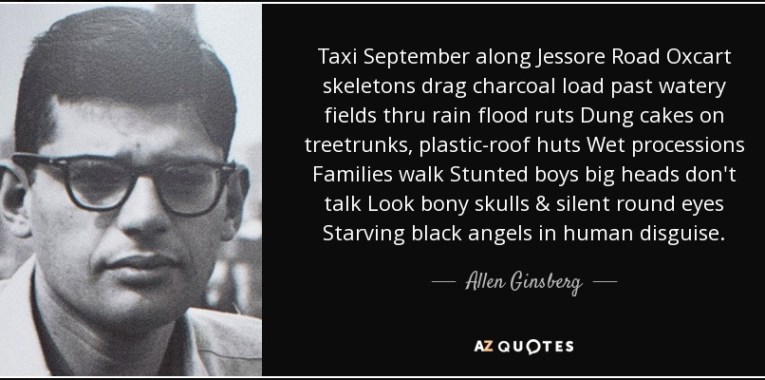
Taxi September along Jessore Road
Oxcart skeletons drag charcoal load
past watery fields thru rain flood ruts
Dung cakes on treetrunks, plastic-roof huts

Wet processions Families walk
Stunted boys big heads don’t talk
Look bony skulls & silent round eyes
Starving black angels in human disguise

Mother squats weeping & points to her sons
Standing thin legged like elderly nuns
small bodied hands to their mouths in prayer
Five months small food since they settled there

on one floor mat with small empty pot
Father lifts up his hands at their lot
Tears come to their mother’s eye
Pain makes mother Maya cry

Two children together in palmroof shade
Stare at me no word is said
Rice ration, lentils one time a week
Milk powder for warweary infants meek

No vegetable money or work for the man
Rice lasts four days eat while they can
Then children starve three days in a row
and vomit their next food unless they eat slow.

On Jessore road Mother wept at my knees
Bengali tongue cried mister Please
Identity card torn up on the floor
Husband still waits at the camp office door

Baby at play I was washing the flood
Now they won’t give us any more food
The pieces are here in my celluloid purse
Innocent baby play our death curse

Two policemen surrounded by thousands of boys
Crowded waiting their daily bread joys
Carry big whistles & long bamboo sticks
to whack them in line They play hungry tricks

Breaking the line and jumping in front
Into the circle sneaks one skinny runt
Two brothers dance forward on the mud stage
Teh gaurds blow their whistles & chase them in rage

Why are these infants massed in this place
Laughing in play & pushing for space
Why do they wait here so cheerful & dread
Why this is the House where they give children bread

The man in the bread door Cries & comes out
Thousands of boys and girls Take up his shout
Is it joy? is it prayer? “No more bread today”
Thousands of Children at once scream “Hooray!”

Run home to tents where elders await
Messenger children with bread from the state
No bread more today! & and no place to squat
Painful baby, sick shit he has got.

Malnutrition skulls thousands for months
Dysentery drains bowels all at once
Nurse shows disease card Enterostrep
Suspension is wanting or else chlorostrep

Refugee camps in hospital shacks
Newborn lay naked on mother’s thin laps
Monkeysized week old Rheumatic babe eye
Gastoenteritis Blood Poison thousands must die

September Jessore Road rickshaw
50,000 souls in one camp I saw
Rows of bamboo huts in the flood
Open drains, & wet families waiting for food

Border trucks flooded, food cant get past,
American Angel machine please come fast!
Where is Ambassador Bunker today?
Are his Helios machinegunning children at play?

Where are the helicopters of U.S. AID?
Smuggling dope in Bangkok’s green shade.
Where is America’s Air Force of Light?
Bombing North Laos all day and all night?

Where are the President’s Armies of Gold?
Billionaire Navies merciful Bold?
Bringing us medicine food and relief?
Napalming North Viet Nam and causing more grief?

Where are our tears? Who weeps for the pain?
Where can these families go in the rain?
Jessore Road’s children close their big eyes
Where will we sleep when Our Father dies?

Whom shall we pray to for rice and for care?
Who can bring bread to this shit flood foul’d lair?
Millions of children alone in the rain!
Millions of children weeping in pain!

Ring O ye tongues of the world for their woe
Ring out ye voices for Love we don’t know
Ring out ye bells of electrical pain
Ring in the conscious of America brain

How many children are we who are lost
Whose are these daughters we see turn to ghost?
What are our souls that we have lost care?
Ring out ye musics and weep if you dare–

Cries in the mud by the thatch’d house sand drain
Sleeps in huge pipes in the wet shit-field rain
waits by the pump well, Woe to the world!
whose children still starve in their mother’s arms curled.

Is this what I did to myself in the past?
What shall I do Sunil Poet I asked?
Move on and leave them without any coins?
What should I care for the love of my loins?

What should we care for our cities and cars?
What shall we buy with our Food Stamps on Mars?
How many millions sit down in New York
& sup this night’s table on bone & roast pork?

How many millions of beer cans are tossed
in Oceans of Mother? How much does She cost?
Cigar gasolines and asphalt car dreams
Stinking the world and dimming star beams–

Finish the war in your breast with a sigh
Come tast the tears in your own Human eye
Pity us millions of phantoms you see
Starved in Samsara on planet TV

How many millions of children die more
before our Good Mothers perceive the Great Lord?
How many good fathers pay tax to rebuild
Armed forces that boast the children they’ve killed?

How many souls walk through Maya in pain
How many babes in illusory pain?
How many families hollow eyed lost?
How many grandmothers turning to ghost?

How many loves who never get bread?
How many Aunts with holes in their head?
How many sisters skulls on the ground?
How many grandfathers make no more sound?

How many fathers in woe
How many sons nowhere to go?
How many daughters nothing to eat?
How many uncles with swollen sick feet?

Millions of babies in pain
Millions of mothers in rain
Millions of brothers in woe
Millions of children nowhere to go
https://www.nytimes.com/books/01/04/08/specials/ginsberg-jessore.html

The East Berliner, 1989 – Food Poem by Ginger Murchison

The humble banana becomes an expression of welcome, joy, defiance, transition, love, plenty and evidence in this unlikely food poem. Enjoy!

They didn’t come for the bananas,
but everyone who came through
that hole in the wall wanted one,
the West ready with its Welkommen!
mountains of yellow.
After twenty-eight years of concrete-cold
days and only those few flowers
defiant in the cracks of denial,
imagine the yellow-fresh sight,
that spike on the tongue,
the fireworks and flares
shot through the half-language
of heavy machines shattering
the cold Baltic chill, the half-song,
half-wail of horns, sirens and shouts
and behind it all, Beethoven’s 9th,
then that East Berliner, shuffling out,
hatless and dazed in a worm-eaten brown coat
to see it, and not believe it—
the bright yellow word he’ll take home
to his wife, tight in his fist.

“The East Berliner, 1989” by Ginger Murchison from A Scrap of Linen, A Bone. © Press, 53, 2016.

From: http://writersalmanac.org/

Strawberries – Food Poem by Paul Martin

It’s ripe strawberries that bring me
to my knees in the garden this morning,

impossibly big and red as those
on the covers of gardening magazines in January

and almost as sweet as the small wild ones
my brother and I picked up on Best’s Hill,

eating more than we dropped into the coffee cans
our mother fitted with wire handles.

If a cloud moved across that blue sky
casting a shadow, I didn’t notice,

the snakes we were warned about
never appeared, and who could see,

even in that brilliant light,
beyond the quiet hills all the way to Vietnam

and the war he’d carry back with him.
Heads down we browsed through the field

until we were filled and drowsy,
sprawled next to each other in the warm grass,

juice smeared across our T-shirts,
our mouths and hands.

“Strawberries” by Paul Martin from Closing Distances. © The Backwaters Press, 2009.

from http://writersalmanac.org/

Mary Oliver’s Leaves and Blossoms Along the Way

IMG_1559

If you have trouble finding “the right place for yourself,” like me,  this poem might help. I seem to crave both city excitement and natural calmness. The two don’t often pair well but like the two flavors of sweet and spicy, when the experiences do work well, its magic…like Central Park in NYC or Lake Shore Drive in Chicago. What would be the geographical equivalent of a red curry with pineapple, or tandoori chicken with raita?

Leaves and Blossoms Along the Way: A Poem

If you're John Muir you want trees to 
live among. If you're Emily, a garden
will do. 
Try to find the right place for yourself. 
If you can't find it, at least dream of it. 

                                             •

When one is alone and lonely, the body
gladly lingers in the wind or the rain, 
or splashes into the cold river, or
pushes through the ice-crusted snow. 

Anything that touches. 

                                             •

God, or the gods, are invisible, quite
understandable. But holiness is visible, 
entirely. 

                                             •

Some words will never leave God's mouth, 
no matter how hard you listen.  

                                             •

In all the works of Beethoven, you will 
not find a single lie.

                                             •

All important ideas must include the trees,
the mountains, and the rivers. 

                                             •

To understand many things you must reach out 
of your own condition. 

                                             •

For how many years did I wander slowly 
through the forest. What wonder and 
glory I would have missed had I ever been
in a hurry!

                                             •

Beauty can both shout and whisper, and still
it explains nothing. 

                                             •

The point is, you're you, and that's for keeps.

from http://www.onbeing.org/blog/leaves-and-blossoms-along-the-way/8042

Food Poem – Ripe Cherries by Athena Kildegaard

I read that the men,
on their way to Gettysburg,
stopped along the road
to pick and eat ripe cherries.

That the fruit should not
go to waste.

That they should take
such pleasure before battle.

That the oldest among them
should shake the trees
and the youngest gather
the fallen fruit.
That they should aim rifles
with the taste of cherries
against their teeth.

“Ripe Cherries” by Athena Kildegaard from Bodies of Light. © Red Dragonfly Press, 2011.

from: http://writersalmanac.org/page/3/