Food Poem- Chinese Restaurant by David Shumate

This poem beautifully describes how a good meal under the care of a harmonious family can dissolve arguments. My favorite part is “after dinner we sat in the comfort of their silence.” We should all have “after argument” rituals and places that offer comforting silence. As long as we don’t eat our anger, I love the idea of food as a form of conflict resolution.

After an argument, my family always dined at the Chinese
restaurant. Something about the Orient washed the bitterness
away. Like a riverbank where you rest for awhile. The owner
bowed as we entered. The face of one who had seen too much.
A revolution. The torture of loved ones. Horrors he would never
reveal. His wife ushered us to our table. Her steps smaller than
ours. The younger daughter brought us tea. The older one took
our orders in perfect English. Each year her beauty was more
delicate than before. Sometimes we were the only customers
and they smiled from afar as we ate duck and shrimp with our
chopsticks. After dinner we sat in the comfort of their silence.
My brother told a joke. My mother folded a napkin into the shape
of a bird. My sister broke open our cookies and read our fortunes
aloud. As we left, my father always shook the old man’s hand.

“Chinese Restaurant” by David Shumate from The Floating Bridge. © University of Pittsburgh Press, 2008.

From the Writer’s Almanac http://writersalmanac.org/episodes/20170101/

Amplifying: Visual Strategies of the Women’s March

We must speak our minds openly, debate our disagreements honestly, but always pursue solidarity. —- President Donald Trump, Inauguration Speech, 1/20/2017

What do the posters tell us about the Women’s March?

As it evolved from post-election despair, I hoped that the Women’s March would become an affirmation of unity instead of a flat rejection of the ideological personality of Donald Trump. To me, the five images chosen by the Amplifier Foundation does just that by highlighting the struggle between the conceptual and the concrete, the abstract and the material, and the biological and the cultural.

wmw_hearourvoice_bleedlowres

The “Hear Our Voice” poster eloquently presents unity in diversity in form, color, and background. Notice the abstracted black fist with the red flame that supports the three distinct and individualized hands, one with a ring, one with bracelets and one with nail polish. Notice the visual movement from the bottom text to the collective birdsong. The bird, the shared voice is the only diagonal in the image that breaks the unity and symmetry of the image. Notice the starry blue background that references the United States of America. Notice the colors and the use of blood red. Notice the handcrafted quality of the image. This poster represents doing without the comfort of pristine ideology. For artists out there saying you can do better. Do it. There is room for more vision. This poster is only one of five on one website. “Hear our voice” is a call to act, to listen. It paints an alternative picture of collaboration and action, against masculine competition fueled by greed, violence and empty egotistical ideology.

If we read the Women’s March Principles (addressing issues of violence, reproduction, LGBQTIA, work, civil rights, disability, immigration and environment) with this visual in mind, we see the movement towards unity as THE struggle, irrespective of coming and going political establishments. Where human rights can be abstract and universal, Women’s rights depend on the immediacy of blood and local support. How can we take care of our sisters despite our disagreements? How can we have a working conversation about sensitive and intimate problems about our bodies, our work, and our loved ones? None of us have the answer to these questions on our own. That’s the point. That’s what the poster and the march are about.

Previously, I had considered the visual strategies of the Occupy Wall Street posters. The Women’s March offers an alternative and parallel world of action. It asks, what if we value collaborative action over power secured through profit?

For me, the Women’s March is about amplifying our common needs despite our biological, cultural, political and economic differences.

I join my daughter, you and yours at the Women’s March in Washington and beyond,

Walking with you always,

Mom, sister, friend, hungryphil, Lisa

For more posters go to http://march.domecollective.com/


Wobblyogi Wednesday – Book Club Notes 2

Hello, fellow yogis engaged in self-study!

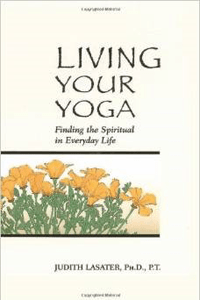
This week my notes are about the first 4 chapters of Living Your Yoga by Judith Lasater.

Spiritual Seeking

Whether we seek something called spirituality, holiness, or enlightenment, the route to it is through our humanness, complete with our strengths and our weaknesses, our successes and our failures….

To practice yoga in the deepest sense is to commit to developing awareness by observing our lives: our thoughts, our words, and our actions.

In order to cultivate spirituality Lasater suggests the strategy of adopting an “abiding practice” in which we combine a pose (an action) with a mantra (a deliberate thought). For example, combine tadasana (mountain pose) and the mantra, “I commit to living my life fully at this moment.” If you have a particular spiritual direction, you can combine an action or asana with a short prayer. This way we bring in mindfulness to our actions. We abide and stay with the act instead of rushing to completion. I am particularly guilty of rushing through tasks I don’t enjoy like washing the dishes or folding laundry. Next time I’ll try to add a mantra and see if that helps me stay in the moment, maybe even appreciate the moment.

Discipline

Do what you can do fully.

Patanjali describes this as abhayasa, which comes from the Sanskrit roots of abhi and as, and means literally “to apply oneself.” From this viewpoint, all of life is practice. Practice is not about what you get, it is about what you give. Whether you are driven or resistant, the medicine is the same: do what is truly possible with unwavering commitment to giving your self to the moment. Without this intention, practice becomes another task to be completed and it loses its ability to transform. And transformation, or freedom, is the reason for all discipline.

Lasater’s strategy to cultivate discipline involves making a list of things you want to do, choosing one and devoting 15 minutes, every day to that task, whether it is writing a book, meditating, blogging, playing an instrument or sewing. Honor your choice. After you have done this for a month, review yourself. How are you doing? How do you feel?

I unknowingly followed this technique when I started blogging. Small consistent steps. It became a habit, like my childhood journaling. And has led me to be more comfortable with my voice. I also tell myself “I have all the time to do what I want.” This reassurance helps me feel less rushed and behind. Discipline is certainly an area I continue to work through. I find I can focus on one intention at a time. For now, for me, it is writing every day. I would like to add meditation and yoga every day. I save that struggle in discipline for another time, soon.

Letting Go

Letting go involves cultivating perspective, a release of control and expectations.

Patanjali’s “detachment” beckons you to cultivate the willingness to surrender as you go along, right here and now, but not because you despair or are uninterested. On the contrary, detachment requires total engagement. When you allow yourself to see things as they really are, then– and only then– can you love yourself and others without hidden expectations. Detachment is the greatest act of love.

This is a familiar concept in many religions that require a submission to the divine, the relinquishing of the perception of control. When you find yourself struggling, Lasater’s advice for letting go is to shine a spotlight of awareness on the attachment, instead of trying to detach. This attention allows us to loosen our grip and weaken its power over us. Staying in the moment, without control and expectation, is a difficult task. Often when in a group, I will deliberately relinquish control of the situation, whether it be choosing the restaurant or a movie, for me prioritizing being together over asserting my want or authority helps. I try to notice when I want to interrupt a conversation or offer uninvited “help.” Especially as a mom, I find the balance between letting go and active direction difficult.

Self-Judgment

The grip of self-judgment can be suffocating. Yet, we are all guilty of it. I liked how Lasater explains the compulsion to self-judge as a form of egoism.

….there was no way that I could be harsh towards myself and, at the same time, be compassionate to others. I realized also that the process of silently putting myself down was actually a form of egoism.

If you expect more from yourself than from others, you are saying that you are better than others and , therefore, must perform at a superior level. I do not mean that you should not set goals for yourself. Rather, the quesiton is, how do you react if you cannot meet these goals?

Lasater suggests that as we engage in a difficult task, we tell ourselves “I am attempting something difficult, and I appreciate myself for trying.” This way we release expectations and enjoy the process of learning or trying something new. She has other suggestions too, for example, taking a break from criticizing anyone, including ourselves for an hour a day.

During my day, I try to notice these topics and look for opportunities to use a few of these strategies. None of this is easy or automatic, I suppose that’s why yoga is a practice. A lot of practice.

How did you feel about the first four sections? What resonated with you? What practices do you find most difficult? Are there other strategies that work for you?

Excited to hear your thoughts,

the Wobblyogi

Wobblyogi Wednesday – Book Club Notes 1

Welcome to the yoga bookclub hosted by Community Yoga in Indiana!

Living Your Yoga – Finding the Spiritual in Everyday Life by Judith Lasater (Berkley, CA: Rodmell Press, 2000)

For more information on Judith Lasater herself and quick background, look up her website: http://www.judithhansonlasater.com/

[The notes relate to the first edition. I recently got the second edition and will note any significant changes. Her introduction to the second edition talks about the additions.]

If you have the book already in hand, let’s get started with the introduction where Lasater talks about how she came to yoga, how she understands yoga, how she “lives her yoga” and how she designed the book.

Here are a few passages and associated questions that resonated wih me and I can’t wait to hear which phrases, passages or ideas resonated with you.

Thought 1

Lasater talks about her experience in coping with childbirth, her background as a dancer and her “desire for a direct and personal relationship with divine,” as factors that led her to seek out and continue to practice yoga.

She writes, ” What I now know is that I had been seeking wholeness through integration of my body, my mind and my spirit.”

For us,we can ask,

What do I seek?

What brings me to yoga?

What makes me stay?

Thought 2

Laster’s yoga practice, she explains, responds to her search for wholeness.

…to practice is to pay attention to your whole life: your thoughts, your bodily sensations, and your speech and other actions. As you do, you will discover that nothing is separate from anything else. Thoughts are sensations of the mind just as sensations are the thoughts of the body. Each moment of your life is a moment of potential practice.

Practice, then, can be understood as a willingness to return to the reality of the very moment, that is, to observe with dispassion and clarity exactly what is — right now.

What is happening right NOW in my life? Why am I hosting a book club? Writing these words? What do I hope for my thoughts, feelings and sensations?

How do I connect to my own wholeness?

How do I connect to this very moment?

How do I connect with you my fellow readers?

Thought 3

After Lasater describes the structure of the book she concludes the introduction with a quote from Dag Hammarskjold, secretary general to the United Nations (1953-61):

In our era, the road to holiness necessarily passes through the world of action.

She then asks us to “use this book in whatever ways best serve your needs. Living Your Yoga is my gift to you.”

What might be my road, my world of action?

How might I best use Lasater’s gift of  Living Your Yoga?

Here are my quick thoughts. What are yours? How might we bring these thoughts to our practice?

Let’s talk!

Let the book club begin!!

Anyone reading can join the conversation on this blog, just add your comments below. There is also a protected discussion platform. For a password and more information about the bookclub and April 1st workshop, go to:  https://communityyogalafayette.com/book-club/

Much love,

The Wobblyogi

My plan for offering notes to help us stay with the book is as follows:

January 13: Chapters 1-4
February 1: Chapters 5-7  (and additional chapter on relaxation)
February 15: Chapters 8-11
March 1: Chapters 12-14
March 15: Chapters 15-18 (and additional second edition chapter on empathy)
March 29: Chapters 19-21 (and additional second edition chapter on worship)
April 1: Book Club Workshop


Wobblyogi Wednesday – Burnt Cookies and a Joyful mind

If you feel burdened by the expectation to have a Happy Holiday or a Merry Christmas   Here is a story about keeping a joyful mind from Pema Chodron that might help (and it involves food).

Once a cook at Gampo camp was feeling very unhappy. Like most of us, she kept finding gloom with her actions and her thoughts; hour by hour her mood was getting darker. She decided to try to ventilate her escalating emotions by baking chocolate chip cookies. Her plan backfired, however — she burned them all to a crisp. At that point, rather than dump the burned cookies in the garbage, she stuffed them into her pockets and backpack and went out for a walk. She trudged along the dirt road, her head hanging down and her mind burning with resentment. She was saying to herself, “So where’s all the beauty and magic I keep hearing about?”

At that moment she looked up. There walking toward her was a little fox. Her mind stopped and she held her breath and watched. The fox sat down right in front of her, gazing up expectantly. She reached into her pockets and pulled out some cookies. The fox ate them and slowly trotted away. She told this story to all of us at the abbey, saying: “I learned today that life is very precious. Even when we’re determined to block the magic, it will get through and wake us up. That little fox taught me that no matter how shut down we get, we can always look outside our cocoon and connect with joy.”

When in doubt go for a walk………….

A quick reminder to join the Community Yoga Book Club! We’ll start reading “Living Your Yoga” by Judith Lasater on January 4th. Order your copy today. I found an inexpensive used version on Amazon.

Please join me for morning vinyasa on Wednesdays at 6 am and afternoon vinyasa at 12:15 pm on Tuesdays and Thursdays starting January 5th.

Also, find me at two workshops in spring,  March 25th (Spring Workshop) and April 1st (Book Club Workshop). More details to come.

If you are new to yoga and in the area: Community Yoga is offering $54 unlimited yoga for your first month [a $99 value]. Please take advantage of the deal and try out all our classes and meet our wonderful yoga instructors.

Come to our donation classes on Sundays and give what you can. We are trying our best to make yoga accessible to everyone!

Wishing you joyful connections,

wobblyogi

Food Poem- The Poet’s Occasional Alternative by Grace Paley

As a hungryphilosopher I relate to this poem deeply. Creative work of any kind is both so difficult and so enjoyable. Sometimes I just want to be received. For me, cooking has been that easy creative connection with others. This poem by Grace Paley describes the urgent need for “responsive eatership” deliciously. Enjoy!

I was going to write a poem
I made a pie instead      it took
about the same amount of time
of course the pie was a final
draft      a poem would have had some
distance to go      days and weeks and
much crumpled paper

the pie already had a talking
tumbling audience among small
trucks and a fire engine on
the kitchen floor

everybody will like this pie
it will have apples and cranberries
dried apricots in it      many friends
will say      why in the world did you
make only one

this does not happen with poems

because of unreportable
sadnesses I decided to
settle this morning for a re-
sponsive eatership      I do not
want to wait a week      a year      a
generation for the right
consumer to come along

“The Poet’s Occasional Alternative” by Grace Paley from Begin Again. © Farrar, Straus & Giroux, 2000.

From the Writers Almanac http://writersalmanac.org/

Food Poem – Strong Coffee by Anne Higgins

A poem for all my fellow morning coffee addicts out there:

Strong coffee
smells like a current
of warm southerly air
in the climate of dawn.
Strong coffee
gets stronger
when poured back
through the grounds.
Opaque,
thick, hot, bitter
for waking up,
the caffeine
pumps through your center,
stains your mouth with morning,
with going to work,
surprises you
with your own
breath.

“Strong Coffee” by Anne Higgins from At the Year’s Elbow. © Mellen Poetry Press, 2000.

From the Writer’s Almanac http://writersalmanac.org/

Wobblyogi Wednesday – Patanjali 101, Week 3 Notes – Death

My favorite moment this week involved, Judith Lasater’s discussion of corpse pose, Savasana. Death. “By admitting death, Savasana teaches us how to live,” paraphrasing Lasater. She spoke about fully investing in our breath, intentions and movement as we practice asana so that we can let go during Savasana without restlessness.  Most poignantly for me, she connected the experience of corpse pose with our last moments. Will I have invested and lived fully enough to be at ease as I die? Will I be able to let go of my life without regret when the time comes?

The discussion reminded me of raising my girls. I had the privilege of being a full-time mom, even if distracted,  during their formative years. I find myself able to let go because I am comfortable with all the time we spent together as intentful and loving. I trust in our relationship. Maybe the practice of yoga is like nurturing and mothering my life , to build trust and to able to let go with ease when the time comes. Mortality becomes a reminder to live fully. Savasana becomes a reminder to move intently.

The second moment I enjoyed this week involved, Lizzie’s (and her mom’s) comparison between philosophers and yogis. “A philosopher watches the ocean, a yogi jumps into it.” Yoga demands engagement with life, at least in Hatha yoga. As a philosopher, I really like this comparison. I imagine, after watching for years, I got tired and found yoga to be my path towards wisdom beyond knowledge.

The third moment I want to mention is the discussion about whether “witness consciousness” makes us numb and indifferent. Lasater answered with a Kantian aesthetic condition of “disinterested interest” or in her words, “disinterested and fascinated.” For Kant, one can only judge beauty if it there is no ‘self’ interest in the judgment. Maybe,  yogic witness consciousness allows us to be aware without being subject to the intensity of emotional and physical strain.  It permits us to drop ‘self’ or ego-centric interest. Things are not happening TO me. They are just happening. Witness consciousness us to stay in the tension without trying to escape or wallow. Sometimes I call this my anthropologist research mode.

There are so many moments this week that made me think and wonder. Even the idea that vinyasa involves noticing the moments of linking, transition and change as accepting that life is ever-changing. This morning as I was teaching, I almost forgot a part of a sequence on the second side that involved moving from a high lunge, twisted high lunge, back to high lunge then stepping into a pyramid. As I started and noticed my oversight, I laughed and took a step back to recover. The 2 seconds and one step to recover my place seemed like a huge gap, a break in the flow. Despite my initial self-judgement and backward step, staying with the rhymic flow gave me an unanticipated ease the rest of the practice. As long as I keep moving forward (sometimes back) all is well.

May we all keep moving with ease (until it is time for the ultimate savasana).

Thank you, my fellow Patanjali readers.

Wobblyogi

Wobblyogi Wednesday – Self-Study (svadhyaya)

The kriya yoga component of svadhayaya or self-study naturally resonates with the philosophical imperative to pursue an examined life. In the triad of tapas-svadhayaisvarapranidhana-kriya-yoga (Pada 2, 1st sutra), self-study connects, the seemingly opposing directions of actively approaching the difficult and again actively surrendering. Self-reflection, in the yogic context,  is the necessary intermediate key between engagement and repose, desire and release, friction and ease, heat and light, existential conflict and transcendental subsumption. Self-study, reflection, examination, all actions and events that return us to ourselves are moments when we decide to accept or endure.

In the Patanjali 101 course, Judith Lasater spoke of doing one thing a day that is difficult for us as an exercise of tapas or self-castigation, self-discipline, burning-desire (a jumping off the cliff moment). She also wisely warns that not everything difficult is helpful. The value of tapas “roughness” she explains is that it invites awareness (like an aching tooth and an inquisitive tongue). We decide to make our response to an experience helpful or hurtful. I like to think that awareness leads us back to ourselves to notice and decide whether that experienced difficulty is a practice of self-discipline (tapas) or self-surrender (isvara pranidhana). We’ve all experienced these moments. Many of us appeal to faith and submit to divine will, having done everything we could. Many of us push forward as an exercise of self-discipline and perseverance. In any given situation when and how we decide the tone of our energy is uniquely our own, the balance of discipline and surrender is uniquely our own. Learning when to engage and when to let go, finding our personal edge is a constant inner-dialogue, on and off the mat….. and uniquely our own.

Judith Lasater asks us to consider each pose as a question to ourselves. How does it feel to be in a forward fold, can I release even further? Instead of telling my body where to go and what to do, can I ask my body and notice the response? Can I be disciplined enough to practice a pose difficult for me and surrender to the attempt?  How does the dance between self-discipline and self-surrender work for me?

An unexamined life may not be worth living, but yogic practice demands more…. the ability to let go.  So difficult.  Letting go requires discipline. Self-study holds us in that uncomfortable and unresolved human tension.

Wonderful second week of the course! Also very much enjoyed the conversation about cultivating contentment, another exercise of discipline (of not engaging in the negative) and surrender (letting go to what we cannot change).

I’m inspired by the importance of personal practice precisely to allow myself time and space for my own questions (poses) and aware responses. As Lizzie said, in order to find my “personalized dosage” of awareness, of svadyaya, self-study.

Honored to be “self-studying” with all of you,

the wobblyogi


Food Poem- Autumn Song by Daniel Mark Epstein

Little flower, you live in constant danger:
Likely to be crushed under foot or torn by wind,
Sun-scorched or gobbled by a goat.

These October days streaked with regrets and tears
Are like you, brindled flower, as they bloom
And fade, harried by heat as much as by the cold.

Our ship sets out to sea, not with ivory or gold
In the hold, but with fragrant apples for cargo. Just so
My days are not heavy but delicate, fleeting and vain,

Leaving behind the sweet, faint scent of renown
That quickly will vanish like the taste of fruit
Passing from the tongues and hearts of everyone.


from Writer’s Almanac http://writersalmanac.org/page/6/