
Kant’s Hosting Advice

Akos Moravanszky, begins the essay, The Reproducibility of Taste by quoting a passage from Kant’s Anthology from a Pragmatic Point of View:

There is no situation where sensuality and reason, enjoyed conjointly, can be so long continued and so often repeated with satisfaction — like a good meal in good company. (…) The aesthetic taste of the host is manifest here in the skill of making universally valid choices; but he cannot effect this through his own senses.”  Since different dishes pleases different palates, the host must invest in variety, so that “there is something for everyone according to his taste; which results in comparative general validity.”

Comparative general validity is nowhere more difficult than the family dinner. Thankfully, Kant is talking about hosting guests. I suppose, as the cook, I theoretically can impose my own subjective taste as generally valid for my family. However, as hostess, I must choose carefully. My choice would have to involve reason. Just because I enjoy broccoli, I cannot rationally assume that all my guests will enjoy broccoli. This works if me and my guest have a general cultural consensus about what is delicious. Does the principle of comparative general validity hold if the group’s taste too diverse for general consensus? For example, I’m a Bengali throwing a dinner party for a group of non-Bengali’s in Indiana. My choice of menu items based on general consensus would have to exclude my culturally derived palate. I cannot begin the meal with bitter melon. I might however choose a dish, like shrimp in coconut milk, that has vaguely familiar tastes for a Western palate. Do I offer two different menus? One with familiar items of steak, pasta or pizza and another with rice, lentils and spiced meats. Or do I construct hybrid dishes? In the past, hosting a group of ethnically diverse graduate students, I have served chicken in two different sauces, a spicy Asian sauce and a barbeque sauce. That worked well except I had only made rolls and the Asian chicken would have been so much better with rice. My point is, achieving “comparative general validity” is difficult and depends on a solid understanding of what might be generally valid without limiting the possibility of experimentation. The “basic know your audience” adage might work. Some of my guests are more adventurous than others. In such cases, a pot-luck allows for both personal reassurance (at least I can eat whatever I make) and experimentation.  Sometimes deconstructed meals work, similar to a Bibimbap, fajita bar, burger bar or pasta bar. Consensus and choice.  These are all practical strategies of negotiating unity and difference in our daily lives.  There are still subjective limits that include allergies, dietary and religious restrictions and strong preferences to consider. In the end, its the thoughtful effort that counts, right?

In the essay, the author offers the bento box as an example of diverse tastes taking up space together. Thinking of food beyond ethnic derivations but rather embodied derivations of taste sensations may be one way to approach cultural diversity and aesthetic consensus. That might be a dinner philosophy project worth experimenting. What has been your experience with “other” foods at dinner parties?

Timothy Morton’s Shredded Wheat World

photo

“This is a Shredded Wheat world (“Nothing added, nothing taken away” was how it was advertised in the 1970s). But a humble bowl of this sort of Shredded Wheat makes the most coruscating psychedelic lightshow look pale and boring. This is a reality in which the realness of things is in direct proportion to their weird pretense, the way in which things wear perfect replicas of themselves, so that everything is a masquerade, yet absolutely, stunningly real — and for the very same reason.”

In Realist Magic: Objects, Ontology, Causality, Timothy Morton gives us a philosophical version of “what you see is what you get” attitude towards the world. He uses shredded wheat and its branding as an example of the exposed meaning of things. Our task is not one of discovering hidden meaning but to accept surface complexity. If we really LOOK at a bowl of shredded wheat cereal we see it as a culmination of complex forces involving, wheat, farming, land, industrial processing, machines, boxes, branding, packaging, traveling, stacking, purchasing, car trunks, pantries, little and big hands, tipping over, pouring into, drenching in milk, cradling in a spoon, crunching, digesting…….and on and on. It took a miracle for me and my spoon of shredded wheat cereal to meet. In the shredded wheat world of nothing added or taken away that bite of cereal was a bite into reality disappearing as I chewed.

The Futurist “Declaration of Love Dinner”

photo

The Italian movement, founded by Thomas Marinetti, rightly and wrongly associated with fascism cultivated a modern mythology of speed.  In his 1909 Futurist Manifesto, he charts a violent, energetic movement that sings “the man at the wheel, the ideal axis of which crosses the earth, itself hurled along its orbit.” http://vserver1.cscs.lsa.umich.edu/~crshalizi/T4PM/futurist-manifesto.html

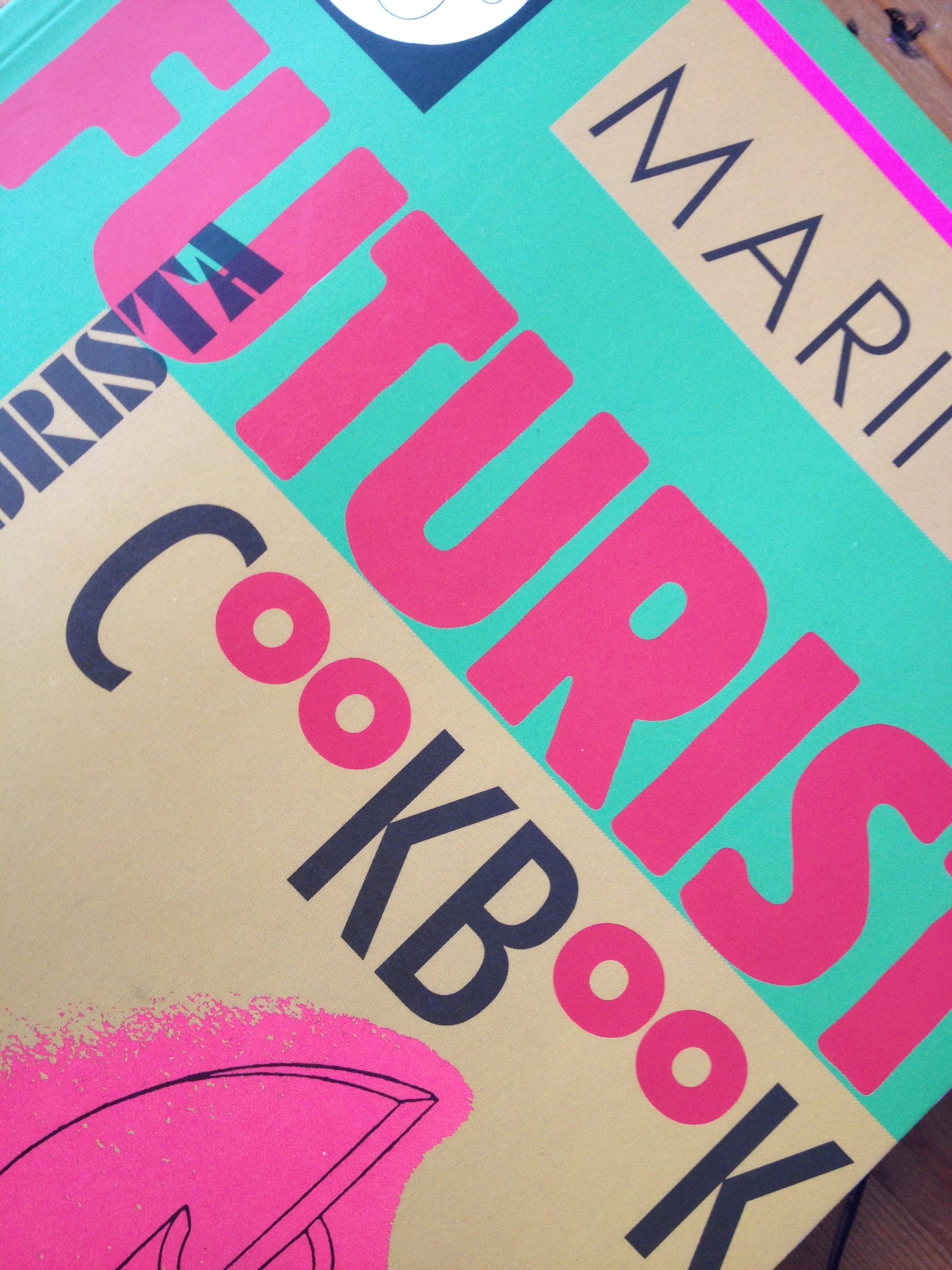
Here is an excerpt from the 1931 Futurist Cookbook  that felt appropriate for upcoming Valentine’s Day. It makes us ask, what is the taste of love and desire? And, by extension……..What would my 2014 menu show? I’ll have to think about this one and get back to you.

I desire you: antipasto composed of a myriad selection of exquisite tid-bits, which the waiter will only let them admire, while She contents herself with bread and butter.

Flesh Adored: A big plate made from a shining mirror. In the centre, chicken slices perfumed with amber and covered with a thin layer of cherry jam. She while eating, will admire her reflection in the plate.

This is How I’ll Love You: Little tubes of pastry filled with many different flavours, one of plums, one of apples cooked in rum, one of potatoes drenched in cognac, one of sweet rice, etc. She, without batting an eyelid, will eat them all.

Super Passion: A very compact cake of sweet pastry with small cavities on the top filled with anise, glacier mints, rum, juniper and Amaro.

Tonight With Me: A very ripe orange enclosed in a large hollowed-out sweet pepper, embedded in a thick zabaglione flavoured with juniper and salted with little bits of oyster and drops of sea water.

Trust in Cake

I can unreservedly say that I’m comfortable in the kitchen. Chopping, slicing, grating, sautéing, frying, boiling…no problem. But ask me to measure and bake and I become an insecure wreck. I have often wondered about my peculiar kitchen disability. I thought maybe its cultural baggage since I didn’t see the cooks in my family measure or bake. Maybe. There is something mysterious about combining ingredients and placing it in this hot metal box to have it transform into something delicious. On its own! Without my vigilant attention, my stirring, my tasting, my adjusting, my anticipating. It seems like cheating. Can I claim to have cooked something if I haven’t stood over the stove and invested my time, energy and emotion?  Baking feels like letting go. Recently, I’ve been trying to get over my suspicion of the oven. I’ve been baking pies and most recently… chocolate cake. I’ve made mistakes. When I used a 9” pan instead of the prescribed size, the cake was thin. When I opened the oven door before the cake was ready, it fell into a sad crater as if deeply insulted. When I used a smaller pan, the cake batter in its attempt to escape grabbed onto the pan and would not let go. It has been a struggle. But I’m learning to let go. I’m learning to trust that the measured ingredients will indeed transform itself into something delicious, maybe a chocolate cake, maybe not. Doesn’t matter. I’m learning to trust, the ingredients, the oven and myself.

I recently finished reading Provence 1970: M.F.K. Fisher, Julia Child, James Beard and the Reinvention of American Taste by Luke Barr. There is much to admire and learn from these dinner conversations. The following quote about the dismissive charge that Julia Child was “the minister of measure” relates to my fear of the oven and measurement. Barr writes,

“But if Child preserved a teacher’s sense of basic instruction, she jettisoned schoolmarmish pursed lips and disapproval. She embraced pleasure and fun. And unlike Beck, or Olney, or  the tradition-minded French, she was open to change and experimentation. She was         unorthodox, unafraid. And she wanted her readers to feel the same way.”

Barr’s sympathetic reading of Julia’s insistence on proper measure makes me rethink my own aversion to measurement as control, prescriptive, directive and unimaginative. Indeed, it can be all those things. But, as a baking novice, I have new appreciation for detailed instruction able to dissolve my fear. Recipes can feel like a challenge. If I follow this prescription then my dish should be perfect. If the dish is not perfect, then it is my failure. But, recipes can only dictate success if I let it, if I set my expectation to imitated perfection. Here philosopher Carlyn Korsmeyer’s essay Ethical Gourmandism helps in explaining that taste has lot to do with our expectations and presumptions. Like not telling my kids what they’re eating before they taste it. Ignorance may allow open interpretation but does not cultivate taste or culinary ability. Similarly, recipes may set our expectations but they do not determine the success of the taste experience. A recipe gives us an educated and measured starting point from which to posit our own deviations and mistakes as we discover our own abilities, taste and identity.

There is room for imagination and experimentation between blaming a bad recipe and blaming a bad baker. My Jim has selflessly volunteered to eat all my chocolate cake experimentations. I cannot fail. I’m learning to trust the cake baking in the oven. I’m learning to let go.

I used Mom’s Chocolate Cake Recipe from Food and Wine. It was simple and liked the whole and repeated measurements.

http://www.foodandwine.com/recipes/moms-chocolate-cake

Raymond Loewy on Burgers versus Creamy Chicken

In his 1951 autobiography, Never Leave Well Enough Alone, French-born American Industrial Designer, Raymond Loewy devotes a chapter on “American Cooking” and gives food a pivotal role in the development of his design aesthetic. The analogy between food consumption and product consumption arises out a shared response to taste. Loewy presents himself as the harbinger of modern taste in food and products.  In order to promote ‘industrial’ and simple, he negates the  ‘domestic’ and the decorative, through gender differentiation. He writes,

“It seems to me that the American Woman may be partly responsible for the blandness discussed above. I’ve noticed that about the best food in America is not found in the tearoom shoppe, but at the truck driver’s joints, near plants at workmen’s eat shops, or Second Avenue bars and grills. There, you can always get a wholesome hamburger or some nice juicy pork chops with plenty of hot cottage fries, a hefty chunk (not a thin, patrician slice) of corned beef with real honest to goodness cabbage, and a glass of cool beer. I believe that if men were left alone they would soon demand real he-man’s bread, not the sissified stuff that looks as if it were daintily made by some arty and desiccated spinster at Ye Olde Tea Roome Shoppe.”

“Okay, sister, you win. Bring on the pink candle and the lace paper doily.”

His blame of ‘bland’ ascribed to women, separates the domestic and decorative from the mobile, industrial masculine world of diners. According to Loewy, the best food happens on the road or near industrial plants, where men consume unadorned, unadulterated, ‘wholesome’ food. The menu he describes of hamburgers, chops, corned beef and beer consists primarily of meat without accompaniment. The association of diners and diner food with masculinity, continues today in shows like ‘Diners, Drive-ins and Dives.’ The 1930-40s diners were exemplars of modern life that served mobility, urbanity, simplicity, mass production, mechanical production, masculinity, efficiency and reliability that Loewy hoped to spread.

By way of concluding the chapter and continuing on his gender differentiation, Loewy continues, “Another surprising American culinary phenomenon is the Home Economist. These dangerous creatures try to keep the bored and frustrated hausfrau from falling into the hands of a psychoanalyst (which they couldn’t afford anyhow) by keeping them busy in the kitchen. The formula is a blend of poetry, art and cookery. It gives the repressed, romantic mamma a chance to express her social amenities and relieve her libido through refuge in Arts and Cookies. A typical example of the home economist recipe ordinarily calls for an electric mixer and it runs something like this:……..” Here he inserts a recipe in the form of a poem.  His first accusation against American women involves, pink paper doilies, dainty decorations and superfluous details. His second accusation, involves the misuse of technology. Whereby the use of blender is followed by attention to presentation details. The use of machines, scientific attention to food by the home economist lacks, according to Loewy, simplicity and honesty. Loewy accused the house wife of ‘busy work’ using the decorative to mine meaning, whether by habit or intention. The desiccated spinster and the hausfrau in need of psychoanalysis represent obstructions to modern progress. They are guilty of sauces that cover and garnishes that distract. He would not appreciate food network shows like‘Semi Home Made’ that promote presentation.

Loewy’s autobiography is full of such anecdotes and opinions about food aim to direct modern consumption habits. More on Loewy later……..

[excerpt from conference presentation for “Food Networks: Gender and Foodways” University of Notre Dame, 2012]

Alton Brown, Philosopher-chef?

Alton Brown, a philosopher-chef? Yes. According to Georgia Tech Professor, Ian Bogost, by attending to to the specificity and complexity of ingredients Food Network star Alton Brown is engaged in alien phenomenology. Bogost explains that “Brown’s cakery embraces tiny ontology. The cake exists, to be sure. So does the Kitchen-Aid 5 quart stand mixer, the preheated oven, the mixing bowl, and the awaiting gullet. But to do so the sugars, the flour granules, the butterfat crystals, the leavener, the gas bubbles. And they do not merely exist – they exist equally, and Good Eats proves that flat existence entails equal levels of potential worth. The relationship between fat crystal and sugar, leavener and batter is just as fundamental as that between cake and and sugar, leavener and batter is just as fundamental as that between cake and mouth. The dispersion of gases that rises is surely interesting and useful as it relates to the end product (a light and fluffy cake), but Good Eats also presents the gas bubbles and the flour granules as their own end product, worthy of consideration, scrutiny and even awe.”

Alien Phenomenolgy is according to Bogost, the practice of specific speculation that helps us imagine Alton Brown attention to the interaction of ingredients, tools and process allows us to think about the relation between things or ingredients independent of our needs. While the cake maybe delicious to us, the specific interaction of heat and batter occurs independent of us. Our need for a delicious cake only sets up the conditions but the active combination of flour, sugar and heat make the intention reality.  This culinary moment is significant for design disciplines. It shows the capacity of attentive construction processes to promote an object orientation that is attentive to inorganic agency. Design that considers opacity, complexity and process of things can maintain at least a partial object orientation. It gives us an appreciation or process and elements beyond the end product, the delicious cake.  Bogost’s culinary example about Alton Brown’s poundcake shows us how things relate through complex encounters that we both don’t and do control.

(From my recent publication in the Journal of Speculative Philosophy entitled “Black Noise: Design Lessons from Roasted Green Chiles, Udon Noodles and Pound Cake”)

Apples and Carrots

Walter Isaacson’s 2011 biography of Apple founder Steve Jobs brings up set of gastronomic idiosyncrasies. In the third chapter, “The Dropout,” Isaacson describes Jobs’s fascination with vegetarianism and Zen Buddhism in 1972. According to Isaacson, Jobs at the time was influenced by Diet for a Small Planet by Frances Moore Lappé and Mucusless Diet Healing Systems by Arnold Ehret. These books encouraged Jobs to assume a diet of simple fruits and starch-less vegetables. Soon, Jobs became obsessed with limiting weeklong diets to single items, such as apples or carrots, either of which he would eat exclusively for a whole week. In doing so, Jobs eliminated milk and carbohydrates that increased the risk of harmful mucus. Referring to Jobs’s carrot diet, Isaacson mentions that, “Friends remember him [Jobs] having, at times, a sunset-like orange hue.”[1] Jobs would also fast from two to seven days at a time, after which “you start to feel fantastic,” according to Jobs: “You get a ton of vitality from not having to digest all this food. I was in great shape. I felt I could get up and walk to San Francisco anytime I wanted.”[1] In the entire biography, prepared food is mentioned twice: once in relation to his eating sushi with his daughter and secondly to his vegan wedding cake. These references to  Jobs’s eating habits are by no means anecdotal; describing his return to Apple in 1997 and his obsession with translucent and colored plastic, Isaacson writes that “Jobs became infatuated with different materials the way he did with certain foods.”[1] Food as an indicator of a designer’s relationship with the non-human reveals much about design motivations. Jobs’s compulsion toward clean, simple shapes can be traced back to his demand for mucus-less diets of single fruits.