
“Be Kind” by Michael Blumenthal from No Hurry. © Etruscan Press, 2012. From the Writers Almanac April 12th, 2017 |

“Be Kind” by Michael Blumenthal from No Hurry. © Etruscan Press, 2012. From the Writers Almanac April 12th, 2017 |

Here is the meditation that helped me emotionally survive a weekend of dance competition. Almost.
Our late start Saturday morning thankfully gave me time to sit for 20 minutes.
The solidity of the floor is always best for a long straight spine but hotel room carpets always feel threatening to me. So, I sat comfortably on the pillowy bed. I closed my eyes and felt my breath. Then I started to listen for all the noises around me, loud and quiet. The hum of machines, slamming doors, cars passing on the road, people talking, water running, children running, As my mind noticed all the noises, I quietly said to myself, “There is noise but I am still. There is noise but I am still. There is noise but I am still.” I didn’t have to be moved by the noise and sensory chaos. I tried to memorize the feeling of noticing noise without the need to be moved by it. The feeling of being the calm center of a storm, the feeling of channeling Aristotle’s unmoved mover.
I sat in my pillow nest enjoying the quiet center of a noisy day.
The 20 minutes made a world of a difference sitting in the loud auditorium. There is noise but I am still.
I thought I won the day. I defeated the fatigue of watching dance all day. I was confident of my yogic super powers.
The awards began past 10:00 pm that evening. After 15 minutes I folded and found myself hunched over as if child’s pose. My serenity lost.
I wasn’t ready for the repetitive, auction-like rush of words and numbers. I couldn’t just tune out, after all I was waiting to hear about how our dancers did. What to do? How can I be aware and engaged but not burdened and fatigued?
What helped was commiserating with other moms just as tired and invested as I was. It didn’t take away our fatigue but the jokes, sighs and laughter sure made it bearable. Sometimes meditation works and sometimes we just need to laugh with a friend to get through difficult hours of waiting.
Next competition I’m going in with all the support I can muster: snacks, meditation and friends.
May I focus beyond my achy back, hungry tummy and overloaded eyes and ears to be in the present and enjoy our girls dance through the long days with grace, skill and beauty.
Wishing you all laughter and quiet, as needed,
Wobblyogi
That’s my dance baby flying strong in the air. Proud mom moment 🙂

Last weekend our yoga book club met to talk, practice, eat, watch a documentary and talk some more. The three hours flew by. Jacqueline lead us through a beautiful asana practice inspired by mantras from the book. We talked about the difference between ambition and greed, between pain and suffering. We talked about what we liked about the book and what we didn’t like. We talked beyond the book about the challenges of a home practice, about how we came to join the book club. We watched and talked about the documentary: Yoga Is. It was movie night, book club and tea time rolled into one. What a wonderful way to spend a Spring Sunday afternoon!
Usually after practice we rush back to our respective lives. What a welcomed treat to sit and laugh with my fellow yogis.
Our snack menu included items to balance Spring Kapha flavored with heat building spices of ginger and black pepper.
All of the snacks were easy to assemble. The most “cooking” I did was the tofu scramble. The “heat inviting” meal ironically required very little fire to prepare.
Here are a few directions.
For the Corn Tacos (less gluten and dairy helps balance Kapha): Break up a box of extra firm tofu. Add any spice mix of your choice to the broken up pieces. I used a spring spice mix with turmeric, fennel, cumin, ginger, black pepper and chili powder. Heat a tablespoon of oil in a wide pan or wok. Add tofu. Let it dry out and even brown on one side before you move the pieces around. You can take the tofu out of the pan or just have it waiting on one side of the pan, while you wilt some greens (spinach, arugula, chard). You can also add onions or garlic, if you like. I didn’t. Once wilted, toss greens with tofu and your filling is done!Warm some corn tortillas with ghee, butter or an oil of your choice. Add filling. Maybe top with shredded carrots or avocado slices. Enjoy.
The stuffed dates were simply crystallized ginger and almonds pulsed together into a grainy consistency. Stuff the mixture into de-seeded Medjool dates.
The cucumber slices were just that. Sliced cucumbers topped with hummus and sprinkled with feta.
The roasted chickpeas (deep frying is tastier but not very healthy) were drained canned chickpeas, tossed with vinegar, oil and a spice mix (I used the same spring spice mix as the tofu) and baked at 400 degrees until crispy. Between 30-40 minutes. During cooking you’ll need to moves the peas around to get an even bake. That’s it.
The spiced tea was regular tea with milk, a touch of sugar, spiced with ginger and black pepper.
If you couldn’t join us, I hope you can find the time to enjoy the book, the movie and the snacks with your friends. Next time, join us.
Looking forward to our next book club meeting in late summer,
The Wobblyogi
http://www.judithhansonlasater.com/lly2/
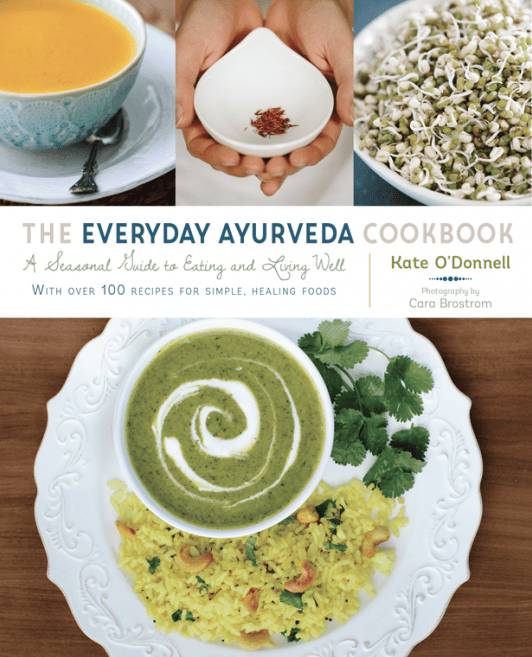
My favorite Ayurveda Cookbook is this one by Kate O’Donnell. I modified the taco recipe offered in this book. It has many other recipes that are easy to to prepare and have easy to find ingredients. O’Donnell reminds us that Ayurvedic cooking is not limited to Indian food!

The mother does not engineer her child’s intrauterine development, but she influences it enormously through her lifestyle and her sensitivity, her anxieties, appetites and attitudes, her history and her constitution. Who she is, and the physical and emotional environment that she herself inhabits, affects the nature and the quality of the sanctum that she provides for the growing form of life within her. And so it seems to be with intuition: there are conditions which render the mental womb more or less hospitable to the growth and birth of ideas; and differing ways in which, and extents to which, different people are able, wittingly and unwittingly, to provide thsoe conducive conditions. The more clearly we can identify what these conditiona are, the more able we shall be to see how they can be fostered.
From Hare Brain and Tortoise Mind: How Intelligence Increases When You Think Less
Meditation and mindfulness are ways to foster intuitive awareness and intelligence. It allows our brain to synthesize and absorb information and feelings. The book defends intuitive and creative intelligence, pooh-bear thinking, through an analytical “d-mode” rabbit logic. It shows the value of thinking differently as the need arises, “abiding in uncertainty” for fuzzy problems and seeking clear solutions for defined problems.
Deciding whether a problem is fuzzy or defined may require both.
Related to the complexity about how to think about X, Claxton explains the fallacy of dream interpretation according to James Hillman.
It is the very nature of nature of dreams to hint and allude. ‘An image always seems more profound, more powerful and more beautiful than the comprehension of it.’ To ask of a dream “What does it mean?” is as misguided as to ask the same question of a painting or a poem – or a sunset, come to that. “To give a dream the meaning of a rational mind is … a kind of dreading up and hauling all the material from one side of the bridge to the other. It is an attitude of wanting from the uncounsious, using it to gain information, power, energy, exploiting it for the sake of the ego: make it mine, make it mine.’ The proper attitude towards a dream, according to analytical psychology, is to ‘befriend’ it: ‘to participate in it, to enter into its imagery and mood, to …play with, live with, carry and become familiar with – as one would do with a friend.’ So, ‘the first think in this non-interpretive approach to the dream is that we give time and patience to it, jumping to no conclusions, fixing it in no solutions … This kind of exploration meets the dream on its own imaginative ground and give it a chance to reaveal itself further.’
Thank you, Kathy, my friend, for recommending this book! Looking forward to reading, Intelligence in the Flesh: Why Your Mind Needs Your Body Much More Than It Thinks.
May we all foster creative conditions, have good idea babies and befriend our dreams,
Hungryphil
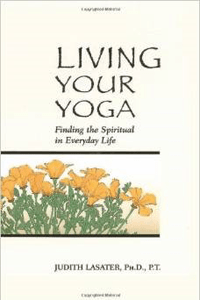
If you are reading along, we are up to the second four sections of part two in our book Living Your Yoga: Finding your Spiritual in Everyday Life. Here author Judith Lasater addresses issues of Attachment, Suffering, Impermanence and Empathy.
Attachment is the process which occurs in the body-mind when you do not get your preference; aversion is a form of attachment. Both create bodily and emotional reactions. Aversion may create frustration, anger, and blame of self or others. I find that fear is often at the root of my reactions when I am in a state of aversion. Clinging to a preference, whether it is from attachment or aversion, creates suffering. It is also the precise moment when you can grow by choosing to recognize attachemtn or aversion for what it is.
How do I know when to persist and when to let go? When to notice a preference or aversion, honor it and when to simply go along? Any creative work involves a degree of attachment, sometimes veering on obsession. Shouldn’t that creative preference induced suffering be endured? I’m confused. When I ask “How should it be?” as Laster suggests, my internal answer is “better.” Do hope and aspiration lead to suffering? Should I not be attached to my preference for ease, clarity, beauty, calmness etc.?
I suppose this dilemma leads to questions about the nature of suffering, the next topic. Laster explains,
…we suffer because of the process of identifying with pain. If we have an internal dialogue that reinforces the belief that we are suffering, that we have no choice, that the whole world is doing it to us, then we will remain stuck in our suffering. The paradox about suffering is the no one can make us suffer. We can choose to feel left out, incompetent, or inferior. Others may act in unkind ways. But there is no way that we will feel left out, incompetent, or inferior unless we participate in the process. Although we may have feeling about what is happening to us, whether we suffer is up to us. It is a matter of choice.
The idea that suffering is a choice is an idea I’m working hard to hold. It requires a level of personal responsibility regardless of worldly demands, while at the same time promises a level of freedom from worldly demands. I can choose to bask in my suffering, big and small or refuse to identify with it. Again like addressing attachment, this is difficult. How can I honor what I am feeling without becoming imprisoned by my feelings? Surely if something irritates me, or hurts me, I should notice………. yet not let it become a part of me. My suffering may shape my experience but does not define me.
Identification seems to be a key switch between self-awareness and self-absorption. The next topic Lasater invites us to consider is impermanence. To illustrate the permanence of change she quotes Thich Naht Hanh, a Zen Buddhist monk, who summarizes the five remembrances:
I am of the nature to grow old. There is no way to escape growing old.
I am of the nature to have ill health. There is no way to escape having ill health.
I am of the nature to die. There is no way to escape death.
All that is dear to me and everyone I love of the nature to change. There is no way to escape being separated from them.
My actions are my only true belongings. I cannot escape the consequences of my actions. My actions are the ground on which I stand.
As a philosopher (defined as one who practices the art of dying) this realization comes easy to me. Everything changes. It is both sad and wonderful. Everything is old and new, always. Including my kids. How limiting it would be to confine them to my memories and expectations. I try my best to see them as they are right now and not as I saw them when I first looked down on their little faces. That is my cherished memory, not theirs. Similarly, I enjoy whatever thing I have but I also know that these things do not define me. More things, big as property or small as books, will not solidify my existence into permanence.
If I consider all that I have in light of what those things help me do then the value of my laptop, my phone, my pencil, my coffee mug and my soft fuzzy boots emerge. I belong to my actions. I read-write, eat-cook and hopefully care for people in the process. Most of my life I have felt homeless, this realization gives me much comfort.
Completing this section about how we relate to others, Lasater talks about, empathy.
To cultivate empathy means to see the world through the eyes of another without judgment, without trying to “fix” it, without needing it to be different. It is acceptance independent of agreement, understanding without any implied coercion for oneself or the other to change. There is also no sense of wanting to “educate” the other person about how their perspective is wrong and ours is right.
As a recovering academic, the idea of not trying to “educate” is so counter-intuitive. It is difficult sometimes to just listen and support each his/her own journey. When should I “help”? Only if and when asked? The problem with empathy is that it makes me want to ease the suffering, makes me want to “fix” it. But, I suppose I’m only supposed to see from a different perspective without making it my own. So many unresolved feelings.
I have much work to do in addressing my attachments, suffering, impermanence and empathy.
How was this section for you? Do you find it as messy as I do?
Happy reading,
Wobblyogi
Lasater, Judith Hanson. Living Your Yoga: Finding the Spiritual in Everyday Life (Kindle Locations 1527-1530). Shambhala.

My new borrowed mantra: “You cannot write until you know how to inhabit your own experience” is from Jane Hirshfield. According to today’s Writer’s Almanac, she practiced Zen Buddhism for 8 years before returning to poetry.
Happy Birthday Ms. Hirshfield! This is her poem, Sweater. I hope to be “lengthened by unmetaphysical pullings on” like her sweater. Enjoy!
What is asked of one is not what is asked of another.
A sweater takes on the shape of its wearer,
a coffee cup sits to the left or the right of the workspace,
making its pale Saturn rings of now and before.
Lucky the one who rises to sit at a table,
day after day spilling coffee sweet with sugar, whitened with milk.
Lucky the one who writes in a book of spiral-bound mornings
a future in ink, who writes hand unshaking, warmed by thick wool.
Lucky still, the one who writes later, shaking. Acrobatic at last, the
sweater,
elastic as breath that enters what shape it is asked to.
Patient the table; unjudging, the ample, refillable cup.
Irrefusable, the shape the sweater is given,
stretched in the shoulders, sleeves lengthened by unmetaphysical
pullings on.“Sweater” by Jane Hirshfield from Come, Thief. © Knopf, 2011.
Wishing you a happy weekend,
Hungryphil

All this time,
the life you were
supposed to live
has been rising around you
like the walls of a house
designed with warm
harmonious lines.As if you had actually
planned it that way.As if you had
stacked up bricks
at random,
and built by mistake
a lucky star.“Lucky” by Kirsten Dierking from Northern Oracle. © Spout Press, 2007.
From the Writers Almanac February 23, 2017
The image is from NASA and captures the death of a star.
Hello, Everyone!
Our adventure in self-study through reading Judith Lasater’s Living Your Yoga continues. How is reading going for you? What are you asking yourself? Finding any surprising answers?
If you’re not reading the book but just checking in with the blog….. perfect. That’s what this blog series is for. This effort is less about the book more about asking ourselves questions about what irks us and how can we limit those small and big irritations.
The first part of the book was about awareness within and addresses themes of discipline, letting go, faith, perspective and more. Part two is about how yoga helps with our relationships with others and the world. Judith Lasater talks about compassion, control, fear, and patience. One of the reasons I love her book is her constant reference to motherhood and stories related to her children. Using yoga principles to guide our role as moms, for me really resonates.
As a parent, I have often wrestled with what it means to be compassionate toward my children…………..I have learned that the most compassionate response I can have is to be willing not to judge their behavior, but to try to see the situation from their point of view. This does not mean that I forfeit my opinion on the most effective course of action they might choose. Rather I have the intention to truly feel the situation from their narrow views, thus stepping back from my own narrow views.
What! Not judge the behavior of my children! Isn’t that my job? My interpretation of what she is saying is this: really listen to what they are saying, repeat back to make sure I understand their perspective, “so you are saying that you really need to go the party because all your other friends will be there and your the acceptance of your friends is very important to you”….or something like that and then I offer my opinion about why that request or feeling has multiple considerations attached like, “Did you do your homework?” “Do you need a ride”, “is it on a school night?” and maybe “why is the acceptance of this group of friends so important”, etc. Compassion may not alter my expectations as a mom, but it can help me see the issue from my kid’s perspective. I’ll try.
Do you judge yourself if a yoga pose doesn’t look “perfect”? Can I be compassionate with my own body and its abilities? Allow my left knee to crunch without judgment?
Who among us hasn’t been accused of being controlling, particularly when it comes to our kids? Here is Lasater’s advice:
Dr. Rosenberg explained that if you coerce your child into doing something, you will pay a price. For example, even if you could exert enough control to make him take out the garbage, he would make you pay for getting your way…. If we try to control the behavior of others, we may get what we want but we won’t enjoy it. If we have the thought that we are making someone do what we want without eliciting their true cooperation, that control is the greatest of illusions.
What to do if the other’s behavior is self-destructive? If they are not invested in their own well-being, ultimately I, as a mom can’t sustain control over them. That is truly difficult to accept. She later addresses this issue by writing,
But where does letting go of control end and taking responsibility for my life begin? We must understand (and accept) what it is exactly that we can control and what we cannot control. In the final analysis, we can control only ourselves. But we are often dismayed at our inability to master even this. What prevents us? When we feel out of control, it is usually when there is a conflict between what we think and what we feel. Our feelings may scream one thing while our minds demand something else.
I try to be realistic and honest about what I can do and what I can’t in relation to my kids and others. I feel, if I hear and try to understand my kids, they, in turn, hear me better too. They may not like my preferences as I may not like theirs, but being open about what we can do individually helps us in being compassionate with each other. My beautiful and talented dancer daughter understands that loud noise and big crowds are overwhelming for me and doesn’t insist on my presence throughout all her dance competitions (of course she wants me to see her dance, as I do but she understands if I don’t stick around). I let go of the fear that my daughter might see my limitation as a lack of care. If we scratch deeper we always find either love or fear. Laster appropriately continues the next section on the topic of fear.
On the yoga mat, when I am overthinking a pose, I know I’m trying to control. Alignment cues are directions, not destinations. Yoga is not a “follow the leader” kind of activity. My role as a teacher is to stand a guide and demonstration with my body, my abilities, and limitations. I also have to accept however a student interprets and acts on my guidance, as long as he or she doesn’t hurt themselves. What is the difference between correction and control?
The most interesting thing that Lasater says about fear for me was that if you are really living the present moment there is no fear. And, if you say “I am afraid,” admit and name the emotion, fear loosens its grip. I’ve tried this when afraid to drive on icy roads and found it helped me find ease. About being present and unafraid she writes,
If you are involved in actually fighting for your life, there is no time to be afraid. The sympathetic nervous system is mobilizing you to run or attack, and your bodily functions are working full blast. For example, the eyes open wider to see the danger better, blood is shunted to the muscles so that you can use them in the fight, and the mind becomes completely focused in the immediate need at hand. Your nervous system is not distracted by thinking in the abstract about what may happen. Rather, it is dealing with what is happening. It is only when you think about what may happen or what could have happened that you feel afraid.
Fear is, unfortunately, a standard and inevitable mom-emotion. It is challenging to find the balance between fear and love. I try not use my fears as an emotional weapon to limit the growth of my children. There is a difference between saying “please lock the front door” and “never go out.” Caution and fear. Instead of hoping that nothing bad ever happens to them, I hope they cultivate the strength to recover from anything. This takes practice and trust.
When I practice crow pose, I’ll bring a bolster or block in front of me to allow my head to come down. Somehow that eases the fear that I’ll come tumbling forward.

Patience is another absolutely required parental skill. My favorite part was when she talked about our concept of “wasted time.” I am guilty of considering most of my day as “wasting time.” Lasater’s explanation struck a nerve for me when she talked about impatience arising out of a feeling of wasting time as associated with a fear of being devalued. The thought that – I could be doing better things than sitting in traffic, doing the laundry, waiting in line – etc is a symptom of feeling “I’m not doing enough.” Lasater explains it better:
What is really wasted? Nothing. All gives me the opportunity to live in the present moment. When I do, I am patient. This realization supports even the most mundane events of my daily life. I can wait in lines, sit in traffic jams, and understand when someone is late for an appointment. All of these times – waiting, sitting, and understanding – are valuable. I can choose not to experience them as wasted time by choosing to be present and actually live these precious moments. After all to reject them is to reject life itself………..
Beneath my “time-wasting” thoughts was the most startling realization of all. I was afraid. You see, my self-worth was so tied to how much I accomplished. I thought that if I could speed up things around me, then I could get more done. If I did that, then I would be more valued, therefore more loved, therefore happier.
The next time I’m waiting in the school parking lot for my daughter to emerge, I’ll try to think of it as a practice in patience, and self-value. Waiting as mothering.
Maybe I can practice patience when in a forward fold, standing, seated and wide instead of judging my tight hamstrings.
For me, this section tugged at my mommy heart. What stood out for you? Was it teaching and control? Dealing with difficult people with compassion? Fear and anxiety about what we can’t control? How to accept control as an illusion?
I hope it was a good read for you. Looking forward to hearing your comments.
Happy reading Community Yoga Bookclub!
Yours,
Wobblyogi

So….how’s the reading going? Do you find yourself noting moments of mindfulness during your day? Do you hear Judith Laster’s gentle advice to heed the feelings of impatience and fear? Somedays I am more self-aware than others. This week’s notes cover topics about our relationship with ourselves: faith, perspective, courage and relaxation.
“….I came to understand that belief is a preconception about the way reality should be; faith is the willingness to experience reality as it is, including the acceptance of the unknown.”
Spirituality in all forms begins with the premise that we can’t know how everything connects, a faith in something greater than our limited existence. I liked one of mantras for daily living that Lasater offers in the chapter: ” Faith is the quiet cousin of courage.” It prompted me to ask myself what do I have faith in? How does that faith guide my actions and days? Does faith help me to stay in the reality as it is or is it a belief in how reality should be?
“With our willingness to have perspective, not only do we increase our ability to disinguish the important from the unimportant, we also increase our capacity for compassion toward ourselves and others.”
To take life’s challenges big or small as an invitation to shift our perspective and our expectations is so difficult. What do I consider demanding or challenging? Why? How could that challenging person or event help me see differently? How do I let go of my stubborn perspective and let myself see from another person’s perspective? In the current political climate, I’ve been feeling particularly challenged to see from different perspectives who see immigrants and Muslims as potential threats, who see me as a potential threat to national security. Can I feel compassion for that fear? In an effort to see from a different perspective I’ve widened my collection of daily newspapers and reading [highly recommend: Strangers in their own Land by Hochschild and Between the World and Me by Ta-Nehisi Coates], refrained from deleting people from my media stream, I’ve appealed to my faith in the innate goodness of people and mostly I’ve cultivated my gratitude . Yes, perspective has lately required much effort. Lasater’s mantra, “The worse could happen; the best could happen. Life is usually somewhere in between.” helps.
The next topic that flows from perspective is courage; to act out of compassion instead of fear.
….those times when I have been most afraid were when I felt disconnected from God, from Sprit, from the Universe, from family and friends, and, most importantly, from my own heart. Courage cannot exist in isolation.
To have courage in the face of the unknown and of shifting perspectives is to rely on a deep commitment to the connections that sustain us. What is worthy of my courage, my action? What is worthy of struggle?
As if sensing our strain, from the demands of faith, perspective and courage, Lasater concludes the section about yoga within yourself with…..relaxation.
This is a key to living yoga. Watching thoughts of anger, greed, boredom, impatience, I was no longer at the mercy of them. I had some space to choose what I would say and do in a way I never had before. I began to recognize patterns; I began to take it all more lightly. By learning to relax, I experienced less physical tension, which allowed me to see my monkey mind, which allowed me to let go of it a bit, which allowed me to feel more connected to the present moment, which is another word for the Infinite.
Oddly, relaxation takes practice. To develop the skill of relaxation, I allow myself to be a spectator instead of an actor. As I witness my thoughts, actions, emotions, I begin to realize that I am more than all those aspects of myself. And, more importantly, the person next to me is also more than her actions, thoughts, and emotions. That “something more” is what we all share. It is not by accident that Shavasana or corpse pose is a reference to our shared mortality with all living things.
The progression of these chapters asking us to notice our faith, perspective, courage, and relaxation was difficult. How can we be both courageous and relaxed at the same time? How can we witness and act at the same time? How can we honor ourselves and other perspectives too?
Part two, about our connection with others, begins to address my concerns. Not surprisingly the first topic in the next section is compassion.
Tell me about your thoughts about reading. How do you feel about the topics? Are they challenging for you? How do you resolve the seeming contradictions that I see?
Wishing you happy reading and ease,
the Wobblyogi
This past week, during yoga practice, I focused on “staying in the present moment” and asked myself and my students to notice what makes our mind stray from absorbing everything that is happening right at this moment. Is it when a pose becomes uncomfortable, maybe when we become bored, maybe because we feel guilty for taking the time out of our busy day when so much needs to be done, maybe because we begin to judge the music, the space, the people or ourselves. So many possibilities nestled in the actuality of the moment that we too often ignore.
This poem read on the Writer’s Almanac this morning beautifully sums up the gratitude of living, owning and flowing in the moment. [replace the gendered language to suit you as you read].
Happy the man, and happy he alone,
He who can call today his own:
He who, secure within, can say,
Tomorrow do thy worst, for I have lived today.
Be fair or foul or rain or shine
The joys I have possessed, in spite of fate, are mine.
Not Heaven itself upon the past has power,
But what has been, has been, and I have had my hour.
 The Hungry Philosopher