Food Poem – Making Risotto for Dinner When His Ex-Wife Calls by Kendra Tanacea

I myself am an ex-wife and I’m also the wife cooking dinner during an ex-wife phone call. I feel the discomfort of intrusion from both perspectives. It is the unwelcome reminder that I am not the center of anyone’s universe as young love believes.  I feel the pang of the poem and its wisdom of being the other woman either on the phone or cooking. In this case, is cooking an escape or a grounding in reality? Maybe both?

While I mince an onion, he talks with her,
planning their son’s bar mitzvah, sounding
so familiar, so nuts and bolts. Turning up the gas flame,
I sauté the onion translucent. Butter sizzles, foams,
as they go over the invitation list, names I’ve never heard.

Adding a cup of Arborio, I think of white rice
thrown high in the air by the fistful. I pour
two glasses of chardonnay, one for the risotto,
one for myself, sip, then gulp. Blend.

The band, flowers, menu?
Heady, I stare at the recipe to orient myself, to understand
what I am doing: Add broth, cup by cup, until absorbed.
Add Parmesan. Serve immediately.

The word immediately catches my eye,
but their conversation continues, then his son
gets on the line and hangs up on him,
as I stir and stir, holding the wooden spoon.

“Making Risotto for Dinner When His Ex-Wife Calls” by Kendra Tanacea from A Filament Burns in Blue Degrees. © Lost Horse Press, 2017.

From the Writer’s Almanac March 31, 2017

Me, a hungry philosopher?

IMG_4202.jpg

I am a self-proclaimed food philosopher. Maybe I’ll be able to convince a few others of my suspicion after “How to Eat Bittermelons and Brownies: Recipes from a Philosopher Mom” is complete. Until then, I am an unverified food philosopher and an imperfect but verified mom.

I used to be a design historian and secretly a design philosopher. Design brought me to the dinner table, figuratively and literally. In Adolf Loos’ roast beef and Loewy’s burgers, I found insight into how creative people think about things. I became fascinated with how what we eat flavors how we see the world.

Whether I categorize myself as a food writer or a design historian, I always approach edible and inedible things through the lens of philosophy. Instead of looking at things through a historical analysis of context, change, and style, I like to ask: what makes this thing possible? Where does this thing begin?  How is this thing, an independent thing?

Regardless of whether I’m looking at a table, a dinner plate, a fork or a piece of fried chicken on a plate, or Hawaiian Kona coffee in a teal ceramic mug, my inner-questioning is the same: conditions, origins, and autonomy.

I experience the edible and inedible as events of self-examination.  My teal mug of Hawaiian Kona coffee sitting on my small square cafe table is more than mere caffeine to sustain my thoughts. It is rent. Bitter. Sweet. Milky. Warm. Traveled. Brewed. Stirred. Transported. Grown. Exchanged. Fragile. Heavy. Liquid. Deco. Diner style. Comforting. Inspiring. It is always more than my analysis can reveal, like myself. It is more than its history. Everything is a question, awaiting a response. But, never THE response.

I am a food philosopher not because I review restaurants, document my travel eats, collect food narratives, curate food poems, post pictures of food and write recipes. I am a philosopher who wonders about how my cup of coffee came to be. It is real, worldly, messy and mysterious. As I do so, I am not “ecstatic” in a Heideggerian sense, I am not “thrown in the world.” Rather I strain to stay “in” and among things, I strain to stay with my cup of coffee, even as I drain it and will soon abandon it in a bin of dirty dishes to washed up by a stranger later today.

I am a hungry philosopher because I feed on wonder. Like you.

As I work on my manuscript, I often lose my place and perspective. This was just a quick reminder that I write because you read. I read because you write. We are all questions and responses. Consuming and consumed.

I so appreciate you.

Yours,

Hungryphil


Food Poem- Hamburger Heaven by Ronald Wallace

Tonight we find them again,
parked under the stars
(no one ever
eats inside in Heaven),
beeping the tired carhop
with her pageboy and mascara
for a paper boat of French fries
drenched in sauce,
a smashed hamburger baptized
with spices.
They’re sixteen and in love;
the night is hot,
sweet and tangy on their tongues.
Why do we stop?
They’re in Heaven, after all,
listening to the fry cook
in the kitchen
with his savory benedictions,
the AM radio playing
“Love Me Tender,” “Peggy Sue,”
unperturbed by the future with its
franchises and malls, its
conglomerates and information
highways. Is there something
we would tell them?
Here in Hamburger Heaven where
the nights go on forever,
where desire’s resurrected
and every hunger’s filled?
Wait! Do we call out?
But now they’ve seen us
close behind them with our
fervent “Thou Shalt Nots,”
our longings glaring in
the rearview mirror.
And they’ve turned on
the ignition
and they’ve floored it
and are gone.

“Hamburger Heaven” by Ronald Wallace from For a Limited Time Only. © University of Pittsburgh Press, 2008.

From http://writersalmanac.org/page/9/

Food Poem- Room Service English Muffins by Kim Dower

When we travel we tend to notice the details, the fine print, the hidden salt and pepper shakers, better. We allow ourselves to break our own patterns and habits, we allow ourselves to try new things and accept deviations like butter on our English muffin, we allow a different world. This poem captures the sense of gratitude, awareness, and wonder on a room service tray.

If you’ve ever had one you know what I’m saying:
soggy with steam, too much butter soaking into the crevices.
At first you’re mad—you told them butter on the side
but then you’re grateful to have it. Day after day
you eat it dry, now away, alone on business
in your overheated hotel room,
you’re grateful for the butter, indebted to strangers
wearing hair nets in a distant kitchen for slathering your muffins,
tucking them into a cloth napkin, placed in a mesh basket,
variety of colorful jams for you to choose.
It’s enough joy just to take that first bite, if you’re lucky
it’s still warm even after the long elevator ride.
If you’re lucky there’s a yellow single stem rose in a bud vase,
shiny silverware poking out of the starched white napkin.
Why give me a fork, you think? You ordered coffee and a muffin,
why complicate it with a fork? And then you spot the tiny
salt & pepper shakers in the shadow of the napkin, and you wonder,
does anyone, no matter how troubled, put salt & pepper
on their English Muffins? Maybe.
Maybe when they’re far from home.

“Room Service English Muffins” by Kim Dower from Air Kissing on Mars. © Red Hen Press, 2010. From the Writer’s Almanac http://writersalmanac.org/page/2/

Hungryphil Eats London: Borough Market Food Tour

IMG_4140

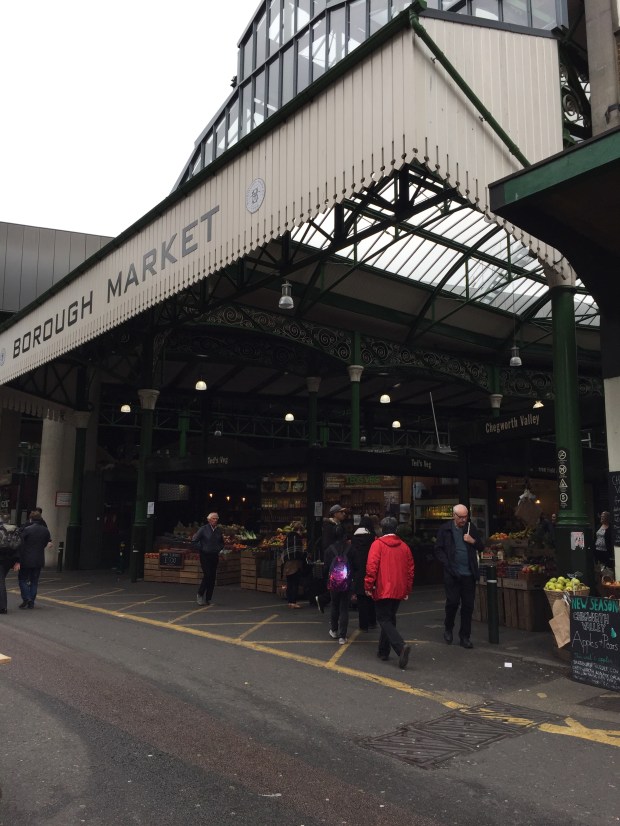
It was an expectedly cool spring day in London. Atiya and I waited at a nearby Starbucks for our much-anticipated food tour near London Bridge.  I was worried that our next hours would be so focused on keeping warm that we might miss the food fun. Atiya will happily attest to my pre-tour cranky mood. Thankfully, all my worries dissolved away at our first stop at Scotchtails for Scotched Eggs (for vegetarians: Goats Cheese, sweet potato pie from Pieminister).

IMG_4133 The day only got brighter like the sunny, runny, bright orange fresh yoke of the Scotched Egg.

Here are some of the highlights from the tour:

The best Fish and Chips I ever had at Fish Kitchen.

The best vanilla custard doughnuts from Breadahead. Look at Atiya’s happiness.

After a few more stops, our tour ended with English Breakfast Tea and Sticky Toffee Pudding at Chop House. It turned out to be a sweet, fried and salty day with my baby, best because it was a cold day. Everything we ate represented comfort food.

Here is what I learned about London eaters based on the gastronomic narrative of the Borough Market and London Bridge Walking Tour.

  1. Simple foods can be surprisingly complex and crafted. For example, the chips are cooked THREE times! Boiled, fried and fried again with appropriate time intervals between.
  2. British food swings between casual, portable street foods like fish and chips or scotched eggs, and formal, elegant cream tea and accompaniments. A family in-between meal would be Sunday roast (we didn’t get to try this delicious combination of roast and yorkshire pudding).
  3. While our tour was focused on traditional English eats, the market represented a diversity of ethnic tastes: Turkish delights, Thai curries, Indian Samosas, Ethiopian Injeera, Balkan breads and more. The Borough market food story also has hidden tartness and spice.

A post-colonial critique of British food would miss the inherent inner-struggle between Anglo-Saxon, French, German, Roman and Viking past. English history has no “pure” native lineage. The “Other” is already inscribed. Food is a visceral way to respond to the climate and confronting cultures.  The Borough market English food tour was an exercise of simple and few ingredients, treated with care.

In the end, regardless of cuisine culture, we can taste –  care. No cultural critique needed.

Wishing you happy and “care-ful” eating,

hungryphil


Having an Idea – Guy Claxton

The mother does not engineer her child’s intrauterine development, but she influences it enormously through her lifestyle and her sensitivity, her anxieties, appetites and attitudes, her history and her constitution. Who she is, and the physical and emotional environment that she herself inhabits, affects the nature and the quality of the sanctum that she provides for the growing form of life within her. And so it seems to be with intuition: there are conditions which render the mental womb more or less hospitable to the growth and birth of ideas; and differing ways in which, and extents to which, different people are able, wittingly and unwittingly, to provide thsoe conducive conditions. The more clearly we can identify what these conditiona are, the more able we shall be to see how they can be fostered.

From Hare Brain and Tortoise Mind: How Intelligence Increases When You Think Less

Meditation and mindfulness are ways to foster intuitive awareness and intelligence. It allows our brain to synthesize and absorb information and feelings.  The book defends intuitive and creative intelligence, pooh-bear thinking, through an analytical “d-mode” rabbit logic. It shows the value of thinking differently as the need arises, “abiding in uncertainty” for fuzzy problems and seeking clear solutions for defined problems.

Deciding whether a problem is fuzzy or defined may require both.

Related to the complexity about how to think about X, Claxton explains the fallacy of dream interpretation according to James Hillman.

It is the very nature of nature of dreams to hint and allude. ‘An image always seems more profound, more powerful and more beautiful than the comprehension of it.’ To ask of a dream “What does it mean?” is as misguided as to ask the same question of a painting or a poem – or a sunset, come to that. “To give a dream the meaning of a rational mind is … a kind of dreading up and hauling all the material from one side of the bridge to the other. It is an attitude of wanting from the uncounsious, using it to gain information, power, energy, exploiting it for the sake of the ego: make it mine, make it mine.’ The proper attitude towards a dream, according to analytical psychology, is to ‘befriend’ it: ‘to participate in it, to enter into its imagery and mood, to …play with, live with, carry and become familiar with – as one would do with a friend.’ So, ‘the first think in this non-interpretive approach to the dream is that we give time and patience to it, jumping to no conclusions, fixing it in no solutions … This kind of exploration meets the dream on its own imaginative ground and give it a chance to reaveal itself further.’

Thank you, Kathy, my friend, for recommending this book! Looking forward to reading, Intelligence in the Flesh: Why Your Mind Needs Your Body Much More Than It Thinks.

May we all foster  creative conditions, have good  idea babies and befriend our dreams,

Hungryphil

Wobblyogi Wednesday: Yoga Book Club Notes #5

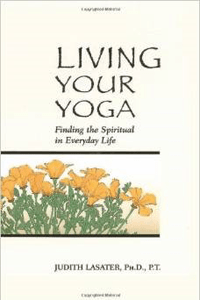
If you are reading along, we are up to the second four sections of part two in our book Living Your Yoga: Finding your Spiritual in Everyday Life.  Here author Judith Lasater addresses issues of Attachment, Suffering, Impermanence and Empathy.

Attachment is the process which occurs in the body-mind when you do not get your preference; aversion is a form of attachment. Both create bodily and emotional reactions. Aversion may create frustration, anger, and blame of self or others. I find that fear is often at the root of my reactions when I am in a state of aversion. Clinging to a preference, whether it is from attachment or aversion, creates suffering. It is also the precise moment when you can grow by choosing to recognize attachemtn or aversion for what it is.

How do I know when to persist and when to let go? When to notice a preference or aversion, honor it and when to simply go along? Any creative work involves a degree of attachment, sometimes veering on obsession. Shouldn’t that creative preference induced suffering be endured? I’m confused. When I ask “How should it be?” as Laster suggests, my internal answer is “better.” Do hope and aspiration lead to suffering? Should I not be attached to my preference for ease, clarity, beauty, calmness etc.?

I suppose this dilemma leads to questions about the nature of suffering, the next topic. Laster explains,

…we suffer because of the process of identifying with pain. If we have an internal dialogue that reinforces the belief that we are suffering, that we have no choice, that the whole world is doing it to us, then we will remain stuck in our suffering. The paradox about suffering is the no one can make us suffer. We can choose to feel left out, incompetent, or inferior. Others may act in unkind ways. But there is no way that we will feel left out, incompetent, or inferior unless we participate in the process. Although we may have feeling about what is happening to us, whether we suffer is up to us. It is a matter of choice.

The idea that suffering is a choice is an idea I’m working hard to hold. It requires a level of personal responsibility regardless of worldly demands, while at the same time promises a level of freedom from worldly demands. I can choose to bask in my suffering, big and small or refuse to identify with it. Again like addressing attachment, this is difficult. How can I honor what I am feeling without becoming imprisoned by my feelings? Surely if something irritates me, or hurts me, I should notice………. yet not let it become a part of me. My suffering may shape my experience but does not define me.

Identification seems to be a key switch between self-awareness and self-absorption. The next topic Lasater invites us to consider is impermanence. To illustrate the permanence of change she quotes Thich Naht Hanh, a Zen Buddhist monk, who summarizes the five remembrances:

  1. I am of the nature to grow old. There is no way to escape growing old.

  2. I am of the nature to have ill health. There is no way to escape having ill health.

  3. I am of the nature to die. There is no way to escape death.

  4. All that is dear to me and everyone I love of the nature to change. There is no way to escape being separated from them.

  5. My actions are my only true belongings. I cannot escape the consequences of my actions. My actions are the ground on which I stand.

As a philosopher (defined as one who practices the art of dying) this realization comes easy to me. Everything changes. It is both sad and wonderful. Everything is old and new, always. Including my kids. How limiting it would be to confine them to my memories and expectations. I try my best to see them as they are right now and not as I saw them when I first looked down on their little faces. That is my cherished memory, not theirs. Similarly, I enjoy whatever thing I have but I also know that these things do not define me. More things, big as property or small as books, will not solidify my existence into permanence.

If I consider all that I have in light of what those things help me do then the value of my laptop, my phone, my pencil, my coffee mug and my soft fuzzy boots emerge. I belong to my actions. I read-write, eat-cook and hopefully care for people in the process. Most of my life I have felt homeless, this realization gives me much comfort.

Completing this section about how we relate to others, Lasater talks about, empathy.

To cultivate empathy means to see the world through the eyes of another without judgment, without trying to “fix” it, without needing it to be different. It is acceptance independent of agreement, understanding without any implied coercion for oneself or the other to change. There is also no sense of wanting to “educate” the other person about how their perspective is wrong and ours is right.

As a recovering academic, the idea of not trying to “educate” is so counter-intuitive. It is difficult sometimes to just listen and support each his/her own journey. When should I “help”? Only if and when asked? The problem with empathy is that it makes me want to ease the suffering, makes me want to “fix” it. But, I suppose I’m only supposed to see from a different perspective without making it my own. So many unresolved feelings.

I have much work to do in addressing my attachments, suffering, impermanence and empathy.

How was this section for you? Do you find it as messy as I do?

Happy reading,

Wobblyogi


Lasater, Judith Hanson. Living Your Yoga: Finding the Spiritual in Everyday Life (Kindle Locations 1527-1530). Shambhala.
Food-Yoga-Writer Poem: Sweater by Jane Hirshfield

My new borrowed mantra: “You cannot write until you know how to inhabit your own experience” is from Jane Hirshfield. According to today’s Writer’s Almanac, she practiced Zen Buddhism for 8 years before returning to poetry.

Happy Birthday Ms. Hirshfield!  This is her poem, Sweater.  I hope to be “lengthened by unmetaphysical pullings on” like her sweater.  Enjoy!

What is asked of one is not what is asked of another.
A sweater takes on the shape of its wearer,
a coffee cup sits to the left or the right of the workspace,
making its pale Saturn rings of now and before.
Lucky the one who rises to sit at a table,
day after day spilling coffee sweet with sugar, whitened with milk.
Lucky the one who writes in a book of spiral-bound mornings
a future in ink, who writes hand unshaking, warmed by thick wool.
Lucky still, the one who writes later, shaking. Acrobatic at last, the
sweater,
elastic as breath that enters what shape it is asked to.
Patient the table; unjudging, the ample, refillable cup.
Irrefusable, the shape the sweater is given,
stretched in the shoulders, sleeves lengthened by unmetaphysical
pullings on.

“Sweater” by Jane Hirshfield from Come, Thief. © Knopf, 2011.

Wishing you a happy weekend,

Hungryphil

Yoga Poem- Lucky Star by Kirsten Dierking

All this time,
the life you were
supposed to live
has been rising around you
like the walls of a house
designed with warm
harmonious lines.

As if you had actually
planned it that way.

As if you had
stacked up bricks
at random,
and built by mistake
a lucky star.

“Lucky” by Kirsten Dierking from Northern Oracle. © Spout Press, 2007.

From the Writers Almanac February 23, 2017

The image is from NASA and captures the death of a star.

Food Poem – The Idea of Living by Joyce Sutphen

This poem reverses the idea that we eat to nourish the body and instead suggests we have a body in order to eat. I love the celebration of embodied sensual experience! I hope you do too 🙂

It has its attractions,
chiefly visual: all those

shapes and lines, hunks
of color and light (the way

the gold light falls across
the lawn in early summer,

the iridescent blue floating
on the lake at sunset),

and being alive seems
to be a necessity if you want

to sit in the sun or rub your
toes in the sand at the beach.

You need to be breathing
in order to eat paella and

drink sangria, and making love
is quite impossible without

a body, unless you are one
of those, given – like gold –
to spin in airy thinness forever.

“The Idea of Living” by Joyce Sutphen from Modern Love & Other Myths. © Red Dragonfly Press, 2015.

From the Writer’s Almanac http://writersalmanac.org/page/4/