Happy President’s Day from Lincoln’s Kitchen

The first sentence in Rae Katherine Eighmey’s book, Abraham Lincoln in the Kitchen: A Culinary View of Lincoln’s Life and Times, begins–

“Abraham Lincoln cooked!” The words leapt off the pages of my sixty-nine-year-old copy of Rufus Wilson’s Lincoln Among His Friends. I could hardly believe what I was reading. Yet there it was. Phillip Wheelock Ayers, whose family at the corner of Eighth and Jackson, described how Abraham Lincoln walked the few blocks home from his Springfield law office, put on a blue apron, and helped Mary Lincoln make dinner for their boys.

The book, picked up at the Lincoln museum store this weekend,  proceeds to serve a multi-layered story of Lincoln’s life through tastes, celebrations, and trials. I just started reading the book and have made it only up to the first recipe for corn dodgers (a sturdy enough corn cake that kid Lincoln could carry in his pocket as a lunch and reading snack during the workday). Midwestern Corn-based breads seem the perfect place to start cooking with Lincoln. The culinary historical journey includes 55 updated recipes from the period. Maybe next President’s Day will include eating like a president.

For today, imagine Lincoln in a blue apron prepping dinner in his small kitchen pictured above.

Mario Batali on Creative Discipline

I love to cook. LOVE to eat. Love to watch and read anything related to cooking and eating. I watched Food Network grow up along with my daughter born in 1995. My love of cooking and my children are so interwoven that I can’t help but think of one without the other.

Conventional wisdom tells us to “do what you are passionate about.” I am certainly passionate about food but I don’t want to do it professionally.

For one simple reason:  I am incapable of consistency.

Skill-wise, I am a culinary child bouncing between passionate experimentation. My cooking doesn’t have the maturity of disciplined and consistent devotion.

I admire those who can run restaurants, catering businesses and the most attractive of all…..food trucks. But I am content with my “Try the World Boxes,” my “spicebar” experimentations, my Lucky Peach, Southern Living, Saveur, Cooking Light sticky notes.

After all, I have practice being an admirer of the arts as a design historian and as a philosopher focused on aesthetics. I am a trained spectator and cheerleader. An appreciative eater and a curious cook.

I will not be the next Food Network Star. Or, the next celebrity chef. And, that’s absolutely okay.

After reading Mario Batali’s article in Lucky Peach, I feel reassured of my decision NOT to attend culinary school or embark on a culinary career despite my long-standing fascination.

When you go to these three-star Michelin restaurants, repetition is the fundamental driving truth behind it, not that the cooks got whipped. It’s that they had to do it again and again and again. And you go to Michel Guérard or Roger Vergé and you have those zucchini blossoms stuffed with the black truffle and the little porky thing that’s around it. Thirty-five years on that dish is still a revolution; it’s still unbelievable. It’s not just creativity—sometimes it’s productivity and repetition. That’s discipline. It’s hard for people to understand that repetition is the discipline that these guys think they’re missing because no one can anymore.

Wise chef Batali explains the need for repetition and discipline in shaping super chefs – “it’s not just creativity – sometimes it’s productivity and repetition.”

Particularly, in the West where creativity and individuality are highly prized, the crucial role of simple repetition gets lost.  The culinary need for discipline holds true for any arts,  whether visual or performing. Discipline sharpens creativity.

I’m happy to waft in and out of the kitchen, my messy playground. Sometimes I’m lucky to be an appreciative eater of work by disciplined culinary designers.

Wishing you happy weekend eats,

Hungryphil


For the full article click the link below:

http://luckypeach.com/how-food-became-pop-culture-mario-batali/

unspecified2


Wobblyogi Wednesday – Book Club Notes #4

Hello, Everyone!

Our adventure in self-study through reading Judith Lasater’s Living Your Yoga continues. How is reading going for you? What are you asking yourself? Finding any surprising answers?

If you’re not reading the book but just checking in with the blog….. perfect. That’s what this blog series is for. This effort is less about the book more about asking ourselves questions about what irks us and how can we limit those small and big irritations.

The first part of the book was about awareness within and addresses themes of discipline, letting go, faith, perspective and more. Part two is about how yoga helps with our relationships with others and the world. Judith Lasater talks about compassion, control, fear, and patience. One of the reasons I love her book is her constant reference to motherhood and stories related to her children. Using yoga principles to guide our role as moms, for me really resonates.

Compassion

As a parent, I have often wrestled with what it means to be compassionate toward my children…………..I have learned that the most compassionate response I can have is to be willing not to judge their behavior, but to try to see the situation from their point of view. This does not mean that I forfeit my opinion on the most effective course of action they might choose. Rather I have the intention to truly feel the situation from their narrow views, thus stepping back from my own narrow views.

What! Not judge the behavior of my children! Isn’t that my job? My interpretation of what she is saying is this: really listen to what they are saying, repeat back to make sure I understand their perspective, “so you are saying that you really need to go the party because all your other friends will be there and your the acceptance of your friends is very important to you”….or something like that and then I offer my opinion about why that request or feeling has multiple considerations attached like, “Did you do your homework?” “Do you need a ride”, “is it on a school night?” and maybe “why is the acceptance of this group of friends so important”, etc. Compassion may not alter my expectations as a mom, but it can help me see the issue from my kid’s perspective. I’ll try.

Do you judge yourself if a yoga pose doesn’t look “perfect”? Can I be compassionate with my own body and its abilities? Allow my left knee to crunch without judgment?

Control

Who among us hasn’t been accused of being controlling, particularly when it comes to our kids? Here is Lasater’s advice:

Dr. Rosenberg explained that if you coerce your child into doing something, you will pay a price. For example, even if you could exert enough control to make him take out the garbage, he would make you pay for getting your way…. If we try to control the behavior of others, we may get what we want but we won’t enjoy it. If we have the thought that we are making someone do what we want without eliciting their true cooperation, that control is the greatest of illusions.

What to do if the other’s behavior is self-destructive? If they are not invested in their own well-being, ultimately I, as a mom can’t sustain control over them. That is truly difficult to accept.  She later addresses this issue by writing,

But where does letting go of control end and taking responsibility for my life begin? We must understand (and accept) what it is exactly that we can control and what we cannot control. In the final analysis, we can control only ourselves. But we are often dismayed at our inability to master even this. What prevents us? When we feel out of control, it is usually when there is a conflict between what we think and what we feel. Our feelings may scream one thing while our minds demand something else.

I try to be realistic and honest about what I can do and what I can’t in relation to my kids and others. I feel, if I hear and try to understand my kids, they, in turn, hear me better too. They may not like my preferences as I may not like theirs, but being open about what we can do individually helps us in being compassionate with each other. My beautiful and talented dancer daughter understands that loud noise and big crowds are overwhelming for me and doesn’t insist on my presence throughout all her dance competitions (of course she wants me to see her dance, as I do but she understands if I don’t stick around). I let go of the fear that my daughter might see my limitation as a lack of care. If we scratch deeper we always find either love or fear. Laster appropriately continues the next section on the topic of fear.

On the yoga mat, when I am overthinking a pose, I know I’m trying to control. Alignment cues are directions, not destinations. Yoga is not a “follow the leader” kind of activity. My role as a teacher is to stand a guide and demonstration with my body, my abilities, and limitations. I also have to accept however a student interprets and acts on my guidance, as long as he or she doesn’t hurt themselves. What is the difference between correction and control?

Fear

The most interesting thing that Lasater says about fear for me was that if you are really living the present moment there is no fear. And, if you say “I am afraid,” admit and name the emotion, fear loosens its grip. I’ve tried this when afraid to drive on icy roads and found it helped me find ease. About being present and unafraid she writes,

If you are involved in actually fighting for your life, there is no time to be afraid. The sympathetic nervous system is mobilizing you to run or attack, and your bodily functions are working full blast. For example, the eyes open wider to see the danger better, blood is shunted to the muscles so that you can use them in the fight, and the mind becomes completely focused in the immediate need at hand. Your nervous system is not distracted by thinking in the abstract about what may happen. Rather, it is dealing with what is happening. It is only when you think about what may happen or what could have happened that you feel afraid.

Fear is, unfortunately, a standard and inevitable mom-emotion. It is challenging to find the balance between fear and love. I try not use my fears as an emotional weapon to limit the growth of my children. There is a difference between saying “please lock the front door” and “never go out.” Caution and fear. Instead of hoping that nothing bad ever happens to them, I hope they cultivate the strength to recover from anything. This takes practice and trust.

When I practice crow pose, I’ll bring a bolster or block in front of me to allow my head to come down. Somehow that eases the fear that I’ll come tumbling forward.

yoga-quote.jpg

Patience

Patience is another absolutely required parental skill. My favorite part was when she talked about our concept of “wasted time.” I am guilty of considering most of my day as “wasting time.” Lasater’s explanation struck a nerve for me when she talked about impatience arising out of a feeling of wasting time as associated with a fear of being devalued. The thought that – I could be doing better things than sitting in traffic, doing the laundry, waiting in line –  etc  is a symptom of feeling “I’m not doing enough.”  Lasater explains it better:

What is really wasted? Nothing. All gives me the opportunity to live in the present moment. When I do, I am patient. This realization supports even the most mundane events of my daily life. I can wait in lines, sit in traffic jams, and understand when someone is late for an appointment. All of these times – waiting, sitting, and understanding – are valuable. I can choose not to experience them as wasted time by choosing to be present and actually live these precious moments. After all to reject them is to reject life itself………..

Beneath my “time-wasting” thoughts was the most startling realization of all. I was afraid. You see, my self-worth was so tied to how much I accomplished. I thought that if I could speed up things around me, then I could get more done. If I did that, then I would be more valued, therefore more loved, therefore happier.

The next time I’m waiting in the school parking lot for my daughter to emerge, I’ll try to think of it as a practice in patience, and self-value. Waiting as mothering.

Maybe I can practice patience when in a forward fold, standing, seated and wide instead of judging my tight hamstrings.

For me, this section tugged at my mommy heart. What stood out for you? Was it teaching and control? Dealing with difficult people with compassion? Fear and anxiety about what we can’t control? How to accept control as an illusion?

I hope it was a good read for you. Looking forward to hearing your comments.

Happy reading Community Yoga Bookclub!

Yours,

Wobblyogi

cylogob-w

Wobblyogi Wednesday -Book Club Notes 3

So….how’s the reading going? Do you find yourself noting moments of mindfulness during your day? Do you hear Judith Laster’s gentle advice to heed the feelings of impatience and fear? Somedays I am more self-aware than others. This week’s notes cover topics about our relationship with ourselves:  faith, perspective, courage and relaxation.

“….I came to understand that belief is a preconception about the way reality should be; faith is the willingness to experience reality as it is, including the acceptance of the unknown.”

Spirituality in all forms begins with the premise that we can’t know how everything connects, a faith in something greater than our limited existence. I liked one of mantras for daily living that Lasater offers in the chapter: ” Faith is the quiet cousin of courage.” It prompted me to ask myself what do I have faith in? How does that faith guide my actions and days? Does faith help me to stay in the reality as it is or is it a belief in how reality should be?

“With our willingness to have perspective, not only do we increase our ability to disinguish the important from the unimportant, we also increase our capacity for compassion toward ourselves and others.”

To take life’s challenges big or small as an invitation to shift our perspective and our expectations is so difficult. What do I consider demanding or challenging? Why? How could that challenging person or event help me see differently? How do I let go of my stubborn perspective and let myself see from another person’s perspective? In the current political climate, I’ve been feeling particularly challenged to see from different perspectives who see immigrants and Muslims as potential threats, who see me as a potential threat to national security. Can I feel compassion for that fear? In an effort to see from a different perspective I’ve widened my collection of daily newspapers and reading [highly recommend: Strangers in their own Land by Hochschild and Between the World and Me by Ta-Nehisi Coates], refrained from deleting people from my media stream,  I’ve appealed to my faith in the innate goodness  of people and mostly I’ve cultivated my gratitude . Yes, perspective has lately required much effort. Lasater’s mantra, “The worse could happen; the best could happen. Life is usually somewhere in between.” helps.

The next topic that flows from perspective is courage; to act out of compassion instead of fear.

….those times when I have been most afraid were when I felt disconnected from God, from Sprit, from the Universe, from family and friends, and, most importantly, from my own heart. Courage cannot exist in isolation.

To have courage in the face of the unknown and of shifting perspectives is to rely on a deep commitment to the connections that sustain us. What is worthy of my courage, my action? What is worthy of struggle?

As if sensing our strain, from the demands of faith, perspective and courage, Lasater concludes the section about yoga within yourself with…..relaxation.

This is a key to living yoga. Watching thoughts of anger, greed, boredom, impatience, I was no longer at the mercy of them. I had some space to choose what I would say and do in a way I never had before. I began to recognize patterns; I began to take it all more lightly. By learning to relax, I experienced less physical tension, which allowed me to see my monkey mind, which allowed me to let go of it a bit, which allowed me to feel more connected to the present moment, which is another word for the Infinite.

Oddly, relaxation takes practice. To develop the skill of relaxation, I allow myself to be a spectator instead of an actor. As I witness my thoughts, actions, emotions, I begin to realize that I am more than all those aspects of myself. And, more importantly, the person next to me is also more than her actions, thoughts, and emotions. That “something more” is what we all share. It is not by accident that Shavasana or corpse pose is a reference to our shared mortality with all living things.

The progression of these chapters asking us to notice our faith, perspective, courage, and relaxation was difficult. How can we be both courageous and relaxed at the same time? How can we witness and act at the same time? How can we honor ourselves and other perspectives too?

Part two, about our connection with others, begins to address my concerns. Not surprisingly the first topic in the next section is compassion.

Tell me about your thoughts about reading. How do you feel about the topics? Are they challenging for you? How do you resolve the seeming contradictions that I see?

Wishing you happy reading and ease,

the Wobblyogi


Yoga Poem- Happy the Man by John Dryden

This past week, during yoga practice, I focused on “staying in the present moment” and asked myself and my students to notice what makes our mind stray from absorbing everything that is happening right at this moment. Is it when a pose becomes uncomfortable, maybe when we become bored, maybe because we feel guilty for taking the time out of our busy day when so much needs to be done, maybe because we begin to judge the music, the space, the people or ourselves. So many possibilities nestled in the actuality of the moment that we too often ignore.

This poem read on the Writer’s Almanac this morning beautifully sums up the gratitude of living, owning and flowing in the moment. [replace the gendered language to suit you as you read].

Happy the man, and happy he alone,
He who can call today his own:
He who, secure within, can say,
Tomorrow do thy worst, for I have lived today.
Be fair or foul or rain or shine
The joys I have possessed, in spite of fate, are mine.
Not Heaven itself upon the past has power,
But what has been, has been, and I have had my hour.


Food Poem- Chinese Restaurant by David Shumate

This poem beautifully describes how a good meal under the care of a harmonious family can dissolve arguments. My favorite part is “after dinner we sat in the comfort of their silence.” We should all have “after argument” rituals and places that offer comforting silence. As long as we don’t eat our anger, I love the idea of food as a form of conflict resolution.

After an argument, my family always dined at the Chinese
restaurant. Something about the Orient washed the bitterness
away. Like a riverbank where you rest for awhile. The owner
bowed as we entered. The face of one who had seen too much.
A revolution. The torture of loved ones. Horrors he would never
reveal. His wife ushered us to our table. Her steps smaller than
ours. The younger daughter brought us tea. The older one took
our orders in perfect English. Each year her beauty was more
delicate than before. Sometimes we were the only customers
and they smiled from afar as we ate duck and shrimp with our
chopsticks. After dinner we sat in the comfort of their silence.
My brother told a joke. My mother folded a napkin into the shape
of a bird. My sister broke open our cookies and read our fortunes
aloud. As we left, my father always shook the old man’s hand.

“Chinese Restaurant” by David Shumate from The Floating Bridge. © University of Pittsburgh Press, 2008.

From the Writer’s Almanac http://writersalmanac.org/episodes/20170101/

Amplifying: Visual Strategies of the Women’s March

We must speak our minds openly, debate our disagreements honestly, but always pursue solidarity. —- President Donald Trump, Inauguration Speech, 1/20/2017

What do the posters tell us about the Women’s March?

As it evolved from post-election despair, I hoped that the Women’s March would become an affirmation of unity instead of a flat rejection of the ideological personality of Donald Trump. To me, the five images chosen by the Amplifier Foundation does just that by highlighting the struggle between the conceptual and the concrete, the abstract and the material, and the biological and the cultural.

wmw_hearourvoice_bleedlowres

The “Hear Our Voice” poster eloquently presents unity in diversity in form, color, and background. Notice the abstracted black fist with the red flame that supports the three distinct and individualized hands, one with a ring, one with bracelets and one with nail polish. Notice the visual movement from the bottom text to the collective birdsong. The bird, the shared voice is the only diagonal in the image that breaks the unity and symmetry of the image. Notice the starry blue background that references the United States of America. Notice the colors and the use of blood red. Notice the handcrafted quality of the image. This poster represents doing without the comfort of pristine ideology. For artists out there saying you can do better. Do it. There is room for more vision. This poster is only one of five on one website. “Hear our voice” is a call to act, to listen. It paints an alternative picture of collaboration and action, against masculine competition fueled by greed, violence and empty egotistical ideology.

If we read the Women’s March Principles (addressing issues of violence, reproduction, LGBQTIA, work, civil rights, disability, immigration and environment) with this visual in mind, we see the movement towards unity as THE struggle, irrespective of coming and going political establishments. Where human rights can be abstract and universal, Women’s rights depend on the immediacy of blood and local support. How can we take care of our sisters despite our disagreements? How can we have a working conversation about sensitive and intimate problems about our bodies, our work, and our loved ones? None of us have the answer to these questions on our own. That’s the point. That’s what the poster and the march are about.

Previously, I had considered the visual strategies of the Occupy Wall Street posters. The Women’s March offers an alternative and parallel world of action. It asks, what if we value collaborative action over power secured through profit?

For me, the Women’s March is about amplifying our common needs despite our biological, cultural, political and economic differences.

I join my daughter, you and yours at the Women’s March in Washington and beyond,

Walking with you always,

Mom, sister, friend, hungryphil, Lisa

For more posters go to http://march.domecollective.com/


Wobblyogi Wednesday – Book Club Notes 2

Hello, fellow yogis engaged in self-study!

This week my notes are about the first 4 chapters of Living Your Yoga by Judith Lasater.

Spiritual Seeking

Whether we seek something called spirituality, holiness, or enlightenment, the route to it is through our humanness, complete with our strengths and our weaknesses, our successes and our failures….

To practice yoga in the deepest sense is to commit to developing awareness by observing our lives: our thoughts, our words, and our actions.

In order to cultivate spirituality Lasater suggests the strategy of adopting an “abiding practice” in which we combine a pose (an action) with a mantra (a deliberate thought). For example, combine tadasana (mountain pose) and the mantra, “I commit to living my life fully at this moment.” If you have a particular spiritual direction, you can combine an action or asana with a short prayer. This way we bring in mindfulness to our actions. We abide and stay with the act instead of rushing to completion. I am particularly guilty of rushing through tasks I don’t enjoy like washing the dishes or folding laundry. Next time I’ll try to add a mantra and see if that helps me stay in the moment, maybe even appreciate the moment.

Discipline

Do what you can do fully.

Patanjali describes this as abhayasa, which comes from the Sanskrit roots of abhi and as, and means literally “to apply oneself.” From this viewpoint, all of life is practice. Practice is not about what you get, it is about what you give. Whether you are driven or resistant, the medicine is the same: do what is truly possible with unwavering commitment to giving your self to the moment. Without this intention, practice becomes another task to be completed and it loses its ability to transform. And transformation, or freedom, is the reason for all discipline.

Lasater’s strategy to cultivate discipline involves making a list of things you want to do, choosing one and devoting 15 minutes, every day to that task, whether it is writing a book, meditating, blogging, playing an instrument or sewing. Honor your choice. After you have done this for a month, review yourself. How are you doing? How do you feel?

I unknowingly followed this technique when I started blogging. Small consistent steps. It became a habit, like my childhood journaling. And has led me to be more comfortable with my voice. I also tell myself “I have all the time to do what I want.” This reassurance helps me feel less rushed and behind. Discipline is certainly an area I continue to work through. I find I can focus on one intention at a time. For now, for me, it is writing every day. I would like to add meditation and yoga every day. I save that struggle in discipline for another time, soon.

Letting Go

Letting go involves cultivating perspective, a release of control and expectations.

Patanjali’s “detachment” beckons you to cultivate the willingness to surrender as you go along, right here and now, but not because you despair or are uninterested. On the contrary, detachment requires total engagement. When you allow yourself to see things as they really are, then– and only then– can you love yourself and others without hidden expectations. Detachment is the greatest act of love.

This is a familiar concept in many religions that require a submission to the divine, the relinquishing of the perception of control. When you find yourself struggling, Lasater’s advice for letting go is to shine a spotlight of awareness on the attachment, instead of trying to detach. This attention allows us to loosen our grip and weaken its power over us. Staying in the moment, without control and expectation, is a difficult task. Often when in a group, I will deliberately relinquish control of the situation, whether it be choosing the restaurant or a movie, for me prioritizing being together over asserting my want or authority helps. I try to notice when I want to interrupt a conversation or offer uninvited “help.” Especially as a mom, I find the balance between letting go and active direction difficult.

Self-Judgment

The grip of self-judgment can be suffocating. Yet, we are all guilty of it. I liked how Lasater explains the compulsion to self-judge as a form of egoism.

….there was no way that I could be harsh towards myself and, at the same time, be compassionate to others. I realized also that the process of silently putting myself down was actually a form of egoism.

If you expect more from yourself than from others, you are saying that you are better than others and , therefore, must perform at a superior level. I do not mean that you should not set goals for yourself. Rather, the quesiton is, how do you react if you cannot meet these goals?

Lasater suggests that as we engage in a difficult task, we tell ourselves “I am attempting something difficult, and I appreciate myself for trying.” This way we release expectations and enjoy the process of learning or trying something new. She has other suggestions too, for example, taking a break from criticizing anyone, including ourselves for an hour a day.

During my day, I try to notice these topics and look for opportunities to use a few of these strategies. None of this is easy or automatic, I suppose that’s why yoga is a practice. A lot of practice.

How did you feel about the first four sections? What resonated with you? What practices do you find most difficult? Are there other strategies that work for you?

Excited to hear your thoughts,

the Wobblyogi

Wobblyogi Wednesday – Book Club Notes 1

Welcome to the yoga bookclub hosted by Community Yoga in Indiana!

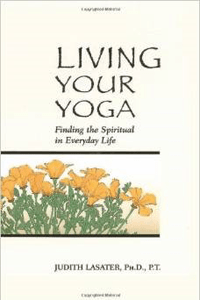
Living Your Yoga – Finding the Spiritual in Everyday Life by Judith Lasater (Berkley, CA: Rodmell Press, 2000)

For more information on Judith Lasater herself and quick background, look up her website: http://www.judithhansonlasater.com/

[The notes relate to the first edition. I recently got the second edition and will note any significant changes. Her introduction to the second edition talks about the additions.]

If you have the book already in hand, let’s get started with the introduction where Lasater talks about how she came to yoga, how she understands yoga, how she “lives her yoga” and how she designed the book.

Here are a few passages and associated questions that resonated wih me and I can’t wait to hear which phrases, passages or ideas resonated with you.

Thought 1

Lasater talks about her experience in coping with childbirth, her background as a dancer and her “desire for a direct and personal relationship with divine,” as factors that led her to seek out and continue to practice yoga.

She writes, ” What I now know is that I had been seeking wholeness through integration of my body, my mind and my spirit.”

For us,we can ask,

What do I seek?

What brings me to yoga?

What makes me stay?

Thought 2

Laster’s yoga practice, she explains, responds to her search for wholeness.

…to practice is to pay attention to your whole life: your thoughts, your bodily sensations, and your speech and other actions. As you do, you will discover that nothing is separate from anything else. Thoughts are sensations of the mind just as sensations are the thoughts of the body. Each moment of your life is a moment of potential practice.

Practice, then, can be understood as a willingness to return to the reality of the very moment, that is, to observe with dispassion and clarity exactly what is — right now.

What is happening right NOW in my life? Why am I hosting a book club? Writing these words? What do I hope for my thoughts, feelings and sensations?

How do I connect to my own wholeness?

How do I connect to this very moment?

How do I connect with you my fellow readers?

Thought 3

After Lasater describes the structure of the book she concludes the introduction with a quote from Dag Hammarskjold, secretary general to the United Nations (1953-61):

In our era, the road to holiness necessarily passes through the world of action.

She then asks us to “use this book in whatever ways best serve your needs. Living Your Yoga is my gift to you.”

What might be my road, my world of action?

How might I best use Lasater’s gift of  Living Your Yoga?

Here are my quick thoughts. What are yours? How might we bring these thoughts to our practice?

Let’s talk!

Let the book club begin!!

Anyone reading can join the conversation on this blog, just add your comments below. There is also a protected discussion platform. For a password and more information about the bookclub and April 1st workshop, go to:  https://communityyogalafayette.com/book-club/

Much love,

The Wobblyogi

My plan for offering notes to help us stay with the book is as follows:

January 13: Chapters 1-4
February 1: Chapters 5-7  (and additional chapter on relaxation)
February 15: Chapters 8-11
March 1: Chapters 12-14
March 15: Chapters 15-18 (and additional second edition chapter on empathy)
March 29: Chapters 19-21 (and additional second edition chapter on worship)
April 1: Book Club Workshop


Wobblyogi Wednesday – Burnt Cookies and a Joyful mind

If you feel burdened by the expectation to have a Happy Holiday or a Merry Christmas   Here is a story about keeping a joyful mind from Pema Chodron that might help (and it involves food).

Once a cook at Gampo camp was feeling very unhappy. Like most of us, she kept finding gloom with her actions and her thoughts; hour by hour her mood was getting darker. She decided to try to ventilate her escalating emotions by baking chocolate chip cookies. Her plan backfired, however — she burned them all to a crisp. At that point, rather than dump the burned cookies in the garbage, she stuffed them into her pockets and backpack and went out for a walk. She trudged along the dirt road, her head hanging down and her mind burning with resentment. She was saying to herself, “So where’s all the beauty and magic I keep hearing about?”

At that moment she looked up. There walking toward her was a little fox. Her mind stopped and she held her breath and watched. The fox sat down right in front of her, gazing up expectantly. She reached into her pockets and pulled out some cookies. The fox ate them and slowly trotted away. She told this story to all of us at the abbey, saying: “I learned today that life is very precious. Even when we’re determined to block the magic, it will get through and wake us up. That little fox taught me that no matter how shut down we get, we can always look outside our cocoon and connect with joy.”

When in doubt go for a walk………….

A quick reminder to join the Community Yoga Book Club! We’ll start reading “Living Your Yoga” by Judith Lasater on January 4th. Order your copy today. I found an inexpensive used version on Amazon.

Please join me for morning vinyasa on Wednesdays at 6 am and afternoon vinyasa at 12:15 pm on Tuesdays and Thursdays starting January 5th.

Also, find me at two workshops in spring,  March 25th (Spring Workshop) and April 1st (Book Club Workshop). More details to come.

If you are new to yoga and in the area: Community Yoga is offering $54 unlimited yoga for your first month [a $99 value]. Please take advantage of the deal and try out all our classes and meet our wonderful yoga instructors.

Come to our donation classes on Sundays and give what you can. We are trying our best to make yoga accessible to everyone!

Wishing you joyful connections,

wobblyogi