
Fishing for Joy: A Personalized Restaurant Rating System (PRE-9)

I remember very little about that childhood trip from Dhaka to Rajshahi, except for how a piece of turmeric stained white flaky fish glistening in the sunshine transformed atmospheric overwhelm into delicious comfort. Fresh caught Rui fish skillfully hacked into thick steaks, generously slathered in red-yellow speckled spices, dropped into pans of sputtering hot mustard oil before being unceremoniously delivered to the backseat window of our Toyota. At that moment, the bustle of a crowded ferry crossing over the Jamuna River receded as all my greedy attention converged onto a taste that carried my senses inward and allowed me to swallow the chaos like a goddess. Since then, every bite of seasoned fried fish opens an emotional escape hatch from the restless boredom of waiting under a blanket of thick humid heat vaporizing into rancid smells. Retrospectively, belatedly, by surprise I recognize myself in that memory. That savored piece of fish flavors all my bites by comparison. Only now, I see it as a memorable event of self-soothing joy. The remembered satisfaction of my 10-year-old self fortifies my tastebuds with the possibility of a deliciously defiant celebration of difficult circumstances. In therapeutic terms, my fried-fish memory is an empowering and embodied resource of joy.

A Yelp review of this intimate gastronomically induced “everything-everywhere-all-at- once” happy place is shockingly inadequate. At the same time, heavily reviewed establishments can also become equally hidden by the burden of spot-lit conceptual overexposure. In both cases, the charge of meaning falls on the restaurant alone: the chef, the staff, the servers, the space, the food. The depth of experience that I bring as an eater remains unaccounted in the reduction to seemingly objective stars guiding other eaters. As I am guided by others or guide others, “I” disappear. No doubt, crowdsourcing to identify a potentially pleasurable gastronomic experience in unfamiliar territory can be deeply satisfying. If over a 1000 people bestowed a restaurant with 4 stars, the collective choice conjures an aura of objective truth. The restaurant might be good, but can it host transformative joy for me?

When I want to know a restaurant I follow reviews, when I want to connect with others, I add my review. When I want an opportunity to understand myself, I am called to craft my own review. The truth of each restaurant experience is a matching game between my personal rating and the ratings offered by others. And so, unique experiences deserve subjective AND objective approaches that speak intimately and publicly, at the same time. My mouth is a crossroad where I meet myself in taste and meet others in words. Savoring my piece of fish, I welcome the outward noise from which it is caught, dressed, prepared, and served, and follow it inward through my senses and into its future incarnations and connections by comparison and expression. This delicious and deliberate internal journey becomes the “this reminds me of …..” connection with others. In this way, I bring my childhood experience on the riverbank to translate into fried fish with my fellow architecture students in the mountains of Mexico, fried fish at a roadside eatery with my parents between Mecca and Medina, or Mahi fish tacos at my local North Carolina taco stand with my family. The quality of one food experience reveals itself only in the context of all my food experiences. Each bite evokes all bites, like an omniscient tasting power practiced through wide deliberate eating. Savoring and swallowing a bite is the ultimate embodied act of integrating familial, cultural, historical, and political experiences. This may be why hunger strikes have been historically used to reject undigestible familial and social conditions.

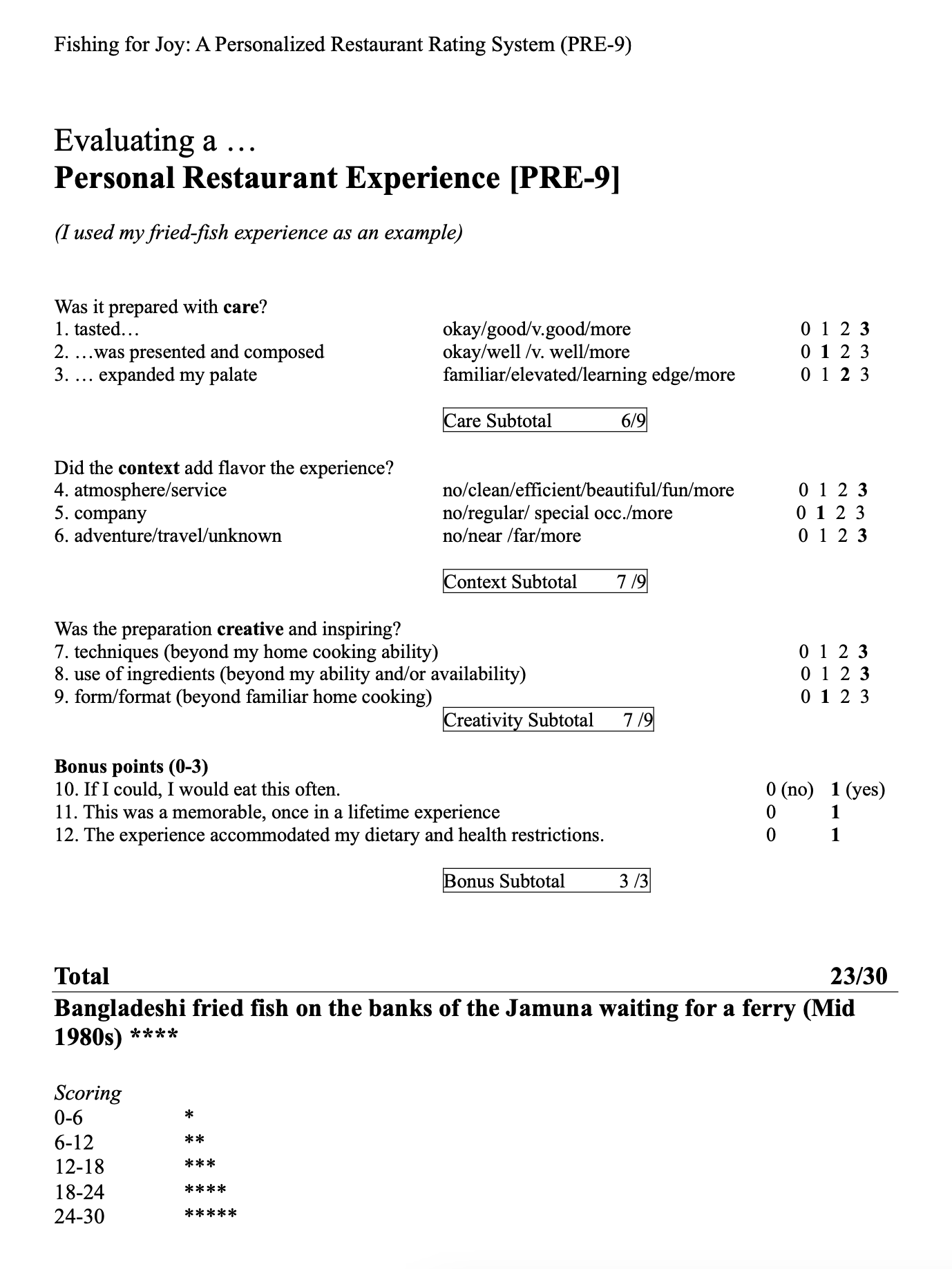
To discover and seek out more transformative fried-fish moments, I rely on my grief and anxiety counseling background. In my field of practice there are examples of measures that objectively rate subjective emotional experience, like satisfaction, depression, anxiety, self-worth etc. To fully appreciate the value of my childhood riverbank fried fish I borrowed the PHQ-9 format that measures depression. It seemed poetically justified to honor the format that identifies isolating depression to help identify connecting joy. The PHQ-9 measures sleep, energy, appetite, concentration, movement, pleasure as well as suicidal thoughts. Anhedonia, a symptom of depression is when what previously brought you joy no longer does so. Imagine having your favorite meal and feeling numb. I hope you don’t recognize this feeling, if you do, please stop reading and reach out. To identify the opposite state of anhedonia, the state of joy and pleasure fully experienced and expressed, a different scale would be needed. To measure my Personal Restaurant Experience (PRE-9) I identified my highest food values: care, context, creativity. Your criteria for gastronomic joy will be different. Other criteria can be leftover potential, zero waste, local, affordable, region specific, history specific, sustainable, strong aversions, strong preferences, dietary restrictions, etc. The scale gives me an instrument of mindful deliberation that can stretch the range of restaurant considerations from humble street food to Yelp-celebrated based on my own criteria for joy.

As an avid home cook, I value care taken to prepare a meal. Underdone, overcooked, under seasoned, over seasoned, poor ingredients or sloppy plating indicate a sad lack of care and pride in the preparation. My riverbank fried fish was prepared with skill evident in the efficiency of the whole process from carving to serving. As a design sensitive soul, I taste the context and environment just as much as the flavors. On the criteria of context my fish-fry was both a product of hustling context and a daringly delicious escape from it. Ideally, a restaurant meal would go beyond my own cooking abilities and knowledge, the skills and use of ingredients would inspire me, and the format would joyfully surprise me. The best meals challenge my assumptions about everything, surprise me, teach me, elevate me, and empower me to see the potential of humble things celebrated with careful joy. The bonus points of my rubric account for how the gastronomic experience serves joy in general. If the experience was memorable, repeatable, and invited me to follow the taste in my mouth and find the words to share that taste, it was worthy.

In retrospect, the piece of turmeric stained fried fish challenged me to accept the savory gift of nourishment within an unsavory crush of restless waiting. It had enticed me out of the protective shell of the car back seat and helped me experience feeling trapped as a sensational adventure instead. Transformative dishes open me to myself and my world, an ultimate act of embodied self-awareness that digests life itself. The PRE-9 expresses my deliberated search for joy through food and invites you to do the same. It prompts us to seek out universe-condensing bites of existence as antidotes to anhedonia particularly when life feels overwhelming.

Here are two no-recipe recipes: One for Bangladeshi Mach Bhaja (spice-fried fish) and one for a personalized evaluation of a restaurant experience.

Mach Bhaja [Fish Fry]

  1. Preferably a fatty big river fish but any fish works: tilapia, flounder, salmon, cod.
  2. Preferably steaks but filet is fine too. Scored skin on the filets offer extra flavor.
  3. Preferably fresh wet spices. A paste of turmeric powder, Kashmiri chili powder and salt works. Choose any spice combination and amount that settles your soul.
  4. Preferably mustard oil but olive oil or canola are fine too.
  5. Paint fish pieces with spices. Let the painted fish rest for up to an hour.
  6. Heat enough oil to cover the bottom of the pan until shimmering hot.
  7. Turn the vent on high. Without the benefit of an open sky and bustling market, the smells of hot mustard oil, spice, and fried fish can linger like guests past their welcome.
  8. Carefully place fish pieces in hot oil. Do not overcrowd the pan. If you do, you won’t get the roasted spice sear, fish will boil instead. Because of the water and spices, the fish will angrily splatter. Use a splatter screen or risk oil scars. Just assume there will be clean up afterwards.
  9. Lower heat to medium, let fish hard sear on one side. Flip and sear other side. In Bangladesh, fish tends to be cooked almost like meat. You are welcome to gently lift and place the fish onto paper towels to soak up the excess oil or serve with the clinging spiced oil. In Bangladesh, the spiced oil is a welcome sauce to coat and flavor the accompanying rice. To the Western palate accustomed to soft, poached, flaky salt- water fish, the hard fried fish may feel overcooked and oily.
  10. Eat immediately with steaming hot white rice, green chilies, and lime wedges.
Sleeping Kittens, Dog Dreams, and A Recipe for Happiness

I’ve been watching kittens on social media, out of professional interest. At least that’s my story. Soft fluffy adorable kittens comfortably sleeping, and then lured with snacks into happy wakefulness. What an addictive spectacle of joy! The transformation from sleep to aliveness is like a celebration of rebirth and might explain the recent social media trend of kittens waking up by sniffing food which has nearly 39 million views on TikTok. I am particularly interested in this social media recipe for engineered joy because I’ve seen a version of it before in my design history research.

The 1950 Fall issue of the Cosmopolitan Magazine included an interview with industrial designer Raymond Loewy, famous for designing modern kitchen appliances, including the widely popular 1934 Sears Coldspot Super Six Refrigerator.  The magazine interview included 4 recipes from the designer’s kitchen. While the first three recipes, predictable in the designer’s aggressive self-promotion, offer recipes that require a refrigerator, the last provides a whimsical window into the designer’s personality.  I see the cook-engineer of gastronomic satisfaction, Loewy himself, as the connection between the first three recipes and the last recipe. Raymond Loewy’s Recipe Book guides us to design our own happiness in the form of cool modern desserts – and buy one of his designed products while we do so.

Here’s why watching kittens wake up to snacks, for me, a life adjustment consultant, is of professional interest. Fellow pet video connoisseurs will find a very familiar description in the fourth recipe, “a demonstration of complete happiness”…

“Another simple recipe for anyone interested in a demonstration of complete happiness in this world of ours. I use it quite often and find it refreshing:

Take a good-size live dog, fast asleep, preferably an Irish setter. Place gently, as close to its nostrils as possible, a large chunk of liverwurst. Sit back and watch.

Stage One: At each intake of breath the scent of the sausage slowly permeates the unconscious brain of the subject until it reaches the boundaries of semi-consciousness. Then the nostrils begin to quiver slightly.

Stage Two: Lashes begin to flutter, saliva oozes out, and breathing evolves into sniffing.

Stage Three: Subject suddenly realizes the reality of the dream and in a violent convulsion lunges at the morsel and swallows in one gulp.

Stage Four: The final stage is the most interesting one for the expert to watch as it greatly varies according to individual dogs. Setters ordinarily express their utter bewilderment by sitting up and staring bleakly – unable to decide what to do next. They remain there, unconvinced that such ecstasies exist outside the world of dreams.”

There is something worth reverse engineering about this personalized recipe for joy. Five ingredients stand out:

  1. A relaxed state: The first ingredient of Loewy’s recipe involves a pet enjoying a safe, sleepy, restful state of ease. By choosing his sleepy dog to demonstrate an expression of happiness, he is defining happiness as an unintentional surprise. What interrupts a boring sequence of expected events and wakes you up to unexpected joy? Sensory pleasure. From a therapeutic standpoint feeling safe and relaxed, a non-traumatic state is essential in inviting an experience of happy surprise.
  2. Attention to sensation: Stages one and two of Loewy’s recipe, prompted by placing a sausage in front of the dog’s nostrils show the importance of sensory information in feeling happy. Loewy describes senses awakening by desire, much like simplified “self-care” routines of incense, face masks, massages, tea, and pillows that soothe the body into a relaxed state.  Safety is maintained through the surprise. The dog does not wake up irritable,  jarred and fearful.
  3. Action out of sensation: Stage three of the dog’s sudden leap into action prompted by the dreamy promise of liverwurst marks the direct transition from the unconscious to action without rational mediation. The dog “realizes the reality of the dream.” For Loewy’s pet Irish Setter, pleasurable fulfillment is not dependent on a rationally guided concept of liverwurst. The dog in a “violent compulsion” simply lunges to fulfill his dream. The dog does not overthink. When something surprisingly good happens, do you find yourself questioning and editing your happiness? If so, we might need to talk.
  4. Understanding: Belatedly, stage four represents the search for understanding. Confusion appears as the dog efforts to validate the unplanned joyful experience. The dog’s doubt and confusion after being satisfied show happiness to be recognized after the fact of sensory fulfillment. Was that tasty happiness real? – The dog’s bewildered pause seems to be asking. Perhaps Loewy points to a taste of loss between belated pleasure and unaware pleasure, a feeling that happiness can only be constructed in hindsight, unintentionally. Here again, the dog does not overthink or get stuck in the quick arrival and loss of tasty satisfaction. It is done. It was good. A full experience untainted by conceptual expectations.
  5. Witness: The most essential ingredient in Raymond’s recipe for happiness is himself, the chef-engineer of this scenario. He plays both the facilitator and the witness to joy. In watching the kitten videos, maybe we also vicariously and empathetically experience a moment of satisfaction, maybe it gives us permission to seek the same by design, maybe it reminds us that we can engineer acts of joy for others. Unlike pets, we can cook up our own recipe for happiness to be shared.  

In therapeutic terms, the first three stages of relaxation, attention, and action represented by Loewy’s Irish Setter show us the role of the body in the construction of happiness. The dog’s confusion and belated awareness of happiness describe the mind’s effort to validate and understand pleasure. The hidden ingredient, Raymond Loewy himself, represents the heart that witnesses and supports the evolving experience of unconscious pleasure and conscious reflection. The recipe’s last line serves the dish with a warning. Many of us, like the Irish setter, “remain there, unconvinced that such ecstasies exist outside the world of dreams.” We become frozen in a haze of joy experienced in the past as a dream. Loewy’s list of ingredients reminds us that whipping up happiness is not to be found out “there.”  It is at the tip of our nostrils waiting to be swallowed. We might imagine the sad confusion of the Irish setter in his swallowing without savoring, his dreamy consumption without mindful awareness.

            Try Loewy’s recipe, and cook up some happiness for yourself with the ingredients of safety, sensation, surprise, and company. As a part of the sensory-focused step two of the recipe for happiness, try one of his first three recipes:

Champagne and Peaches

“Place a nice juicy peach, previously peeled, at the bottom of a tall glass. Half fill with cracked ice, and add a jigger of Grand Marnier. Crush the peach slightly, and fill the glass with iced champagne. Drink while very cold.”

Coffee Caramel Sauce

“Take a pound of granulated sugar, ¼ lb. of butter, 2 pints of heavy cream. Place in copper pan, blend well, and let cook until it reaches the consistency of fudge. Add a tablespoonful of real vanilla extract and half cup of very strong coffee. Let simmer a while. In order to test the consistency, pour a drop on a buttered plate and feel with your fingers. It should be quite firm, but not hard – like chewy caramels. Sauce should be served rather hot over good vanilla or coffee ice cream.”

Sherbet

“Prepare a mixture of 1/3 apricot nectar, 1/3 tangerine juice, and 1/3 pineapple juice. Add plenty of good champagne, a dash of fresh lime juice and freeze in an ice-cream freezer. It is delicious.”

A watched pot (turtle nest) boils in Oak Island

A volunteer waved us left as we approached the tiny runway shaped to help guide baby turtles towards the sea. During our evening walks we noticed these small runways lined with green edges, centers brushed smooth carefully made ready for turtle nests incubating in the warm July sand past 50 days.  

“They’re coming. Please walk over and behind.” The excitement of new life. A small group of people composed of “nest mothers”, volunteers, and the vacationing and local curious was hovering over the patch of sand with a square grate the size of a doormat. The patch had a small crack where the sand caved in the size of my hand. This was an indication of restlessness, cracking, and movement below. The crowd of children, adults and more volunteers grew on either side of the runway as the sun began to set. We all waited. And waited. So did the turtles. They were waiting for the sand to cool as a sign of the waning sun that would make it easier to hide from predators. As the sun dipped, they rose and boiled like small dark shadows rising out of the growing hole in the ground.

Am I seeing this? The instinct is to shed light on this miracle. But light is exactly what they are avoiding. Light disorients budding life. They turn away and go in the wrong direction. “They have been listening to the ocean this whole time, they know to move towards the sound,” a volunteer explained while encouraging us to use our “inside voices” so the turtles can hear the ocean calling them. Or is it the magnetic pull? The ocean is like the mother’s heartbeat for a human baby emerging out of a uterine water sac. The baby moves towards the light, and a turtle also moves towards the moonlight on the water. Lights on the beach confuse them, they move in the wrong direction away from the water and into the grips of a predator. The beauty of turtles rising together. This I’ve learned affords survival of the species, many are sacrificed to predators so a few can live and serve a larger commitment to life. We humans have so much to learn from these tiny dark, squiggly, directed shadows. We can stand by, watch, guide, and mostly care enough to stay out of their way and keep other humans from staying out of their way…waving them to go around or stop shining light on the fragile eyes looking for the ocean. It is a practice of humble awe. A gentle suggestion that perhaps we are not the center of all life.

Sea turtles are a protected species. The Oak Island Turtle Protection Program is on a mission to monitor and protect the sea turtles and to foster community-based conservation…basically to wave us away from trampling the turtles and to welcome us to come close without shining light and with hushed reverence. In the three weeks of living here sitting on the sand alongside the turtle runway was the first and most satisfying sense of community I have experienced. No power, monetization, or exclusivity. The simplicity of a random community of curious humans channeling and watching small shadows scurry to glistening dark waves. It was magnificent.

The turtles are protected from industrial pollution and natural predators. We are among that list of natural predators. In my efforts to learn about the region I now call home, I researched a few cookbooks available at the local library. One of the cookbooks entitled “The Beachcomber’s Handbook of Seafood Cookery” by Hugh Zachary (1969) shares a Sea Turtle Stew recipe. The author prefaces the recipe with a story about gathering eggs from the beach, a culture of turtle hunting, followed by a plea.  He writes,

“I saw a couple of huge loggerheads that had been killed, wantonly killed, on Long Beach, not for their meat, but just for the fun of killing something so large, apparently. I like turtles. I like turtles better than I like some people – namely people who would kill a big loggerhead just for the experience. Loggerhead turtles are a vanishing breed. It’s fun to go turtle hunting during a full moon in a warm month on a nice night. It’s an interesting experience to find a big turtle on her nest and watch her lay eggs and cover them with her awkward, instinctive, and utterly laborious movements. My sympathy goes out to the big beast who comes out of her natural element to try to fight the odds against the survival of her species.

Let’s don’t eat loggerheads.”

Zachary, Hugh. (1969) The Beachcomber’s Handbook of Seafood Cookery. Kingsport Press: Tennessee.

On the margins of this recipe page, the library added a note about the law protecting sea turtles.

from the Beachcomber’s Handbook of Seafood Cookery (1969)

We humans can be both predators and conservators, vicious and curious. Sitting there watching the baby turtles a representation of life itself flapping, flailing, scurrying, blind and confused, I was reminded of the choice. As food curious as I am, I am okay letting turtle meat remain a mystery. I don’t know what my line is for eating other living beings, is it endangered animals? Or like Mr. Rogers who avoided anything that had a mother? Eat flesh out of necessity or politeness? Practice a generally plant-based diet? I don’t have my own answer, let alone have one for you. All I can say is that I hope to be aware of and own my choices today. Tomorrow may be different. Last evening it felt good to be among a community of humans who chose to stand together and aside watching life emerge out of a dark small crack in the earth.

Thank you baby turtles. I hope you live a long life and return to this beach as a place of safety and care. We’ll wait for you.

For lunch today, cereal with frozen blueberries sounds refreshing.

Wishing you thoughtful eating,

hungryphil

Food Poem – Recipe for a Salad by Sydney Smith

To make this condiment, your poet begs
The pounded yellow of two hard-boiled eggs;
Two boiled potatoes, passed through kitchen-sieve,
Smoothness and softness to the salad give;
Let onion atoms lurk within the bowl,
And, half-suspected, animate the whole.
Of mordant mustard add a single spoon,
Distrust the condiment that bites so soon;
But deem it not, thou man of herbs, a fault,
To add a double quantity of salt.
And, lastly, o'er the flavored compound toss
A magic soup-spoon of anchovy sauce.
Oh, green and glorious! Oh, herbaceous treat!
'T would tempt the dying anchorite to eat;
Back to the world he'd turn his fleeting soul,
And plunge his fingers in the salad bowl!
Serenely full, the epicure would say,
Fate can not harm me, I have dined to-day!

“Recipe for a Salad” by Sydney Smith. from the Writer’s Almanac 2/3/2022

I love the part about the onion, lurking in the bottom, animating the whole 🙂

May you be serenely full,

Hungryphil

Food Poem – Everybody Made Soups by Lisa Coffman

After it all, the events of the holidays,
the dinner tables passing like great ships,
everybody made soups for a while.
Cooked and cooked until the broth kept
the story of the onion, the weeping meat.
It was over, the year was spent, the new one
had yet to make its demands on us,
each day lay in the dark like a folded letter.
Then out of it all we made one final thing
out of the bounty that had not always filled us,
out of the ruined cathedral carcass of the turkey,
the limp celery chopped back into plenty,
the fish head, the spine. Out of the rejected,
the passed over, never the object of love.
It was as if all the pageantry had been for this:
the quiet after, the simmered light,
the soothing shapes our mouths made as we tasted.

Lisa Coffman, “Everybody Made Soups” from Less Obvious Gods. From Writer’s Almanac 2/2/2022

Wishing you warm “quiet afters” on this snowy day in the Midwest,

Hungryphil

Food Poem – In the Produce Aisle by Kirsten Dierking

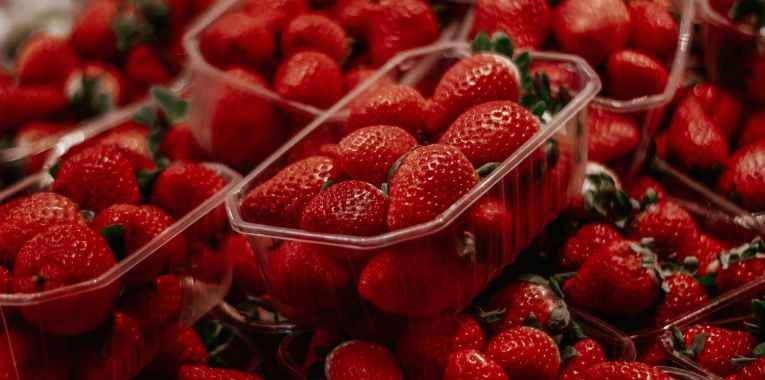
In the vivid red
of the fresh berries,
in the pebbled skin
of an emerald lime,
in the bright colors
of things made
to be transitory,
you see the same
loveliness
you find in your own
delicate flesh,
the lines fanned
around your eyes
charming like
the burnish
of plums,
your life like
all the other
fragile organics,
your soft hand
hovering over
the succulent apple,
you reach for it,
already transforming.

Kirsten Dierking, “In the Produce Aisle”  from Northern Oracle. © 2007 Kirsten Dierking published by Spout Press. From 1/5/2022 The Writer’s Almanac

Food Poem: Living in the Body by Joyce Sutphen

Body is something you need in order to stay
on this planet and you only get one.
And no matter which one you get, it will not
be satisfactory. It will not be beautiful
enough, it will not be fast enough, it will
not keep on for days at a time, but will
pull you down into a sleepy swamp and
demand apples and coffee and chocolate cake.

Body is a thing you have to carry
from one day into the next. Always the
same eyebrows over the same eyes in the same
skin when you look in the mirror, and the
same creaky knee when you get up from the
floor and the same wrist under the watchband.
The changes you can make are small and
costly—better to leave it as it is.

Body is a thing that you have to leave
eventually. You know that because you have
seen others do it, others who were once like you,
living inside their pile of bones and
flesh, smiling at you, loving you,
leaning in the doorway, talking to you
for hours and then one day they
are gone. No forwarding address.

Joyce Sutphen, “Living in the Body” from Coming Back to the Body from the Writer’s Almanac, 9/20/21

I eat a slice of chocolate cake every year to celebrate a loss I’ve had. This poem reminds me of living and of celebrating despite and because of loss. Some years I bake a cake to freeze slices to enjoy throughout the year. A way to keep both the sadness and the gratitude in my body.

The body is everything. Let’s promise to be in ours today.

With warmth,

Hungryphil

P.S. Next time I bake a cake for the occasion, I’ll have to take a picture to share. For now, I rely on stock photos online.

Food Poem: Breakfast by Joyce Sutphen

My father taught me how to eat breakfast
those mornings when it was my turn to help
him milk the cows. I loved rising up from

the darkness and coming quietly down
the stairs while the others were still sleeping.
I’d take a bowl from the cupboard, a spoon

from the drawer, and slip into the pantry
where he was already eating spoonfuls
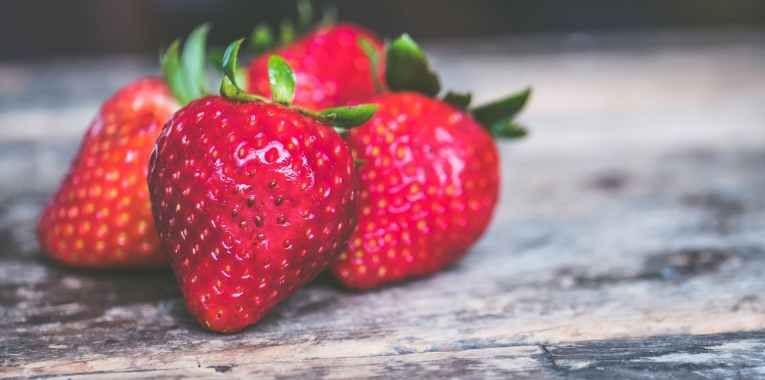
of cornflakes covered with mashed strawberries

from our own strawberry fields forever.
Didn’t talk much—except to mention how
good the strawberries tasted or the way

those clouds hung over the hay barn roof.
Simple—that’s how we started up the day.


Joyce Sutphen, “Breakfast” from First Words, Red Dragonfly. from the Writer’s Almanac, Monday 9/13/21

A simple start to the day with a loved one is so comforting. What is your favorite morning ritual?

First World Food Warning: Taco trucks at every corner

Usually, I post benign, seemingly non-political musings about food as social glue. I know this is old news but I’m fascinated by a perceived immigrant threat represented through food. In this case, the threat that increased latin immigration in the U.S will result in food trucks at every street corner turned into a joke, as most enjoy tacos regardless of political views on immigration.

The threat that increased latin immigration in the U.S will result in food trucks at every street corner was projected as, cultural and culinary. That’s funny in a deeply meaningful kind of way, right?

Think of it, french fries, hot dogs, pretzels, spaghetti, pizza, all are cultural “impositions” in the U.S. I’m not even going to address European imposition on Native American culture. I don’t know how because the imposition was so overwhelming and complete.

The problem with this argument is that in most cases no one is “forcing” another to eat a certain type of food. I may want to impose samosas on an unsuspecting American culture. But how would I? Sell samosas everywhere, perhaps every street corner? But here is my problem. Selling. People would have to buy and want samosas at every street corner for it to work. [Unless people are starving and samosas are the only option. This is why the scarcity of water is so scary. There is no choice, we need water to survive.]

Historically the imposition works the other way to “Americanize” immigrant foods. For example historian, Jane Ziegelman writes of Italian immigrants in 97 Orchard: An edible history of five immigrant families in one New York Tenement,

In the hostile environment first encountered by Italians, food took on new meanings and new powers. The many forms of discrimination leveled at Italians encouraged immigrants  to seal themselves off, culturally speaking, from the rest of America.[…….] Harsh critics of Italian eating habits, Americans tried through various means to reform the immigrant cook. The Italians were unmoved. Despite the cooking classes and public school lectures, and despite the persistent advice of visiting nurses and settlement workers, the immigrants’ belief in the superiority of their native foods was unwavering.

Don’t we all think that our food tradition is better? Regardless, compulsion in cuisine, whether by immigrants or natives, seems difficult. There has been historically failed efforts to force new foods or limit certain food types (like the Futurist effort to ban pasta in Italy or the parent struggle to make kids eat vegetables) Still, in democratic, capitalist America, the taco truck warning does seem laughable and serious at the same time.

The fact that Marco Gutierrez, founder of the group Latinos for Trump, a Latino! issues the threat is extra confusing.

“My culture is a very dominant culture, and it’s imposing and it’s causing problems. If you don’t do something about it, you’re going to have taco trucks on every corner.”

Should I be worried about imposing my Bengaliness on my unsuspecting American, ethnically European friends and family? I, the hungryphilosoper, am so confused. This first world food problem certainly requires more consideration.

For now, here was one response to the “food fight”: Guac the vote.

https://munchies.vice.com/en/articles/latinos-are-co-opting-the-taco-trucks-on-every-corner-threat-to-guac-the-vote

Thank you, dear Latin people for your contribution to my personal taste buds…I and my South Asian peeps very much appreciate the chili peppers.

Off to find a taco and wish there was a truck on the corner,

Hungryphil


Navigating Brooklyn’s Food Mecca as a Broke, Millennial Foodie – Guest Post

Immediately after accepting an internship offer in Manhattan last April, I started to fantasize about how fabulous my summer would be. The first thing on my mind was not the crazy nightlife, the many free summer concerts, or the various world-renowned art museums – it was Smorgasburg, an outdoor ‘flea’ market that hosts dozens of vendors selling the trendiest and most Instagram-worthy food.

Since getting to NYC, I’ve been to Smorgasburg twice, giving me ample opportunity to sample the spread that this market has to offer, convincing my companions to split dishes with me to maximize the diversity of dishes we could try. Mostly serving as a guide for when HungryPhil visits me in a few weeks, here’s a rundown of my Smorgasburg highlights:

Grilled Summer Corn from Bisska

blog-1 blog2Seemingly simple, this corn was definitely one of my most favorite things I’ve had since getting to city. Cooked to order on a charcoal grill in front of you, this charred corn is topped with a mayo and paprika based sauce and served in a paper boat. The sweetness of the corn, the smokiness of the paprika complimented by the charcoal, and the creamy mayo tying it all together made this an unforgettable summery eat.

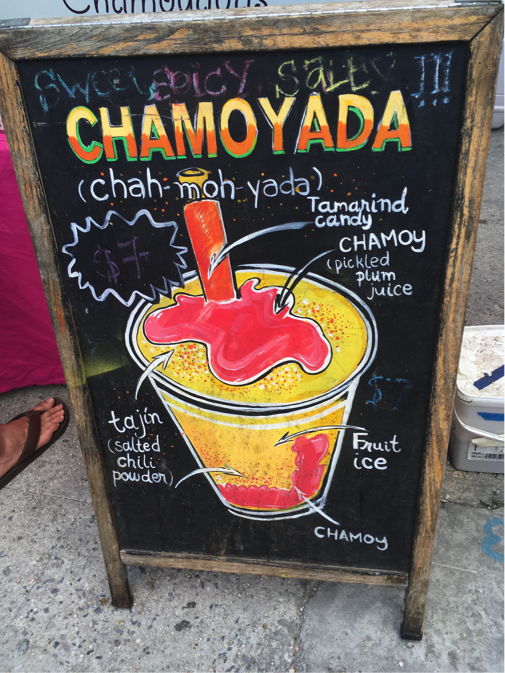
Chamoyada from La Newyorkina

blog3 blog4

This beverage had a lot going on, and I was incredibly intrigued with how this sweet/spicy/salty combination would turn out. Somehow, it all blended together perfectly, and served as a refreshing, cold respite from the 90 degree weather. So many of these flavors were familiar to me individually in a South Asian context, but this Mexican slush combined these to create a whole new, unique experience. 

Shaved Ice from People’s Pops

blog5

Although my first thought, when seeing them chisel ice on-the-spot, was that they were trying too hard, this hand-shaved ice definitely added a layer of complexity to a usually mundane summer treat. Each flake was shaped differently, and melted differently on your tongue, allowing the Arnold Palmer flavoring to absorb at different rates. It served as a good, refreshing palate cleanser.

Mozzarella Sticks from Big Mozz

blog7

Again, another seemingly mundane food has a ‘foodie’ makeover, and comes out beautifully. Lactose-intolerance be damned. These mozzarella sticks had nothing fancy going on, just quality, hand-pulled mozzarella deep-fried to order with some fresh marinara sauce on the side. Simplicity won in this round.

The Ramen Burger

blog8

This was my second foray into the famous Ramen Burger territory. The burger consists of a small beef patty, sandwiched in between two disks of compressed, spongy ramen, and covered with a soy-sauce based dressing, arugula, and scallions.

As with many things that are hyped up, the burger (on both occasions) failed to live up to my expectations. There’s no denying that it was delicious, with the bun melting in your mouth as you bit into it. It was, however, very one-noted – there didn’t seem to be the complexity of flavors that I usually expect in a burger, something to balance the super-savory meatiness of the patty. Something like a spicy kimchi slaw would really elevate this burger – perhaps I just need to make my own DIY version at home.

Spicy Mayo Salmon Poke from East Coast Poke

blog9

This quite possibly was my favorite dish out of everything I’ve tried at Smorgasburg. Kind of like deconstructed sushi, poke is a traditional Hawaiian dish. This version was served on a bed of seaweed salad and soft, sticky sushi rice. A creamy Sriracha mayo pulled everything together. Although semi-skeptical of eating raw fish that was being served outside in the summer weather, I really enjoyed how simultaneously refreshing and substantial the poke was.

Hopefully with throughout the rest of the summer, I’ll be able to expand this list, but for now, I think I’ve done some decent damage to exploring the 75+ vendors at Smorgasburg.