Food Poem- The Poet’s Occasional Alternative by Grace Paley

As a hungryphilosopher I relate to this poem deeply. Creative work of any kind is both so difficult and so enjoyable. Sometimes I just want to be received. For me, cooking has been that easy creative connection with others. This poem by Grace Paley describes the urgent need for “responsive eatership” deliciously. Enjoy!

I was going to write a poem
I made a pie instead      it took
about the same amount of time
of course the pie was a final
draft      a poem would have had some
distance to go      days and weeks and
much crumpled paper

the pie already had a talking
tumbling audience among small
trucks and a fire engine on
the kitchen floor

everybody will like this pie
it will have apples and cranberries
dried apricots in it      many friends
will say      why in the world did you
make only one

this does not happen with poems

because of unreportable
sadnesses I decided to
settle this morning for a re-
sponsive eatership      I do not
want to wait a week      a year      a
generation for the right
consumer to come along

“The Poet’s Occasional Alternative” by Grace Paley from Begin Again. © Farrar, Straus & Giroux, 2000.

From the Writers Almanac http://writersalmanac.org/

Food Poem- Autumn Song by Daniel Mark Epstein

Little flower, you live in constant danger:
Likely to be crushed under foot or torn by wind,
Sun-scorched or gobbled by a goat.

These October days streaked with regrets and tears
Are like you, brindled flower, as they bloom
And fade, harried by heat as much as by the cold.

Our ship sets out to sea, not with ivory or gold
In the hold, but with fragrant apples for cargo. Just so
My days are not heavy but delicate, fleeting and vain,

Leaving behind the sweet, faint scent of renown
That quickly will vanish like the taste of fruit
Passing from the tongues and hearts of everyone.


from Writer’s Almanac http://writersalmanac.org/page/6/

Food Poem – Ice Cream Stop by Shel Silverstein

The circus train made an ice cream stop
At the fifty-two-flavor ice cream stand.
The animals all got off the train
And walked right up to the ice cream man.
“I’ll take Vanilla,” yelled the gorilla.
“I’ll take Chocolate,” shouted the ocelot.
“I’ll take the Strawberry,” chirped the canary.
“Rocky Road,” croaked the toad.
“Lemon and Lime,” growled the lion.
Said the ice cream man, “‘Til I see a dime.
You’ll get no ice cream of mine.”
Then the animals snarled and screeched and growled
And whinnied and whimpered and hooted and howled
And gobbled up the whole ice cream stand,
All fifty-two flavors
(Fifty-three with Ice Cream Man).

“Ice Cream Stop” by Shel Silverstein from Falling Up. © Harper Collins Publishers, 1996.

From the Writers Almanac:  http://writersalmanac.org/

Image from: http://www.pbs.org/food/the-history-kitchen/explore-the-delicious-history-of-ice-cream/

Food Poem – My Mother Was a Brilliant Cook by Maria Mazzioti Gillan

You know I had to post this! It connects the craft of cooking with contentment. May we all find a craft that helps us be so at home.

The first time my mother went out
to eat was on her 25th wedding anniversary
at Scordato’s in Paterson, and the second time
was for her 50th anniversary
at the Iron Kettle House in Wyckoff.

My mother said, “I could have cooked
this meal better myself.”
But I knew she was happy,
though she would have never admitted it.

Once my mother came to Paterson
from Italy in steerage,
she was content to stay there.
She was a brilliant cook,
and didn’t need to go to restaurants.
She loved her house, poor as it was,
and never stayed in a motel or took a vacation
or wanted to.

She was content to offer platter after platter
of food to her family gathered
in her basement kitchen, and to watch them
laughing and talking together,
while she stood behind them
and smiled.

“My Mother Was a Brilliant Cook” by Maria Mazziotti Gillian from What Blooms in Winter. © NYQ Books, 2016.

From the Writer’s Almanac

Food Poem – Canning by Joyce Sutphen

The last string of words, “packing a glass suitcase for the winter,” make me smile. Enjoy.

It’s what she does and what her mother did.
It’s what I’d do if I were anything
like her mother’s mother—or if the times
demanded that I work in my garden,
planting rows of beans and carrots, weeding
the pickles and potatoes, picking worms
off the cabbages.
Today she’s canning
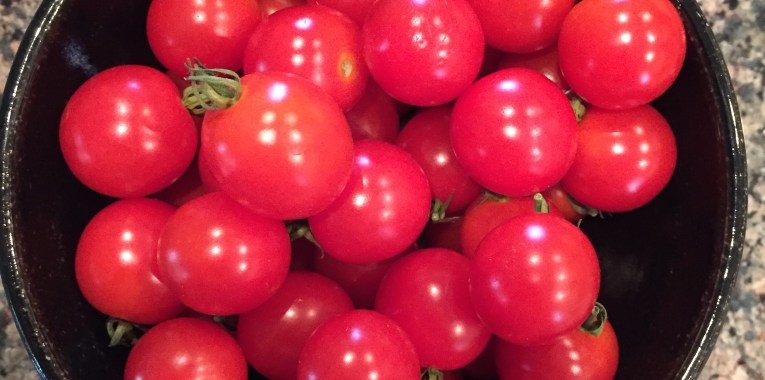
tomatoes, which means there are baskets
of red Jubilees waiting on the porch
and she’s been in the cellar looking for jars.
There’s a box of lids and a heap of gold
rings on the counter. She gets the spices
out; she revs the engine of the old stove.

Now I declare her Master of Preserves!
I say that if there were degrees in canning
she would be summa cum laude—God knows
she’s spent as many hours at the sink peeling
the skins off hot tomatoes as I have
bent over a difficult text. I see
her at the window, filling up the jar,
packing a glass suitcase for the winter.

“Canning” by Joyce Sutphen from First Words. © Red Dragonfly Press, 2010.

From the Writer’s Almanac

Food Poem – Cucumber Fields Crossed by High Tension Wires by Thomas Lux

This week I enjoyed cucumber sandwiches and tea with my friends on the screened in porch. It was an uncharacteristically civilized evening. I used thin Pepperidge Farm white bread, mandolin thin sliced and peeled fresh garden cucumbers, Kerrygold yellow butter, salt and white pepper. That is it. Super simple. Here is a food poem that makes me think of that not so long ago relaxing and fun evening. May we all enjoy the season of delicate cucumber and juicy red tomato sandwiches.

The high-tension spires spike the sky
beneath which boys bend
to pick from prickly vines
the deep-sopped fruit, the rind’s green
a green sunk
in green. They part the plants’ leaves,
reach into the nest,
and pull out mother, father, fat Uncle Phil.
The smaller yellow-green children stay,
for now. The fruit goes
in baskets by the side of the row,
every thirty feet or so. By these bushels
the boys get paid, in cash,
at day’s end, this summer
of the last days of the empire
that will become known as
the past, adios, then,
the ragged-edged beautiful blink.

from the Writer’s Almanac

Food Poem – Ode to the Pull-Out Couch by Sonja Johnson

Eating supper instead of dinner, sleeping on a couch instead of a guest room. Check out how food and furniture convey messages of class difference in this poem.

Which once belonged to your great-
grandparents, but belongs to us now,
and still works, even if the cushions
are pretty well flattened and the stuffing
is coming out from one armrest,
and the color, which was probably
once cream with red stitching, has
become mostly a muddy rust —

and which is always called a couch
and never, ever a sofa, just as
a pocketbook is not a purse, a bureau
is not a dresser, and pants are not
slacks. Only snooty people on TV
would call a couch a sofa, or rich
people, or maybe people from away.
Which we are not.

Because if we were any of those,
instead of just a pull-out couch,
we would have a guest room, with
a comforter and duvet, which no
guests would ever sleep under
because they would be staying at
a five-star hotel, where we would
join them for a five-star dinner

instead of the supper we cook
for our cousins up from Alfred,
which makes them still from here
and not from away, so they can’t
afford to go out to dinner, much
less afford a fancy hotel room
even if there was a hotel in town.
Which there is not.

And after our supper and before
we wake up early to take them
ice fishing, we pull out the couch
and give them pillows and blankets
and maybe even the granny-square
afghan, and they get to sleep by
the woodstove with the extra cats
and know that they are welcome.

From the Writer’s Almanac

Food Poem – Ripe Cherries by Athena Kildegaard

I read that the men,
on their way to Gettysburg,
stopped along the road
to pick and eat ripe cherries.

That the fruit should not
go to waste.

That they should take
such pleasure before battle.

That the oldest among them
should shake the trees
and the youngest gather
the fallen fruit.
That they should aim rifles
with the taste of cherries
against their teeth.

“Ripe Cherries” by Athena Kildegaard from Bodies of Light. © Red Dragonfly Press, 2011.

from: http://writersalmanac.org/page/3/

Food Poem- There will be things you do by Kim Dower

you won’t know why.
Maybe waiting to tie
your shoelaces

until everything else
is in place.
Could be you’ll slide

your egg yolks aside
eat every bit of bacon,
toast, whites while the forsaken

yellow orbs stare at you
from the side pocket
of your empty plate.

People will ask
why do you save
your yolks for last

and you won’t know—
won’t recall
the cousin from the south

came to visit one summer
ate his eggs so odd
your family said

stuck with you
like the way
you love to be kissed

on the back of your neck
can vaguely recollect
your mother’s kisses

after your bath
too gentle for memory.
There will be things you do

you won’t know why
like the way you look
up at the sky

when anxious or blue
it’s what your father
used to do

every family trip
when nothing else
was right

except those clouds
moving north by northwest
through the night

he showed you
what pilots knew:
factors for safe flying

are visibility
and how low
and mean the clouds are.

“There Will Be Things You Do” by Kim Dower from Last Train to the Missing Planet. © Red Hen Press, 2016.

From the Writer’s Almanac: http://writersalmanac.org/page/5/

Food Poem – Lobsters by Howard Nemerov

Here at the Super Duper, in a glass tank
Supplied by a rill of cold fresh water
Running down a glass washboard at one end
And siphoned off at the other, and so
Perpetually renewed, a herd of lobster
Is made available to the customer
Who may choose whichever one he wants
to carry home and drop into boiling water
And serve with a sauce of melted butter.

Meanwhile, the beauty of strangeness marks
These creatures, who move (when they do)
With a slow, vague wavering of claws,
The somnambulist’s effortless clambering
As he crawls over the shell of a dream
Resembling himself. Their velvet colors,
Mud red, bruise purple, cadaver green
Speckled with black, their camouflage at home,
Make them conspicuous here in the strong
Day-imitating light, the incommensurable
Philosophers and at the same time victims
Herded together in the marketplace, asleep
Except for certain tentative gestures
Of their antennae, or their imperial claws
Pegged shut with a whittled stick at the wrist.

We inlanders, buying our needful food,
Pause over these slow, gigantic spiders
That spin not. We pause and are bemused,
And sometimes it happens that a mind sinks down
to the blind abyss in a swirl of sand, goes cold
And archaic in a carapace of horn,
Thinking: There’s something underneath the world.

The flame beneath the pot that boils the water.

From http://writersalmanac.org/