
Yoga for Grief 4 (Off the Mat) – Insomnia

Haven’t we all suffered nights of restless sleep? I still do sometimes, but now without the added anxiety and self-judgment. I don’t feel like a victim of my restless thoughts, emotions, and imagination.

Knowing a few relaxation techniques gives us tools to try while lying in bed, eyes wide open, instead of stirring up anxiety with questions like, “Why am I awake? What is wrong with me? If I don’t sleep I’ll be tired tomorrow, ……I can proactively relax. Hmmm, sounds like a contradiction.

You have to find what works for your specific form of insomnia. Try everything. What have you got to lose, except for feeling like a helpless victim of your exhausted and spinning spirit?

Here is what we practiced this week at the hospice sponsored Yoga for Grief session. Join us.

“Yoga nidra is a form of meditative self-inquiry that, while relaxing the body, opens the mind to greater discernment and self-awareness, and the heart to love and acceptance of what is. It is a powerful tool for clearing away our limiting beliefs and emotions and for living from a more balanced state of mind.”

Weintraub, Amy. Yoga Skills for Therapists: Effective Practices for Mood Management (Norton Professional Books (Hardcover)) (p. 160). W. W. Norton & Company. Kindle Edition.

Today we’ll practice 7 techniques:

Technique 1: Body scan, Mindful Breathing and Crocodile breath from Yoga as Medicine, What keeps you from resting?

Technique 2: Chest Expansion Breathing from Yoga and Mindfulness Therapy

Technique 3: Turn off electronics, same bedtime, stretches before bed, nutrition, dark room, warm bath, prepare your body to rest.

Technique 4: 3 poses. If you find yourself awake, supported forward bend, or legs up the wall pose may help lull you back to sleep.

Supta Padangusthasana I Reclining Hand to Big Toe Pose Benefits and How It Works: By stretching the golgi tendon organs within the hamstrings’ tendons, these muscles are induced to relax. The pose brings a sense of floating to the legs and definitely signals “relax” to the entire central nervous system.

Fishman, Loren. Healing Yoga: Proven Postures to Treat Twenty Common Ailments—from Backache to Bone Loss, Shoulder Pain to Bunions, and More (p. 170). W. W. Norton & Company. Kindle Edition.

Technique 5: Lengthening exhale, Left Nostril Breathing, sleep on your right side allowing your left nostril to dominate from Yoga Skills for Therapists

Technique 6: Meditation “good-bye to the day, affirmations and calling back your energy

Technique 7: Yoga Nidra- Body part awareness. Or imagining body as a house, “turn off lights”

Technique 8: Sense awareness essential oils: Lavender, Chamomile, Geranium

Wishing all of you restful sleep and sweet dreams,

Hungryphil

Yoga for Grief 2 (Off the Mat)

This was week 2 of Yoga for Grief at the IU-Arnett Hospice in Lafayette, IN. Thank you to new and returning yoga friends.

Yoga for grief can accompany each of Dr. William Worden’s four tasks of mourning: acceptance, processing, adjusting and finding a place for loss in new life. I am particularly interested in the role of yoga to help us make room for our loss as we continue to build a new life around and beyond. The loss doesn’t diminish or shrink. In order to endure a loss, we have to actively build around it. It requires constant mindful vigilance. Grief work is tiresome and exhausting. Rebuilding a life can feel overwhelming and daunting.

While mourning does not automatically imply depression, there are certainly days when one can find it difficult to get going, to move, to live this newly reconstructed life with focus and effort.

First, meet your mood. How do you feel? Notice your breath, energy, sensations, emotions, thoughts, the collection of experiences that make up your “now”. Are you feeling energetic, lethargic or at ease?

Grieving people are rarely allowed or encouraged to simply be, to feel what they feeling. Yoga, however, asks us again and again to simply be with what is, with compassion toward ourselves and others, being exactly where and how we are in the present moment. It encourages, allows and supports us in being exactly how and where we are, while at the same time giving us tools, support and space in which to adapt, adjust and accommodate who and where we are now that grief has visited a new and unwanted reality upon our lives.

Helbert, Karla. Yoga for Grief and Loss: Poses, Meditation, Devotion, Self-Reflection, Selfless Acts, Ritual (p. 21). Jessica Kingsley Publishers. Kindle Edition.

If you are feeling low on energy and finding it difficult to keep moving, maybe you are anxious at night, sluggish during the day, try these techniques to the extent that they work for your body and heart.

The path of grief is not a straight line; it is meandering and full of switchbacks. One moment you are sitting peacefully on your meditation cushion, then suddenly you are transported through time and space back to the worst day of your life. This is normal, but not at all comfortable. Such moments as these, when you feel the most stuck, are the moments where practice is most important.

Stang, Heather. Mindfulness and Grief: With guided meditations to calm the mind and restore the spirit (p. 94). Ryland Peters & Small. Kindle Edition.

Through gentle yoga practices, we can coax our body into a sense of action and energy. Add big movements with arms overhead. Add expansive breath that fills up the lungs. Add meditation that “moves.”

Today we practiced 7 techniques:

Technique 1: Overhead arm stretches

Technique 2: Ujjiya breath/ocean breath (both calming and energizing from Yoga Skills for Therapists)

Technique 3: Pulling Prana (from Yoga Skills for Therapists) Arms outstretched arms move back on an exhale. 6 times.

Technique 4: Breath of Joy (from Yoga Skills for Therapists) Arms move up and out through a three-step inhale and exhale through the mouth by bringing the arms down as you bend your knees. 6-9 times.

Technique 5: Walking meditation (from Yoga Mindfulness Therapy) for homework. 15 minutes.

Technique 6: Backward and forward meditation (from Yoga Mindfulness Therapy) Imagine a time or place that brought you joy in the past. Can you imagine a time and place beyond the grief you feel now in the future?

Technique 7: Sense-awareness essential oils: Bergamot, Peppermint, Jasmine as examples of energizing, mood enhancing oils.

Lament

Listen, children: Your father is dead.

From his old coats

I’ll make you little jackets;

I’ll make you little trousers

From his old pants.

There’ll be in his pockets

Things he used to put there,

Keys and pennies

Covered with tobacco;

Dan shall have the pennies

To save in his bank;

Anne shall have the keys

To make a pretty noise with.

Life must go on,

And the dead be forgotten;

Life must go on, Though good men die;

Anne, eat your breakfast;

Dan, take your medicine;

Life must go on;

I forget just why.

Edna St. Vincent Millay, 1892 – 1950

https://www.poets.org/poetsorg/poem/lament

Contact me with any questions 🙂

Join me for Gentle Yoga at Morton Community Center, Wednesdays 10 -11:15am and Monthly Meditation at Community Yoga, donation based and usually on the second Sunday of the month, 7:30 -8:30 pm (check for details and to register online).

If you are interested in individual or group grief counseling, let’s talk. As a certified Grief Recovery Specialist, I hope to nurture self-care and hope.

GRM-vertical-color-small-tag.jpg

Socks and Defiant Fragility

I thought back to med school, when a patient had told me that she always wore her most expensive socks to the doctor’s office, so that when she was in a patient’s gown and shoeless, the doctor would see the socks and know she was a person of substance, to be treated with respect.

Kalanithi, Paul. When Breath Becomes Air (p. 187). Random House Publishing Group. Kindle Edition.

This story makes me think about the socks I will wear to my next checkup. It is an apt representation of the struggle to maintain our identity, respectability, and humanity when being medically or otherwise analyzed and assessed.  If I were to choose a pair of socks to carry the burden of expressing my personality, which would it be? My colorful Frida Kahlo socks, dignified black socks, sporty pink lined ankle socks, lace-rimmed boot socks? What makes me, me? and how can I protect and show that I am more than my faulty body, thoughts or feelings? I love this patient’s resistance to being reduced to a medical chart and her insistence on presenting herself as a “person of substance” despite being sick, weak or broken. To know that I am fragile and substantive, or rather because I am fragile, I have meaning. The patient seems to say, “I wear socks as an expression of my defiant fragility. I confront my own exposure to the threat of meaninglessness with the best socks I have.” I find myself inspired by this small act of resistance.

In my training as a hospice volunteer, protecting a sense of choice for patients is paramount. Choice gives them/us, humanity. Choice gives them/us, personality. Choice makes the difference between suffering or confronting death. Hospice gives them/us, socks.

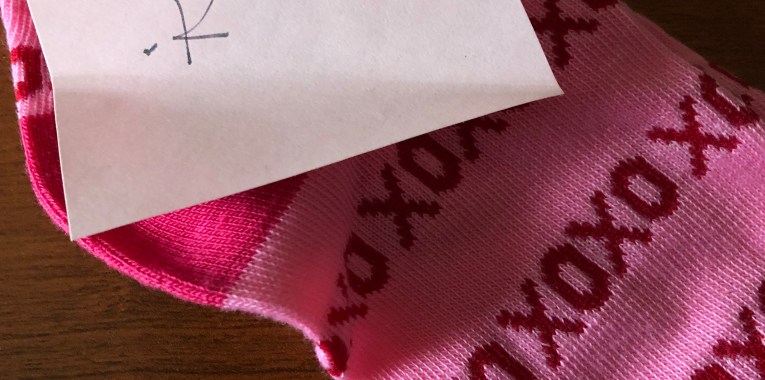
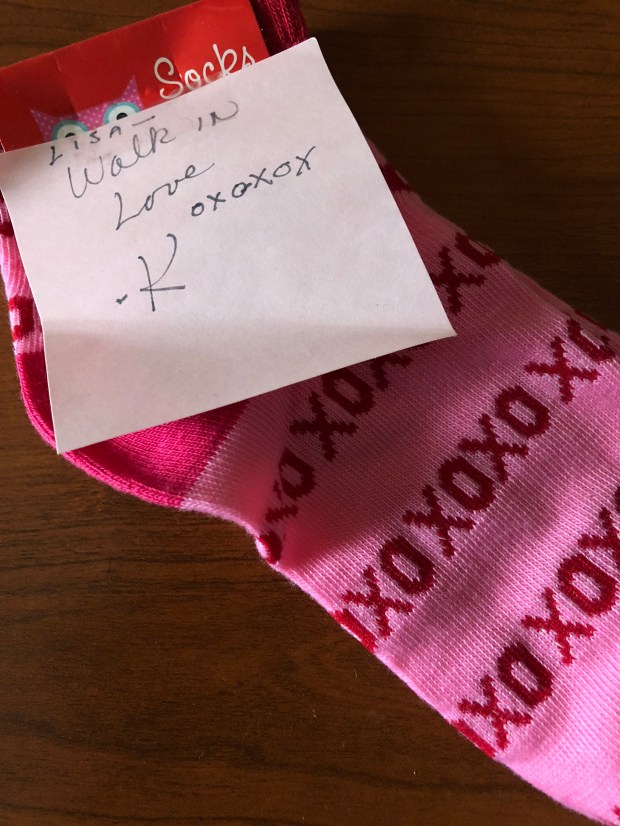
A while back when I was having a difficult time, my good friend K. gave me these socks, with the note “walk in love.” I think this will be my socks when defiant fragility is called for. It is good to have good friends.

IMG_4115