Attending, listening Yoga-style

“The art of listening is the marriage of ear and space.” – Remski interpretation of Patanjali’s sutra 3.41

In my Theory and Practice Course for Social Work, we are learning the art of interviewing. Step one involves achieving a compassionate and empowering balance between attending and reflecting. Here is an ancient yogic way to develop the super power of deep listening by being mindful of our tendency towards “automatic self-referral” as explained by Matthew Remski,

Internal space is also utilized to broaden the gap between “your story” and “my story”. This space is most commonly disrupted by communication habits that fail to nurture the gap of otherness. For instance, if one friend begins to tell another friend of her marriage problems, the second friend can begin to “hold space” for the first by simply reflecting the feelings she hears. This allows the first objective of communication — being heard — to be fulfilled. But if the second friend begins to “false-empathize” with the first by immediately saying, “Oh I know what you mean: let me tell you what my partner did”, she has blocked the space of otherness through a pattern that Miles Sherts (2009) calls “automatic self-referral”. The first friend will not feel heard, and her feelings will become more isolated and compressed, a combination that invites suppression.

Remski, Matthew. Threads of Yoga: A Remix of Patanjali-s Sutra-s, with Commentary and Reverie (p. 180). BookBaby. Kindle Edition.

I’m still working on this super power. Maybe you are too.

Happy listening to “the gap of otherness,”

Hungryphil


Self-Examination, Yoga style

Yoga helps,

  • “the seeker excavate the tensions of inner life in a self-directed manner”

(Look inside)

  •  us be responsible for our own spiritual health

(Be responsible for your own peace)

  • “relocate the unseen within us, invites us to introvert, to open our eyes to why we are who and how we are.”

(See your hidden motivations)

  • “elevates the capacity for internal observation to the level of a virtue previously occupied by notions of “godliness”.”

(Accept Self-examination as cosmic responsibility)

In doing so, yoga exposes the power of internal authority through self-awareness.

In my opinion, and setting aside the accidents of its publishing fame, the yoga sūtra-s deserves our continued attention as a wildly exciting text for four interweaving reasons.

Firstly, it breaks with most previous paths of spiritual growth in its attempt to help the seeker excavate the tensions of inner life in a self-directed manner, without reliance on gurus or corporate bodies of authority. It is openly ambivalent to religious attitudes, going so far as to equate breath-awareness (1.34) with religious devotion (1.23) as a technique of evolution. From the outset, it contains no self-validating list of lineages, no creation story or deference to divine power: the text is a non-denominational and impersonal list of quiet discoveries.

Secondly, the sūtra-s generally (if we remix pāda three) move away from the magical thinking directed at cutting deals with unreachable gods and invisible spirits for a better life — an approach that continues to pervade our current spiritual milieu, from the remote prayer experiments of evangelical Christians to the “think methods” popular in this new age of The Secret.

Thirdly, Patañjali offers a substantive and startlingly modern map of psychomentality, dividing out conscious faculties for our observation, and alluding to how the unconscious shadows that seem to motivate our actions might be illuminated. I render saṃskāra and vāsanā as “trace” and “pattern”, following Feuerstein, who describes saṃskāra as a “sublimilinal activator”, and vāsanā as a “chain of similar karmic activators” (1998, 241). Bursting forth from the Vedic tradition, which sought to pacify the external forces of adṛṣṭa (“unseen” gods and energies), Patañjali relocates the unseen within us, invites us to introvert, to open our eyes to why we are who and how we are. This puts the notion of “trapped memory” front and centre, allowing a clear reckoning of karma: our traces, habits, and grooves. Patañjali suggests that we can slowly free ourselves of the unseen. This relentless excavation of hidden thought as the source of our pain, this dive towards whatever is unconscious, represents a clear displacement of his ancestors’ obsession with the whims of external gods.

This leads to the fourth gesture: the opening chapter of the yoga sūtra-s elevates the capacity for internal observation to the level of a virtue previously occupied by notions of “godliness”. The sincere human no longer needs to adhere to a perfect ideal, whether social or philosophical, to attain wisdom. She simply needs to watch her experience unfold, and to enrich her action with tender watching.

These four gestures amount to a broad gift: the text places implicit value on the power of internal authority.

Remski, Matthew. Threads of Yoga: A Remix of Patanjali-s Sutra-s, with Commentary and Reverie (pp. 42-43). BookBaby. Kindle Edition.

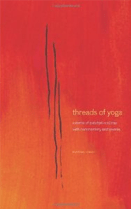
Book Image from http://matthewremski.com/wordpress/books/threads-of-yoga/

Exploded view of my now

Living forces honesty. Answers are seasonal, losing their sense precisely as they become scripture. You will die: this is the first meaning. The world around you seems to bear helpless witness to your wandering. Other people suffer in the same way, and yet this seems to increase loneliness. But you can welcome despair like gravity, for at some point the sheer pressure, tectonic in the soma, compels a violent break in pattern: running through the woods, making love with an utter loss of self. The reality of your condition offers a stark gift you accept through sudden discharges of rage and rage’s joyful shadow: this is the only life you know, and it fills you to overflowing. You live your life, yoga happens to you.

You thought you were alone. You tried to be independent. Then, standing in the market with your hand on an orange, children underfoot, traffic humming, conversations blendingwith the radio by the cash register, shoes you did not make on your feet and clothes you did not sew on your back, sun slanting through rips in the tin awning, you’re almost late for meeting someone, always almost too late. You know this orange will give you life, and that you did not grow it. Someone else gave it to you, it will become your flesh. Its colour adds immeasurably to your language and dreams while its name rhymes with nothing, and you did not conceive of it. The old grocer’s hands have become gnarled through a lifetime of handling boxes of oranges for you to eat. Someone else gives you your flesh. They could not give what they do not have. Someone else holds their flesh forth until it becomes your flesh.

A child triggers an internal laugh. A dog slaps her thick tail against your shin. Every single object that gives you life surrounds you. If you really were alone you would not exist. You did not make the air you breathe. You can’t say where the inside of your flesh begins. You are naturally reaching out as something reaches into you. No one and everyone taught you this. You surrender to the always-already-there, and yoga happens around you, through you.

– Matthew Remski, Threads of Yoga

Beautiful example of philosophical object orientation and mindful awareness, Ian Bogost style, maps, meanwhiles, lists and ontographs, Timothy Morton style thoughts of gravity, weird reality, shredded wheat magical simplicity.

Yoga invites us to the stillness of an exploded view of our present moment. Notice yourself, your body supported by the ground, your arms reaching to the sky, your breath, feelings, thoughts, sensations. All material, all fleeting. In stillness watch yourself move in thought and breath. Yoga offers such quiet power ❤️

Wishing you a weekend of mindful nows,

Hungryphil