
Wobblyogi Wednesday: Yoga body containing and transcending ego?

I was asked recently to identify what type of yoga I teach. She asked, “Hatha?”

In typical philosopher style, I wanted to answer, “Yes and no.”

Yes, the focus of the session will be the unity of body, mind, and breath by flowing through movements.  Yes, I hope the session carries both your mind and body to more ease. And yes, Hatha, as the practice of Sthira-Sukha, stillness and ease, I hope the yoga session helps us find balance.

On the other hand,

I wanted to answer, “No, not just Hatha yoga, as the yoga tradition most devoted to cultivating the body. No, I’m not interested in pushing  you to your physical limit. No, I do not expect you to master difficult poses, head stands or binds. No, I am not invested in your physical wellbeing drained of emotional strength.”

The dilemma about Hatha yoga is common, as we try to balance fitness with mindfulness,  assuming a mind-body duality. There is a long history to this question of the mind as it relates to our understanding of our embodied selves and our material world.

Here is one yoga scholar’s description about the dangers of holding the body as the locus of ego-centric practice:

“…the disciplines of Hatha-Yoga are designed to help manifest the ultimate Reality in the finite human body-mind. In this, Hatha-Yoga expresses the ideal of Tantra, which is to live in the world out of the fullness of Self-realization rather than withdraw from life in order to gain enlightenment.

…The Hatha- Yoga practitioner wants to construct a “divine body” or  “adamantine body” for himself or herself, which would guarantee immortality in the manifest realms. He or she is not interested in attaining enlightenment on the basis of prolonged neglect of the physical body. He or she wants it all: Self-realization and a transmutated body in which to enjoy the manifest universe in its diverse dimensions. Who would not sympathize with this desire? Yet, as can be imagined, the practitioners of Hatha-Yoga have sometimes sacrificed their highest spiritual aspirations and settled for lesser, perhaps magical, goals in service of the ego-personality. Magic, like exo-technology, is a way of manipulating the forces of Nature, whereas spirituality is about the transcendence of the manipulative ego-personality. Narcissism, or body-oriented egocentrism, is as great a danger among hatha-yogins as it is among bodybuilders.”

from George Fuerstein’s The Yoga Tradition

After alerting us about the potential dangers of egocentric self-absorption, Dr. Fuerstein suggests coupling Hatha-yoga with Raja yoga. Perhaps, that ego-countering coupling can include many other forms of yoga: Mantra (chanting), Bhakti (faith), Karma (action) and my favorite, Jnana (wisdom).

This is why as we move through the poses attentive to our breath, we look towards our inner landscape to find moments of pranayama (breath control), pratyahara (withdrawal from outside stimuli) and even dharana (concentration on something specific, like breath or tense tissue). I like to think of asana as the pivotal yoga-limb grounded in the yamas (how we behave with others) and niyamas (how we cultivate ourselves) while reaching and touching pranayama (aware breathing), pratyahara (focusing inward) and dharana (focusing on a single thing). It may or may not help us with dhyana (meditation) that may or may not lead to samadhi (transcendence). Asana can help us walk through 6 of the 8 limbs of the yoga-path. Or, we can metaphorically and literally be stuck in a peacock pose.

When we share our yoga practice with others, we become a community of individuals each striving towards the same thing through different breathing patterns, body types, and levels of awareness. Our bodies are not the same, how can our minds be? We may not be saying the same prayer or holding the same intentions but we are all praying and intending. Unity in diversity, not uniformity.

For me, asana practice, celebrates the diversity of bodies, of being, of lives, of minds that all strives towards the same human need for ease, goodness, and stillness.

But, I simply answered the lady’s question, “Hatha?” with a, “Yes.”

Hope I see her in class soon.

Happyoga,

The Wobblyogi


Wobblyogi Wednesday – YTT Journal


What-Its-REALLY-Like-to-Teach-a-Yoga-Class-Illustrated-30.jpg

It has happened. I’ve taught my first 15 minutes of a real yoga class (outside the comfort zone of my fellow trainees) today. I mumbled, forgot to breathe, relied on notes too much, missed modification cues, was lost for a moment and probably missed other things I don’t even know. And…… it was wonderful! All my mistakes were loud and aggressive in my head but the experienced yogis in the studio graciously overlooked my inner panic. For a moment during a chaturanga, it occurred to me that I was sharing something I so enjoy with others. That moment made it all worth it. I could feel our energy collectively rise as we progressed through the sun salutations.

The conversion from practicing yoga to practicing yoga AND teaching yoga is challenging!

  1. During practice, I focus inward. It seems intrusive to be looking at others when teaching. I feel like a student spying on my fellow yogis.
  2. When to demo and move with the class and when to stop, observe, talk and notice the class? I have yet to find a good rhythm.
  3. The balance between cueing and silence is another skill I need to work on.
  4. Inflection of voice to convey calmness and energy when appropriate is yet another issue.

Despite this self-critique, I’ve grown and learned so much! So thankful that I’m not asking how do you get into a twisted extended side angle [parivttri parsvakonasana]? or what is a sun salutation?, or how do you breathe in a twist? why breathe with movement? Is chaturanga a movement or a pose? What does a neutral spine mean? Only a few weeks ago, I would’ve asked these questions and so many more.

After I deliver food to the table, I eagerly notice the reactions: who jumped to serve themselves, who had seconds, who moved the food around the plate, who picked ingredients out, who got more to drink, who was quiet in her enjoyment, who was adding condiments etc. It is time for me to focus on my fellow yogis to watch and notice as they move and breathe to my cues. Teaching yoga is a new relationship, like any other, full of happy anticipations and nervous anxieties.  I learned today that the beauty of people moving and breathing together is so00000 much better than my crazy inner monolog. I thought through teaching I would help others, turns out they are helping me just as much, if not more. Cue a humble warrior pose……..

Hosting and witnessing the magic of shared breath is the privilege of a yoga teacher.

Thank you, Debra, for sharing your class with me.

Image from: http://www.doyouyoga.com/what-its-really-like-to-teach-a-yoga-class-illustrated-40340/

Wobblyogi Wednesday- YTT200 Journal

06016d4b3780293a1662e1a25f03f256.jpg

As you know, I like to eat. A lot. Frequently. I am after all, hungryphil. I try to walk to burn off some calories and raise my heart rate. And, I practice yoga to calm my frenzy of eating. Admittedly, my practice of both has been sporadic. In an effort to live more mindfully and consistently, I just started a yoga teacher training program. For me, teaching seems to be the best way to learn. In order to share my experience with you, I offer:  Wobblyogi Wednesday.

I’m over forty, my knees creak and inversions make me dizzy. I am not aiming for perfection. There are eight of us in this session of yoga teacher training at the Community Yoga in West Lafayette Indiana. Most of my fellow yogis are shiny-smart and kind-eyed young women around my daughter’s age. As I munched on my mix of nuts and dates, I listened to their stories that brought them there. Each impressive and so amazingly diverse. After introducing ourselves we talked about our expectations, worries and mostly about what the role of a yoga teacher maybe. I imagine this question will be an ongoing thought throughout the coming months.

Here is how I responded to assignment number 1:

Please answer the following in a few paragraphs. We will be sharing our thoughts as a group as well.
From your perspective, what is the role of a yoga teacher? Take into consideration your own experience, your ideal, and your goals as it relates to teaching yoga.

It is rare for someone to engage in the practice of yoga because they are feeling fantastic body and mind. We all enter a yoga practice achy and unfocused. The first and most crucial role of a yoga teacher from my perspective is an empathetic acceptance of human imperfection and weakness. Honesty and humility allows us to accept the cranky knees, the tights shoulders, the sad heart or restless mind. As a teacher, by voicing these concerns I give my fellow yogis permission to accept their own limits without judgment. The most successful yoga teachers create a nourishing, safe and supportive atmosphere. They notice the telltale details of strained spirits, bodies and minds.

Rule #1: There is no room for judgment on the yoga mat. Only honesty sprinkled with humor.

Once the atmosphere is charged with trust and honesty, good yoga teachers, set the mood, tone and pace of the session. If new poses are attempted, they offer reassurance of what is about to happen. Break down difficult sequences. Build up to difficult poses. They do this while reminding each yogi that they are in control of their practice and can choose to follow a much or as little as they wish. The goal of good teachers, like good parents, is to make themselves unnecessary. The best yoga teachers train us not to need them for direction. They are constantly learning, growing and teaching, and show us how to do the same.

Rule #2: Each yogi is his/her own teacher. A good teacher shows us how to teach ourselves.

If we are all empowered by our own practice, then why come together as a community to practice? What is the difference between mountain pose and just standing? A mountain pose harnesses the shared intentionality of standing (through individual intentions) in respect, in prayer or in defiance. The best yoga teachers cultivate a supportive community of individuals. They remind us that we are not alone in our practice, even at 6am on a cold Indiana morning. They help us carry the mindfulness generated on the mat, off the mat and into our day. They help us commit to the search for intentions, even if each of us holds a different intent. A good teacher translates between traditions, movements and words that project the principle of peace: Salam, Namaste or Shalom.

Rule #3: My yoga demands a non-dogmatic search for mindfulness. There can be no inner peace without aspiring towards outer-peace.

No judgment, no authority, no dogma. This is where I want to start…..

Wishing you mindful moving,

The Wobblyogi


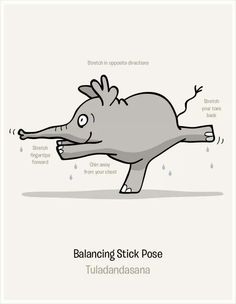
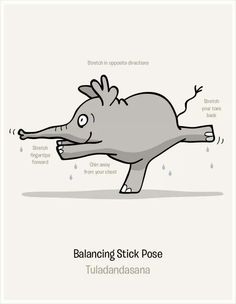
Yogi Elephant image from here