
Radishes and Michel de Montaigne [1533-1592]

I am not excessively fond either of salads or fruits, except melons. My father hated all sorts of sauces; I love them all. Eating too much hurts me; but, as to the quality of what I eat, I do not yet certainly know that any sort of meat disagrees with me; neither have I observed that either full moon or decrease, autumn or spring, have any influence upon me. We have in us motions that are inconstant an unknown; for example, I found radishes first grateful to my stomach, since that nauseous, and now again grateful. In several other things, I find my stomach and appetite vary after the same manner; I have changed again and again from white wine to claret, from claret to white wine.

Few philosophers would write about the size of their gallstones, about love, sex and marriage or what they ate. The father of the essay form, Michel de Montaigne’s work is refreshingly anti-cerebral and anti-academic in a very thoughtful “academic” way.  The passage above describes the unexplainable variability of our appetites. Subjectivity and variability is precisely why historically philosophers avoid love, sex, laughter and food. Despite the hubris of academic thinkers, Montaigne reminds us that we cannot know and explain everything. Rather, everything is subject to custom (Circe’s drink). For him, an attentive description of an experience in all it’s complexity that actively engages others is far better than the passive repetition of learned theoretical abstraction. In the era of rational Renaissance, his insistence on everyday experiences as inherently meaningful, was bold and refreshing. Still is. I love his “down with dogma” attitude. Then again, as Montaigne would say, ‘Que sais-je?’: what do I know?

This passage about variable appetite reminds me of pregnancy cravings or appetites of 2-year old kids. I have to be in the mood for soda, candy or barbecue. Sometimes foods I generally enjoy don’t like me back, like pasta a few days ago. What foods do you enjoy in varying degrees?

Here’s a recipe in honor of radishes and Montaigne.

Bengali Shredded Salad with Radishes:

Combine equal amounts of shredded cucumber, tomatoes, carrots, onions, cilantro and radishes.
Add salt, sliced green chilies and vinegar.

Really good with a rice pilaf (pulao) and Bengali Chicken Roast (Chicken roasted with shallots, ginger and garam masala) or Beef Bhuna (a dry beef curry). This works even better with shredded beets. The whole salad turns red! 

Image from: http://plato.stanford.edu/entries/montaigne/


Sunday Clean-Up Dinner

Like so many of us, Sunday, is the day for weekly groceries: A day of accounting for leftovers and unused fresh ingredients from the week before. Will I eat this? Can I still cook this? Does this smell? Can I transform this? It requires honesty and creativity.

Here’s how I did on the scale of efficient mindful eating:

  1. Two packs of chicken wings having waited in the fridge for two weeks, smelled and perished. [Thank you Jim for throwing the stinky chicken out] Yuck.
  2. Used this week’s leftover pumpkin curry to make vegetable koftas (veggieballs). Its a good way to use up any cooked leftover vegetables. Mix leftovers with mashed potatoes, bread crumbs and egg.  Add enough of each in order to form small balls. Fry or bake. Wednesday I’ll make a quick tomato cream curry sauce and simmer the koftas.
  3. A head of cabbage evolved into veggie egg rolls. A great way to use up any “shreddable” vegetable. I added the last three scrawny carrots in the bag, half a head of cabbage, onions, cilantro and mushrooms.
  4. With brown bananas: Bananas with Chinese five-spice Eggrolls. Froze the last brown banana for smoothies later this week.
  5.  Leftover fresh spinach became an easy spinach garlic saute.
  6. A package of skinless chicken thighs became Thai red curry [red curry paste, fish sauce, brown sugar, coconut milk and lemon grass]
  7. Leftover scrambled eggs from Tuesday’s winter weather two-hour school delay become Sunday’s toasted breakfast sandwiches with spinach, tomato and swiss cheese.
  8. I still have kale in the fridge. I trust it will make it to my plate this week. Kale is strong in so many ways.

So begins a new week with re-purposed leftovers, fresh veggies and a few lost items (sorry stinky chicken wings). On the whole, I’m glad to say I enjoyed more than I wasted. The redcurry, spinach and rice, although not much of a looker (few curries are) was filling, bright and gently spicy. The sweet banana eggroll was decadent drizzled with honey, crunchy and smoky sweet. I really liked the Chinese five-spice with the bananas. I might even make this when I don’t have to save bananas from the trash bin!

Now I have red curry, spinach and eggrolls in the fridge. The virtuous cycle of left-overs continues…

Hoping you had a mindful and delicious weekend too,

Hungryphil


Kheer – Rice Pudding with Jaggery

Dear Atiya,

Here are two recipes for the kheer you enjoyed in Fort Worth. The first recipe is the original, your Mimi’s, the second is my inauthentic version you tried recently.

Moli’s Original Kheer Recipe

1/2 pint of Half and Half
1/2 pint 2% Milk
1/2 Cup Soaked Chinigura rice
3/4 cup Jaggery
1/2 cup Coconut
Simmer rice and liquids until soft.
Gradually add jaggery.
Add shredded coconut.
Enjoy.

Mom’s Inauthentic Kheer Recipe

2 1/2 cups of whole milk [had some left over from Mac and Cheese the other night]
1/2 cup Jasmine Rice [I was too lazy to open a fresh bag of Chinigura rice]
3/4 cup Jaggery [bought in Dallas, use poor substitute brown sugar if unavailable]
1/4 cup Shredded Coconut
I heated the milk and rice with 1 cinnamon stick, 3 cardamoms and 1 bay leaf [because I forgot that I wasn’t supposed to because it competes with the jaggery flavor]
Be sure to simmer on low otherwise milk will boil over. This takes a while, about 30-40 minutes. Don’t rush it. The milk will thicken and the rice will soften.
Once the rice was soft, I added the jaggery and the shredded coconut.
Your done! Enjoy warm or chilled.


I’m sure you’ll find your own version when you make it.  Basically milk, rice and sugar. The key is the low and slow simmering.

IMG_2396

Wonders of Waffle House

It wasn’t until Anthony Bourdain extolled the virtues of the Waffle House during a show about Atlanta that I took the humble roadside eatery into consideration. The squat square building capped by a yellow awning and the stark  self-explanatory words “Waffle House”  would be easily overlooked if not for the tall yellow scrabble-tile looking road sign. An Eater.com story by Khusbu Shah explains, Bourdain’s fascination with the place, as exotica,

“Bourdain revealed that while he did try local delicacies like hominy and hoppin’ john, he was most blown away by one discovery in particular: “The glories of the Waffle House.” Bourdain explained: “Talk about exotica, I’ve never been. It’s apparently a place you can go no matter how wrecked and obnoxious you are or how late at night… they are nice to you.” Amused by Bourdain’s admission, Colbert reveals his favorite part about the 24-hour chain: “The nice thing about the Waffle House is that the menu is all pictures, you don’t have to read.”

Yes, yes, I know those of you in the southern states and Indiana [southern in spirit] are rolling your eyes at Yankee anthropological attempts to understand and appreciate “the south” with a mocking undertone. I confess, I myself, entered the with an unacknowledged sense of judgment that quickly evaporated.  First of all, the waitress put  Jim and I at ease by making light of our misguided attempt to enter the diner through the front (where there is no entrance), “I was wondering where you were going?” she sweetly chuckled. Menus were on the table. Coffee soon followed. This was the first time I could choose to have my hash browns: smothered (with onions), capped (with mushrooms), diced (with tomatoes) and peppered (with jalapeno peppers). It was strangely satisfying to personalize otherwise standard and uniform potatoes. Even in the morning light the atmosphere was welcoming as Bourdain claimed. It didn’t take much to imagine what an oasis it would be in the darkness when everything else is closed and one is hungry, hungover, high or just sad and lonely. This is not a Edward Hopper painting of modern alienation rather a calming place  at the counter, watching the eggs sizzle, catching the wafting scent of waffles and allowing oneself to be held in the dance of hardworking cooks and waitresses around you. You are not alone, even if eating alone.

I happily had good company during  the post-holiday weekday morning rush.  Perhaps because of my low expectations or maybe the food WAS really just good, I don’t know, but I found the hashbrowns light and flavorful (not laden with grease), the eggs gently cooked sunny side up and the toasted (and buttered!) biscuit a perfect platform for strawberry jelly.  The line of people waiting against the entry wall made sense.

Just like the signage and building, the food and experience held no pretensions of grandeur, competition or beneficence. I suppose that honesty and simplicity is one of the wonders of the Waffle House [open for 60 years, year-round, including Christmas].

Here is a recent article shared on facebook about Waffle House (Thank You, Rachel!). Note: They take Valentine’s reservations. Despite my appreciation, I don’t think we’ll be attending.

Wishing you all happy roadside eating,

Hungryphil


Food Poem-Everybody Made Soups by Lisa Coffman

After it all, the events of the holidays,

the dinner tables passing like great ships,
everybody made soups for a while.
Cooked and cooked until the broth kept
the story of the onion, the weeping meat.
It was over, the year was spent, the new one
had yet to make its demands on us,
each day lay in the dark like a folded letter.
Then out of it all we made one final thing
out of the bounty that had not always filled us,
out of the ruined cathedral carcass of the turkey,
the limp celery chopped back into plenty,
the fish head, the spine. Out of the rejected,
the passed over, never the object of love.
It was as if all the pageantry had been for this:
the quiet after, the simmered light,
the soothing shapes our mouths made as we tasted.

“Everybody Made Soups” by Lisa Coffman from Less Obvious Gods. © Iris Press, 2013.

From the Writer’s Almanac

Rooted Cosmopolitanism of Nested Travelers

Last post I had causally asked if there was a way out of the seeming dichotomy between local farm to table eating and cosmopolitan global eating. Food philosopher, Lisa Heldke, asked the same question in an insightful essay entitled,”Down-Home Global Cooking: A Third Option between Cosmopolitanism and Localism.”Relying on Kwame Anthony Appiah’s idea of “rooted cosmopolitanism,” she asks the same questions far more eloquently than I had and even offers a possible option in the “nested traveler” and writes:

“What kind of philosophy can underpin and advance the development of food practices that value both local food and ethnic cuisine swapping? That can acknowledge the legitimate rights of communities to cultivate deep and long connections to the soil, while also recognizing and valuing the insights that come from newcomers? “

According to Heldke, the third option must achieve the following aims,

“First, it will manifest literal “groundedness,” a nonarbitrary, nonoptional, earthy contextuality.

Second, this alternate option will recognize that no place is too small, local, and homogeneous to escape us/them thinking, nor is any connection between two people too tenuous to preclude the possibility that they will share a sense of being from the same tribe. That is connections and disconnections are never simple matters of location or dislocation.

A third option will also exhibit greater concern with the cultural than displayed by many agrarian forms of localism, and more concern with the agricultural than most versions of cosmopolitanism manifest.

A fourth aim of this third option is that it ought to help us think about how food practices could enable us both to conceptualize and to enact justice and sustainability — two sociopolitical aims toward which many eaters are attempting to aim our forks. Note that cosmopolitan options tend to emphasize that they alone are capable of safeguarding global justice, while localist options tend to suggest that they alone are concerned about environmental (and other forms of) sustainability.”


New Year’s Blackeyed Peas

Eating black-eyed peas will bring you money in the new year, according to Southern tradition. Owing to this tradition, Rachel, my mom-in-law, made us a New Year’s lunch of collards, black eyed peas and cornbread. We also added leftover coleslaw and chicken wings. The bitter greens and the buttery beans soaked into the crunchy warm cornbread, and together became a hearty meal. I especially enjoyed the pepper sauce with the greens. The vinegar and spice of the sauce bites the bitterness back. A collision of strong angry flavors.

This was my first time eating black eyed peas in celebration of a New Year. I’m waiting for the money to start ringing in.

What are your New Year Celebration food traditions? Any favorites?

http://www.southernliving.com/food/holidays-occasions/new-years-recipes-traditions

http://www.epicurious.com/archive/holidays/newyearsday/luckyfoods

http://www.rd.com/food/fun/7-lucky-new-years-foods/


Bringing Bitter Back

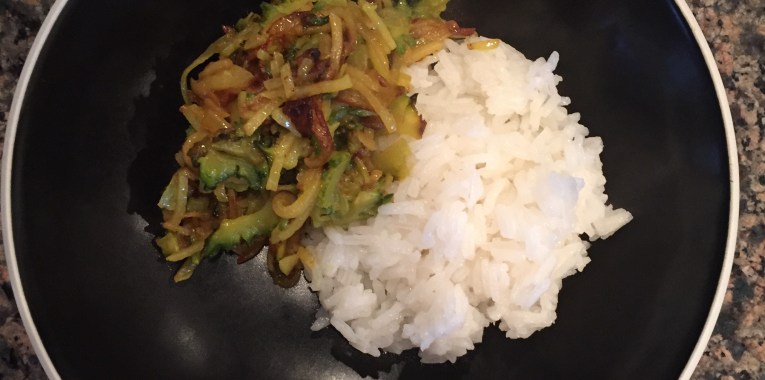
The 2015 December issue of Saveur includes a Bitter Melon tofu stir-fry recipe. It reminded me of my grandmother who would, much to my childhood discontent, insist on starting every lunch with Bitter Melon Bhaji. Worse, she would offer the second course, usually a delicious light fish or chicken curry, only after evidence of a finished bitter melon plate. Bitter Melon was the unwelcomed gatekeeper of lunchtime deliciousness.

My grandmother was a staunch believer in bitterness, a Bengali version of the British stiff upper lip. For her, all sweetness came at the price of bitterness. “The more you laugh, the more you’ll cry,” all the cousins joke. Bitter Melon wasn’t a vegetable, it was a philosophy. I had misinterpreted the lesson as a prescription to avoid the sweet, in order to avoid the bitter. Instead, it should be: accept the bitter and the sweet, equally. It makes life full and robust, a meal savored and stretched between bitter, salty, spicy and sweet. An appreciation of bitterness maybe a taste that is acquired by diligent practice and age. My love of cooking is no small part due to my grandmother’s slow, methodical, everyday practice of cooking. Here’s to you, Bubu.

I’d like to bring bitter back as a taste to be savored along with others, instead of avoided or feared. This is my bittersweet New Year’s Resolution: To finally embrace the Bitter Melons of my life.

Recipe for Bitter Melon Bhaji (Serve 4-6)

  1. Wash two or three bitter melons depending on size.IMG_2372

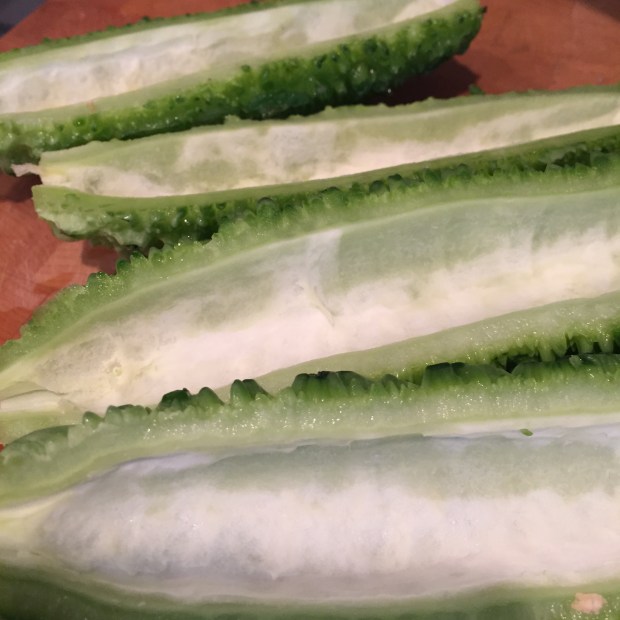
  2. Slice length-wise and scoop out seeds (some leave seeds in if melons are young)IMG_2373IMG_2374

  3. Massage with salt and rinse with cold water for a few minutes. Rinse. Drain. Let dry.IMG_2375

  4. Put 2 tablespoons of vegetable oil in a hot pan.

  5. Fry a medium sliced onion until soft and starts to brown.

  6. Add 1/2 a teaspoon of turmeric and salt to taste.

  7. Add a julienned medium potato.

  8. Fry until coated with turmeric. Bright and yellow.

  9. Add the bitter melon. Fry over gentle heat. Cover.

  10. Simmer, covered until potatoes and melon are soft and edges start to brown and caramelize.

Serve with warm white rice and digest all the day’s bitterness away.

Magical New Year of Eating

Happy to be back here, sitting on my red chair looking out from our end of the cul-de-sac through the picture window,  writing to you and with you. I’m excited to report that I ate so well and so intently that I have MUCH to share with you the coming weeks. By virtue of this blog I will savor the two weeks of vacation for another four weeks. Gosh, I so enjoy eating, cooking, reading and writing that have the ability to make time go fast and slow. Magic.

The first discovered taste I’d like to share is this:

Kaboom Books in Houston, where I found this:

IMG_2371.JPG

What! It was such a magical discovery for THE HUNGRY PHILOSOPHER …..that I started talking about myself in third person!!!

A fun and thoughtful read that proclaims the spirituality of food. Here are a few excerpts:

“The umbilical cord between yourself and the world is the cooking pot. We pass reality through it, and it is indicative of the sort of world we live in. It is a crucible, an alembic in which we are linked with the world, magically if you like.”

“Herbs and spices do for your dishes what grace does for your actions — they give them zest and an inner meaning. The graceless life is the life which has lost it savour.”

“Salvation is to love something real rather than merely having an idea of right or of money or of liberty or whatever. Cooking is a great opportunity for love and therefore salvation. Love the leisure of the simmering pot and the long drawn out thought of the people you wish to please. For God’s sake don’t throw a commonwealth of meat and vegetables into the pot and clamp the lid on in order to have time to look over the agenda for the next meeting. It is the love of ideas which makes us cruel and not the love this bit of meat, these potatoes, this child or wife or husband.”

Hope all of you hungry-philosophers out there had a wonderful winter holiday surrounded by love and good food.

I wish you the magic of eating that makes your world a graceful and kinder place.

More later.

Hungryphil

Examined Eating in Georgia


As the second image shows, Christmas dinner in Austell, Georgia was soothingly summer on a plate. The last stop during my holiday travels it represents how far my taste buds have traveled in place and time. Recipes for half of the plate begin with “grow your own okra, green beans, corn.” The other half of the plate with smoked turkey, dressing and gravy had all the longed-for familiar and savory holiday flavors. The magic of homegrown summer vegetables made the dinner extra special. Dennis and Rachel are most definitely blessed with green thumbs, patience and gardening knowledge. As the last image shows, dinner was greatly appreciated and enjoyed. Just simple, homey and delicious. Can’t get a more local dinner than what’s grown in the backyard!

Fried Okra

  1. Grow okra and pick at appropriate time.
  2. Slice 1/4″ thick pieces. 4 cups.
  3. In a colander pour 1/4 cup of buttermilk over sliced okra.
  4. 1/2 cup flour + 1/2 cup white corn meal. Place lid and shake until pieces are coated.
  5. Shallow fry in an inch of canola oil.
  6. Drain on paper towel and watch the okra disappear.

Creamed Corn

  1. Grow corn and pick at appropriate time.
  2. Shuck and silk.
  3. Soak in water.
  4. Cut off cobb, twice. Once, if big grains are desired.
  5. Scrape.
  6. Cook on stove over low heat, stirring constantly. Bring to boil.
  7. Salt and butter if needed.

Green Beans

  1. Grow Blue lake green beans.
  2. Take ends off, string them if needed.
  3. 4 cups broken into 2 inch pieces.
  4. Boulion cube + 2 cups water + black pepper.
  5. Boil until tender.

Gravy

  1. 2 Tbs Olive Oil + 2 Tbs flour in pan. Stir until brown.
  2. Add 1 can chicken broth.
  3. Add 1 can cream of chicken soup.
  4. Add boiled and chopped turkey liver, neck meat, giblets and two boiled eggs.

Still need to add Patti’s dressing recipe and Dennis’ Smoked Turkey recipe. More to come.