Recipe Test: Baked Banana Chocolate Wontons

IMG_3912.JPG

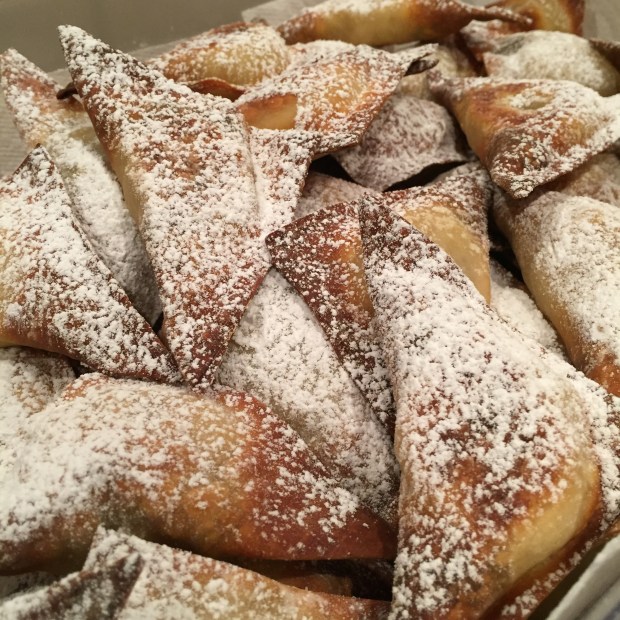
Many thanks to the Wishful Chef and her recipe for Baked Banana Chocolate Wontons. Big hit with my 14-year-old. We are inspired to try other fillings. Crunchy, guilt-free snack. How rare!

  1. Place a slice of banana and a few chocolate chips on a wonton wrapper piece. Fold over. Seal with water.

  2. Place on baking tray in single layer. Spray with cooking oil of your choice.

  3. Bake about 10 minutes until crispy in a 400-degree oven.

I sprinkled mine with powdered sugar. You can leave plain, drizzle honey, chocolate syrup.. although that that point it won’t be very “healthy.”

Go to the Wishful Chef website for this recipe and more at http://wishfulchef.com/baked-banana-chocolate-wontons/

Enjoy!

Wishing you a tasty weekend,

Hungryphil

Crunchy Fried Smelt

img_3871

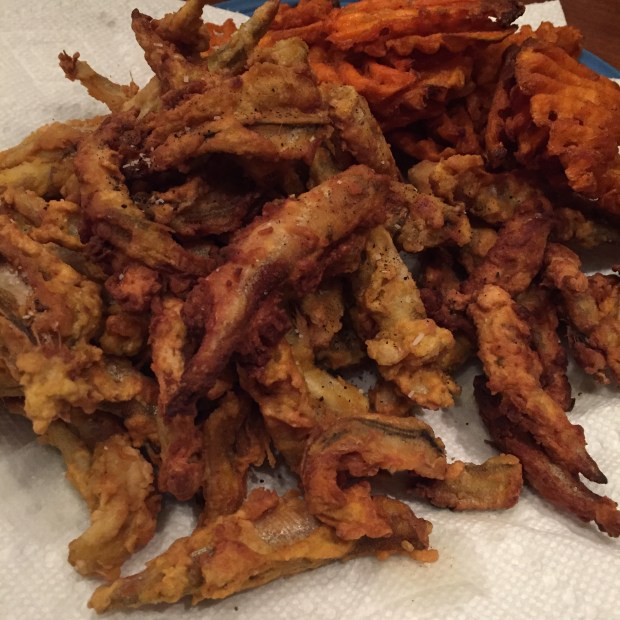
A spur of the moment made-up recipe that worked well. Writing and sharing the recipe so I don’t forget.

  1. 1 bag frozen Smelt (thawed out)

  2. 1 teaspoon each turmeric, chili powder, coriander and salt [you can add any spice mix of your choice, for example, Cajun would be tasty too]

  3. 1/2 cup of besan (chickpea flour) and 1 cup flour [rice flour would work too]

  4. Combine the ingredients. The fish holds so much water that adding water isn’t necessary. In fact, you may need more flour for the batter to stick to the fish.

  5. Shallow fry in vegetable oil or olive oil.

Serve hot sprinkled with lemon and salt. Dipping sauce of your choice.

Enjoy!

Election Cake – #makeamericacakeagain

IMG_3866.JPG

Baking as a stress relief. A dry cake to be washed down with drinks, sustain voters and celebrate democracy.

This story about the cake is from the Washington Post by Daron Taylor:

After making it through one of the most bitter and divisive campaign seasons in generations, maybe we could all use a slice of delicious cake. That’s exactly how America used to celebrate democracy in action when our country began: With ‘election cakes.’ Enormous in size, these sweet, spiced and fruit-filled cakes were designed to sustain voters at the polls.

The oldest known recipe for election cake is found in one of the first cookbooks ever published in America: the second edition of American Cookery by Amelia Simmons, published in 1796. The election of 1796 was certainly one worth celebrating. It was the election held after George Washington refused a third term as president, and it was a test of the peaceful transfer of power in our new democracy.

Women were not allowed to vote when the first recipes for election cakes were written, and baking cakes was encouraged as a way to participate in the electoral process if only from the sidelines. By the time the 19th amendment was ratified in 1920, election cakes had fallen out of favor.

More than 90 years later, a new generation of bakers is reviving these old recipes for the 2016 election using the hashtag #makeamericacakeagain. Baking, and women’s historical role in domestic and public life, holds a special significance in this year’s presidential campaign, the first ever to include a female presidential nominee. Election cakes, and for that matter the act of baking itself, is non-partisan.

Want to bake an election cake? Try out The Washington Post’s recipe for Election Day Cake.


This is the recipe I used to make the cake. It is more like a dry fruity bread rather than a moist cake.

Wishing all of you in America Happy Election Day,

Hungryphil


Weekend Eats Experiment: Pumpkin- Lemon Cream Cheese Chess Pie

IMG_3863.JPG

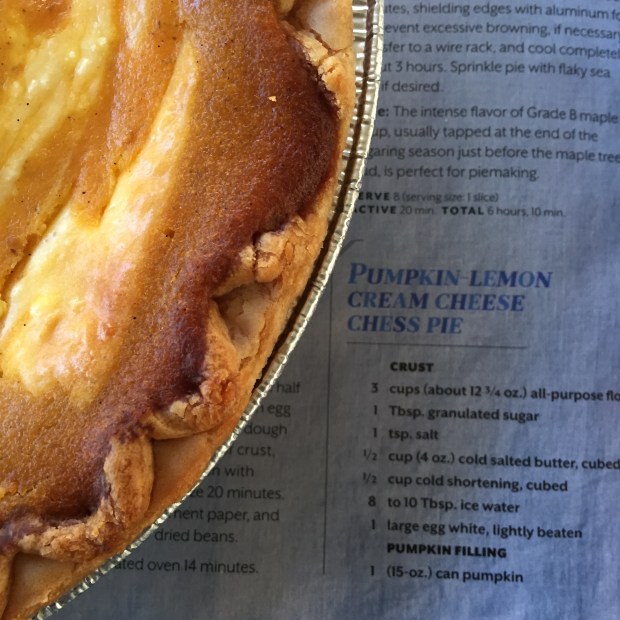
This month’s Southern Living Magazine includes a recipe for pumpkin pie, in addition to other classics like sweet potato and pecan. I used store bought pie crust to save time. The filling is enough for two deep dish pie crusts. For me, the combination of summery lemon cream cheese and fall pumpkin spice make the dessert one of the best pumpkin pies I’ve ever had. Sweet-tart, smooth-creamy and airy…like a two in one dessert that works very well. If you have ever wondered what happens when you put together a cheese cake and a pumpkin pie, try this. Its worth the small effort.

Wishing you happy Monday,

Hungryphil


Eating Object-Oriented Thinking

Last week at the Purdue Aesthetics Conference I spoke of four object-oriented thinkers who employ food references to demonstrate their defense of object wonder, vitality, complexity and gravity.

  1. Ian Bogost’s pound cake shows us complex “alien” encounters that yield a pound cake. He compares Alton Brown and Duff Goldman’s approach to cake baking.
  2. Jane Bennett’s berries and beef show us by comparison Nietzsche and Thoreau’s food preference as indicative of their philosophies.
  3. Timothy Morton borrows from the Shredded Wheat commercial slogan of “nothing added nothing taken away” to celebrate things as they openly announce their duplicity.
  4. Levi Bryant’s brazil nuts exemplify bright objects capable of exerting existential gravity on things around them.

My study of OOO was meant to help me develop a food-oriented strategy towards writing a cookbook. It is not about simply writing recipes for my daughters to follow but rather offer guidelines that might help them question all recipes (normative prescriptions) and find their own relationship with each dish (embodied and existential situation amidst other organic and inorganic things) in order to avoid living a correlationist life searching for correspondence to an abstract external “truth.”( I have to find a subtle way to insert the philosophy between the lines. Is there one?)

OOO offers strategies and orientations to think things, to speculate and imagine object lives and demands. I eat it…… is only one-half the story in any inter-object relationship. How it eats me…is the other half of the story…the more, imaginative, interesting, consuming part of any object story. And so, the task of Bittermelon and Brownies: Proclamations of a Philosopher-Mom is to show how we are ourselves ingredients in each recipe.

Now that I’ve announced the project I really have to do it! Yikes!

I’ve just started to work on the cookbook. Wish me patient consistent writing! I’m open to your advice and suggestions dear bloggers, hungry philosophers, food writers, chefs, and cookbook authors.

Here is a satirical example of a philosopher writing a cookbook that I find instructive and funny!

October 10

I find myself trying ever more radical interpretations of traditional dishes, in an effort to somehow express the void I feel so acutely. Today I tried this recipe:

Tuna Casserole

Ingredients: 1 large casserole dish

Place the casserole dish in a cold oven. Place a chair facing the oven and sit in it forever. Think about how hungry you are. When night falls, do not turn on the light.

While a void is expressed in this recipe, I am struck by its inapplicability to the bourgeois lifestyle. How can the eater recognize that the food denied him is a tuna casserole and not some other dish? I am becoming more and more frustrated.

From, The Jean-Paul Sartre Cookbook by Marty Smith, from the Free Agent, 1987

Hungryphil eats the FEAST

Last month I wrote an article for Edible Indy Magazine inviting everyone to experience the Feast of the Hunter’s Moon at Fort Ouiatenon. Of course for your benefit my dear readers (with no self interest at all) I had to try the fry bread and other other delicacies for myself. It was a difficult task on a foggy, cool, Sunday morning but I prevailed and ate through the Feast (as I said only as research). Here is what I ate, learned and saw:

Forfar Bridies

The pastry crust was buttery soft and flaky. The meat filling (I don’t know what it was and don’t want to know) was moist and flavorful with an almost  soft meatball mouth feel. Surprisingly filling and delicious.

Beautiful Furry, Shiny and Colorful Things

Noodables

A vegetable pasta sort of dish. Not my favorite but a very tasty vegetarian option. [ Very few things can compete with fried dough]

Desperation Pie

A cream, egg and flour pie made during the winter when all else is well……dead. Hence, called desperation pie. The best part of this story is that desperation pie is Indiana’s state pie. I’ll leave you to draw your own conclusions.

Popular Turkey Legs offered by the Audubon Society

No comment needed.

Dances, Processions and Learning

Feast organizer Leslie Martin Conwell (seen below in the red dress) did a wonderful job explaining, welcoming and opening the festivities on Sunday morning, while looking stunningly regal.

img_3047

People Making Stuff

Fascinating, tedious and difficult stuff like lace, roast chicken and woven gourds

Delicious Varieties of Fried Dough

As I said before what could be better on a cool, foggy morning, strolling through the complex past while eating fried dough with a cup of spiced cider?

Amazing to think how contested, (as evident by all the flags flying) a small patch of land can be. At the Feast of the Hunter’s Moon we got a chance to enjoy the sweet on the banks of the bitter.  We human beings are so odd in our sharing and killing of each other. Capable of such creativity, deliciousness and brutality. The Feast reminds us that amidst the grand histories of war there was a parallel labored history of beautiful and tasty things that defied death and conflict. If you haven’t already experienced this historical moment in Tippecanoe county, go ahead and mark your calendars for the 50th anniversary of the Feast, October 2017.

I wish cultural exchanges were only and all about sweet fried bread.

Extending to all of you imaginary virtual bread,

hungryphil

Food Poem – My Mother Was a Brilliant Cook by Maria Mazzioti Gillan

You know I had to post this! It connects the craft of cooking with contentment. May we all find a craft that helps us be so at home.

The first time my mother went out
to eat was on her 25th wedding anniversary
at Scordato’s in Paterson, and the second time
was for her 50th anniversary
at the Iron Kettle House in Wyckoff.

My mother said, “I could have cooked
this meal better myself.”
But I knew she was happy,
though she would have never admitted it.

Once my mother came to Paterson
from Italy in steerage,
she was content to stay there.
She was a brilliant cook,
and didn’t need to go to restaurants.
She loved her house, poor as it was,
and never stayed in a motel or took a vacation
or wanted to.

She was content to offer platter after platter
of food to her family gathered
in her basement kitchen, and to watch them
laughing and talking together,
while she stood behind them
and smiled.

“My Mother Was a Brilliant Cook” by Maria Mazziotti Gillian from What Blooms in Winter. © NYQ Books, 2016.

From the Writer’s Almanac

First World Food Warning: Taco trucks at every corner

Usually, I post benign, seemingly non-political musings about food as social glue. I know this is old news but I’m fascinated by a perceived immigrant threat represented through food. In this case, the threat that increased latin immigration in the U.S will result in food trucks at every street corner turned into a joke, as most enjoy tacos regardless of political views on immigration.

The threat that increased latin immigration in the U.S will result in food trucks at every street corner was projected as, cultural and culinary. That’s funny in a deeply meaningful kind of way, right?

Think of it, french fries, hot dogs, pretzels, spaghetti, pizza, all are cultural “impositions” in the U.S. I’m not even going to address European imposition on Native American culture. I don’t know how because the imposition was so overwhelming and complete.

The problem with this argument is that in most cases no one is “forcing” another to eat a certain type of food. I may want to impose samosas on an unsuspecting American culture. But how would I? Sell samosas everywhere, perhaps every street corner? But here is my problem. Selling. People would have to buy and want samosas at every street corner for it to work. [Unless people are starving and samosas are the only option. This is why the scarcity of water is so scary. There is no choice, we need water to survive.]

Historically the imposition works the other way to “Americanize” immigrant foods. For example historian, Jane Ziegelman writes of Italian immigrants in 97 Orchard: An edible history of five immigrant families in one New York Tenement,

In the hostile environment first encountered by Italians, food took on new meanings and new powers. The many forms of discrimination leveled at Italians encouraged immigrants  to seal themselves off, culturally speaking, from the rest of America.[…….] Harsh critics of Italian eating habits, Americans tried through various means to reform the immigrant cook. The Italians were unmoved. Despite the cooking classes and public school lectures, and despite the persistent advice of visiting nurses and settlement workers, the immigrants’ belief in the superiority of their native foods was unwavering.

Don’t we all think that our food tradition is better? Regardless, compulsion in cuisine, whether by immigrants or natives, seems difficult. There has been historically failed efforts to force new foods or limit certain food types (like the Futurist effort to ban pasta in Italy or the parent struggle to make kids eat vegetables) Still, in democratic, capitalist America, the taco truck warning does seem laughable and serious at the same time.

The fact that Marco Gutierrez, founder of the group Latinos for Trump, a Latino! issues the threat is extra confusing.

“My culture is a very dominant culture, and it’s imposing and it’s causing problems. If you don’t do something about it, you’re going to have taco trucks on every corner.”

Should I be worried about imposing my Bengaliness on my unsuspecting American, ethnically European friends and family? I, the hungryphilosoper, am so confused. This first world food problem certainly requires more consideration.

For now, here was one response to the “food fight”: Guac the vote.

https://munchies.vice.com/en/articles/latinos-are-co-opting-the-taco-trucks-on-every-corner-threat-to-guac-the-vote

Thank you, dear Latin people for your contribution to my personal taste buds…I and my South Asian peeps very much appreciate the chili peppers.

Off to find a taco and wish there was a truck on the corner,

Hungryphil


Inorganic Recipes from Artist Charles A. Gick

IMG_3706.JPG

Don’t miss this extraordinary exhibition about ordinary things, like dirt and spoons. Here is why…

This local studio to gallery recipe grows out of a Catholic farming family in Indiana. Artist and inorganic chef, Charles Gick, has been perfecting the cracked earth recipe since his childhood on the farm, drawing with a stick on summer mud. The exhibition is a culmination of his first tastes of meditative marking, multi-medium expression and elemental reverie. His work is as primal as the first cave etchings and as contemplative as the black paintings in Rothko Chapel. Cracked earth, both atmospheric and sculptural, becomes the ground for offerings and incomplete messages that either hover above or sit unanchored. On the slabs of cracked mud we taste the farm in the collective labor that stretches between the trucks of earth, the mixing of wet mud, the drying until cracked. Through this strange and shared effort of working the earth Gick cultivates a meditative space. The broken earth’s hunger for the clouds reminds us of a simple farming truth: blooming requires others. Gick distills the bittersweet taste of this farming truth by framing raw, earthworm etched, air-dried, messy dirt with intentional clean clarity, like all sophisticated farm-to-table dishes that celebrate the ingredients. His skill as an inorganic chef finds full expression in his ability to balance the raw and the refined. Not only is he able to balance sorrow and delight, longing and union, vulgar and elegant, he is also able to offer these tastes in multiple mediums and forms. His work includes performance, painting, sculpture, photography, design and video, so people with diverse aesthetic palates can find something to savor. The slabs of cracked earth become meditative totems, prayers for clouds. It materializes, an ethereal longing for the other. Enjoy these recipes for cracked earth, empty… and full… and taste your own muddy and cloudy longings.

Ingredients

Makes 2 (16’X16’ Slabs)

  • Local dirt 10 tons
  • Water 850 gallons

Equipment

  • 1 Truck with a hydraulic lift bed to transport, deliver, and dump dirt
  • 3-5 Human beings to mix and transport the mud
  • 1 spade and 1 shovel to scoop dirt from dirt pile and place into buckets
  • 1 – 3’x3’ wire sifter to shift out dirt clods
  • Wheelbarrow to transport dirt to fill the buckets
  • 3 electric drills with dry wall mixing blades to mix the dirt and water
  • 25 – 5 gallon buckets to mix and hold the mud
  • A large cart on casters to transport the buckets of mud
  • 1 floor scraper to clean the floor of splattered mud
  • 2 commercial floor drying fans (additional small fans can be used as needed) to help expedite the drying and cracking process
  • 16 sheets of 4’ x 8’ – 5/8” plywood
  • 24 – 8’, 2”x6” pine
  • 8 – 16’, 2”x6” pine
  • 150 linear feet of pine screen bead board
  • 1 miter saw
  • 1 cross saw
  • 1 coping saw
  • 1 miter box
  • 150 – 7/8” metal brads to secure the screen bead board to edges of platform
  • 40 – 3” wood screws to secure the outside corners and end pieces of platform
  • 400 – 1-1/4” or longer wood screws to secure plywood to platform
  • 4 tubes of silicone calking and 1 calk gun to seal seams of plywood
  • 2 – 3 gallons of paint to paint the surface of the platform
  • Paint roller and paint tray
  • Wet/dry vacuum and a mop and bucket and broom to clean dust and water off of the gallery floor
  • 1 – 10’ x 100’ 6mil black poly sheeting to protect the gallery floor from moisture from pouring mud onto platforms
  • 4 – 16’, 1”x6” pine boards for the outer walls of mud mold
  • 2 – 8’, x 1”x6” pine boards to build a dam while pouring mud

Directions

  1. Build platform: First lay down a 20’X20” square of heavy plastic to protect gallery floor from the mud and water. It is imperative to be a considerate guest artist. Build platform, a 14’X14’ base with evenly spaced joists that can bear the weight of mud. Screw the 16’X16’ plywood top to cantilever over the base. Be sure to make the seams minimal. Each seam is an invitation for a water leak. Apply chalking over each seam in a futile nature-defying attempt at waterproofing.

Next add the 1” X 6” wood strip around the platform perimeter creating a frame to hug and constrict the mud. Apply black Gorilla Tape at the seam to prevent the escape of water to the floor. Now the platform is ready to receive the mixed wet mud.

  1. Mix mud: Ask politely for the dirt to be delivered and dumped outside. Shovel or spade scoopfuls of mud to be sifted and shaken. Much like baking a satiny smooth cake the sifting allows the removal of big clumps. If banana bread like texture is desired, leave dirt un-sifted. Note the difference in the two cracked earth slabs: The one holding the cloud dome is less sifted and has more texture while the slab under the earth and sky coat has less.

Using a wheelbarrow, transport dirt to the interior space closer to a water source. This transfer may also offer relief from hot Indiana summer days. Scoop dirt into 25 – 5 gallon buckets. Using a drill, mix 2 to 3 gallons of water to each bucket until a thick cake batter state is achieved. Relying on a table with castors and the energy of 3 people, push 25 buckets close to the platform in the gallery. Walk up onto platform as needed. Construct a sidewalk concrete pour-like dam that will permit a slow and controlled pour. Each dammed section will be limited by the stretch of your body. Pour mud until a thickness of 5” is reached. Repeat until the full 16’X16’ square pan is filled.

  1. Let dry: Do not be alarmed when water rises to top. The rising water allows for a brownie like crusty surface (a ¼ inch of water floating on top is fine). If a heavy spot of water develops use wet-dry vacuum to pull the water away without touching the surface.

Use commercial fans to hasten the drying process. Rotate fans around every couple days. Be sure to face fans in the same single direction so that air travels across the surface, like wind over the landscape. Do not create tornado conditions. Allow for 2 weeks of drying time.

For vulnerable and soft areas, mix thicker mud to make a stronger mold. Also note that the gallery will become humid as water escapes into the air, creating an invisible domesticated cloud.

The poured wet mud of 5 inches will shrink down to 3 inches. The mud will become hard enough to walk across and hang up watches or place a cloud dome. Limit walking to protect brownie-like crust. Once mud pulls away from the platform wall about a ¼ to ½ inch, lift the 1”X6” form away without hurting or pulling the slab. Now the cracked earth is ready, hovering over the platform, broken and waiting to receive.

Serve the Slabs of Cracked Earth with:

The Earth and Sky Coat

The Cloud Dome

Charles A. Gick’s Recipe for Empty

  1. Locate 20 square feet of wall space
  2. 241 unfilled teaspoons will make 2-1/2 pints of absence. Gallons of restless meditations can gently perch on each cusp. Breathe deeply to give life to each possibility.
  3. Form a 5’ diameter circle filled with 8 concentric rings of emptiness

Charles A. Gick’s Recipe for Full

  1. Locate 20 square feet of wall space
  2. 241 teaspoons of sifted dirt will make 2-1/2 pints of presence

Find a willing gallery director, not afraid of heights or dirt, to stand on a lift, hold cup under each spoon, sprinkle dirt over each until a tiny mountain forms within each cradle, let the dirt granules comfortably settle. Do not apply wind to the fragile dry earth. Hold your breath. The teaspoons cannot hold anymore.

  1. Form a 5’ diameter circle filled with 8 concentric rings of fullness

‘My fathers’ globe knocks on its nave and sings.’
‘This that we tread was, too, your fathers’ land.’
‘But this we tread bears the angelic gangs
Sweet are their fathered faces in their wings.’
‘These are but dreaming men. Breathe, and they fade.’

Excerpt from I fellowed sleep by Dylan Thomas

For recipes and tastes like, how to cage a cloud, how to sew an earth & sky coat and more, visit Charles A. Gick’s Dirt & Flowers: and other things we eat and breathe… at Wabash College.

Recipe developed by Charles A. Gick and written by the Hungryphilosopher
Simplicity – Chef Alexandre Couillon

IMG_0113.jpg

“When you get a star you question everything. I looked to Celine and said “What should we do?”…..Here was our chance to do something different. And, that’s where the idea of demolishing everything began…to start from scratch, to say, “we are going to build a real restaurant.” We started to put a lot of things in the dishes with no particular construction. We were trying to be different. We tried tomato ice cream with potato chips. We made shallot orange jams, tomato juice drinks…We were doing all this in one dish. It was ten dishes in one. We were lost.

….Simplicity is what gives us so much emotion. The goal was to imagine that there was no separation between the sea and the kitchen. That’s what I was missing. That is the path of the future.We started to simplify dishes…to refocus our cuisine.”

Image from: http://www.critique-gastronomique.com/

Quote from: Chef Alexandre Couillon of La Marine from The Chef’s Table, Season 5