BakingPhil Project 1: Cream Scones

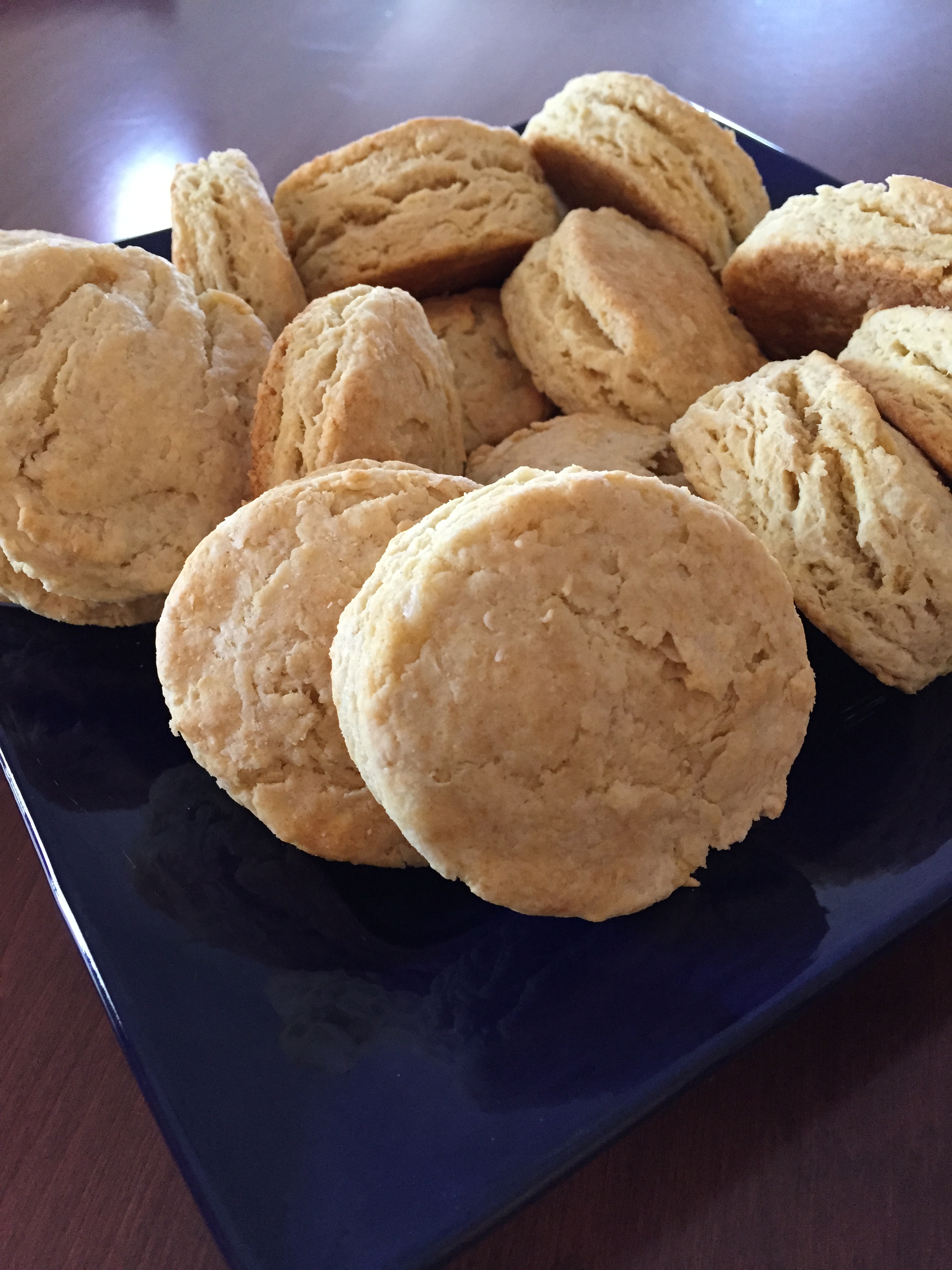
IMG_1429

It may seem ironic that I’m embarking on this baking fest. After all, I started 2015 limiting wheat, milk, sugar, caffeine and red meat. On the opposite end of the spectrum, last night I enjoyed an unhealthy amount of delicious processed food in the forms of nachos, wings, tiny hot dogs, cookies, banana pudding and cake pops. The truth of my appetite is somewhere in between. Maybe because I’m trying to limit all the yummy, supposedly bad for me stuff, I feel the need to make the carbs, sugar and red meat I do have….an event. No plain white bread, frozen beef-patti burgers or cheap milk chocolate for me. No thank you. If I’m going to poison my body, I want to at least enjoy a few moments of deliberate and designed gastronomic delight.

So, here I am at the first entry. I’ve chosen Cream Scones first, because I’ve made biscuits before and wanted to try something different. Second, Jim always orders scones, I’d like to be able to make him some and lastly, as previously confessed, my sister’s taunting.

Cream Scones (Recipe 6.5 in the textbook OnBaking)

This recipe requires that we apply the biscuit method of mixing. If you want the actual recipe, let me know. There are so many recipes online and I’m not really adding anything. The point here is not offer a how to guide ( I cannot claim expertise) or a recipe for scones but rather expose how everything you do, even as seemingly simple as baking bread, can be meaningful and philosophical. We are all hungry philosophers. We all make meaning everyday, even in baking scones. The interesting features of this particular method are:

  1. The fat that gives it flavor and adds air in the form of flakiness is solid. So, if we speak in architectural terms, the butter acts as scaffolding that helps the structure rise, but also forms the spaces. Its poetic to think of the disappearing butter as the secret to a biscuit or scones particular flavor.
  2. In this method, over-mixing is a sin. Don’t do it. The key is to keep the ingredients in a loose aggregate that allows space for the butter to form pockets of air. Aggressive mixing literally squashes the possibility of flakiness, of air/flavor pockets…..and then you get the hard as a rock hockey puck that I myself am guilty of making. I’d like to think I’m a gentler person who believes in supporting the benevolent actions all diverse components, now. The biscuit method demands gentility. As Hannah Arendt wrote, one of the techniques of totalitarianism is in blocking free movement:

“By pressing men against each other, total terror destroys the space between them; compared to the condition within its iron band, even the desert of tyranny, insofar as it is still some kind of space, appears like a guarantee of freedom. Totalitarian government does not just curtail liberties or abolish essential freedoms; nor does it, at least to our limited knowledge, succeed in eradicating love for freedom from the hearts of man. It destroys the one essential prerequisite of all freedom which is simply the capacity of motion which cannot exist without space.” (Origins of Totalitarianism, 466)

Don’t be a totalitarian with your scones, says the recipe.

What I Learned:

  1. Don’t let the fear of over-mixing scare you. In my nervousness I added the liquid BEFORE I cut in the butter. Yikes. Not a good start to this whole project. I grated the solid butter and then added it to the flour under the liquid as best I could.
  2. I didn’t have half and half as the recipe required. So I mixed whole milk and whipping cream. May have been too heavy for the recipe.
  3. The 10-minute baking time needed adjusting. I let it bake for a few more minutes. But I think I could have left in a bit longer to get more color.

Baking may be a science but accidents happen, substitutions and adjustments are often needed. I have a feeling this may be a dominant theme in future posts.

It tastes moist, slightly sweet, flakes as I bite into it. Soft, not hard. The dough was flaky even I was rolling it. Next time, I’d like to try adding more flavorings like orange zest or strawberries. I’d probably give myself a ‘B’ on account of the sequence fiasco and it could’ve risen more and had more color. I’ll perfect it before I send my sister a box.

Credits

Thank you to the book Onbaking and the systems of publishing, my mixing bowls, rolling pin, flour, butter, sugar, baking powder, soda, eggs, milk and the systems that produced, distributed, packaged, branded and sold the ingredients like, chickens, cows, wheat plants, wood, truck drivers, grocery shelf stockers, my oven, my warm house, my kitchen island, my roof, the gas company, the gas, the pipes that brought it to my oven, the timer, the internet, this blog, my camera, my tasters……etc. etc. for making this taste experience of production and consumption possible.

Baking Philosopher Project

51YXERWMKRL._SY344_BO1,204,203,200_

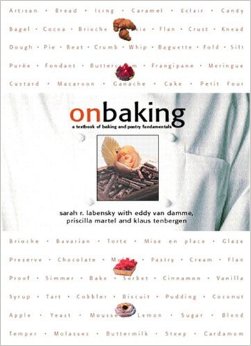
As long as I can remember, I loved to cook. Baking, however, intimidated me with its strange bipolar rhythm between energetic beating, whisking, rolling, folding and patient waiting to heat, cook and cool. But mostly, what scared me is its insistence on measurement. Recently, I’ve come to rethink baking as architecture. Baking is a measured combination of flour and air, just like architecture is a measured experience between structure and space. The quality our experiences related to both is enhanced by color/flavorings, comfort/fat and texture/grains. The comparison is not mine alone. In reading the textbook Onbaking: a textbook of baking and pastry fundamentals (Sarah R. Labensky, Eddy van Damme, Priscilla Martel and Klaus Tenbergen), I found this quote by Marie-Antoine Careme (1783-1833)

THE FINE ARTS ARE FIVE IN NUMBER, NAMELY: PAINTING, SCULPTURE, POETRY, MUSIC AND ARCHITECTURE, THE PRINCIPAL BRANCH OF THE LATTER BEING PASTRY.

Maybe I can learn to love baking too. So the next few months, I’ll be working on philosophically developing practical appreciation. As you can tell, I got the book. Not much research in that, just ordered a used textbook (new textbooks are very expensive!). I’ll be following onbaking for this project. The first five chapters cover history, equipment, principles, ingredients and such. I’ll start posting at chapter 6 Quick Breads.  Here’s my five reasons for doing this:

  1. Given all the information and support available online I should be able to teach “myself” to bake. It’s a DIY exercise of teaching and learning. There is nothing like having an experienced baker’s tastebuds and skills…which brings me to my second reason.
  2. I don’t have money to spend on baking school. If I win the lottery, it’ll be top on my list.
  3. I want to treat this as a radical philosophy project. In What It’s Like to Be a Thing, philosopher Ian Bogost calls us all to be hybrid philosophers. This is my attempt to be a philosopher-baker, by which I bring thoughtful attention to the practice and all its magic. What would it mean to live philosophically, to bake and cook philosophically?
  4. On a mommy level, I want to be able to send my baby in college yummy treats. Baked goods are tasty pieces of love that travel well, unlike my cooking.
  5. Now that I’ve publicly announced this project, I’ll have to be accountable for myself. Nothing like, guilt and shame to sustain a project. Okay…fine….for you positive people out there…yes, I’m talking to you Jim…..Support. Hopefully, I’ll have your support to continue on this tasty adventure. If you want to join me online in this baking project, please do. Go through any baking book you have on hand. If you live near me, you know who you are…come over.

Let the BAKINGPHIL PROJECT, Begin! First, the three mixing methods: biscuit, muffin and creaming. Next time: The muffin method of mixing used in cream scones. I start here because my sister teases me mercilessly about the “hockey-puck” scones I made loooooong ago (literally 25 years ago). She hasn’t forgotten. I shall have my vindication! Didn’t I say, baked goods ship well. Hmmmm.

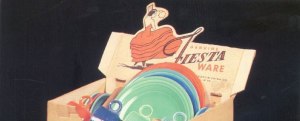
Fiestaware: Freedom is Fun (1936)

history-fiesta

Bright. Colorful. Affordable. Fun. Produced 1936 by the Homer Laughlin China Company and designed by ceramicist Fredrick Rhead, Fiestaware, is and continues to be emblematic of American youthful enthusiasm. The dinner set befitting a casual dining experience was sold as a fun way for the housewife to set the table with mix matched colors of dinner plates, bowls and salad plates. This attempt to convert domestic labor into pleasurable home making, added creativity as a component to democratic domesticity. Unlike the dinner sets of formal uniformity and applied decals, Fiestaware was decoratively stark yet robust in color. Creative pleasure in composing the dinner table replaced the dinner set as a symbolic social indicator of wealth into a domestic craft. Marketing for the low and middle income, Fiestaware hoped to empower the average American housewife with a palette of colorful pieces with which to construct her masterpiece………the family dinner. In the era of post-depression recovery, a well considered and presented family dinner was no mundane matter. It was the height of democratic resilience.

The great depression had threatened the very ideal of endless American frontiers and possibilities. Recovering the joy at the dinner table reclaimed a sense of abundance. Instead of recreating a dreamed of Rockwellian past, Fiestaware dinnerware aimed to deliver a new future. Fiestaware was for a community table, a party or a neighborhood, instead of family table. The flexibility of quantity and color reflected gatherings of any size. This sense of sharing beyond family depicted democratic resilience that invited guests in times of need. Emblematic of collective shared joy, Fiestaware announced the rebirth of the American dream, not as the endless frontier, but as the united local front against the world. The celebration of community through bright colors, exchangeability and simplicity reflected the sense of unity in qualified diversity.

The idea of ‘fun’ in domestic upkeep and entertaining was a novel modern American ideal. The name ‘fiestaware’ pays homage to the atmosphere of collective joviality. Despite its Spanish name or maybe because of it, ‘Fiestaware’ deserves a spot in our list of American things. The name is the first clue to its American character. Fiesta. Party ware. The name alone conveys the youthful, vibrancy of a young emerging nation and its designs. Although ‘Fiestaware’ was quintessentially American in character, the name American Modern, was soon to be taken by Russel Wright working for Steubenville Pottery of Ohio, in 1937. The American Modern Dinner set was also based on the same principle of interchangeable colors. However unlike the geometric and deco style of ‘Fiestaware’, ‘American Modern’ was organic in shape. Fiestware and American Modern showed two different visions of an American future: one structural futuristic and the other, organic. Both shared an antipathy for historical reference and applied decoration.

Fiesta ware’s form has much to do with its longevity. Geometric, basic shapes, the high gloss finish, the banding lines on the rim and most importantly the variation of colors red, orange and blue. One could either purchase a single color or a mix. The feature of the interchangeable colors relates to individuality in a party and serves the informality of inconsistency. The standardized interchangeable colors conveyed, pluralism and individuality, two prized American ideals. The third ideal present in the dinnerware is attention to the future. The geometric, concentric, circular patterns without narrative reference projected a casual non-hierarchical simple future. In direct contradiction to European traditional dinnerware, Fiesta ware hoped to invoke the space age of possibility through blank colorful pieces for each housewife to compose as she chose. A far cry from 19th century British potter Josiah Wedgewood’s Queen Ann ware, Fiestaware shed all hints of aristocratic imitation. Fiestaware’s aversion to historical decorative arts represented by simple geometric clarity, bright colors and mass-market appeal shares the perspective of the 1920s German Bauhaus school of design that emphasized materials and the industrial production process. Fiestaware emblematic of the American spirit of casual dining, youth, vibrancy festive optimism at the eve of WWII would set the stage for the maturation of mid-century American style.

The 1930s witnessed the rise of industrial design as a profession. Easing housework drudgery was high on the national agenda as a democratic aspiration. Industrial designers like Walter Dorwin Teague, Raymond Loewy, Henry Dreyfuss, with backgrounds in commercial illustration and theater, constructed the appearance of a clean, efficient, simple modern world. Frederick Rhead’s Fiestaware was a member of the 1930s campaign of for visual simplicity, domestic comfort and mass-produced collective consumption that fueled American nationalism.

An immigrant potter from Britain, Fredrick Rhead produced his ware in the heart of the U.S. in West Virginia. The production location in a small town and celebration of the middle class consumption both attest to its democratic spirit. The spirit of national service continued to characterize the product. Reporting the recent 75th anniversary of Fiestaware, Holly Goring writes, “One of the most well-known aspects of Fiesta’s history was the discovery that the original red-orange Fiesta glazed dishes contained detectable amounts of uranium oxide (as did many red glazes produced by US potteries of the time). The red glaze is not the only color of vintage Fiesta ceramic glazes that is radioactive; it is also detectable in other colors, including ivory. During WWII, the government took control of uranium for development of the atom bomb, and confiscated the company’s production quantities. Unsurprisingly, Homer Laughlin discontinued the color in 1943.”[i]

Although first molded in 1936, and despite a period of radioactive glazes, Fiestaware continues to appease American taste. In shops like Kohls and Macy’s we still see Fiestaware grace the displays and weekly circulars. Due to low sales, Fiestaware was discontinued in the 1970s. In 1986, responding to a high value on Fiestaware collectable, the Homer Laughlin began production again. Fiestaware celebrated its 75th year in 2012 with the color ‘marigold.’ About Homer Laughlin’s flexible mass production, marketing and technological innovation, historian Regina Blasczynk writes, “Serving mass retailers and their customers was the name of the game at Homer Laughlin. From the 1920s through the 1940s, the firm’s managers undertook an expansion and renovation program designed to strengthen their alliances with mass merchandisers and to safeguard their reputation as potters to Her Majesty-The American Housewife. With the objective of meeting the demand for more goods and varied goods, Homer Laughlin’s managers selectively introduced Fordist methods to their Ohio River valley industrial site, deliberately shielding certain craft operations against mechanization.”[ii]

The civic role of Fiestaware is not unique. Post-depression design efforts conveyed a sense of national investment towards economic, social, and political recovery. Democracy, itself was at stake in this period. The climate of defending democracy is evident also in philosopher, educator John Dewey’s idea of design. Writing in the same time period, as Fiestaware, Dewey was concerned with democracy grounded in education, and correspondingly aesthetics ground in collective appeal. According to him, a democratic structure aims to diminish hierarchies of any kind and asserts “primarily a mode of associated life, of conjoint communicated experience.”[iii] In Dewey’s thought we find no privilege but rather continuity of theory and practice, art and design, beautiful and useful, means and ends, artist and beholder, form and context, producer and consumer. So, the artist has no more power than the viewer of the artwork. In aesthetic reflection, the viewer recreates the artwork and sympathizes with the efforts of its maker.[iv] It is the subjective continuity and connection mediated by the art object that Dewey found compelling. The design translation of his philosophy appears as increased attention to consumer responses to products. The agency of the consumer, viewer or user is important to note, as we consider Dewey’s idea of collectivity and creativity. In aiming to support the creativity of the housewife, Fiestaware, invited flexible everyday use and gave democratic freedom a fun and playful look. Fiestaware was sold as a palette for the creative housewife. The increased role of the average American consumer in affecting the production and marketing of products was in contrast not only to European aristocratic systems but also the communist system of shared labor. Decades later 1959 in pointing out the dishwasher, during the famous Nixon-Kruschev debate, Nixon was pointing out the importance of domestic labor in a democracy. In 1936, Fiestaware was an exercise of flexible consumer choice that set America apart. The principles of individuality, non-hierarchical imitation, interchangeable place settings, domestic ease, joy in homemaking, all characterized the notion of American freedom cultivated against European aristocracy or communist uniformity. The story of Fiestaware is a cosmopolitan statement of joy found in American national achievement through domestic comfort.

[i] Holly Goring, “Fiestaware Fiesta,” Ceramics Monthly, no. January (2012).

[ii] Regina Lee Blaszczyk, “Reign of the Robots: The Homer Laughlin China Company and Flexible Mass Production,” Technology and Culture 36, no. 4 (1995).

[iii] Richard Bernstein, John Dewey (New York Washington Square Press, 1966).

[iv] “A work of art is recreated every time aesthetically experienced” Ibid.



Apple Crisp and Ice cream Happiness

exps6080_DM1002C21

Happiness

Why, Dot asks, stuck in the back
seat of her sister’s two-door, her freckled hand
feeling the roof for the right spot
to pull her wide self up onto her left,
the unarthritic, ankle—why
does her sister, coaching outside on her cane,
have to make her laugh so, she flops
back just as she was, though now
looking wistfully out through the restaurant
reflected in her back window, she seems bigger,
and couldn’t possibly mean we should go
ahead in without her, she’ll be all right, and so
when you finally place the pillow behind her back
and lift her right out into the sunshine,
all four of us are happy, none more
than she, who straightens the blossoms
on her blouse, says how nice it is to get out
once in a while, and then goes in to eat
with the greatest delicacy ( oh
I could never finish all that) and aplomb
the complete roast beef dinner with apple crisp
and ice cream, just a small scoop.

“Happiness” by Wesley McNair from The Town of No and My Brother Running. © David R. Godine, 1998. Reprinted with permission.   (buy now)

from the writersalmanac.org

Justaddwater: Bringing molecular gastronomy home

koz-susani-design-justaddwater-nutrition-ecosystem-designboom-10

The January issue of the popular design magazine Metropolis has a short story about the designed nutrition and flavor system branded “justaddwater.” The designers call this a nutrition ecosystem that adjusts to the needs of the user, recommends and prepares appropriate meals (with the inclusion of flavor pills and fresh ingredients). Its like a strange mix of convenient keurig machine and a responsive nest climate controller. It takes the cooking out of cooking and offers a healthy replacement for precooked meals or fast food. For a restricted diet, it certainly would be helpful. Here is a quote from designboom.com,

‘justaddwater’ is a step toward transferring the food revolution of molecular gastronomy from exotic and high-end restaurants into the home, expanding the trend from elite consumers, to the more mainstream market. its values lie in bringing new appreciation to what we put into our bodies — gratifying one through gastronomic pleasure, while respecting food, its associated rituals and nutritional values. above all, it aims at doing this through a renewed design language, merging the artificial with the natural in a way that is beneficial and does not pose any friction.

The websites below have demonstrations and more information about this future direction in food design. What do you think?

http://www.kozsusanidesign.com/

http://www.brit.co/just-add-water/

koz susani design harvest justaddwater nutrition ecosystem

Koz Susani Design imagines food of the future

The Mythology of Steak Tartare

Mythologies_trans_Annette_Laverssteaktartare1

Roland Barthes’ collection of essays, Mythologies was written one a month during the years of 1954-1956 in order to infuse contemporary events and objects with a sense of history and time, with an aura of mythology. In order to live thoughtfully in our constructed world, Barthes’ suggested we all become mythologists, someone who can see the fluidity of value and meaning constructing and reconstructing itself continually, like someone riding in a car.

Myth is a value, truth is no guarantee for it; nothing prevents it from being a perpetual alibi: it is enough that its signifier has two sides for it always to have an ‘elsewhere’ at its disposal. The meaning is always there to present the form; the form is always there to outdistance the meaning. And there never is any contradiction, conflict, or split between meaning and the form: they are never at the same place. In the same way, if I am in a car and I look at the scenery through the window, I can at will focus on the scenery or the window-pane. At one moment I grasp the presence of the glass and the distance of the landscape; at another, on the contrary, the transparence of the glass and the depth of the landscape; but the result of this alternation is constant; the glass is at once present and empty to me, and the landscape unreal and full. The same thing occurs in the mythical signifier: its form is empty but present, its meaning absent but full. To wonder at the contradiction I must voluntarily interrupt this turnstile of form and meaning, I must focus on each separately, and apply to myth a static method of deciphering, in short, I must go against its own dynamics: to sum up, I must pass from the state of the reader to that of a mythologist.

For us, hungry philosophers, his chapters on “Wine and Milk” and “Steak and Chips” is particularly fascinating in how he looks at steak as a celebration of ‘full-bloodedness,’ an expression of sanguine mythology, like wine, in France.

To eat steak rare therefore represents both a nature and a morality. It is supposed to benefit all the temperaments, the sanguine because it is identical, the nervous and lymphatic because it is complementary to them. And just as wine becomes for a good number of intellectuals a mediumistic substance which leads them towards the original strength of nature, steak is for them a redeeming food, thanks to which they bring their intellectualism to the level of prose and exorcize, through the blood and soft pulp, the sterile dryness of which they are constantly accused. The craze for steak tartare, for instance, is a magic spell against the romantic association between sensitiveness and sickliness; there are to be found, in this preparation, all the germinating states of matter: the blood mash and the glair of eggs, a whole harmony of soft and life-giving substances, a sort of meaningful compendium of the images of pre-parturition.

Wow…..the myth of steak tartar takes us way back to uterine blood. This insight certainly interrupts the turnstile of form and meaning in order to look at the dish in its components, blood, pulp and egg, carefully prepared and its meaning reinforced (instead of a savage un-thought state of eating raw meat and eggs). The preparation, the design, the enjoyment constructs the mythology. Can we use Barthes’ method in uncovering the mythology of our things and foods, now in 2015? Maybe I can try in a future entry. The KFC double down, the Kuerig Machine, the Vitamix….come to mind.

Disclaimer: I have subjected myself to a New Year’s detox period without “toxins” i.e. wheat, dairy, sugar, red meat and CAFFEINE. Therefore, I may write A LOT about beef, bread and coffee, all things of related deliciousness. Dear readers, I beg your patience.

Mapping Roasted Chicken, Big Mac and Rice Relations

51Muy3NeWxL._SY344_BO1,204,203,200_-1

Philosopher Levi Bryant’s Onto-Cartography: An Ontology of Machines and Media presents us with multiple examples of how things (machines) exercise power over us and the world. Here are three food examples from the book:

We go to the grocer and buy a roasted chicken, believing that there is nothing social about this relation insofar as it is simply a relation between us and the chicken. Yet the commodity embodies an entire set of social relations that are the medium of the chicken, insofar as it was produced by people under certain conditions, within a particular legal system, within a particular network of distribution, and so on. As Deleuze and Guattari remark, “….we cannot tell from the mere taste of wheat who grew it; the product gives us no hint as to the system and the relations of production. The “mediasphere” of the chicken and wheat is veiled in the thing withdrawn from view.

What would a map of all the hidden relations in my grocery cart look like? I imagine quite a complex web. Here’s another familiar  and branded example,

When for example, I eat a Big Mac, I think I am involved in a purely cultural affair that has nothing to do with nature. In analyzing the Big Mac, the cultural theorist might discuss how what I’m really eating is “signifiers,” examining how this sandwich is a marker of national identity, class, symbolic position, and so on. What is not examined is how the Big Mac is related to the clearing of Amazonian rain forests for bovine grazing, and all of the material outputs produced in transporting the meat, processing it cooking it and consuming it. The Big Mac is thought of as something unrelated to these issues of relevance to climate change and ecology.

Like my grocery cart, what if I were to map my dinner plate. Where my ingredients came from, supermarket it came from, how much energy to took to cook, how long of my time and much of my space, how the ingredients affect my health, how much I waste, the role of my garbage man in carrying the waste away, the plumbing system that allowed me to wash my ingredients, the factories that produced the knives, pots and pans, how I found my recipes online, the network of foodies, cooks, eaters online, the taste, ……what a complex map my dinner is unfolding into. The next example, demonstrates how rice is an example of a bright object that has the directive power to organize and influence us and our world.

Rice is yet another example of a bright object. The rate at which it develops, how it is planted, how it is harvested, the number of times it can be harvested a year, all contribute strongly to the organization of people’s lives that rely on rice. These properties of rice influence the sort of labor people engage in, the tools that they fabricate, their bodily postures, how their bodies develop as a function of rice heavy diets, the sorts of social relations that develop between people, and feast and famine as a result of weather vents that affect harvests or diseases that befall plants. Once the technology or practices are developed allowing  rice to be planted in water, new problems emerge. Harvest sizes are increased through these new planting methods, but the water in which the rice is planted also becomes a nest for diseases. Now these diseases must be dealt with. Rice organizes the space-time of these people’s lives, especially before the advent of robust international trade and things like supermarkets. It organizes the rhythm of days, when things are done, how long they’re done, cooking methods, and variety of other things besides.

The book is a fantastic example of an object oriented approach to thinking about our world. I look forward to re-reading, highlighting, noting, pondering over these and other moments. Hope you do too.

Poetics of Buttered Toast

Not Yet

by Jane Hirshfield

Morning of buttered toast;
of coffee, sweetened, with milk.

Out the window,
snow-spruces step from their cobwebs.
Flurry of chickadees, feeding then gone.
A single cardinal stipples an empty branch—
one maple leaf lifted back.

I turn my blessings like photographs into the light;
over my shoulder the god of Not-Yet looks on:

Not-yet-dead, not-yet-lost, not-yet-taken.
Not-yet-shattered, not-yet-sectioned,
not-yet-strewn.

Ample litany, sparing nothing I hate or love,
not-yet-silenced, not-yet-fractured; not-yet-

Not-yet-not.

I move my ear a little closer to that humming figure,
I ask him only to stay.

“Not Yet” by Jane Hirshfield from The Lives of the Heart. © Harper Collins, 1997. Reprinted with permission. (buy now)

From the Writer’s Almanac

Confections of capitalism, fantasy, materiality, ideology, atmosphere and more

51QFWHG66TL

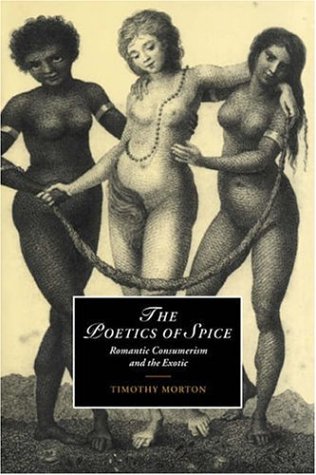
Among the most fascinating attributes of spice is its status as a cultural marker, and a strange one at that, halfway between object and sign, goods and money. Spice can become a sign of signs, and in poetry it serves as a figure for poetic language itself, a special kind of figure that Harold Bloom has called ‘transumptive’. In this role it approximates one of the economic values of spice in  the early modern period, its capacity to be used as a sign of other goods, as a form of money. Moreover, spice in its consumption becomes an index of social value. It is a highly self-reflexive kind of substance-sign: ‘about’-ness is what it is ‘about’. However much spice is brought into the realm of intellectus, it also still remains within the realm of the res as a hard kernel of the Real, a flow of desire. The poetics of space is not only about materiality, however — it is also about poetics. Thus there are two aspects to the poetics of spice, which are in a rather asymmetrical relationship: materiality and transumption.

Timothy Morton from the Poetics of Spice

I will be thinking about this for a long time. I feel the urge to cook with saffron, rose water and pistachios.

Faddists and Face stuffers not welcome

9780520269347

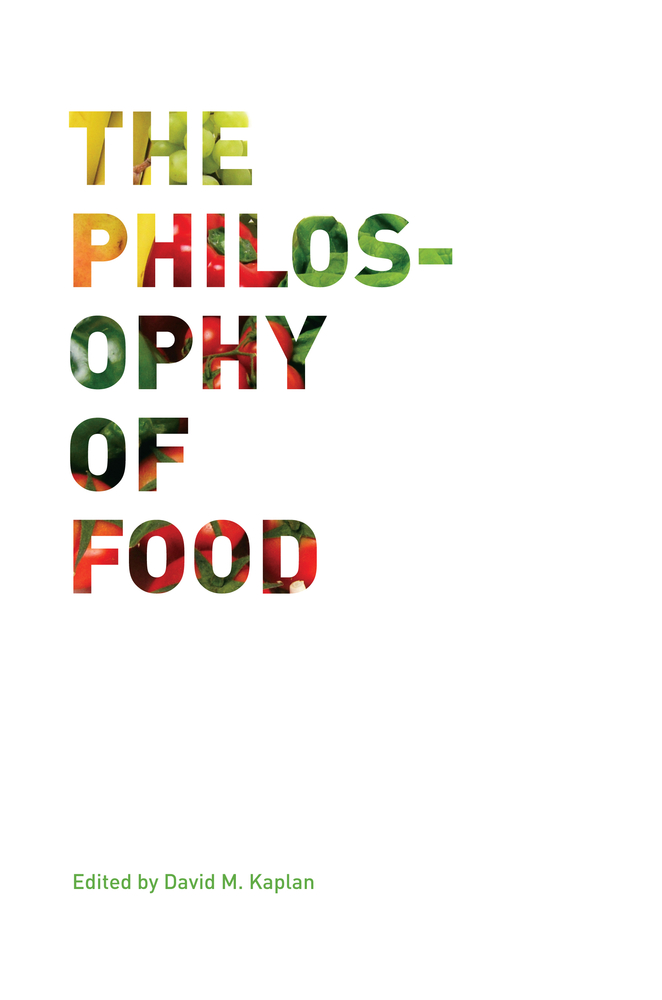
The rudeness of the glutton and the face stuffer is obvious. Equally ill-mannered- though it is politically incorrect to say so — is the food faddist, who makes a point of announcing, wherever he goes, that just this or this can pass his lips, and all other things mush be rejected, even when offered as a gift. …..Both the faddist and the glutton have lost sight of the ceremonial character of eating, the essence of which is hospitality and gift. For each of them, I and my body occupy center stage, and the meal loses its meaning as human dialogue. Though the health-food addict is in one sense the opposite of the burger stuffer and the chocaholic, he too is a product of fridge culture, for whom eating is feeding, and feeding a solipsistic episode, in which others are disregarded. The finicky beak of the health freak and the stretched maw of the junk-food addict are alike signs of deep self-centeredness. It is probably better that such people eat on their own, since even in company they are really locked in solitude.

This quote from the chapter entitled “Real Men Have Manners” by Roger Scruton published in the Philosophy of Food eloquently and vividly explains why we find sharing a table with picky eaters so unpleasant. You know this person. Maybe this year, when someone at the table begins to complain about the amount of butter in the thanksgiving meal you’ll know exactly why you’re irritated by their self-centeredness disguised as discriminating taste.