#grapegate and onions

 -1

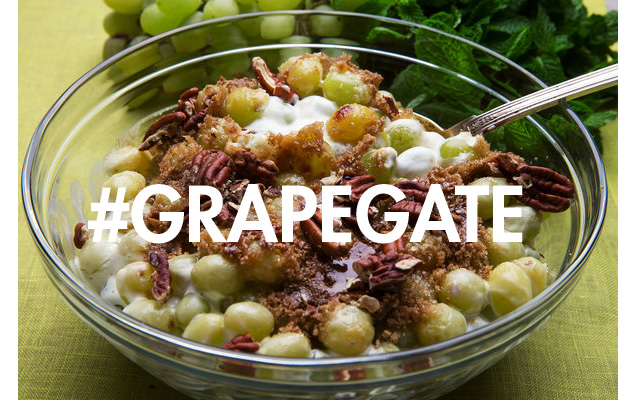
Usually we associate food with harmonious, benevolent, generous sharing. But….the angry response dubbed #grapegate to The New York Times article “The United States of Thanksgiving” (http://nyti.ms/1t9Ebcp) reminds us that food is deeply connected to how we identify ourselves. In this case the article offended the state of Minnesota with its attribution of grape salad as a gastronomic emblem. Alabama is not too happy either. Disagreement certainly fuels reviews, recipes, blogs, food writing, competitions and more. As Minnesota arrives at wild rice consensus we witness a region reclaiming it’s identity. Thanksgiving is not only a time of sharing but more importantly a time to confront tradition, nationally, regionally and personally. Whose recipes make it to the table? How are the recipes personalized? Imagine an Immigrant’s Thanksgiving Table…now there’s a great cookbook idea! As a cook in a chopped and blended family, I have to say, the dinner table is an exhausting culinary and cultural challenge with occasional exhilarating moments of delicious resolution (for us, usually in burgers and brownies).

(Dear Bobby Flay, yesterday I made your pumpkin bread recipe from the Epicurious recipe app. It was fantastic, moist, light, flavorful. I confess, I added dried cranberries making it even better. I feel you would approve. Recipes like rules are meant to be broken, sometimes with thought.)

May we all eat well and grow this Thanksgiving as we confront who we are and want to be together.

http://www.npr.org/blogs/monkeysee/2014/11/19/365194058/grape-salad-is-not-minnesotan-and-other-lessons-in-cultural-mapmaking


Here is a poem from today’s Writer’s Almanac that speaks to the intensity and intimacy of everyday culinary disagreements.

Recollection of Tranquility

The first time we ever quarreled
you were cutting an onion
in the kitchen of our rented cottage.
I remember vividly. We were making creole
for a late night supper with champagne,
and you were taking it seemed forever
to cut the onion.
Each time your dull paring knife
chopped on the counter, I shifted my feet,
and I saw once in a glimpse over my shoulder
a white wedge of onion wobbling loose.
I sighed inaudibly. The butter I stirred
had already bubbled and browned.
I was starting over with a new yellow lump
that was slipping on the silver aluminum
when you brought, cupped in your hands,
the broken pieces, the edges all ragged,
the layers separated, bruised and oozing
cloudy white onion juice.
I complained:
the family recipe stated specifically,
the onion must be “finely chopped,”
for what I explained were very good reasons.
Otherwise, the pungent flavors would be trapped
irrevocably in the collapsed cellular structure
of the delicate root.

You sighed, I guess, inaudibly
and adjusted your glasses carefully
with two fingers (a fidget
I have since come to know
as a sign of mild perturbation)
and explained:
the pungence of onions too finely chopped
would be simmered away. The original sharp
burning crispness could be retained
only in fairly large, bite-sized chunks.
But you wouldn’t fight tradition.
I mopped onion on the counter
with the dull knife, while you set the table
and figured the best way of popping the cork.

“Recollection of Tranquility” by Idris Anderson, from Mrs. Ramsay’s Knee. © Utah State University Press, 2008.
http://writersalmanac.org/

Eating and Dying to be human

bicentennial_man_05

“I am designing a system for allowing androids-myself-to gain energy from the combustion of hydrocarbons, rather than atomic cells.”

Paul raised his eyebrows. “So they will breathe and eat?”

“Yes.”

“How long have you been pushing in that direction?”

“For a long time now, but I think I have designed an adequate combustion chamber for catalyzed controlled breakdown.”

“But why, Andrew? The atomic cell is surely infinitely better.”

“In some ways, perhaps, but the atomic cell is inhuman.”

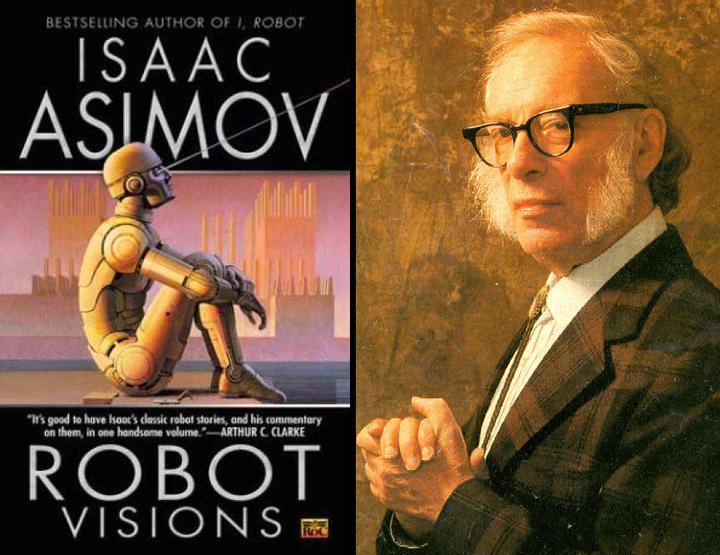
In previous post, I had written about the Golem’s pretense of eating in order to prove her humanity in the Golem and the Jinni by Helen Wecker. Another sci-fi classic version of the same pretense can be found in Isaac Asimov’s Bicentiennial Man, a story of transformation from robot to human that involves creativity, clothing, digestion, breathing and eventually death. Eating is the privilege of the living, organic and artificial, as the story suggests. Everyday, we limit or qualify our energy source, our food. Why don’t we all just take an efficient nutrition pill to sustain ourselves? (Our poor dog has been placed under a diet. He’s been extra needy. He really likes chicken and treats.) Anyway, back to our persistent effort to spice up, gluten free, sweeten, bake, fry, blend, season and plate our source of energy. If we put so much thought into what we put into our (and our pets) bodies as fuel, why don’t we worry about the energy we put into our lamps, heaters, cars, phones…all our stuff? Is it because our phones can’t taste or like chicken as Oreo the dog does? If my toaster worked better with one source of energy versus another would we care? Does the source of energy effect performance of things? I don’t know. Again…I digress. Asimov was on to something and anticipated this post-humanist era of thinking beyond the artificial/organic divide. I wonder if Andrew the prosthetic human ate meat?

As we approach the decadent and delicious feast of Thanksgiving, I wonder how could I feed my stove, refrigerator, stand mixer, blender? How can I show my appreciation for all my primitive robots that make a tasty dinner possible?

Seductive Consolations of Food

How could I have written all these posts without having mentioned Elizabeth Gilbert’s Eat, Pray, Love? So here it is…… an excerpt describing her first moment of recognized contentment in Italy after a good meal. Note: I said good satisfying meal, not overindulgent-stuffing-our-disappointments-down-with-candy-ice-cream and chips. One must be careful about gastronomic self-soothing. I’m sure many of us can relate. Enough said.

Eat,_Pray,_Love_–_Elizabeth_Gilbert,_2007

The first meal I ate in Rome was nothing much. Just some homemade pasta (spaghetti alla carbonara) with a side order of sauteéd spinach and garlic. (The great romantic poet Shelley once wrote a horrified letter to a friend in England about cuisine in Italy: “Young women of rank actually eat– you will never guess it — GARLIC!”) Also, I had one artichoke, just to try it; the Romans are awfully proud of their artichokes. Then there was a pop-surprise bonus side order brought over by the waitress for me for free — a serving of fried zucchini blossoms with a soft dab of cheese in the middle (prepared so delicately that the blossoms probably didn’t even notice they weren’t on the vine anymore). After the spaghetti, I tried the veal. Oh and also I drank a bottle of house red, just for me. And ate some warm bread, with olive oil and salt. Tiramisu for dessert.

Walking home after the meal, around 11:00 PM, I could hear noise coming from one of the buildings on my street, something that sounded like a convention of seven-year-olds — a birthday party, maybe? Laughter and screaming and running around. I climbed the stairs to my apartment, lay down in my bed and turned off the light. I waited to start crying or worrying, since that’s what usually happened to me with the lights off, but I actually felt OK. I felt fine. I felt the symptoms of contentment.

Ruhlman’s Rule # 1: Think

Cooking is philosophical activity…..as the hungry philosopher, I  rest my case. It also helps to have Michael Ruhlman’s Rulman’s Twenty: 20 Techniques, 100 Recipes, A Cooks Manifesto that opens with the chapter, “Think: Where Cooking Begins.”

books

It’s underrated. If you have a recipe, do you have to think? When you open a book that says, “Combine A and B, add C, stir, and bake for 20 minutes at 350℉/180℃,” do you simply follow the instructions?

Cooking doesn’t work that way. Cooking is an infinitely nuanced series of action, the outcome of which is dependent on countless variables. What’s the simplest dish you can think of? Let’s say buttered toast. Can you write a perfect recipe for it? There is no exact way to convey how to make buttered toast and account for all variables. The temperatures of the butter has a huge impact on the final result, as does the type of bread, how thick it’s cut, and how hot your toaster gets. Because all the variables in cooking can never be accounted for, whether you’re cooking from a book or cooking by instinct, it stands to reason that the most important first step in the kitchen is simply to think, even if all you’re making is buttered toast.

Thinking in the kitchen is underrated.

Thinking.

Before you begin. Stand still. Think.

Freedom in Ratios not Recipes


The fact is, there are hundreds of thousands of recipes out there, but few of them help you to be a better cook in any substantial way. In fact, they may hurt you as a cook by keeping you chained to recipes. Getting your hands on a ratio is like being given a key to unlock those chains. Ratios free you.

Ratios are about the basics of cooking. They teach us how the fundamental ingredients of the kitchen — flour, water, butter, and oils, milk, cream, eggs — work and how variations in proportions create the variations in our dishes, bread rather than past, crepes rather than cakes.

from Ratio: The Simple Codes Behind the Craft of Everyday Cooking by Michael Ruhlman

As with any craft there is a creative difference between using a template and understanding the logic of the template. Cooking is no different. Recipes offer us the comfort of measure, guidance and direction that yields something predictably delicious. Sometimes out of necessity we find alternatives for ingredients or methods and accidentally discover something yummy. We watch our grandmothers and mimic. As with any craft, the step from imitation to creation involves understanding, risk and speculative thinking. Informed guessing.

Ruhlman’s recipe book presents a ratio and demonstrates its varied uses for a range of menu items from chocolate ganache to bread. Theory and practice combine to show, for example, what are the basic characteristics of custard or the difference between sponge cake and pound cake (that have the same ratio of ingredients but different sequencing). For a cross cultural cook like me, understanding the fundamentals of ratios and methods allow me to thoughtfully play with my ingredients. Can I make a tandoori bearnaise sauce, a lemon mustard vinaigratte, or a almond cardamom custard? Ruhlman translates between all my thematic cookbooks from Bengali Regional Cooking to Lydia’s Italian Table to Southern Community cook books.

I like the possibility of creative home cooking and Ruhlman helps. A LOT. But, I think even he would say keep your cookbooks just like we keep great works of art around. For direction, inspiration, reaction and sometimes rejection.

Rain. Sorry, lunch is cancelled.

solar_kitchen_helsinki_3_guixe_project

http://www.designboom.com/design/marti-guixe-antto-melasniemi-solar-kitchen-restaurant

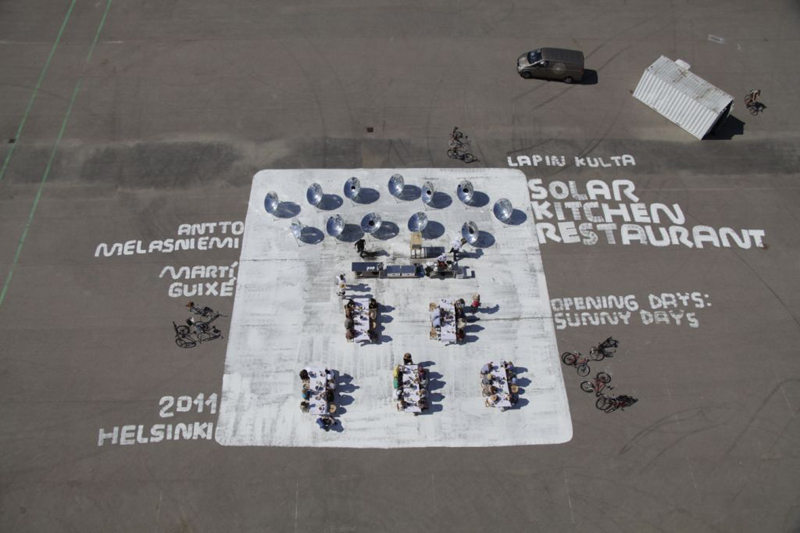
Marti Guixe and Antto Melasniemi’s Solar Kitchen Restaurant for Lapin Kulta is a fantastic exploration our tolerance for uncertainty coupled with our acceptance of complex natural and artificial processes. Since the meals are cooked with solar power, a cloudy day or rain can significantly affect the taste, timing and delivery of the meal. The restaurant invites consumers willing to be flexible participants of an orchestrated but not determined event. It challenges consumers models of mass and mechanical efficiency and product predictability with the joy of considered and uncertain localized experience. The factors that would make my lunch delicious would include not only the prowess of the chef, the freshness of the ingredients but also the weather and the strength of the sun. My lunch becomes a recognized cosmic event! Probably, not the best idea for a school cafeteria….or maybe the perfect idea to demonstrate the complex web of natural and artificial things that makes lunch possible.

Kenny Shopsin’s Creative Process

As promised earlier, here is an excerpt from Eat Me: The Food and Philosophy of Kenny Shopsin about creativity.

“Cooking, for me, is a creative process, and I believe that people who are creative are creative for one of two reasons: Either they are going for truth and beauty, or they create as a way to dilute the venom produced by the subconscious minds. I cook for the second reason. When I cook, I am in a cathartic, recuperative process that calms me down and brings me from a neurotic state to a relaxed, functioning state.” ……

“I am not an Alice Waters type of cook who is inspired by ingredients and builds from there. The inspiration is mine — it comes from within me. But as a creative person, ingredients are the tangible medium I work with, so when I am inspired, when I am in the therapeutic, creative process of cooking, I start looking around, and the more ingredients I have, the more creative I can be.”

Cooking as creative therapy is certainly familiar to many us. When my children were young, cooking was a major creative outlet that I could share with my family everyday. I fondly remember my oldest sitting on the counter discovering new tastes as I was discovering new techniques and ingredients. Cooking became a visceral form of philosophy for me. I like Shopsin’s compulsive sense of creativity as a self-recovering urge. And, that his relationship with ingredients is collaborative rather than instructive. The emphasis on more….abundance, multiplicity, contradiction, duality (ying-yang bowls) reflects in his recipes. He is not searching for the true and the authentic. He talks about his “culinary fictions” that are dishes not authentically ethnic, like Carmine Street Enchiladas, but “feels” to him Mexican, Brazilian or Greek.

From a design historian point of view I see him adopting the early 20th century Aesthetic Movement stance that aspired to convey the sense and feel of  a culture, to mix and match as the designer or artist saw fit. It was a philosophy that embraced the joy of life and the freedom of artists, appropriately championed by Oscar Wilde. It was an era that produced incredibly standardization resistant, subjective and creative things like this, tongue vase by Christopher Dresser. IF

I feel like Kenny Shopsin would appreciate this vase. Although I don’t think we’ll find it at Walmart anytime soon.


Eat me – Shopsin’s Philosophy

41pV4Fd04hL

Eat Me: The Food and Philosophy of Kenny Shopsin is most definitely one of my favorite, cooking, food writing, philosophy and design books. Its witty, thoughtful, informative, blatantly honest and at times appropriately NYC gritty. I enjoy the images, as much as the words, that are profoundly mundane and real. Shopsin’s philosophy  implicitly fuels his life, cooking, business and becomes explicit, almost belatedly,  in his epilogue about the art of staying small,

“Running a restaurant for me is about running a restaurant. It is not a means to get someplace else. I wake up every morning and work for a living like a farmer. Running a restaurant is a condition of life for me. And I like everything about this life. I like waking up in the morning knowing I am going to the restaurant to cook, that something unexpected will happen to me in the kitchen, and that no matter what, I will learn something new. I like the actual process of cooking. I like shopping for the food that I cook, and I like my interactions with the people I meet while shopping. I like my customers, and I like working with my kids. It is a simple existence, but for me the beauty is in that simplicity. These are the things that bring me pleasure — and they bring me great pleasure on an extremely regular basis.

Living this way, pursuing your own happiness, is addictive and it’s the way I have tried to conduct my life. What this means is doing what it takes to make yourself feel good each day, not to make yourself less good today in the hopes that your life will be good in ten years because you’re working really hard now or because your property will be worth more money then. The way I figure it, if you make everyday of your life as happy as you can, nobody can take that away from you. It’s in the bank.”

Shopsin’s insistence on experience, on being in the present, on owning one’s pleasure, on loving a complete process, all point to his pragmatic life affirming philosophy just as his extensive menu is evidence of his lust for experimentation, learning and innovation. Next time, a quote about his thoughts on creativity. In the meantime,  read the book and its recipes. Its about food, philosophy and design that is perfect reading for hungry philosophers everywhere.


(De)sign for Homemade

_76293904_logo_afpmesturet2_624

http://www.bbc.com/news/magazine-28313666

A recent law aiming to protect the quality of French food requires restaurants to identify dishes that are cooked to order (not frozen or pre-made). Philosophically, the question of what makes something “homemade” is worth considering as is the new logo (a casserole dish with a house roof) that will alert consumers.

The basic claim was that “homemade” supports local produce and labor needed to cut, chop and peel the local produce in addition to supporting the culinary craft. The negotiated law however, allows frozen and packaged produce and according to critics undermines the initial intent. The law differentiates and requires restauranteurs to identify industrially produced from locally crafted food. But the differentiation itself is proving difficult. Hence, the controversy.

How do we personally identify a home-made dish? Last night we had grilled salmon with lemon, garlic butter, salad and bread sticks. The salad was prepackaged, as was the bread sticks, we grilled the salmon and the mixed the butter with lemon zest, lemon juice and a clove a garlic. We also had brownies and ice-cream for desert made from a prepackaged mix. Was that a homemade meal? I don’t know. Our tolerance for industrial food products, perhaps particularly in the U.S. has risen to an almost naturalized level. When we go out, do we expect a custom made dinner? When so many of our favorite restaurants are represented in the freezer section of the local grocery stores, the myth of a local customized dinner is not only shattered but celebrated. What is the line between convenience and craft? Shouldn’t there be a line? The battle over standardization and industrialization against craft and localization takes place on our dinner plate every night. Who are we as 21st century consumers?

What is at stake in the “homemade” logo is the responsibility of thoughtful, aware and discerning consumption. I wonder if someone is planning to study consumer behavior related to the new logo. Will customers choose the identified “homemade” more? Would you or I?


Hannah Arendt’s Cherries and Cigarettes

http://www.imdb.com/title/tt1674773/

Last night I watched the 2012 Hannah Arendt movie about her coverage of the Eichmann Trials and its subsequent public reaction. The movie depicts her own struggle to take public responsibility for her thoughts about thoughtlessness (i.e. banality) at the root of evil.  In an age where opinion polls, consumer reports and endless reviews easily replace ownership of personal thoughts and responsibility, Arendt’s call to think for oneself seems so simple, yet so impossible.

Here is a blog post from the Arendt Center that talks about Arendt’s love of philosophical debate over bowls of cherries and her love of cooking. Now, I will always think of Hannah Arendt as I, the ever hungry philosopher eat cherries. Hope you do too.

http://www.hannaharendtcenter.org/?p=4302

I won Hannah [Arendt] at the Ball with a comment made while dancing, that loving is that act by which something aposteriori–the by-chance-encountered other is transformed into an apriori of one’s own life. –This pretty formula naturally has not been confirmed.

—Günther Anders

In honor of Valentine’s week, we offer this account of Günther Anders courtship of Hannah Arendt. The quotation is taken from Günther Anders book, Die Kirschenschlact: Dialoge mit Hannah Arendt (The Cherry Battle: Dialogues With Hannah Arendt).  The Cherry Battle is an extraordinary window into Arendt’s early thinking.

I am always wary reading a book of biographical or personal content about Hannah Arendt. Her life is fascinating. I am always on guard against the seductive danger of reading too much of her biography into her work. And wow is this a riveting read.

Anders was Arendt’s first husband. A fellow Jew, they met in Martin Heidegger’s lecture hall where they both heard lectures on Hegel’s Logic and participated in a seminar on Kant’s Critique of Pure Reason. Arendt, at the time in love with their Professor, had little time for Anders (who went by his family name Günther Stern). Five years later, in 1929, they met again at a masked ball in Berlin, where he spoke the above words to Arendt while dancing.

Arendt and Anders were married not long afterwards and moved to Drewitz (now Potsdam) where they tried to make lives for themselves as independent writers. It was there, on the balcony of the apartment they sublet, that Arendt and Anders would eat bowls upon bowls of cherries.

We sat across from each other on the tiny balcony, between a colossal basket of cherries; on the left and right were empty marmalade jars, for we pitted the black, plump fruit, in order to cook it—what for her was a great joy, like cooking in general, which she mastered even as well as philosophy. We put the pits in one jar, the fruity flesh in the others. And always a few in our mouths—especially [Hannah], for she was just as desirous of cherries as she was of cigarettes…

Aside from Arendt’s passion for cherries, there is much to learn from Anders’ account of their early conversations. This is true even though the book is a reconstruction, part truth and part fantasy. As he writes, the dialogue itself is real (as is the scene of the cherry battle), but the words themselves are “just as much poetry as truth.”

The topic of the dialogue is one that would occupy Arendt and Anders both for much of their lives: “The Irrelevance of Mankind.” That is Anders formulation. What comes through in this magical dialogue is the joy in thinking and sparring by two young and gifted thinkers (Arendt was 22-23 at the time, Anders around 30). They punch and counterpunch, Anders taking up the Darwinian and scientific position that man is, in the end, merely one creature among others, not special or particularly relevant in any way. Or, as Arendt asks him, astonished: “You mean we are fully irrelevant? And unknown? And purely busybodies, things with no sense? Metaphysical busybodies?”

Arendt is, in Anders’ words, “too Jewish” to concede that human beings were simply “pieces of the world.” The world was, and remained for Arendt,  “created for mankind.”

At one point Anders insists: “we are simply not mature enough to concede the fact of our cosmic irrelevance; that we are too cowardly and possess too little civil courage to learn to accept that which has been that human modesty that follows from Copernicus.”

Arendt counters that all species think of themselves as the center of the world, to which Anders parries: the fact that we share a defect with other species does not make us better than they. To be met with what Anders calls Arendt’s “winning argument”: “Naturally not. But perhaps we are the only species that is conscious of this defect; that at the least has a monopoly on the insight into its non-monopoly position.”

We’ll have a full review of Die Kirschenschlacht: Dialoge mit Hannah Arendt before long. For now, just think, it is only a few months before the cherries are ripe.

-RB