Learning (and Eating) from Las Vegas

learning+from+las+vegas%24%24%24%24%24%24

fig0302

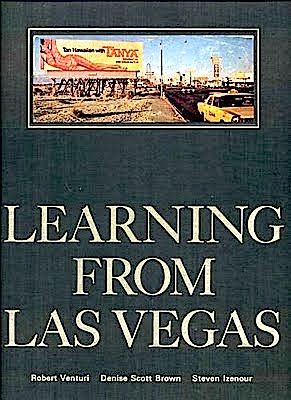
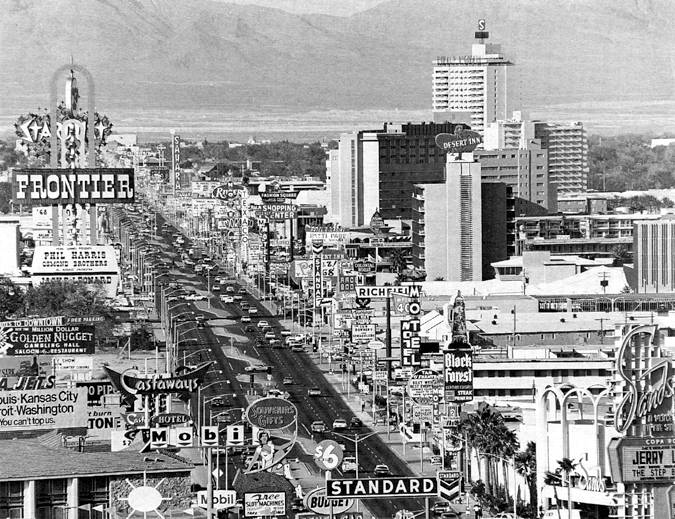
Learning from Las Vegas by Robert Venturi and Dennis Scott Brown, published 1977, was a postmodern call to celebrate the vernacular and everyday. The images of the strip bustling with billboards and signs challenged the way architects thought about the formal role of commercial and public buildings. The architects, Venturi and Brown, argued against modernist “holier than thou” purist abstraction and suggested that the Vegas strip satisfied a collective emotional longing for the imagined American main street. The post-modern architectural manifesto venerated buildings that spoke volumes through billboards and bright signs of human lust, gluttony and greed. Building that spoke of the messy reality of life instead of an idealized vision projected on a drafting table.

One might argue that today Las Vegas is anything but common and everyday and has lost its 1970s main street appeal. Sure the scale and brightness of the signs have grown to fantastic proportions yet the content is the same: gambling, entertainment and food.

Yes, FOOD.


The extravagance of Las Vegas buffets has long been legendary. My recent visit to The Bacchanal at Ceasar’s Palace certainly supports it’s fame by boasting over 500 international dishes. I felt both dizzy with the seemingly infinite choices and doomed in my incapacity to enjoy all of it. An existential crisis of sorts looking into the cauldron of infinite gastronomical choices. The scripted labels announcing each dish to the diner mimicked the billboards outside. The buffet is an easy architectural translation of gastronomic and aesthetic choice where individual preference has priority over collective good (for example: a school cafeteria lunch). The Bacchanal was NO school cafeteria.

I was surprised how deliberately and unrelentingly celebrity chefs and their restaurants were promoted. Indeed, food tourism has taken a very strong cross media hold in Las Vegas. As an avid Food Network, Cooking Channel viewer I was both soothed by the familiar and overwhelmed by the dominance of personality over food. Are we witnessing the rise of popular haute cuisine as inaccessibly expensive exercises of vanity and commerce or is it a sign of innovative gastronomic experiments? I imagine a bit of both, but how do I decipher the difference? First of all, I can’t afford the $$$$ Yelp range, so that takes care of that dilemma. Even so, there still remains much to choose from.

The privilege of individual preference particularly in Las Vegas makes my experience limited and almost too particular to be worth rational judgment. So, the following is not a review but merely an account of three meals touched by television celebrity. Were my expectations different? Did my food taste different? Did the “chef-signature” affect the quality of the experience? In the buffet of signs, architectural and gastronomic, how do we make a choice?

Yelp did not help me in this overwhelming situation where the quality is generally equivalent. Reviews only matter if you know what you personally like. Maybe I like standard overpriced well cooked steak and potatoes, maybe my feet are tired and despite mixed reviews and warnings of bad service, I’ll eat anything. Maybe I’m lost and I can’t find the four star rated restaurant and instead I have to settle for something else that turns out to be fantastic……………sometimes the uncertainty is too great for the collective might of Yelp. As it should be.


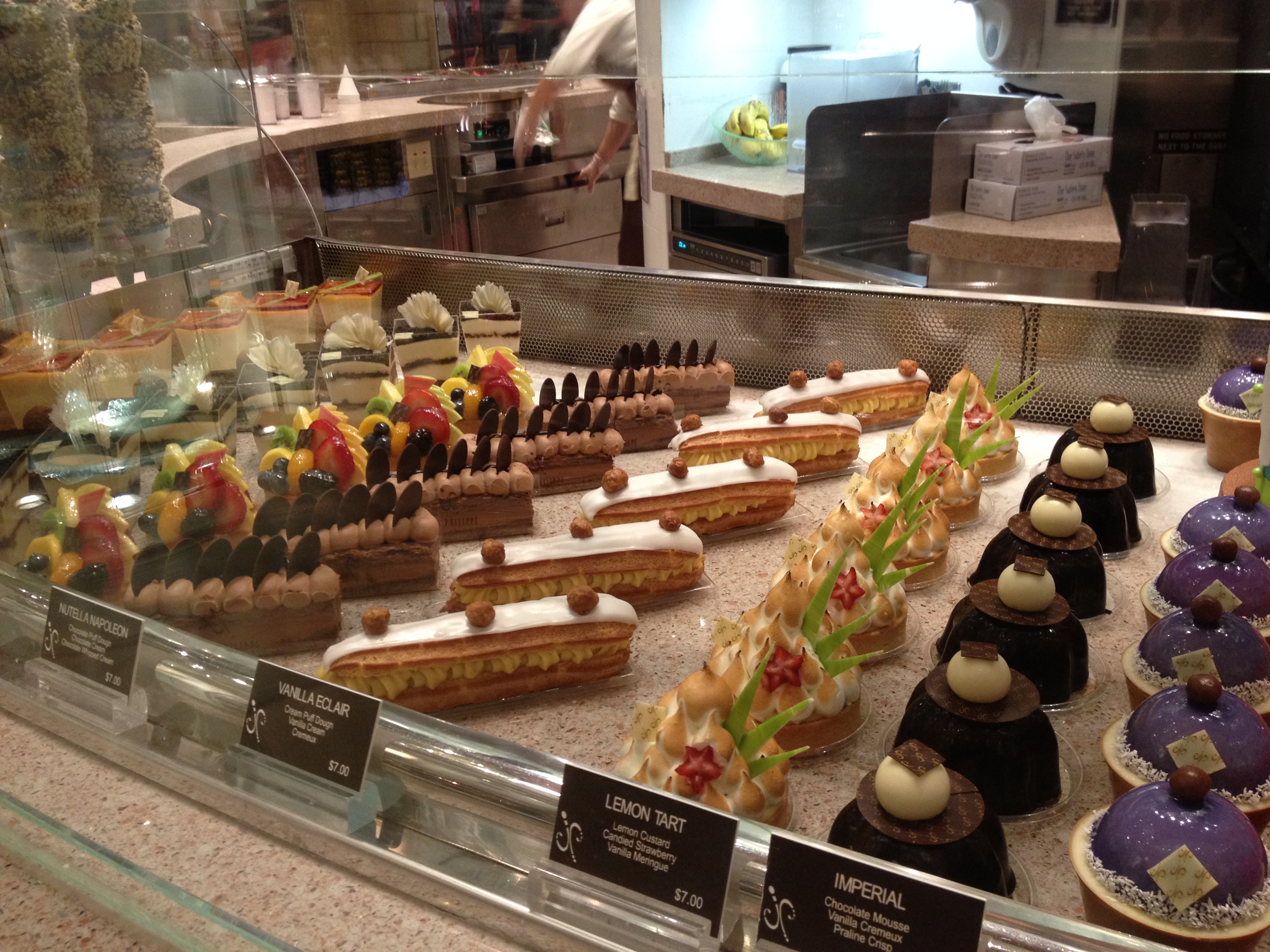
Pastry Chef Jean-Philippe Patisserie at the Bellagio
http://www.jpchocolates.com/

photo 4

photo 1

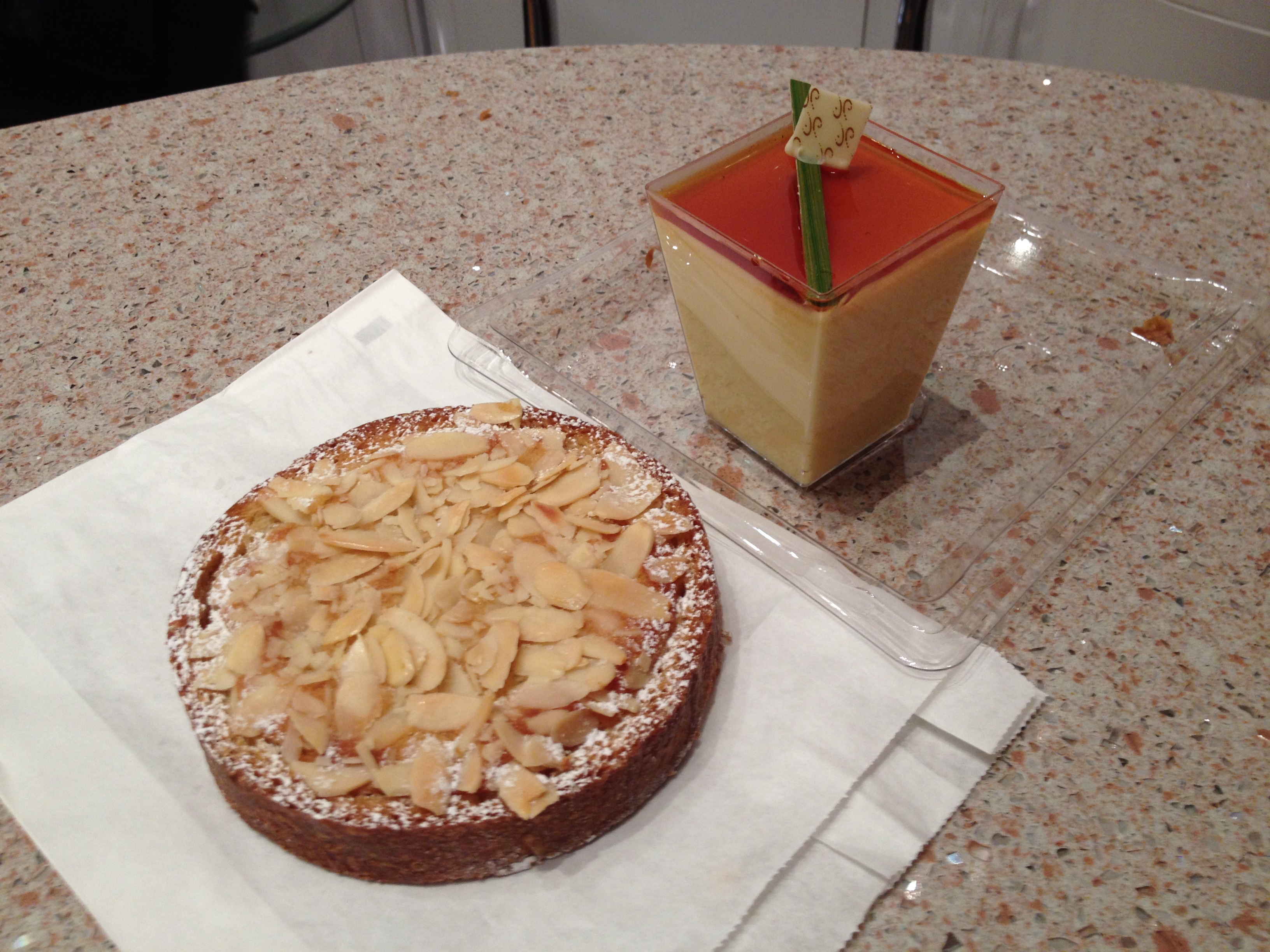
Boasts the world largest chocolate fountain. The choice to visit was easy. Did not know much about the chef and consequently did not have specific expectations. Had breakfast of an Almond Brioche. The bread was a beautifully toasted platform for the slightly sweet almond cream with roasted and crunchy almond flakes. It was delicate and substantive, creamy and crunchy, sweet and slightly salty from the almonds. It was early enough, without a crowd, to eat and enjoy the view of the chocolate fountain. The small and intimate scale of the space heightened the glistening and precious sweets beckoning beyond the glass cases. Next time, I’ll have to have something chocolate. In context, the chocolate fountain made sense and was not a mere publicity stunt. The chocolate fountain summoned us like a religious relic and we as pilgrims rejoiced at the sight and taste. The pastries were quite literally and visually the centerpiece of the establishment (not the personality of the pastry chef). I appreciate the obvious love of crafted sweets that converts indulgence into an art form.

Table 10 Chef Emeril Lagasse at the Palazzo

http://www.emerilsrestaurants.com/table-10
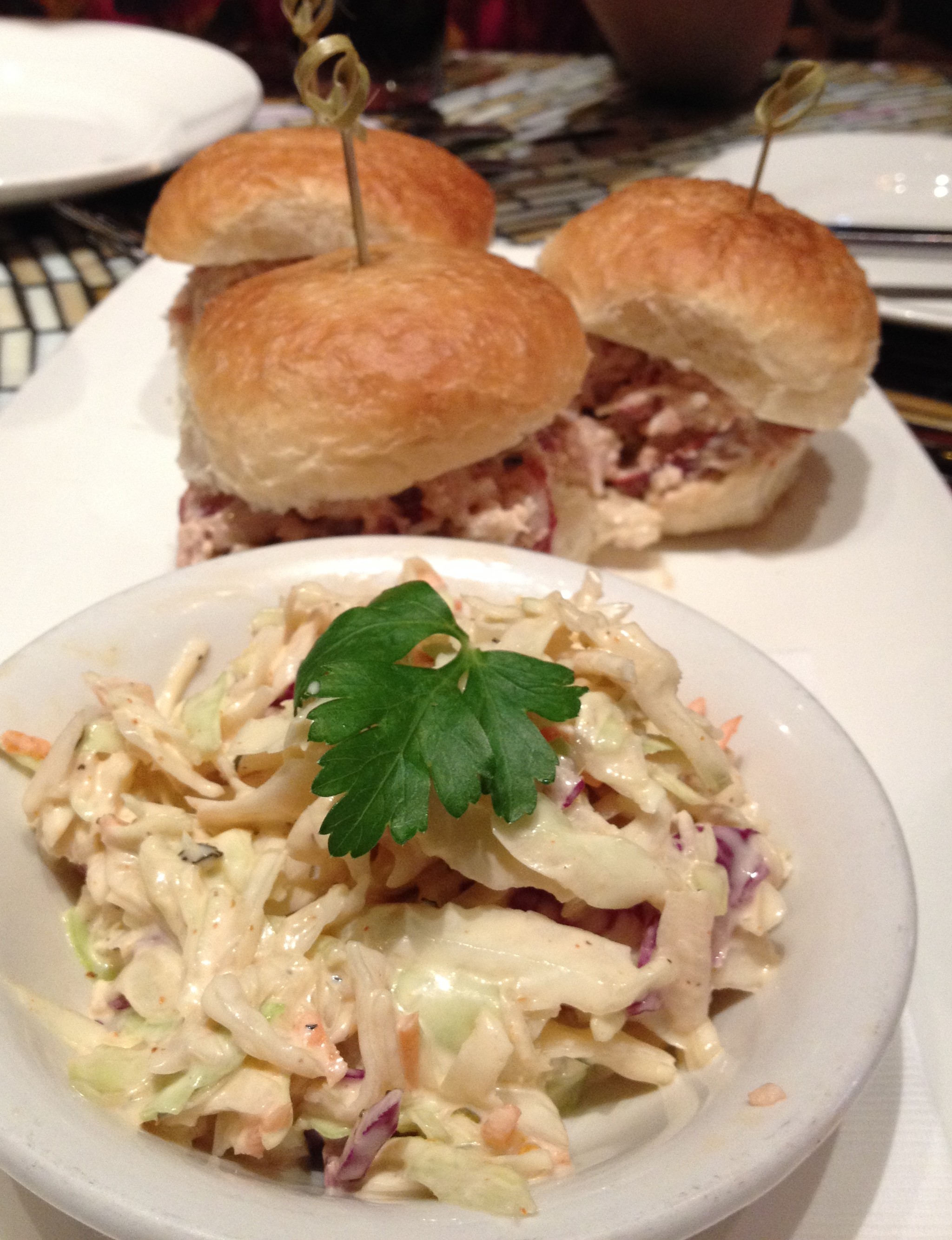
photo 5

We were tired from walking in the sun and looking for a break around three in the afternoon. Table Ten was a lucky surprise. My sister and I shared the little lobster rolls. Our meal was too small and tame to justify the big personality of BAM! Emeril Lagasse. I can’t fault him for my sense of being underwhelmed. The décor that included multiple chef coats, Emeril spice mixes, cooking tools, alongside the open kitchen highlighted the celebrity chef appeal of the restaurant. The familiar taste of the lobster roll was amplified by a touch of celebrity vanity. Maybe the Lagasse signature convinced me that it was better than it was. Served the same thing anywhere else, my response would be “ Wow! this is very good” instead of “this very good and of course it should be.” Did my high expectations weaken my experience? Does more information enhance or diminish the taste? Like knowing how something is made or who made it?

China Poblano at the Cosmopolitan by Chef Jose Andres
http://www.chinapoblano.com/

photo 2

photo 3

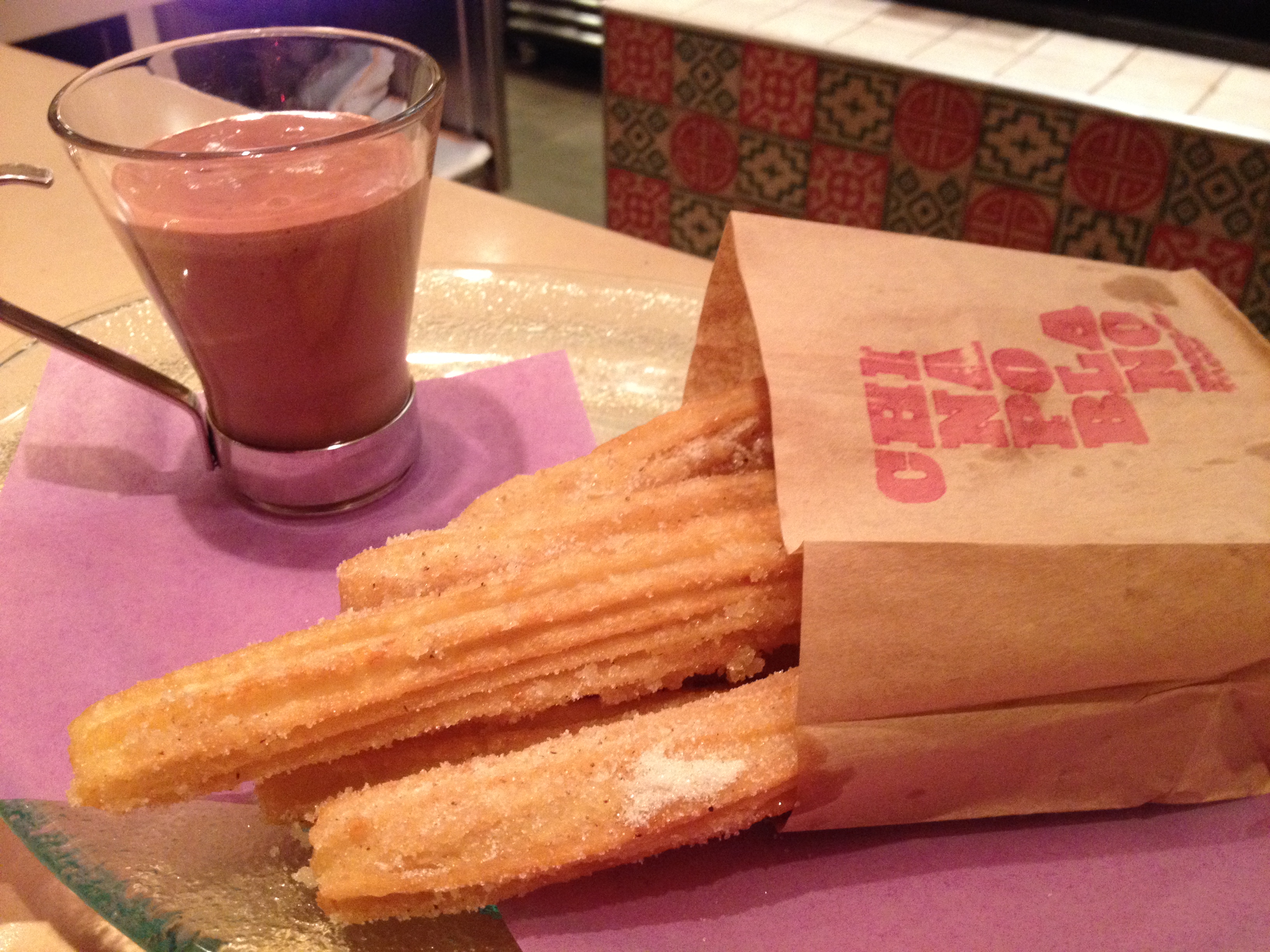
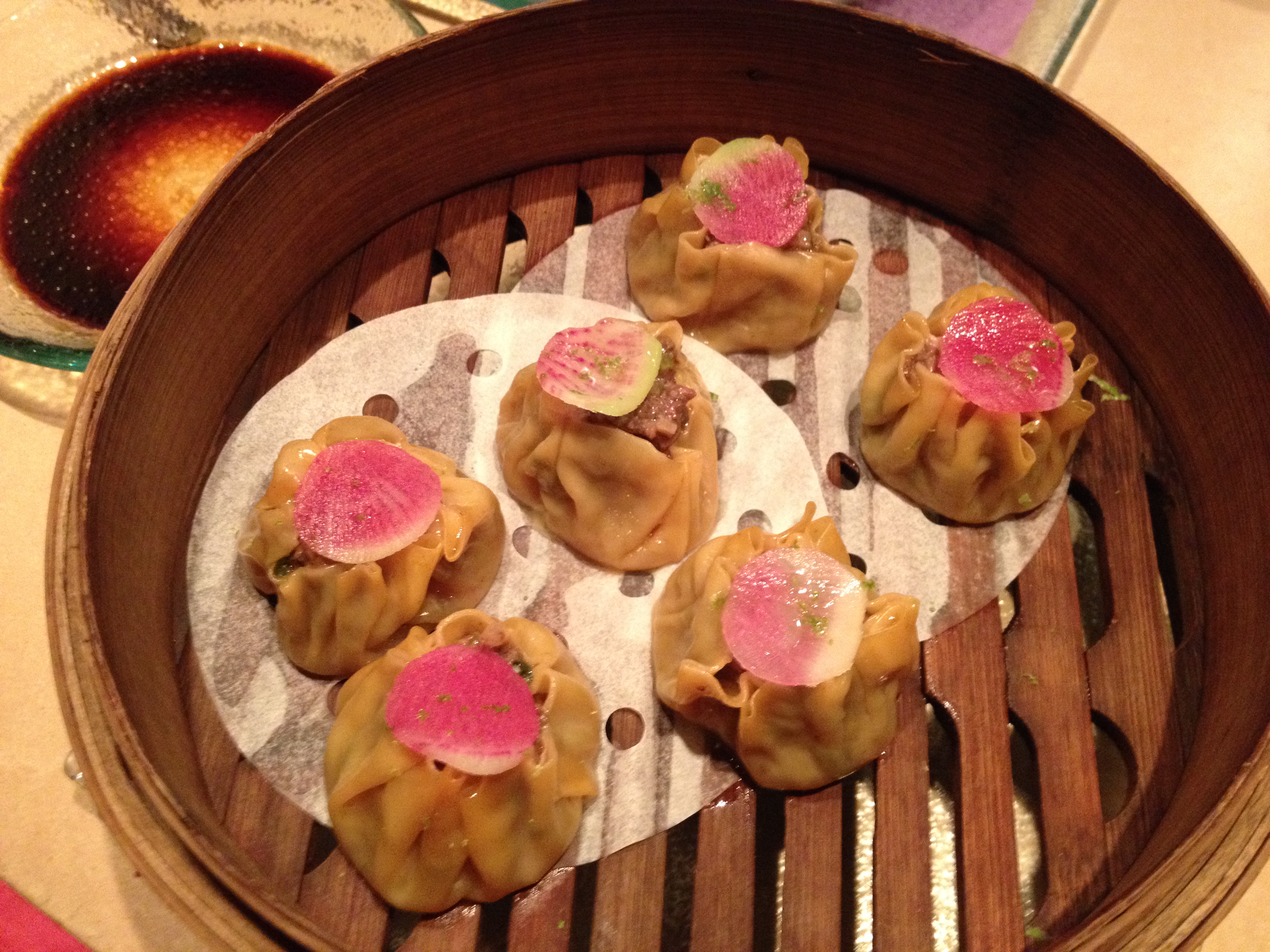
Intrigued by the hybrid concept, I hoped and planned for visiting China Poblano. Visually the restaurant maintains the duality by splitting the space into the China side with a dumpling-making area and the Mexico side with a taco-making area. Visitors seated at the “bar” that winds across both work stations can watch the busy construction of dumplings and tacos as they eat. The walls are decorated with masks and large prints depicting both cultures. The restaurant boasts a 40-40-20 split, whereby, each culture is represented 40% and 20% of the dishes represent a “marriage,” not a fusion, of flavors (this according to the hotel publicity channel). Owing to the dual theme (and being already very full from our visit to Table 10) we ordered the guacamole that was being made in front of us at the “bar,” salsa and chips and the beef watermelon radish suimai. Our order reflected the combination of cultures and as well as a combination of familiar and unfamiliar tastes. The beef suimai was new and unfamiliar, tasted like an exotic lemongrass flavored barbacoa wrapped in a dumpling noodle. Experimentation, playfulness, excitement infused the food and the environment. It is an appropriate restaurant for The Cosmopolitan. The theatricality of the space and food production was a happy surprise. It was a learning experience: of how the familiar can feel strange like fantastically fresh guacamole in warm corn tortillas and conversely, how the strange can feel familiar like beef suimai. The tastes were beyond judgments of good or bad: I don’t know if I “liked” the suimai. BUT…it certainly was interesting and thought provoking. To me, a philosopher, that’s worth it. I had also been to Jaleo, same chef but with a very different vibe (Spanish tapas), in D.C with my daughter for her birthday. The menu, atmosphere, food, wait staff, open kitchens everything about China Poblano conveyed its legend of a kidnapped Asian girl taken on a long voyage to Mexico. It makes me wonder about other possible legends, a Bengali in Bolivia? My visit to China Poblano was certainly a trip!

Bobby Flay’s Burger Palace was on my wish list. I appreciate the bright open welcoming design of the restaurant. The menu is visible from the street as are diners enjoying the fare. Again, much like the many restaurants in Las Vegas with open kitchens and dining rooms, eating is a spectacle at the Burger Palace. Alas, I had no room to take in the show.

The spectacle of food raised to level of theatrical entertainment competes for our attention and money. Images of the Cake Boss, Giada, Bobby Flay are displayed alongside the Beatles, The Blue Man Group, Cirque de Soleil, magic shows and adult entertainment. The visual and the gastronomic are now combined as the theatrical experience of Las Vegas hyperreality. This is not the era of static billboards but giant dynamic video screens. Celebrity chefs perform online, on T.V and through the fantasy of their restaurants. What I learned through visiting these three establishments is their vision as displayed and interpreted by designers and their taste as performed and imitated by local culinary talent. It’s a production like any other.

So, does the “signature-chef” experience affect the quality of the experience? Like all good philosophical questions the answer is both: yes and no.

For me (quality level being generally equal) the answer depended mostly on my expectation and my physical state (hungry, tired). How do you decide where to go, what to eat and how much you enjoyed the experience? In the buffet of restaurants what is your criteria? What LOOKS good to you?

It seems, there is still a lot to learn from Las Vegas both visually and gastronomically.

Pondering Brillat-Savarin’s Portait of a Pretty Gourmande

Jean-Anthelme_Brillat_de_Savarin_(1755-1826)

Those of us, who may have over-indulged on Mother’s Day Brunch, may find consolation in transcendental gastronomy. Very roughly summarized and perhaps twisted: women who eat are pretty and wrinkle free (although I don’t think 18th Century French secret food writer Brillat-Savarin would approve of either a buffet or the indulgence it fosters).  Nevertheless, I think he offers something to think about against the contemporary valorization of thin.

Brillat-Savarin’s meditations  The Physiology of Taste  (first published 1826) is full of fascinating observations about food in its fullest sense. The encyclopedic account of all things related to eating covers definitions (or rather meditations) of senses, taste, gastronomic sciences, appetite, specific food items like chocolate, sugar, truffles and fish (and their associated erotic properties), methods of cooking such as frying, thirst and drinks, obesity, cooking, illness ….and so on.

Meditation 11: On Gourmandism describes the pretty gourmande as follows:

Nothing is more agreeable to look at than a pretty gourmande in full battle dress: her napkin is tucked in most sensibly; one of her hands lies on the table; the other carries elegantly carved little morsels to her mouth, or perhaps a partridge wing on which she nibbles; her eyes shine, her lips are soft and moist, her conversation is pleasant, and all her gestures are full of grace; she does not hide that vein of coquetry women show in everything they do. With so much in her favor, she is utterly irresistible, and Cato the Censor himself would be moved by her.

…..ladies who know how to eat are comparatively ten years younger than those to whom this science is a stranger.

Brillat-Savarin continues his description of sensuality as both physical and gastronomic in his account of “Sensual Predestination”:

People predestined to gourmandism are in general of medium height; they have round or square faces, bright eyes, small foreheads, short noses, full lips and rounded chins. The women so predisposed are plump, more likely to be pretty than beautiful, and have a tendency toward corpulence. The ones who are most fond of tidbits and delicacies are finer featured, with a daintier air; they are more attractive and above all are distinguished by a way of speaking which is all their own.

It is by these outer traits that the most agreeable dinner companions must be judged and chosen: they accept everything that is served them, eat slowly, and enjoy reflectively what they have swallowed.

I doubt if Savarin’s physiological theory that people with “a general air of elongation” do not enjoy food.  Even so,  his coupling of the visual and the gastronomic could offer a clue to our current fascination with thin. Does minimalist modern design feed into the aesthetic and gastronomic sensibility of “thin”? Can we study design eras in relation to celebrated body types? I digress……

Happy Belated Mother’s Day to all those agreeable, pleasant, plump and pretty gourmandes everywhere. Hope you enjoyed your brunch buffet!


Soren Kierkegaard on food

Of all ridiculous things the most ridiculous seems to me, to be busy — to be a man who is brisk about his food and his work.


Happy Birthday Kierkegaard


Yummy wet noodles

-1

If we all just ate for mere nourishment there would be no need for the culinary crafts, no need for critics, no need for gourmet groceries or special tools, television shows, recipe books, blogs, festivals….candy or ice-cream. Yummy food embodies choice and ability, as well as decadence and gluttony.  We can’t but want to share a delicious meal with our loved ones. Who among us hasn’t reached across the table with a loaded fork and said “try this”? Ironically, we can only share the experience of a delicious bite if we are willing to part with it. The structure of shared taste is grounded in limiting self-interest. Sharing at the table can be an ethically beautiful moment. Sure, there is the compulsion for aesthetic gastronomic agreement that aims to solicit common identity. If you like the food on my plate, you accept my taste and by extension me. Related to this compulsive search for commonality, I suspect the multi-dish restaurant experience of sharing is a 20th century phenomena in contrast to the the rustic biblical images of breaking a shared loaf of bread together. Sharing has become complex and discursive. It is not merely chewing the same meal or reaching from the same plate but rather pondering our shared and divergent experiences of “yummy” at the very same table. Sharing food from another’s plate implies a level of intimacy. Many people don’t welcome the intrusion into their plate and or taste (this makes me think of an episode of Modern Family). This weekend I’ve been reading Carolyn Korsmeyer’s Making Sense of Taste: Food and Philosophy. Her book offers a wonderful philosophical history about the meaning of food and warns against overly romantic notions of the shared table. After all, poison and cannibalism are instances when food is weaponized. Still, I think, as African American culinary chef and historian, Micheal Twitty reminds us, “yummy” retains its enslaved African American roots of cajoling young children to “yum-yum”…. to eat. I remember my youngest, when learning how to feed herself would always offer a cold wet, baby drool laden noodle with her uncertain little hand to me, her dad or her sister. While I may not have always wanted to accept the wet noodle, I still appreciate the gesture. I’m sure you have pictures of your kids feeding you, as you have fed them. Beautiful primal and human moment, isn’t it?


“Something I cooked up”

…..seems a strange phrase to imply improvisation. The metaphor captures the fabricated, responsive, performance of cooking. Despite recipes, despite directions. There is an element of surprise to cooking that is both challenging yet satisfying. For example, yesterday I cooked two batches of brownies (Betty Crocker Mix….I’ll address the use and abuse of prepared mixes in another post). At the appointed time, one batch was almost overcooked while the other was still runny. Same oven, same temperature. Hhmmmm. Assuming I measured and followed directions (which is a huge assumption) I can only guess that the top shelf got too little heat, while the bottom shelf got too much. Now….. know I would’ve needed to exchange the pans half way. Maybe. Maybe the brownies would be runny, or burnt anyway. Cooking is an activity where concept and execution, ideality and reality, recipe and dish are in constant negotiation.  I have often cried, “but I followed the recipe.” As if the failure was the recipe’s fault and not my own. Granted there does exist the occasional bad recipe. Ironically, the only way to test a recipe is to use it, to confront the directions however faulty, to challenge and change the recipe.  Cooking is fundamentally, non-fundamental.  That’s why its so much fun. While my brownies did not fulfill the image on the box, to my surprise, my moment of improvisational rice side dish worked!

I cooked finely chopped onions, carrots, red bell pepper and celery (about 3/4 cup total)  in butter until roasted and glowingly golden. Added sliced mushrooms (a small carton).  Added a cup of left over jasmine rice. Heated all through. Added a half a cup of shredded cheese and about 1/2 of cream. Tossed in a 1/2 cup of peas at the end. Once warmed through the made up rice dish was wonderful with pan roasted lamb chops. Fake risotto. I savored that improvisation. It worked.  I have doubts that I can make it again. In most home cooking, the recipe is an afterthought. Success and failure in the end depends on taste and not a meticulously followed theory. Something we cook up.

What have you cooked up lately? Did it work? What did you do when it didn’t?

Emerson Eats an Apple

Ralph_Waldo_Emerson_ca1857_retouched

“In late October, while working on his Essays, Emerson had another prophetic vision, which he recorded in his journal. “I dreamed that I floated at will in the great Ether, and I saw this world also not far off, but diminished to the size of an apple. Then an angel took it in his hand & brought it to me and said “This must thou eat.’ And I ate the world.”

From Examined Lives by James Miller

What do you dream of eating?

Seneca’s diet saves life….not really

According to Tacitus, Nero had first tried to poison Seneca, but the plot was foiled when Seneca refused a drink offered by a visitor in order to adhere to his modest diet of wild fruit and spring water.

The agency of food is nowhere more acute than in instances of poison. In such cases, the source of nourishment and life, itself  is perverted into a medium of death. Nero’s murder plot assumed the philosopher’s reception of an offering of drink as consistent with social etiquette. It should of been easy to kill Seneca hidden behind the cloak of food and table manners. But…….Seneca, at the time deeply disappointed in his student turned tyrant Nero, was practicing a form of self-restraint characterized by simple eating. Seneca was also subverting the standard social mode of eating and drinking that would accept a visitor’s gesture of sharing. Nero and Seneca were both using the power of food, even if towards different ends. In this scenario is the drink the only victim? Instrumentalized as an agent of death by Nero and an agent of a golden cage lifestyle for Seneca?

Of course, in the end Seneca does drink poison.  Is the agency of food, the thing-power of the non-human exercised when it subverts or when it assumes its relation to humans? Is the existence of poison fulfilled in the death Seneca or merely reduced to its human relation and instrumentalized again? I’m so confused…….can any object oriented ontologists or vital materialist out there help?

This quote comes from Examined Lives by James Miller about the complex lives of 12 philosophers.

“Food is often …

“Food is often the way to “knock” and engage a community. We all bring wine or a dish to thank friends or family for hosting. We eat with new friends to ritualize and legitimize our engagement, even if we don’t really like the particular dishes.”

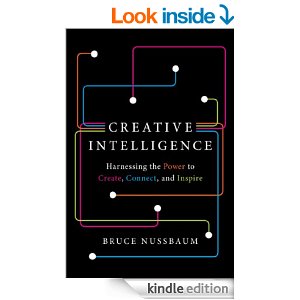
This quote comes from Bruce Nussbaum’s book “Creative Intelligence” in reference to culturally responsive design strategies. After describing his first necessary taste of Monkey Brains…..yes, monkey brains in the Philippines, as a Peace Corps volunteer, he talks about how Lenovo reached a rural audience and marketed their computers better than HP and Dell. Here’s how Nussbaum explains the strategy of “knocking,”

“According to Fast Company, in rural China, people frequently buy PCs as wedding gifts. A computer purchase is not merely a market transaction, based on price; it’s a gift that provides the foundation for a lifetime of social interactions between two families. So the box, the packaging, the entire presentation, is crucial. By making the box representative of the gift it contained, Lenovo was able to capture more of the rural market than HP — a knock worth hundreds of millions of dollars in profits.”

Food as social and commercial strategy emphasizes and validates culturally shared experiences, even if different from our own cultures. The theatrical performance of the Lenovo box as a component of a wedding ritual conveys cultural respect, just as eating monkey brains. It may or may not influence our own tastes or meaning. I don’t think Nussbauam eats monkey brains habitually now. The gesture is enough. One does not need to like monkey brains in order to connect with those who do. But…….one has to at least try it, once. In the case of Lenovo….it wasn’t even the meal but the platter that made all the difference. So much of what designers do involves the aesthetic (articulate and material) presentation of constructed meaning. Food helps us practice the skill of human generosity. Makes me want to host a party! Would paper plates imply disrespect? Maybe not the well designed ones…….41MVIMU75IL._BO2,204,203,200_PIsitb-sticker-v3-big,TopRight,0,-55_SX278_SY278_PIkin4,BottomRight,1,22_AA300_SH20_OU01_

Seinfeld’s Forks are Funny

http://www.theguardian.com/culture/2014/jan/05/jerry-seinfeld-funny-sex-swearing-sitcom-comedy

Seinfeld’s comment that forks are funny and salt shakers are not remind us of the simple reality that things, no matter how small or mundane, have agency. Objects compel us, move us, make us think, laugh, feel. Of course, someone could dispute his comment and insist that salt shakers are funnier than forks. But, that’s not the point.  Forks, spoons, or salt shakers, there is inspiration everywhere. Seinfeld’s comment is consistent with his insight that: When someone does a small task beautifully, their whole environment is affected by it.