Self-Examination, Yoga style

Yoga helps,

  • “the seeker excavate the tensions of inner life in a self-directed manner”

(Look inside)

  •  us be responsible for our own spiritual health

(Be responsible for your own peace)

  • “relocate the unseen within us, invites us to introvert, to open our eyes to why we are who and how we are.”

(See your hidden motivations)

  • “elevates the capacity for internal observation to the level of a virtue previously occupied by notions of “godliness”.”

(Accept Self-examination as cosmic responsibility)

In doing so, yoga exposes the power of internal authority through self-awareness.

In my opinion, and setting aside the accidents of its publishing fame, the yoga sūtra-s deserves our continued attention as a wildly exciting text for four interweaving reasons.

Firstly, it breaks with most previous paths of spiritual growth in its attempt to help the seeker excavate the tensions of inner life in a self-directed manner, without reliance on gurus or corporate bodies of authority. It is openly ambivalent to religious attitudes, going so far as to equate breath-awareness (1.34) with religious devotion (1.23) as a technique of evolution. From the outset, it contains no self-validating list of lineages, no creation story or deference to divine power: the text is a non-denominational and impersonal list of quiet discoveries.

Secondly, the sūtra-s generally (if we remix pāda three) move away from the magical thinking directed at cutting deals with unreachable gods and invisible spirits for a better life — an approach that continues to pervade our current spiritual milieu, from the remote prayer experiments of evangelical Christians to the “think methods” popular in this new age of The Secret.

Thirdly, Patañjali offers a substantive and startlingly modern map of psychomentality, dividing out conscious faculties for our observation, and alluding to how the unconscious shadows that seem to motivate our actions might be illuminated. I render saṃskāra and vāsanā as “trace” and “pattern”, following Feuerstein, who describes saṃskāra as a “sublimilinal activator”, and vāsanā as a “chain of similar karmic activators” (1998, 241). Bursting forth from the Vedic tradition, which sought to pacify the external forces of adṛṣṭa (“unseen” gods and energies), Patañjali relocates the unseen within us, invites us to introvert, to open our eyes to why we are who and how we are. This puts the notion of “trapped memory” front and centre, allowing a clear reckoning of karma: our traces, habits, and grooves. Patañjali suggests that we can slowly free ourselves of the unseen. This relentless excavation of hidden thought as the source of our pain, this dive towards whatever is unconscious, represents a clear displacement of his ancestors’ obsession with the whims of external gods.

This leads to the fourth gesture: the opening chapter of the yoga sūtra-s elevates the capacity for internal observation to the level of a virtue previously occupied by notions of “godliness”. The sincere human no longer needs to adhere to a perfect ideal, whether social or philosophical, to attain wisdom. She simply needs to watch her experience unfold, and to enrich her action with tender watching.

These four gestures amount to a broad gift: the text places implicit value on the power of internal authority.

Remski, Matthew. Threads of Yoga: A Remix of Patanjali-s Sutra-s, with Commentary and Reverie (pp. 42-43). BookBaby. Kindle Edition.

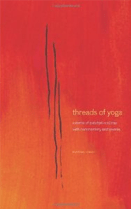
Book Image from http://matthewremski.com/wordpress/books/threads-of-yoga/

Yoga for Grief 4 (Off the Mat) – Insomnia

Haven’t we all suffered nights of restless sleep? I still do sometimes, but now without the added anxiety and self-judgment. I don’t feel like a victim of my restless thoughts, emotions, and imagination.

Knowing a few relaxation techniques gives us tools to try while lying in bed, eyes wide open, instead of stirring up anxiety with questions like, “Why am I awake? What is wrong with me? If I don’t sleep I’ll be tired tomorrow, ……I can proactively relax. Hmmm, sounds like a contradiction.

You have to find what works for your specific form of insomnia. Try everything. What have you got to lose, except for feeling like a helpless victim of your exhausted and spinning spirit?

Here is what we practiced this week at the hospice sponsored Yoga for Grief session. Join us.

“Yoga nidra is a form of meditative self-inquiry that, while relaxing the body, opens the mind to greater discernment and self-awareness, and the heart to love and acceptance of what is. It is a powerful tool for clearing away our limiting beliefs and emotions and for living from a more balanced state of mind.”

Weintraub, Amy. Yoga Skills for Therapists: Effective Practices for Mood Management (Norton Professional Books (Hardcover)) (p. 160). W. W. Norton & Company. Kindle Edition.

Today we’ll practice 7 techniques:

Technique 1: Body scan, Mindful Breathing and Crocodile breath from Yoga as Medicine, What keeps you from resting?

Technique 2: Chest Expansion Breathing from Yoga and Mindfulness Therapy

Technique 3: Turn off electronics, same bedtime, stretches before bed, nutrition, dark room, warm bath, prepare your body to rest.

Technique 4: 3 poses. If you find yourself awake, supported forward bend, or legs up the wall pose may help lull you back to sleep.

Supta Padangusthasana I Reclining Hand to Big Toe Pose Benefits and How It Works: By stretching the golgi tendon organs within the hamstrings’ tendons, these muscles are induced to relax. The pose brings a sense of floating to the legs and definitely signals “relax” to the entire central nervous system.

Fishman, Loren. Healing Yoga: Proven Postures to Treat Twenty Common Ailments—from Backache to Bone Loss, Shoulder Pain to Bunions, and More (p. 170). W. W. Norton & Company. Kindle Edition.

Technique 5: Lengthening exhale, Left Nostril Breathing, sleep on your right side allowing your left nostril to dominate from Yoga Skills for Therapists

Technique 6: Meditation “good-bye to the day, affirmations and calling back your energy

Technique 7: Yoga Nidra- Body part awareness. Or imagining body as a house, “turn off lights”

Technique 8: Sense awareness essential oils: Lavender, Chamomile, Geranium

Wishing all of you restful sleep and sweet dreams,

Hungryphil

Social Work Warnings and Yoga

The course, Introduction to the Social Work Profession opened with a module, not about the glories of the profession, but rather the demands and the emphatic need for self-care.  Symptoms of “compassion fatigue” as one of the embedded TED talks warned was to be monitored on a daily basis.  Compassion fatigue unlike burn-out characterized by dispassion is a form of PTSD that retains and absorbs emotions from clients that results in derivative anxiety or secondary traumatic stress, like second-hand smoke.  The “cost of caring” the module warned can involve:

  • Intrusive mental images
  • Avoidance, detachment, social withdrawal
  • A loss of sense of safety or control
  • Feelings of disillusionment, anger, fear
  • Losing sleep and/or having nightmares
  • Lack of energy and/or emotion
  • Loss of concentration
  • Cynicism
  • Over-identification with clients
  • A sense of “self-entitlement”

Antidotes to this list of unpleasant symptoms involve physical, psychological, emotional, spiritual, relationship and workplace self-care. Notice the needs your body, spirit, and mind. Ask for support. The antidote to secondary traumatic stress is primary and secondary stress-relief. Yoga and meditation help with almost all of these symptoms through movement, breath, and stillness. I feel well prepared.

Now that I have a daily meditation practice, I feel the pause it brings. I need it. It does make a difference. If meditation is not your thing, no problem, just take time to notice yourself and ask, what do I need today? How can you address your own stress if you don’t recognize it? How can you ask for help? Find a way to see yourself regardless of your profession.

For those of you saying I don’t have the time or what’s the point I can’t do anything about it, consider the quality of your life that doesn’t allow you to be present in your life. Hmmmmm…

In the end, you don’t want to be an angry victim of your own life.

This module also warned that social work is a thankless profession with little pay. From philosophy, a profession of outcasts and corrupting non-conformists, a low-paying thankless job is an improvement!  What, there are jobs for helping others and being punished for it? Perfect.

Sign me up.

Hoping you take three full breaths right now and notice yourself,

hungryphil

P.S. Shout out to Community Yoga in West Lafayette for my teacher training and preparing me for this next step in my evolution.


Exploded view of my now

Living forces honesty. Answers are seasonal, losing their sense precisely as they become scripture. You will die: this is the first meaning. The world around you seems to bear helpless witness to your wandering. Other people suffer in the same way, and yet this seems to increase loneliness. But you can welcome despair like gravity, for at some point the sheer pressure, tectonic in the soma, compels a violent break in pattern: running through the woods, making love with an utter loss of self. The reality of your condition offers a stark gift you accept through sudden discharges of rage and rage’s joyful shadow: this is the only life you know, and it fills you to overflowing. You live your life, yoga happens to you.

You thought you were alone. You tried to be independent. Then, standing in the market with your hand on an orange, children underfoot, traffic humming, conversations blendingwith the radio by the cash register, shoes you did not make on your feet and clothes you did not sew on your back, sun slanting through rips in the tin awning, you’re almost late for meeting someone, always almost too late. You know this orange will give you life, and that you did not grow it. Someone else gave it to you, it will become your flesh. Its colour adds immeasurably to your language and dreams while its name rhymes with nothing, and you did not conceive of it. The old grocer’s hands have become gnarled through a lifetime of handling boxes of oranges for you to eat. Someone else gives you your flesh. They could not give what they do not have. Someone else holds their flesh forth until it becomes your flesh.

A child triggers an internal laugh. A dog slaps her thick tail against your shin. Every single object that gives you life surrounds you. If you really were alone you would not exist. You did not make the air you breathe. You can’t say where the inside of your flesh begins. You are naturally reaching out as something reaches into you. No one and everyone taught you this. You surrender to the always-already-there, and yoga happens around you, through you.

– Matthew Remski, Threads of Yoga

Beautiful example of philosophical object orientation and mindful awareness, Ian Bogost style, maps, meanwhiles, lists and ontographs, Timothy Morton style thoughts of gravity, weird reality, shredded wheat magical simplicity.

Yoga invites us to the stillness of an exploded view of our present moment. Notice yourself, your body supported by the ground, your arms reaching to the sky, your breath, feelings, thoughts, sensations. All material, all fleeting. In stillness watch yourself move in thought and breath. Yoga offers such quiet power ❤️

Wishing you a weekend of mindful nows,

Hungryphil

Hungryphil starts an MSW

It is a bit unusual for someone with a Ph.D. to go back to school, right? Yet, here I am.

This is my first-week attending IUPUI’s Masters of Social Work program online. I don’t find my status odd or contradictory. Given my graduate work at the New School School for Social Research, a pursuit of social work practices was inevitable.  A perspective also reinforced by my parents, PhDs in Social Work and Education working in Dhaka. Inevitable.

However, I am surprised to find myself, afraid. What if I fail, what if I’m stupid, what if I’m too old, what if I’m wasting all this money…yada..yada..yada…We are all so vulnerable to our own minds trying desperately to protect us.  This is when a third person inner monologue may help.  Let me demonstrate:

“Hungryphil wants to be a better helper. She wants to help people rebuild their lives after loss of love, meaning, and self-worth. She is afraid of being back in school to help her do so, but the risk of failure is worth it.”

While the use of a  third person voice can be annoying, it helps me distance myself and see myself.

Mostly this week involved awkward video introductions, being overwhelmed with the flood of assignments and the bubbling excitement of learning. It was a good start.

How can a philosopher-architect-food lover evolve into a therapeutic, creative, responsive change agent who helps others rebuild lives out of their own self-discovered empowerment?

My first clue comes from this week’s reading: Chapter 1 of Challenging Oppression and Confronting Privilege by Bob Mullaly, began with the following quote by Ben Agger,

Critical social theory conceives human liberation as the highest form of intellectual activity.

I wonder if this thought will hold under an Object Oriented Ontology perspective?

Hmmm…..so many questions to come……… it seems I’ll be talking to myself a lot!

Happy blossoming everyone,

Hungryphil


Yoga for Grief 2 (Off the Mat)

This was week 2 of Yoga for Grief at the IU-Arnett Hospice in Lafayette, IN. Thank you to new and returning yoga friends.

Yoga for grief can accompany each of Dr. William Worden’s four tasks of mourning: acceptance, processing, adjusting and finding a place for loss in new life. I am particularly interested in the role of yoga to help us make room for our loss as we continue to build a new life around and beyond. The loss doesn’t diminish or shrink. In order to endure a loss, we have to actively build around it. It requires constant mindful vigilance. Grief work is tiresome and exhausting. Rebuilding a life can feel overwhelming and daunting.

While mourning does not automatically imply depression, there are certainly days when one can find it difficult to get going, to move, to live this newly reconstructed life with focus and effort.

First, meet your mood. How do you feel? Notice your breath, energy, sensations, emotions, thoughts, the collection of experiences that make up your “now”. Are you feeling energetic, lethargic or at ease?

Grieving people are rarely allowed or encouraged to simply be, to feel what they feeling. Yoga, however, asks us again and again to simply be with what is, with compassion toward ourselves and others, being exactly where and how we are in the present moment. It encourages, allows and supports us in being exactly how and where we are, while at the same time giving us tools, support and space in which to adapt, adjust and accommodate who and where we are now that grief has visited a new and unwanted reality upon our lives.

Helbert, Karla. Yoga for Grief and Loss: Poses, Meditation, Devotion, Self-Reflection, Selfless Acts, Ritual (p. 21). Jessica Kingsley Publishers. Kindle Edition.

If you are feeling low on energy and finding it difficult to keep moving, maybe you are anxious at night, sluggish during the day, try these techniques to the extent that they work for your body and heart.

The path of grief is not a straight line; it is meandering and full of switchbacks. One moment you are sitting peacefully on your meditation cushion, then suddenly you are transported through time and space back to the worst day of your life. This is normal, but not at all comfortable. Such moments as these, when you feel the most stuck, are the moments where practice is most important.

Stang, Heather. Mindfulness and Grief: With guided meditations to calm the mind and restore the spirit (p. 94). Ryland Peters & Small. Kindle Edition.

Through gentle yoga practices, we can coax our body into a sense of action and energy. Add big movements with arms overhead. Add expansive breath that fills up the lungs. Add meditation that “moves.”

Today we practiced 7 techniques:

Technique 1: Overhead arm stretches

Technique 2: Ujjiya breath/ocean breath (both calming and energizing from Yoga Skills for Therapists)

Technique 3: Pulling Prana (from Yoga Skills for Therapists) Arms outstretched arms move back on an exhale. 6 times.

Technique 4: Breath of Joy (from Yoga Skills for Therapists) Arms move up and out through a three-step inhale and exhale through the mouth by bringing the arms down as you bend your knees. 6-9 times.

Technique 5: Walking meditation (from Yoga Mindfulness Therapy) for homework. 15 minutes.

Technique 6: Backward and forward meditation (from Yoga Mindfulness Therapy) Imagine a time or place that brought you joy in the past. Can you imagine a time and place beyond the grief you feel now in the future?

Technique 7: Sense-awareness essential oils: Bergamot, Peppermint, Jasmine as examples of energizing, mood enhancing oils.

Lament

Listen, children: Your father is dead.

From his old coats

I’ll make you little jackets;

I’ll make you little trousers

From his old pants.

There’ll be in his pockets

Things he used to put there,

Keys and pennies

Covered with tobacco;

Dan shall have the pennies

To save in his bank;

Anne shall have the keys

To make a pretty noise with.

Life must go on,

And the dead be forgotten;

Life must go on, Though good men die;

Anne, eat your breakfast;

Dan, take your medicine;

Life must go on;

I forget just why.

Edna St. Vincent Millay, 1892 – 1950

https://www.poets.org/poetsorg/poem/lament

Contact me with any questions 🙂

Join me for Gentle Yoga at Morton Community Center, Wednesdays 10 -11:15am and Monthly Meditation at Community Yoga, donation based and usually on the second Sunday of the month, 7:30 -8:30 pm (check for details and to register online).

If you are interested in individual or group grief counseling, let’s talk. As a certified Grief Recovery Specialist, I hope to nurture self-care and hope.

GRM-vertical-color-small-tag.jpg

Yoga for Grief (off the mat)

To those who participated in our first session of yoga for grief (serving Lafayette IU Health Hospice Groups), THANK YOU.  We explored basic breath, body and mind awareness as a way to notice and return to ourselves especially after loss.

We started with a few easy standing stretches, seated breath awareness, guided meditation and guided relaxation. Before we summarize the 6 techniques we practice, here is a quick introduction to the group.

What is Yoga?

In helping us, observe ourselves, yoga, among many other benefits, promotes healing through self-awareness.

“1    Now, the teachings of yoga.

2    Yoga is to still the patterning of consciousness.

3    Then pure awareness can abide in its very nature.

4    Otherwise awareness takes itself to be the patterns of consciousness.”

HARTRANFT, CHIP. The Yoga-Sutra of Patanjali: A New Translation with Commentary (Shambhala Classics) (Kindle Locations 247-250). Shambhala. Kindle Edition.

Why Yoga and Grief?

  1. Back to the body as a way back to living.

“Mindfulness lets you expand your view by placing you in the middle ground between denying your pain and overindulging in your suffering. From that vantage point you can observe the whole experience with a sense of openness to whatever arises. You stay in contact with the entire scope of your existence, and you experience grief without becoming grief itself.”

Stang, Heather. Mindfulness and Grief: With guided meditations to calm the mind and restore the spirit (p. 18). Ryland Peters & Small. Kindle Edition.

  1. Learning to hold contradictory feelings of sadness and joy, anxiety and ease. 

“Yoga teaches us how to hold seemingly opposing thoughts, ideas and experiences together at the same time. We can be in grief and live a wholehearted, connected life at the same time.”

Yoga for Grief and Loss: Poses, Meditation, Devotion, Self-Reflection, Selfless Acts, Ritual (p. 19). Jessica Kingsley Publishers. Kindle Edition.

  1. Leaning towards self-aware hope and away from hopelessness.

“The principles of yoga complement the ultimate goals of therapy: self-awareness, self-acceptance, self-efficacy, self-regulation, and whatever individual goals you and your clients may hold for their optimum well-being.”

Weintraub, Amy. Yoga Skills for Therapists: Effective Practices for Mood Management (Norton Professional Books (Hardcover)) (p. 9). W. W. Norton & Company. Kindle Edition.

Today we practiced 6 techniques:

Technique 1: Body alignment in mountain pose. Stand here and now.

Technique 2: Breath awareness: Quality of Breath: Temperature, Rhythm, Texture, Depth

Technique 3: Counted Three Part Breath Practice (inhale 4- exhale 6-pause 2)

Technique 4: Six-sense awareness (eyes, nose, ears, touch, taste, mind)

Technique 5: RAIN Mindful Meditation (Recognize, allow, inquire, natural)

For more information look to the work of Tara Brach, https://www.mindful.org/tara-brach-rain-mindfulness-practice/

Technique 6: Healing essential oils: Lavender (ease), orange (energy-creativity), ylang-ylang (joy) combination

Please feel free to contact me with any questions or concerns.

Join me for Gentle Yoga at Morton Community Center, Wednesdays 10 -11:15am and Monthly Meditation at Community Yoga, donation based and usually on the second Sunday of the month, 7:30 -8:30 pm (check for details and to register online).

If you are interested in individual or group grief counseling, let’s talk. As a certified Grief Recovery Specialist, I hope to nurture self-care and hope.

GRM-vertical-color-small-tag.jpg


The Gift of Grief Recovery

Last weekend I had the joy of attending a certification training for the Grief Recovery Method.  What a gift! I have to admit that I stepped into the training with trepidation and a healthy dose of skepticism. As a philosopher, I worried that the training would be a trite appeal to non-discursive subjective feelings. As a yoga instructor, I worried that it would deny the grief harbored in the body and become a cerebral lecture. My worries were unfounded.

The 12 and 8-week group programs and the individual 7-week program (among others) that made up our training, focused on a sequence of questions and actions that were individually addressed and then shared. There was attention to systemic progression, individual exploration, and small group communication. The focus on giving voice to specific and embodied experiences of grief through visual, verbal and performative expression protects the process from abstraction. The role of the facilitator is just that. No lectures, no advice, no judgments. Similarly, small group partners are asked to be “soft hearts with ears” and to refrain from verbally reacting. We were all there to simply listen, to others and most importantly to ourselves (much like a yoga practice). The logo of a heart in a speech bubble is exactly what the program offers.

I am thankful to have made 11 new friends who have listened to my heart and look forward to sharing the program and learning more as a newly certified grief recovery specialist.

May we listen to our hearts,

Hungryphil


Goose grief and love instincts

IMG_5477

The first response to the disapperance of the partner consists in the anxious attempt to find him again. The goose moves about restlessly by day and night, flying great distances and visiting places where the partner might be found, uttering all the time the pentratrating trisyllable long-distance call…..the searching expeditions are extended farther and farther and quite often the searcher gets lost, or succumbs to an accident….All the objective observable characteristics of the goose’s behavior on loosing its mate are roughly identical with human grief.

William Worden in Grief Counseling and Grief Therapy quotes the work of ethnologist Konrad Lorenz above. It describes the biological crisis associated with loss beyond rational and emotional articulation.

Yoga and meditation may address such non-verbal and primal instinct through breath and body awareness.  It may help ease that biological need to keep searching outside ourselves for our loved ones.

I’ll keep reading.

Wishing you grounded calmness unlike the restless, anxious and lost goose,

Hungryphil

*I didn’t have an image of geese…….but we can imagine the restless flight.

“Undigested Feelings” – Advice Not Given by Mark Epstein


“Emotional content needs a welcoming attitude; otherwise it will remain undigested, waiting to jump out at inopportune times.”

As a hungry philosopher, you can see why the above quote would resonate with me. I’ve thought about digesting yummy tastes, good-for-you food and empowering nutrition. I hadn’t thought about a range “undigested emotions” from PTSD to small irritating hooks into our attention. Makes me wonder how I “digest” emotions? What do I absorb, what do I let go and what do I hold on to? Emotional nourishment or constipation. This is just one example of thought-provoking advice from Mark Epstein’s “Advice Not Given: A Guide to Getting Over Yourself.”

One way he recommends to process and digest emotions follows the “Good enough parent model.” In this model, the key is to observe negative emotions (like an angry child) with presence and without retaliation. He explains,

“…would ask me to elaborate on what being a “good enough” parent actually meant. “It means being able to survive one’s child’s rage,” I would answer. “And what does it mean to survive the rage?” they would ask. “Not to be invasive and not to be rejecting,” I would say. “To be able to hold their anger and be open to their experience without abandoning them but without retaliating either.”

Next time, I feel full of anger, self-judgment, envy, anxiety, I’ll try to first of all notice and name the emotion. Tasting and identifying the emotion or often conflicting emotions is difficult enough. The next step that requires a mindful response but no reaction is very, very difficult. We can only practice “the willingness to separate the raw material of emotion from the story we have built up around it,” right? Most of us, don’t even recognize our own “operating system” or inner-narratives.

In therapy, when we show up, we look for feelings, bring them out, and make them the subject of inquiry. We talk emotions over, examine them, wonder about them, and explore around their edges. This willingness to separate the raw material of emotion from the story we have built up around it is a critical aspect of Right Speech. It allows us to speak more gently to ourselves in the face of our most intense suffering, not just in the midst of meditation or in a therapist’s office but in real life, in the middle of the night when we lie awake wondering what is wrong with us.”

It helps to hear the idea of letting go and noticing through as many ways possible. It helps to hear that we just need to show up in our own lives and narratives.

May we all digest our emotions as well as our dinner,

Hungryphil

Epstein, Mark. Advice Not Given: A Guide to Getting Over Yourself (p. 73). Penguin Publishing Group. Kindle Edition.