Here is an American kitchen tested update on a previously posted recipe.
Category: Random Stuff
Biscuits (Poem)
Mostly when I’m vacuuming the carpet
in Mr. Besdine’s office
I don’t worry, just do the work
and know I’ll be sleeping in my own bed
when all the desks in all them offices
will have people sitting around them.
Sometimes I don’t hear the vacuum cleaner
and I’m quiet like when I play
Praise God From Whom All Blessings Flow
in the Mission Baptist Church.
There are other times I imagine fixing biscuits
unrolling my cloth from the coffee can,
flour still on it from the last time,
smoothing it out on the counter,
cloth white, flour white.
My mother’s biscuit cutter
made from an old Pet Milk can,
not a tack of rust on it,
presses in easy as a body to a hammock.
Some like biscuits and gravy,
I myself fancy biscuits with my homemade
muscadine jelly that comes from the
muscadine grape that grows wild.
Eating to be Human
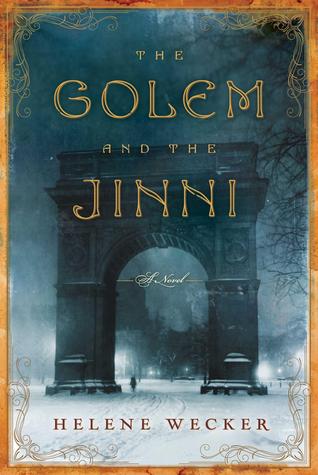
The tea she poured into the water -closet sink when no one was around. The toast and boiled egg she wrapped in a piece of waxed paper and gave it to the first hungry child she passed on her way to the bakery. She didn’t in fact have to do this; she discovered she could in fact, eat. On one of her last nights at the Rabbi’s, curiosity and boredom had overcome her lingering trepidation, and she decided to ingest a small piece of bread. …….The act of eating proved useful at the bakery, as she learned to make adjustments based on taste, and to eat a pastry occasionally as others did. But it was hard not to feel each prop– the cloak and the toast and the quickly eaten pastries — as a small pang, a constant reminder of her otherness.
Appetite (Poem)
Appetite
I eat these
wild red raspberries
still warm from the sun
and smelling faintly of jewelweed
in memory of my fathertucking the napkin
under his chin and bending
over an ironstone bowl
of the bright drupelets
awash in creammy father
with the sigh of a man
who has seen all and been redeemed
said time after time
as he lifted his spoonmen kill for this.
Pondering Brillat-Savarin’s Portait of a Pretty Gourmande

Those of us, who may have over-indulged on Mother’s Day Brunch, may find consolation in transcendental gastronomy. Very roughly summarized and perhaps twisted: women who eat are pretty and wrinkle free (although I don’t think 18th Century French secret food writer Brillat-Savarin would approve of either a buffet or the indulgence it fosters). Nevertheless, I think he offers something to think about against the contemporary valorization of thin.
Brillat-Savarin’s meditations The Physiology of Taste (first published 1826) is full of fascinating observations about food in its fullest sense. The encyclopedic account of all things related to eating covers definitions (or rather meditations) of senses, taste, gastronomic sciences, appetite, specific food items like chocolate, sugar, truffles and fish (and their associated erotic properties), methods of cooking such as frying, thirst and drinks, obesity, cooking, illness ….and so on.
Meditation 11: On Gourmandism describes the pretty gourmande as follows:
Nothing is more agreeable to look at than a pretty gourmande in full battle dress: her napkin is tucked in most sensibly; one of her hands lies on the table; the other carries elegantly carved little morsels to her mouth, or perhaps a partridge wing on which she nibbles; her eyes shine, her lips are soft and moist, her conversation is pleasant, and all her gestures are full of grace; she does not hide that vein of coquetry women show in everything they do. With so much in her favor, she is utterly irresistible, and Cato the Censor himself would be moved by her.
…..ladies who know how to eat are comparatively ten years younger than those to whom this science is a stranger.
Brillat-Savarin continues his description of sensuality as both physical and gastronomic in his account of “Sensual Predestination”:
People predestined to gourmandism are in general of medium height; they have round or square faces, bright eyes, small foreheads, short noses, full lips and rounded chins. The women so predisposed are plump, more likely to be pretty than beautiful, and have a tendency toward corpulence. The ones who are most fond of tidbits and delicacies are finer featured, with a daintier air; they are more attractive and above all are distinguished by a way of speaking which is all their own.
It is by these outer traits that the most agreeable dinner companions must be judged and chosen: they accept everything that is served them, eat slowly, and enjoy reflectively what they have swallowed.
I doubt if Savarin’s physiological theory that people with “a general air of elongation” do not enjoy food. Even so, his coupling of the visual and the gastronomic could offer a clue to our current fascination with thin. Does minimalist modern design feed into the aesthetic and gastronomic sensibility of “thin”? Can we study design eras in relation to celebrated body types? I digress……
Happy Belated Mother’s Day to all those agreeable, pleasant, plump and pretty gourmandes everywhere. Hope you enjoyed your brunch buffet!
The best conversations happen over brunch | Marketplace.org
“Pie is the Ame…
“Pie is the American synonym for prosperity and its varying contents the calendar of changing seasons. Pie is the food of the heroic. No pie eating people can be permanently vanquished.” (published May 3, 1902 in New York Times)
A note related to Jack Kerouac’s 1957 On the Road from Fictitious Dishes by Dinah Fried. What a visual feast for book lovers!
“But I had to get going and stop moaning, so I picked up my bag, said so long to the old hotelkeeper sitting by his spittoon, and went to eat. I ate apple pie and ice-cream– it was getting better as I got deeper into Iowa, the pie bigger, the ice cream richer.” — Jack Kerouac

“…there was a…
“…there was a tradition called Amani, according to which the woman of the house would, the night before, soak rice and the twig of a mango tree in a pot of water and on the morning of the new year, sprinkle it on everyone of the family. This was based on a magical belief that the water would wash away the mistakes and negative aspects of the past year and bring peace to the family. This tradition is also empowering for women as they have the responsibility of this mangolik or wishing-well ritual.”
I knew mangoes were magical!
This quote is from an interview about the Bengali New Year celebration published in the “The Bangladesh Reader” (Duke University Press, 2013)
Yummy wet noodles
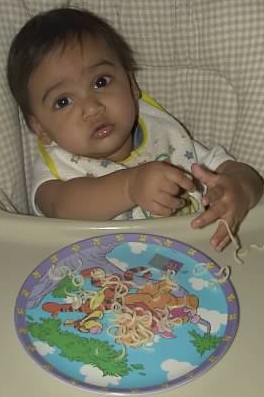
If we all just ate for mere nourishment there would be no need for the culinary crafts, no need for critics, no need for gourmet groceries or special tools, television shows, recipe books, blogs, festivals….candy or ice-cream. Yummy food embodies choice and ability, as well as decadence and gluttony. We can’t but want to share a delicious meal with our loved ones. Who among us hasn’t reached across the table with a loaded fork and said “try this”? Ironically, we can only share the experience of a delicious bite if we are willing to part with it. The structure of shared taste is grounded in limiting self-interest. Sharing at the table can be an ethically beautiful moment. Sure, there is the compulsion for aesthetic gastronomic agreement that aims to solicit common identity. If you like the food on my plate, you accept my taste and by extension me. Related to this compulsive search for commonality, I suspect the multi-dish restaurant experience of sharing is a 20th century phenomena in contrast to the the rustic biblical images of breaking a shared loaf of bread together. Sharing has become complex and discursive. It is not merely chewing the same meal or reaching from the same plate but rather pondering our shared and divergent experiences of “yummy” at the very same table. Sharing food from another’s plate implies a level of intimacy. Many people don’t welcome the intrusion into their plate and or taste (this makes me think of an episode of Modern Family). This weekend I’ve been reading Carolyn Korsmeyer’s Making Sense of Taste: Food and Philosophy. Her book offers a wonderful philosophical history about the meaning of food and warns against overly romantic notions of the shared table. After all, poison and cannibalism are instances when food is weaponized. Still, I think, as African American culinary chef and historian, Micheal Twitty reminds us, “yummy” retains its enslaved African American roots of cajoling young children to “yum-yum”…. to eat. I remember my youngest, when learning how to feed herself would always offer a cold wet, baby drool laden noodle with her uncertain little hand to me, her dad or her sister. While I may not have always wanted to accept the wet noodle, I still appreciate the gesture. I’m sure you have pictures of your kids feeding you, as you have fed them. Beautiful primal and human moment, isn’t it?
 The Hungry Philosopher