Wobblyogi Wednesday – Witness Consciousness

“To me, witness consciousness represents the human capacity to experience a way of knowing that goes beyond the limitations of language. It’s the felt experience of holistically apprehending our being. For most of us, this sense of realization comes and goes in special, fleeting moments. But when we’re in touch with it, it liberates us from the boundaries that ordinarily keep us feeling divided within ourselves, form each other, and against the world. Witness consciousness is, I believe, a capacity of mind that we all have but normally don’t develop. Practices like yoga, meditation, and centering prayer work to strengthen our capacity to access it. If these are done consistently, our ability to tap into it grows over time. This is why experienced practitioners often refer to yoga as spiritual “practice.”

The quotes above and below are from Yoga PhD: Integrating the Life of the Mind with the Wisdom of the Body by ex poli-sci professor, activist yogi, Carol A. Horton.

By noticing our breath, our tense muscles, our moments of ease and stress we cultivate this sense of witness consciousness through our own bodies and experiences. Each pose becomes an invitation to really see ourselves moving and breathing as we struggle to stay in the present and to stay in our bodies.  Sometimes, I find myself, unknowingly, using this holistic witness consciousness to find ease when I’m tired or struggling.

Recently, I was at a football game volunteering. The noise, the crowd, the heat, the carnivalesque atmosphere was overwhelming. I found myself transfixed by the fluttering orange gosamer wings of a butterfly as it floated towards the cloudless, cereulean blue serene sky. Suddenly, the whole stadium dissappered and instead there was blue, orange, lightness, ease, air and space. I survived the rest of the day by taking my gaze up whenever I needed. Just by focusing on a larger picture that included the stadium but was not limited to the stadium, I found my witness consciousness experiencing a joyous crazy football game under a calm and resplendent fall sky. Yoga or connections off the mat can be so magical.

Speaking of magic …Dr. Horton talks about the benefits of contemporary yoga (a mix of physical and mental practice) as an “intuitive opening to the hidden magic of everyday life.”

In the end, what I love most about contemporary yoga is its ability to synthesize the everyday with the extraordinary, the practical with the visionary, the mundane with the sacred. I love that yoga can work to release my tense muscles, negative emotions, and pyschic detritus at the same time. That it can connect me to my body in ways that create new neural pathways in my brain. That it offers a practical tool for coping with everyday stress, as well as an intuitive opening to the hidden magic of everyday life.

Don’t we all need to find the hidden magic of everyday life, at the grocery store, pumping gas, hunched over our computers, loading the dishwasher, tossing a salad and wiping the counter? From this perspective of witness consciousness my suburban, cul-de-sac ordinary, existence becomes a gateway to a magical reality where I can see the lone fluttering butterfly floating above a college football stadium.

Wishing you all happy butterfly chasing,

Wobblyogi

Yoga Poem – The Shining Moment in the Now by David Budbill

When I work outdoors all day, every day, as I do now, in the fall,
getting ready for winter, tearing up the garden, digging potatoes,
gathering the squash, cutting firewood, making kindling, repairing
bridges over the brook, clearing trails in the woods, doing the last of
the fall mowing, pruning apple trees, taking down the screens,
putting up the storm windows, banking the house—all these things,
as preparation for the coming cold…

when I am every day all day all body and no mind, when I am
physically, wholly and completely, in this world with the birds,
the deer, the sky, the wind, the trees…

when day after day I think of nothing but what the next chore is,
when I go from clearing woods roads, to sharpening a chain saw,
to changing the oil in a mower, to stacking wood, when I am
all body and no mind…

when I am only here and now and nowhere else—then, and only
then, do I see the crippling power of mind, the curse of thought,
and I pause and wonder why I so seldom find
this shining moment in the now.

“This Shining Moment in the Now” by David Budbill from While We’ve Still Got Feet. © Copper Canyon Press, 2012.

From the Writers Almanac

Wobblyogi Wednesday – Lunch Time Vinyasa!

My dear West Lafayette friends for whom my 6 am Wednesday Sunrise Yoga session is too early,

Welcome to my Tuesday and Thursday 12:15 – 1:00 p.m. yoga sessions starting next week, September 6th. Here are three reasons to join me,

Reason number 3: Short and gentle session open to all levels of yogis.

The shortened session is intended to be an afternoon break from the desk.  We’ll do a few standing poses to help recover our strength and ground, balance poses to help us focus on our remaining work and hip openers to help us sit through the rest of the workday.

Reason number 2: Wear comfortable work clothes.

No need to change into gym clothes. If you can take a wide stand, fold forward and take your legs up to the sky (comfortably and without flashing anyone),  any stretchy pants and shirt combination will work.  I don’t plan on getting us hot and sweaty. Despite the commercialization, there is no need for specialized yoga clothes! There I said it.

[If you feel the need to change, our bathroom is always available.]

Reason number 1: Grown-up rest time – Savasana.

Doesn’t a mid-day short break sound wonderful? Take yourself back to pre-school nap time (without the drool, waiting for your parents to pick you up, eyes half open, imprints of the mat on your face etc.). Nurture yourself, move your achy joints and muscles, stop the noise and hear yourself breathe for a few moments before you go back to your busy day.

A single session is $15. Try it. If you like it, treat yourself to one of the many packages. Sign up is easy on the Community Yoga Website: https://communityyogalafayette.com

Come move, breathe and rest with me!

Hope to see you next week,

The Wobblyogi

Image from a yoga studio in Bristol England: https://flowyogabristol.co.uk/. I would go there if I lived there. But, I don’t. Sigh. The lady looks so blissful.


Chicken Meatballs – Gluten free and Versatile

This Monday, I have no weekend food exploits to report. School has begun, summer is waning. Sigh.

Saturday, at home, we had a fun and messy summer dinner together of grilled king crab legs on the porch. It involved crab legs, rolls, corn, coleslaw, butter and not much else. A rare combination of easy and decadent.

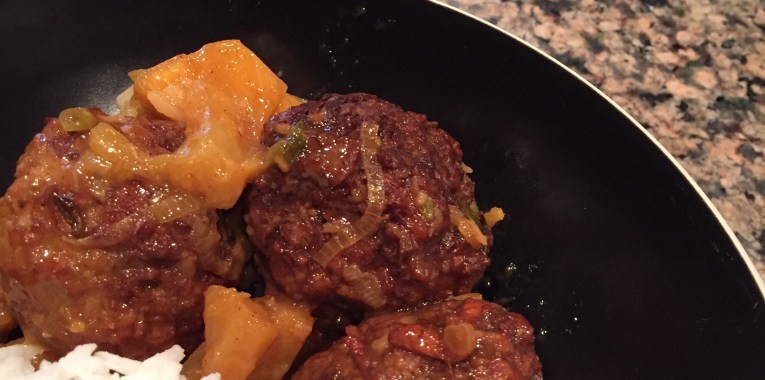
Friday night was teriyaki grilled salmon, white rice, tofu and broccoli stir fry and pineapple sweet and spicy chicken meatballs.

The Chicken Meatball dish was an effort to offer a quick protein snack or dinner for my dancer daughter.

IMG_3649.jpg

Asian Chicken Meatballs

  • 1 pound of ground chicken

  • 1 cauliflower shredded (in a blender with water and drained, or use food processor)

  • 1 tsp ground ginger

  • 1 tbs soy sauce

  • 1 tbs sauce of your choice (sweet chili sauce works well)

  • 1/2 cup coleslaw mix (shredded cabbage and carrots) or green onions, spinach or any shredded veggie can be added. You can also skip this addition.

  • Mix in order to incorporate the cauliflower throughout.

  • Form into small ball shapes.

  • Pan Fry.[or bake if you prefer]

  • Enjoy as a snack, a meatball slider or toss with additional sauce and vegetables for a dinner dish with rice or noodles.

Its gluten free, veggie filled, freezes well, versatile and tasty. It would be a good sandwich for school, after school snack or dinner. I can adjust the taste of this recipe by tossing the meatballs in bbq, Indian curry, thai curry, honey mustard, or any sauce and vary the flavorings within. As long as some liquid is added, the shredded cauliflower does all the work for this recipe.

As school and daily dance practice begins I’m looking for a variety of snacks that are nutrient dense and portable. What else besides, protein bars, nuts and dates, turkey sandwiches, can she take in her backpack?  Recommendations? All you soccer, gymnastics and dance moms out there, what do your kids like?

Here is an article about what ballet dancers eat. Helpful but not very portable suggestions.

Wishing all of you a wonderful week ahead,

Hungryphil


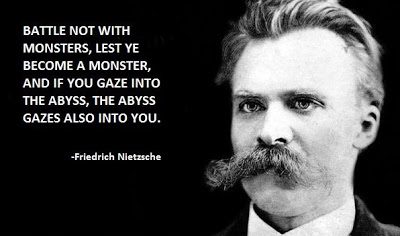
Nietzsche’s Mom Sends Sausages

I find something so appealing and humanizing about a philosopher reporting what he eats to his mother.

Michel Onfray’s Appetites for Thought: Philosophers and Food, explores such gastronomic moments where provocative Nietzsche is hanging up sausages, rational Kant is stumbling home drunk, radical Diogenes is chewing on raw octopus, Rousseau, the philosopher of the French revolution, is drinking and eating milk in all forms.  All ideologies need to be fed.

Here is a short excerpt about Nietzsche’s lifelong love of charcuterie:

“In fact the whole of his correspondence with his mother testifies to the primitive character of his mode of nutrition, and this throughout his life. At no time did Nietzsche seem to want to break from charcuterie and fatty foods.

In 1877 his dietary programme was the following:

Midday: Soup, of a quarter of a teaspoon of Liebig extract, before the meal. Two ham sandwiches and an egg. Six to eight nuts with bread. Two apples. Two pieces of ginger. Two biscuits. Evening: an egg with bread. Five nuts. Sweetened milk with a crispbread or three biscuits.

… However, charcuterie was still his favourite topic in his correspondence– ham ala Dr Wiel, ham sausage — as well as honey, chopped rhubarb and sponge cake. During his last years of lucidity – 1888- he denied himself wine, beer, spirits and coffee. He drank only water and confessed to ‘an extreme regularity in [his] mode of living and eating.’ But he still maintained the combinations of steak/omelette, ham/egg yolks/ bread. That summer he was sent 6 kilos of Lachsschinken (a mild ham) to last four months. When he received his package from his mother Nietzsche hung the sausages — delicate to touch – on a string suspended from his walls: imagine the philosopher drafting The Anti-Christ beneath a string of sausages… “

If no meal is innocent or thoughtless, I wonder what to make of my coffee and cereal for breakfast this morning.

Happy Monday my fellow hungryphilosophers,

Hungryphil


Image from funnyand.com

Food Poem – Canning by Joyce Sutphen

The last string of words, “packing a glass suitcase for the winter,” make me smile. Enjoy.

It’s what she does and what her mother did.
It’s what I’d do if I were anything
like her mother’s mother—or if the times
demanded that I work in my garden,
planting rows of beans and carrots, weeding
the pickles and potatoes, picking worms
off the cabbages.
Today she’s canning
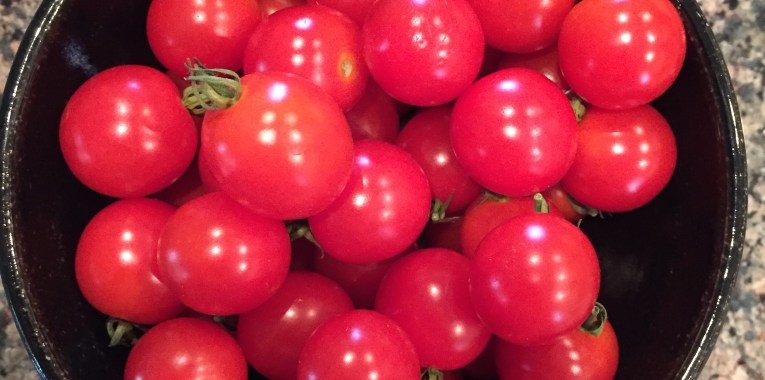
tomatoes, which means there are baskets
of red Jubilees waiting on the porch
and she’s been in the cellar looking for jars.
There’s a box of lids and a heap of gold
rings on the counter. She gets the spices
out; she revs the engine of the old stove.

Now I declare her Master of Preserves!
I say that if there were degrees in canning
she would be summa cum laude—God knows
she’s spent as many hours at the sink peeling
the skins off hot tomatoes as I have
bent over a difficult text. I see
her at the window, filling up the jar,
packing a glass suitcase for the winter.

“Canning” by Joyce Sutphen from First Words. © Red Dragonfly Press, 2010.

From the Writer’s Almanac

Wobblyogi Wednesday: Yoga body containing and transcending ego?

I was asked recently to identify what type of yoga I teach. She asked, “Hatha?”

In typical philosopher style, I wanted to answer, “Yes and no.”

Yes, the focus of the session will be the unity of body, mind, and breath by flowing through movements.  Yes, I hope the session carries both your mind and body to more ease. And yes, Hatha, as the practice of Sthira-Sukha, stillness and ease, I hope the yoga session helps us find balance.

On the other hand,

I wanted to answer, “No, not just Hatha yoga, as the yoga tradition most devoted to cultivating the body. No, I’m not interested in pushing  you to your physical limit. No, I do not expect you to master difficult poses, head stands or binds. No, I am not invested in your physical wellbeing drained of emotional strength.”

The dilemma about Hatha yoga is common, as we try to balance fitness with mindfulness,  assuming a mind-body duality. There is a long history to this question of the mind as it relates to our understanding of our embodied selves and our material world.

Here is one yoga scholar’s description about the dangers of holding the body as the locus of ego-centric practice:

“…the disciplines of Hatha-Yoga are designed to help manifest the ultimate Reality in the finite human body-mind. In this, Hatha-Yoga expresses the ideal of Tantra, which is to live in the world out of the fullness of Self-realization rather than withdraw from life in order to gain enlightenment.

…The Hatha- Yoga practitioner wants to construct a “divine body” or  “adamantine body” for himself or herself, which would guarantee immortality in the manifest realms. He or she is not interested in attaining enlightenment on the basis of prolonged neglect of the physical body. He or she wants it all: Self-realization and a transmutated body in which to enjoy the manifest universe in its diverse dimensions. Who would not sympathize with this desire? Yet, as can be imagined, the practitioners of Hatha-Yoga have sometimes sacrificed their highest spiritual aspirations and settled for lesser, perhaps magical, goals in service of the ego-personality. Magic, like exo-technology, is a way of manipulating the forces of Nature, whereas spirituality is about the transcendence of the manipulative ego-personality. Narcissism, or body-oriented egocentrism, is as great a danger among hatha-yogins as it is among bodybuilders.”

from George Fuerstein’s The Yoga Tradition

After alerting us about the potential dangers of egocentric self-absorption, Dr. Fuerstein suggests coupling Hatha-yoga with Raja yoga. Perhaps, that ego-countering coupling can include many other forms of yoga: Mantra (chanting), Bhakti (faith), Karma (action) and my favorite, Jnana (wisdom).

This is why as we move through the poses attentive to our breath, we look towards our inner landscape to find moments of pranayama (breath control), pratyahara (withdrawal from outside stimuli) and even dharana (concentration on something specific, like breath or tense tissue). I like to think of asana as the pivotal yoga-limb grounded in the yamas (how we behave with others) and niyamas (how we cultivate ourselves) while reaching and touching pranayama (aware breathing), pratyahara (focusing inward) and dharana (focusing on a single thing). It may or may not help us with dhyana (meditation) that may or may not lead to samadhi (transcendence). Asana can help us walk through 6 of the 8 limbs of the yoga-path. Or, we can metaphorically and literally be stuck in a peacock pose.

When we share our yoga practice with others, we become a community of individuals each striving towards the same thing through different breathing patterns, body types, and levels of awareness. Our bodies are not the same, how can our minds be? We may not be saying the same prayer or holding the same intentions but we are all praying and intending. Unity in diversity, not uniformity.

For me, asana practice, celebrates the diversity of bodies, of being, of lives, of minds that all strives towards the same human need for ease, goodness, and stillness.

But, I simply answered the lady’s question, “Hatha?” with a, “Yes.”

Hope I see her in class soon.

Happyoga,

The Wobblyogi


Being Extra and Adolf Loos’ Roast Beef

I am an extra.

I am a non-speaking character in a coffee shop background sipping coffee and staring at my laptop. There are raindrops on the windows, a blade of grass moving in the wind outside, cars moving past on the road, murmuring conversations, a large orange sculpture, a concrete floor, a sneeze, a ding, words, a child’s cry, salt and pepper shakers, mugs, music wafting above the hum of mid-morning conversations, a green shirt, smell of eggs and coffee, fingers on the keyboard, people behind the counter waiting, people cooking lunch, yellow road signs, an itch on the neck, words on the wall, wood tables, metal chairs, stripes and me.

I don’t despair being an extra. Extras in books, movies or television are never credited with names, just actions, like, “shopkeeper” or “crying child.” I am a silent actor in your story, a voiced actor in mine. You can only see my actions, my role as an extra. You don’t see my inner monolog, my struggles, my joys, my worries or my guilt. Recognizing that I am an extra in the world, a silent actor is surprisingly empowering. As you walk by my table where I type, I can trip you or smile, I may not change your story but I can color it with my actions. I don’t have to be the main protagonist. The main character depends on the extra. That is the secret: we are all extras. I came to see myself as an extra and found an extraordinary life. I stopped trying to be named, stopped trying to be the main character, a proper noun.

Philosophy, art, religions all try to address our longing to connect to something larger, more meaningful than us, as disparate individuals. This is an extra attempt, an exercise in noticing the small so that the big comes into focus. We all share the small things, like coffee cups, salt, phones, chairs and walls and the big, like cities, roads, landscapes, clouds, and water. How we focus on either shapes how our individual perspectives live and interact. You are an extra in the stories of almost everyone you meet today. You are also your own, more than. Depending on your outlook you could interpret “being extra” as either, being more, extraordinary or being waste, extraneous. I suspect that each of us, are always both.

I first arrived at this question when reading architect Adolf Loos’ 1908 modernist manifesto Ornament and Crime. All sauces he said were ornamental. He announced, ” I eat roast beef.” From my South Asian perspective beef was ornamental, mostly used as flavoring for curries and only rarely the main component during weddings and celebrations when a sacrifice was offered. Always ritualized and associated with a momentous occasion. Eating beef was considered an extra, a luxury. Never taking up the center of a plate like a steak. By Loos’ definition, I could never be modern. The vivid image of Loos eating a dinner of roast beef to explain the socio-economic value modern architecture stuck in my thoughts and made me wonder how my style of eating might inform my style of living, my philosophy.

How would you complete his sentence: I eat ________________________.

Beef French Dip Sandwich Recipe

Place a slab of beef in a slow cooker. Add water and soy sauce ( a least 1/2 cup) to cover the meat. (Hint: the soy sauce and slow cooking enhance the meat flavor).  Cook for 3-4 hours. Shred meat. Fill crusty rolls with shredded meat. Dip the sandwiches in meat juices. Add sliced onions, pickles, horseradish or whatever sauce or extras you like.

What would Loos make of this recipe? Is the sauce extra or is the meat extra? Doesn’t matter, as long as you are satisfied. Enjoy in moderation. The recipe can easily feed a crowd. Good for buffets and potlucks. If you want to avoid meat and the design debate altogether, just eat a cheese sandwich.

Here is a recipe with exact directions and measurements.

Weekend Eats – Red, Yellow and Green Things

This time of year, late August, the farmer’s market in West Lafayette, Indiana is brimming with delicious fresh and colorful things. It was a rare Saturday morning without any plans and perfect for a farmer’s market stroll. The vegetables and herbs were so enticing that I didn’t get any baked or cooked things. That may have been a first for me.  I was uncharacteristically satisfied with our bag of reds, yellows, and greens (and purples). This was the colorful afternoon snack we made:

IMG_3661.JPG

Fried Green Tomatoes

Dip slices of green tomatoes (about 1/4 inch thick) into a combination flour and cornmeal, salt, pepper, and paprika. Then dip into an egg wash mixture and back into the cornmeal mix. Shallow fry in a pan into golden. I like it with sriracha mayonnaise.

Ripe Red Tomato Sandwiches

Basically, slices of tomato between two slices of bread, with or without butter or mayonnaise.

IMG_3658.JPG

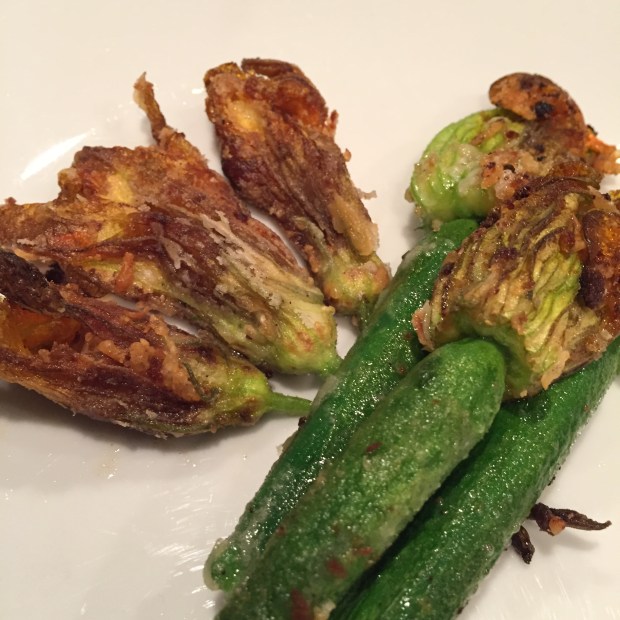
Fried Zucchini Blossoms

Really good stuffed with goat cheese. Sadly the goat cheese waiting in my refrigerator drawer, shall we say, had seen better cheese days. No goat cheese. So my filling was “minimal,” composed of bread crumbs, parmesan cheese and pepper. It was a bit disappointing.  The cheese melts into the flower and builds a creamy center and crusty edge.  On the other hand, without the goat cheese stuffing, I could taste the delicate blossom itself better. Either way, I was eating flowers. I imagine that’s what fairies eat after a rainbow unicorn ride through fluffy white clouds, a bouquet of fried flowers (okay maybe not fried but I bet the edgy fairies eat fried flowers, I don’t know……)

I still have my purple eggplants to eat tonight. May the color fest continue. I love summer and it’s bounty of  juicy, colorful, sweet and yummy things. Sigh. I miss it already as I write in late August sparkling morning sunshine. Soak, soak, soak, summer.  Did we finish all the fried tomatoes?

Wishing you all happy summer sunshine soaking (even if Monday),

Hungryphil


IMG_3656


Food Poem – Cucumber Fields Crossed by High Tension Wires by Thomas Lux

This week I enjoyed cucumber sandwiches and tea with my friends on the screened in porch. It was an uncharacteristically civilized evening. I used thin Pepperidge Farm white bread, mandolin thin sliced and peeled fresh garden cucumbers, Kerrygold yellow butter, salt and white pepper. That is it. Super simple. Here is a food poem that makes me think of that not so long ago relaxing and fun evening. May we all enjoy the season of delicate cucumber and juicy red tomato sandwiches.

The high-tension spires spike the sky
beneath which boys bend
to pick from prickly vines
the deep-sopped fruit, the rind’s green
a green sunk
in green. They part the plants’ leaves,
reach into the nest,
and pull out mother, father, fat Uncle Phil.
The smaller yellow-green children stay,
for now. The fruit goes
in baskets by the side of the row,
every thirty feet or so. By these bushels
the boys get paid, in cash,
at day’s end, this summer
of the last days of the empire
that will become known as
the past, adios, then,
the ragged-edged beautiful blink.

from the Writer’s Almanac