Wobblyogi Wednesday – Jar of Pickles

A jar of pickles….is not a standard yoga practice theme. Since I started teaching Sunrise Morning Yoga classes, I’ve been thinking about opening, waking up and ways to unfold. The first week I looked at poses that reminded me of opening a book like dancing warrior. The second week I looked at poses that made me think of flowers blooming or birds taking flight, like locust, ustrasana or brikasana. This week I looked to gentle twists, like opening a jar, like a revolved side angle or twisted chair. Exploring how we wake up and open to the world through yogic poses and movement has been fun. We started seated one day, in a child pose another and today from a reclined position. Each start progressed through the standard sequencing practices of centering, sun salutations and warmup, standing poses, balance poses, seated poses and back to floor. At this point, I’m getting better at time awareness and “feeling” where I should be in the sequence. I still have to figure out my unique concluding phrase that each yoga instructor seems to have. Do I even need one? I don’t know yet.

Today I’ve been thinking about Aristotle’s De Anima (On the Soul) and how the soul (and nature) is understood as movement, as animation. Can there be philosophy-themed yoga sequences? Nietzsche would definitely require a headstand. Hegel, a lot of opposing movements and then centering. Aristotle would definitely be an Iyengar practitioner, attentive to alignment between movements. Hmmm…I like thinking about this strange yoga thematic turn in practicing philosophies of embodiment. My mind is certainly wobblying now!

Maybe I need to compose Philosophers do Yoga like Monty Python’s Philosopher’s World Cup. Makes me laugh every time. Enjoy!

Wishing you ease and laughter,

The Wobblyogi

Image from: https://daphilosophers.wordpress.com/2011/02/06/yoga/

Wobblyogi Wednesday: Happy Place Escape

16-03-happy-place

Has yoga helped me find my “happy place”? Will it help you find yours? Confessedly, my definition of happiness has shifted from being associated with joy, laughter, passion to being associated with ease being in my own skin and ease being with others in this often unkind and unpredictable world. Today I ended our morning yoga practice with the words of my grandmothers. I’m sure some of my readers have heard the phrases: Shuke Thako, Bhalo Thako. Stay in ease (or happiness, here is the confusion again), Stay in goodness.  I feel bad now for taking those words so flippantly or sometimes even mockingly.  The simple advice to “stay” is basic yoga. Afterall, we are all trying to stay in our bodies, in our minds, in our hearts, in our world, through moving, breathing, focusing and meditating.

Most of all, I’ve learned that yoga is not about escaping to a “happy place” but about being able to just stay in unhappy, uneasy places without becoming unhappy or uneasy. There is unhappiness and there is happiness but I am not happy or unhappy. I am more than my feelings at a given moment, more than a sum of my feelings, more than my existential condition that gives rise to those emotional responses. Meditation does not help me escape my feelings but rather helps me sit with them without being constrained, defined or imprisoned by them. I watch my feelings and say, there is sadness, there is worry, there is joy, there is love, there is anger and so on and so on. Congratulations, I’m human. I’m alive and aware. By tagging and releasing the feelings I emerge lighter. The nagging emotions that refuse to fly away and keep returning to take up space in my mind and heart need more attention, more meditation and sometimes more action. The amount of emotional energy I release always amazes me. So few things are worth lingering over. If I can’t change it, devoting my mind to it won’t help. If I can change or affect it then my concern shifts to practical struggles of how:  from awareness to thinking.

I’m working through Jon Kabat Zinn’s book, Where you go, there you are: Mindfulness Meditation in Everyday Life. I found the chapter titled, “Meditation: Not to be confused with positive thinking” particularly helpful in relation to the notion of  a personal “happy place.” First, a food reference:

“Not only is it [our fundamental nature] not limited by the potpourri of our thinking mind, awareness is the pot which cradles all the fragments, just as the soup pot holds all the chopped up carrots, peas, onions, and the like and allows them to cook into one whole, the soup itself. But it is a magical pot, much like a sorcerer’s pot, because it cooks things without having to do anything, even put a fire underneath it. Awareness itself does the cooking, as long as it is sustained.You just let the fragments stir while you hold them in awareness. Whatever comes up in mind and body goes into the pot, becomes part of the soup.”

Kabat-Zinn concludes the section with these words about the limits of positive thinking,

“If we decide to think positively, that may be useful, but it is not meditation. It is just more thinking. We can easily  become a prisoner of so-called positive thinking as of negative thinking. It too can be confining, fragmented, inaccurate, illusory, self-serving, and wrong. Another element altogether is required to induce transformation in our lives and take us beyond the limits of thought.”

Don’t get me wrong. I often retreat to my happy place (usually when threatened by loud places filled with restless children and rushed adults like, amusement parks). But, that is not meditation. That is escape. I want to be able to escape from my life less and less. So I try to meditate more and more. Become more aware of my pot of soup instead of the peas and carrots.

I want to tweak the  Socratic dictate to,  the unaware life is not worth living.  The difference between the examined life and aware life is worth exploring in another post.

For now, I wish you easy awareness of your own unique pot of experiences,

The Wobblyogi

For a look at the Image and a good article about escapism and meditation visit: http://melbournemeditationcentre.com.au/articles/is-your-happy-place-really-a-happy-place/

Futurist Summer Recipe – Thomas Marinetti

Summer luncheon for painters and sculptors

After a long period of rest, a painter or sculptor who wants to take up his creative activities again at three o’clock on a summer afternoon may vainly try to excite his artistic inspiration with a succulent — traditional meal.

Weighed down, he would then have to walk to digest it and beset by cerebral anxieties and pessimism would end up wasting the whole day loitering artistically without creating any art.

Instead a meal may be served to him made up of pure gastronomic elements: a bowl of good tomato soup, a big yellow polenta, a heap of green salad, not dressed and not on a plate, a bowl full of olive oil, a bowl full of strong vinegar, a bowl full of honey, a big bunch of red radishes, a mass of white roses complete with thorny stems.

As the spirit moves him, without plates or cutlery, and continually refusing to follow the usual nervous habits which crop up, he assuages his hunger while looking at Umberto Boccioni’s picture of ‘The Football Player’.

Formula by the Futurist Aeropoet Marinetti

Dedicated to my exceptionally talented artist friends. I would make you a “meal of pure gastronomic elements” any day.

Wishing you happy summer,

Hungryphil


Weekend Eats: Indiana State Fair and Portuguese Bacalhau

What does Indiana taste like? Like anyplace, depending on where you go, it tastes different. Last weekend was my first taste of the Indiana State Fair. While roasted corn and pork tenderloin sandwiches were obvious favorites, I looked for a mix of the expected and the out of place, like bison egg rolls (popular enough to run out by 3pm). I did have fried green tomatoes, a chicken gyro, beef tips with mashed potatoes and mushrooms, garlic chicken burrito, a pineapple whip and an elephant ear. 

Let me briefly, explain the crazy quantity of food I consumed. It was band competition day at the fair and I had to kill 8 hours between my daughter’s performance. And, I did share (some of it).

While deep fried food rules the fair, I did not partake in the deep fried candy. There is only so much I can eat.

IMG_3595

There were animals: a poultry and rabbits building, a swine building, a cow building, Llamas, and horses. There were crafts like basket weaving, woodworking, sewing, etc. There were farm equipment and demonstrations. There were historical recreations. It was a celebration of Indiana farm produce and industry broadly understood. There was also swirling, dropping, rushing and bright carnival fair rides and games.  I’m not quite sure how band-day relates to this except for offering a large open venue for a competition. It was quite the experience. 8 hours may have been too long but the fair is certainly worth 3 hours of rides, food, and observation.

Sunday was a day of recovery from sitting on stadium metal benches, the late night drive back, the afternoon heat, and the carnival level noise. Our one meal of the day involved the Portuguese “Try the World” box that included bacalhau, Jack Mackerel toasts and then tea and cookies. Surprisingly my favorite was the not-so-good-looking Jack Makerel on toasted baguette slices. The fish canned in olive oil and spice  was soft and not overtly “fishy.” For me, the piri piri sauce made that dish sing the high notes of lemony heat.The bacalhau (not made with traditional salted cod but fresh) was also delicious. Although the bay leaf pieces and large spices were choking hazards and unpleasant in the mouth, the flavor was light and summery. I very much liked the cooking technique under the broiler for 10 minutes on a bed of greens and tomatoes and then another two with garlicky, olive oil coated bread crumbs. I’d like to try that technique with other fish and flavor combinations. A light summer dinner done in 15 minutes.


Here is the broiling technique,

  1. Season fleshy thick fish pieces (Cod, salmon, tuna and the like) with whatever seasoning you like.

  2. Sprinkle lemon and drizzle olive oil.

  3. Place fish over a bed of spinach, sliced tomatoes and onions.

  4. Add chicken stock to cover the bottom of the baking pan.

  5. Broil for 10 minutes.

  6. Combine 1 cup of bread crumbs with olive oil to coat every granule, crushed garlic and red pepper.

  7. Spoon bread crumbs over fish, broil for another 2 minutes.


Chia Seed Pudding – The Art of Recipe Testing

IMG_3572.JPG

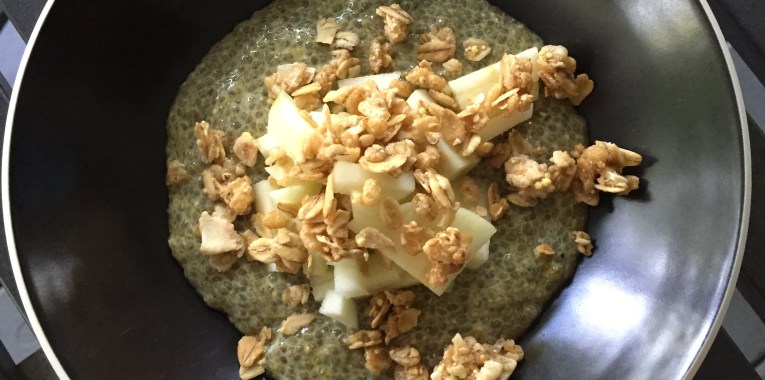
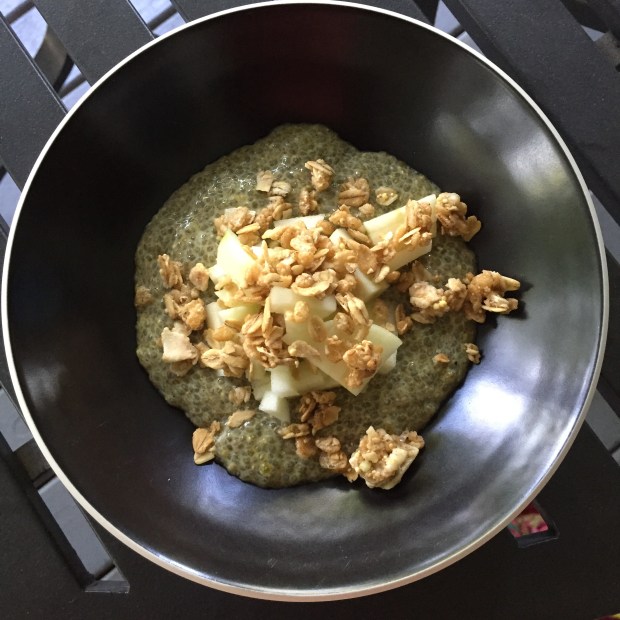
This week one of my struggles included trying to recreate the recipe for turmeric and ginger chia seed pudding that I had in Breckenridge over the summer. I searched online to find a similar recipe and thankfully found many. My first task was sifting through all the recipes in order to find one that spoke to me. This exhausting search and rescue operation in this era of information overload is a tricky one. Most of the time I just give up and reach for a book or a trusted and vetted source. For this odd recipe, that was not an option. Partly because I wasn’t looking for an exact taste. I was looking for proportion and general direction. How much chia seed to add to how much liquid to yield a pudding consistency? Flavor is something I could play with and find with my own palate.

First try: Too much liquid, good taste. Too runny.

Second try: Unsweetened almond milk, too much turmeric, good thick consistency, wrong flavor.

Third try: Getting closer to something healthy, filling and tasty for breakfast. Now to add the best combination of fruits and granola.

Hungryphil’s Morning Chia Seed Pudding

  • 1 cup chia seeds (course ground in coffee grinder)
  • 4 cups sweetened almond milk
  • 3 tablespoons agave nectar
  • 1 teaspoon of a mix of ground cinnamon and cardamom
  • 1/2 teaspoon turmeric (and a pinch of black pepper to help bring out its goodness)
  • 1/4 teaspoon ground ginger
  • 1 teaspoon rose water

Mix together with a whisk. Set overnight in the refrigerator. Serve with toppings of fresh fruit for brightness and granola for crunch.

I can see why conventional recipe testing wisdom dictates at least three. It was a philosophical task for me to notice these small differences in quantity or procedure that affect the overall taste and makes something different. It made me aware of the pungent bitter power of turmeric, the heat of ginger, the viscosity of blooming chia seeds, the lightness of almond milk, the notes of cinnamon, cardamom and rose water that sing over the soft sweetness of agave nectar. It is not the best thing I’ve ever tasted but it feels good to eat on mornings when chewing seems like such a chore. It brings me back to being on vacation, exploring coffee places in the morning with my nieces, and finding something odd and nourishing together. Am I recreating the emotional memory or the physical taste? Like most of what I cook,  I suspect both.

Here is another recipe that looks promising. The  yellow turmeric makes it soothing for the third  solar plexus chakra (Manipura). My yogi friend Debra talks about the chakras in her blog unfold-yoga.

My recipe is still a work in progress but I am happy with the basic consistency and flavor. My dancingtiya approves. Try it, tweak it and make it your own. Notice the details on the way.

Wishing you all a fulfilling bright and yellow weekend,

Hungryphil

IMG_3602 2


Wobblyogi Wednesday – Teaching Fears

My adventures in yoga teaching has officially begun! I am horrified and thrilled. Horrified, that, I, anxious and awkward, dare to invite people to move meditatively. Thrilled, that I get to share my efforts to calm my frenetic mind and heart with others.

I suppose it is the same combination of joy and fear I felt when holding my baby girls, getting married, writing my dissertation, teaching my first philosophy class or eating something unknown. I am mindful of the novelty, the moment of joy and fear and the awareness of a new path. I don’t know where it will take me and for how long but it feels good to look ahead.

Despite my fears, forgetting a pose in a sequence, wrong breath cues, limited alignment direction and the infinite little things that I could’ve done better, it was a wonderful experience. I know this because I want to do better. As soon as I got home, I found myself looking through music, researching sequences, considering different themes and advise on alignment cues. I found myself thumbing through my yoga teacher training notebooks and other books for direction.

I assume that anything or anybody that makes me want to be better is,  despite fear,  good for me. My kids make me want to be a better mom, my beloved makes me want to be a better partner, my philosophy students make me want to be a better teacher, my blog readers make me want to be a better blogger and so now my fellow yogis make me want to be a better yogi. Sharing, amplifies both good and bad, like cooking for others. It is a risk.

Yes, it was a good morning. A good beginning. I am so thankful for the graciousness of my sunrise vinyasa yogis. They have certainly helped me connect to my gratitude.

I was looking online for an appropriate quote that summarizes the crazy complexity of “first” experiences. Didn’t find one yet. I did find two about fear on goodreads that spoke to me. The first, short and sweet, is attributed to artist Salvador Dali.

“Have no fear of perfection – you’ll never reach it.”

There is something comforting in accepting imperfection as  evidence of continuous growth and striving, instead of failure and inadequacy.

The second quote is much longer from Herman Hesse about his admiration of trees.

“For me, trees have always been the most penetrating preachers. I revere them when they live in tribes and families, in forests and groves. And even more I revere them when they stand alone. They are like lonely persons. Not like hermits who have stolen away out of some weakness, but like great, solitary men, like Beethoven and Nietzsche. In their highest boughs the world rustles, their roots rest in infinity; but they do not lose themselves there, they struggle with all the force of their lives for one thing only: to fulfil themselves according to their own laws, to build up their own form, to represent themselves. Nothing is holier, nothing is more exemplary than a beautiful, strong tree. When a tree is cut down and reveals its naked death-wound to the sun, one can read its whole history in the luminous, inscribed disk of its trunk: in the rings of its years, its scars, all the struggle, all the suffering, all the sickness, all the happiness and prosperity stand truly written, the narrow years and the luxurious years, the attacks withstood, the storms endured. And every young farmboy knows that the hardest and noblest wood has the narrowest rings, that high on the mountains and in continuing danger the most indestructible, the strongest, the ideal trees grow.

Trees are sanctuaries. Whoever knows how to speak to them, whoever knows how to listen to them, can learn the truth. They do not preach learning and precepts, they preach, undeterred by particulars, the ancient law of life.

A tree says: A kernel is hidden in me, a spark, a thought, I am life from eternal life. The attempt and the risk that the eternal mother took with me is unique, unique the form and veins of my skin, unique the smallest play of leaves in my branches and the smallest scar on my bark. I was made to form and reveal the eternal in my smallest special detail.

A tree says: My strength is trust. I know nothing about my fathers, I know nothing about the thousand children that every year spring out of me. I live out the secret of my seed to the very end, and I care for nothing else. I trust that God is in me. I trust that my labor is holy. Out of this trust I live.

When we are stricken and cannot bear our lives any longer, then a tree has something to say to us: Be still! Be still! Look at me! Life is not easy, life is not difficult. Those are childish thoughts. Let God speak within you, and your thoughts will grow silent. You are anxious because your path leads away from mother and home. But every step and every day lead you back again to the mother. Home is neither here nor there. Home is within you, or home is nowhere at all.

A longing to wander tears my heart when I hear trees rustling in the wind at evening. If one listens to them silently for a long time, this longing reveals its kernel, its meaning. It is not so much a matter of escaping from one’s suffering, though it may seem to be so. It is a longing for home, for a memory of the mother, for new metaphors for life. It leads home. Every path leads homeward, every step is birth, every step is death, every grave is mother.

So the tree rustles in the evening, when we stand uneasy before our own childish thoughts: Trees have long thoughts, long-breathing and restful, just as they have longer lives than ours. They are wiser than we are, as long as we do not listen to them. But when we have learned how to listen to trees, then the brevity and the quickness and the childlike hastiness of our thoughts achieve an incomparable joy. Whoever has learned how to listen to trees no longer wants to be a tree. He wants to be nothing except what he is. That is home. That is happiness.”

All this, blogging and yoga, helps me share, helps me survive in suburbia, through the pick up and drop offs, the left behind water bottles, the grocery, summertime lunch, dinner planning for 10 hungry dance team girls, an article to write about Indiana woodware, another on an artist, a tagine and coffee pot to wash, a dog to let out, weeds to address and so on and so on.  I can embrace and enjoy it all because I took a full breath with others this morning. Gratitude, indeed.
Wishing all of you many new “firsts” ahead,
Wobblyogi

Pierogi Fest – Whiting, Indiana

Last Saturday, along with three friends, my daughter and I went on a road trip. Our destination? Exotic and distant small town Whiting, Indiana, where the last weekend of July is devoted to celebrating the humble Polish Pierogi. We drove past bountiful corn fields, rows of soy bean bushes, relaxed and grazing animals. We drove under threatening gray clouds and then thankfully, fluffy white cotton candy clouds. We waited patiently through road construction delays, waited not so patiently at a train crossing and then started doing stretches on the side of road. A kind passer-by asked if we’re going to the Pierogi fest, said he’s working there, and offered to guide us through back roads. Eager to escape the wait we followed him to the event parking lot. During that brief ride, there were suspicious alternate scenarios discussed, questions as to why and how he knew we were headed to the fest and concerns that we look like we eat a of pierogies. Our time at the Pierogi fest began with anticipation, excitement and kindness (thank you dear stranger for getting us to the event).

IMG_3547

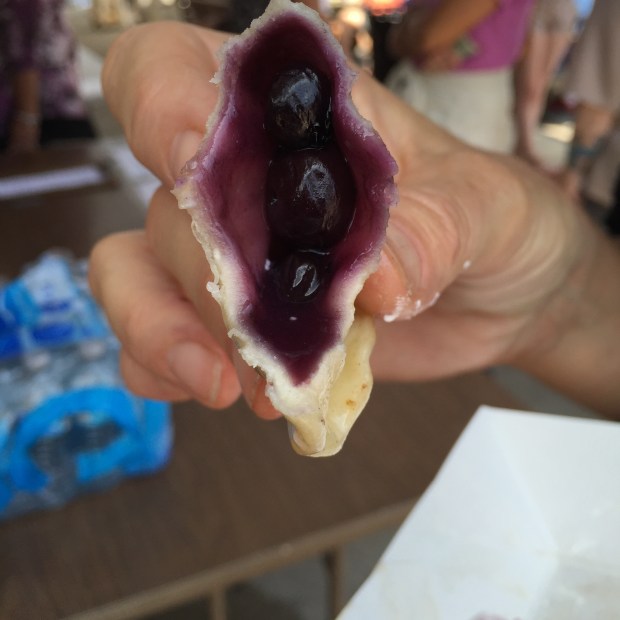
The event was much larger and better organized than I had imagined. It took up at least 6 blocks of Whiting city center. There was no entry fee. Many stalls had pierogies that could be purchased individually for a dollar. In addition to pierogies, there was also ice-cream, tacos, fried dough and refreshing drinks. This diversity in content and price made it affordable and welcoming. There were rides and games, shows, dances, craft stalls and much more. The variety, affordability and scale made it perfect for families, young couples, large groups and hungry friends. We started appropriately with the first stall: Pierogi Bomb. Soft, moist and flavorful, these pierogies set the standard. The ladies were funny and passionate about the Polish treat, warning us against the cultural inferiority of fried or boiled pierogies available at the fest. My daughter and I had the classic potato and cheese, as well as a spinach. My friend, Siggy, swears by the beautiful blueberry pierogi.

IMG_3548IMG_3549

We tried varieties from other stalls, as well as other treats like potato pancakes (I’ve had better), shaved ice and a horchata drink. The numerous sheesh kabob stalls, made me wonder if sausages and kabobs go together on the Polish table.


This cajun stall was so enticing with its large platter of steaming and spicy seafood dishes. Just looks like a party, doesn’t it?

IMG_3555

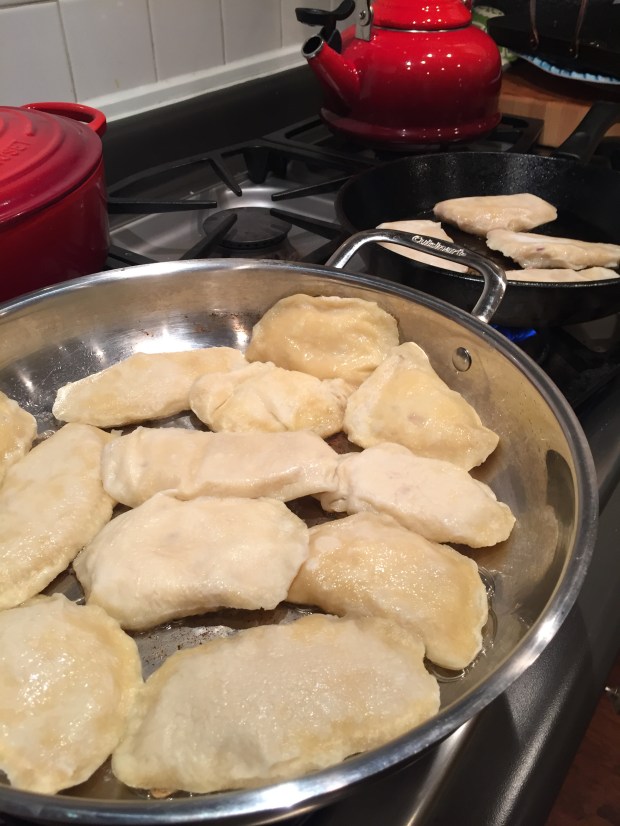
My little friend group, included my new friend (Kathy, my good friend’s sister-in-law), Robin Henke, Polish pierogi maker and our guide. Robin pointed out good that pierogies don’t have a lot of dough on the edges so every bite has filling. She gave us a few batches of her homemade pierogies. Thanks to her, my pierogi fest didn’t end Saturday but continued Sunday. She even shared her recipe!  Can’t wait to try it and feed my new love of pierogies and pierogi fest.

If you missed it this year, mark your calendars for next year.

IMG_3559IMG_3560


Robin’s Pierogi Recipe

POTATO FILLING
3 Tablespoons Butter
1/2 Cup Chopped Onion
2 Cups old Mashed Potatoes
1 Teaspoon Salt
1 Teaspoon White Pepper
1 Cup Shredded Cheese – I use cheddar and mix it into the potatoes when the are still warm

DOUGH
3 Eggs
1 Container (8 oz) Sour Cream
3 Cups Flour
1/4 Teaspoon Salt
1 Tablespoon Baking Powder

1. For the mashed potato filling, melt the butter in a skillet over medium heat.
Stir in the onion and cook until translucent, about 5 mins.
Stir into the mashed potatoes and season with salt and pepper.

2. To make the dough, beat together the eggs and sour cream until smooth.
Sift together the flour, salt and baking powder.
Stir into the sour cream mixture until dough comes together.
Knead the dough on a lightly floured surface until firm and smooth.
Divide the dough in half, then roll out one half to 1/8 inch thickness.
Cut into 3 inch rounds.

3. Place a small spoonful of the mashed potato filing into the center of each round.
Moisten the edges with water, fold over and press together to seal.
Can work on the second half of the dough while cooking the first batch.

4. Bring a large pot of lightly salted water to a boil.
Add pierogies and cook for 3-5 minutes, or until the pierogi float to the top.
Remove with a slotted spoon and let cool on parchment lined baking sheet.

Once I get a cookie sheet full, I put it in the freezer till pierogies are frozen.
Then I shrink wrap them in how ever many I want in a package.

5. To reheat them: melt some butter in a skillet, can add some sliced onion, lay the frozen pierogies on top of onions and sauté until heated through, turning gently a time or two and browned on the outside. I like mine a little crispy on the outside.

Learning from Srilankan Kutto

Srilankan Kutto was a new discovery for me in NYC a few weeks ago at Kottuhouse.
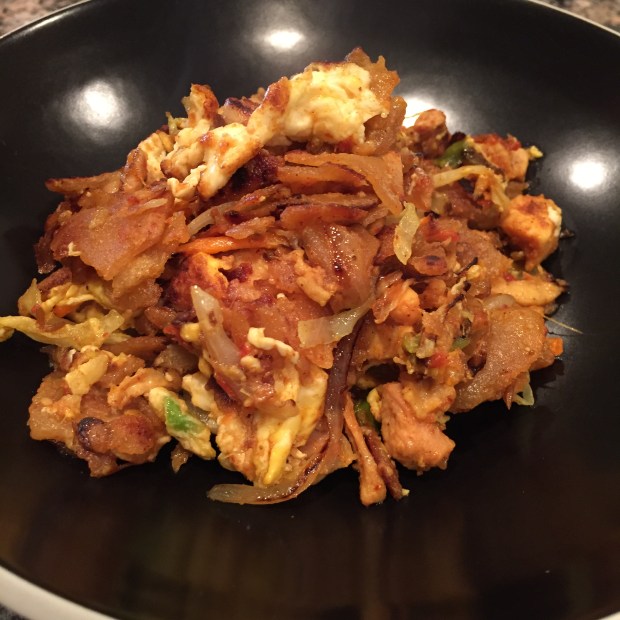
A street food composed of shredded flatbread, curry, vegetables and eggs. Tastes strangely like South Asian flavored stir-fried wide noodles. The dish showed me that shredded bread can a be wonderful new technique. The dish would be a perfect way to use up leftover curries or stretch a curry. It is infinitely adjustable too. Leave the meat out, add more veggies, cut the spice, add spice, make is soft, make it dry etc. My hungryphil jr. daughter, Atiya, suggested adding a fried egg on top (instead of mixed in). This way the runny yolk could dress and soften the bread too. It would be a perfect brunch bowl. The dish recomposes a traditional hand scooped plate of curry and bread to become a spoon and bowl friendly dry dish.  Same flavors, altered form. I’m excited about using the technique for any leftover curry or chili, or stew. Here is the standard I was working from.

IMG_3466


IMG_3467.JPG

http://www.srilankanrecipes.info/recipes/RiceDishes/KoththuRoti.aspx

http://cooking.nytimes.com/recipes/1017015-chicken-kottu-roti

Here is what I did:

  1. Made a quick chicken curry (diced chicken thighs, diced tomatoes, paprika, ginger, garlic, turmeric, coriander, onion, garam masala and vinegar) or you could just use your favorite curry powder.
  2. Shredded three store bought parathas (flat bread from the frozen section of an Indian grocery store) into small 1/4 in pieces. Any unleavened flat bread should work.
  3. Saute sliced onions and green chilies in a wok.
  4. Added a cup of shredded cabbage and carrots from a bag. Coleslaw bag.
  5. Added two eggs.
  6. Added shredded bread.
  7. Added enough curry to moisten the bread. You can always serve more curry on top.

IMG_3544

It didn’t taste as moist as Kuttohouse but was still very much like a stir-fried flavorful spicy noodle dish.

Try ripping up your flatbread and tossing it with something in a hot wok! It gives “bread bowls” a whole new meaning.

Wishing you happy taste experiments,

hungryphil

Wobblyogi Wednesday: Jon Kabat-Zinn

Here is a food poem from third century China referenced in Jon Kabat-Zin’s book, Wherever you go, there you are: Mindfulness Meditation in Everyday Life:

Prince Wen Hui’s cook

Was cutting up an ox.

Out went a hand,

Down went a shoulder,

He planted a foot,

He pressed with a knee,

The ox fell apart

With a whisper,

The bright cleaver murmured

like a gentle wind.

Rhythm! Timing!

Like a sacred dance,

Like “The Mulberry Grove,”

Like ancient harmonies!

“Good work!” the Prince exclaimed,

“Your method is faultless!”

“Method?” said the cook

Laying aside his cleaver,

“What I follow is Tao

Beyond all methods!

“When I first began

to cut up oxen

I would see before me

The whole ox

All in one mass.

After three years

I no longer saw this mass.

I saw the distinctions.

“But now I see nothing

With the eye. My whole being

Apprehends.

My senses are idle. The spirit

Free to work without plan

Follows its own instinct

Guided by natural line,

By the secret opening, the hidden space,

My cleaver finds its own way.

I cut through no joint, chop no bone.

“There are spaces in the joints;

The blade is thin and keen:

When this thinness

Finds the space

There is room for all you need!

It goes like a breeze!

Hence I have this cleaver nineteen years

As if newly sharpened!

“True, there are sometimes

Tough joints. I feel them coming,

I slow down, I watch closely,

Hold back, barely move the blade,

And whump! the part falls away

Landing like a clod of earth.

“Then I withdraw the blade,

I stand still

And let the joy of the work

Sink in.

I clean the blade

And put it away.”

Prince Wen Hui said,

“This is it! My cook has shown me

How I ought to live

My own life!”

CHUANG TZU

Kabat-Zinn continues to explain that,

“Meditation is synonymous with the practice of non-doing. We aren’t practicing to make things perfect or to do thing perfectly. Rather, we practice to grasp and realize (make real for ourselves) the fact that things already are perfect, perfectly what they are. This has everything to do with holding the present moment in its fullness without imposing anything extra on it, perceiving its purity and the freshness of its potential to give rise to the next moment.”

He calls this awareness, being able to detect the “bloom of the present moment in every moment, the ordinary ones, the in-between ones, even the hard ones.”

I like the ideas of welcoming “The bloom of the moment” and “letting the joy of the work, sink in.”

Right now, I’m reading, writing and sharing a moment of discovery. As are you.

I’ll stop writing now and just let this moment sink in.

Wishing you many moments of bloom!

Hungryphil

From Travel Eater to Home Cooker

Dear readers, as you know I’ve been eating out a lot lately. Summer travel is the best excuse to overindulge. And, I have.

It is time to re-enter my kitchen and get back to cooking.

First to give back a bit. Sandwiches at the Lafayette Urban Ministry Homeless Shelter last Thursday night. Turkey Sandwiches. I struggled with my choice of condiments. I put mayonnaise on the sandwiches to dress the lettuce/tomatoes, keep it moist but neutral. I also recognize a lot of people don’t enjoy mayonnaise. Is a better option to make plain sandwiches and offer jars of mayonnaise and mustard, separately?

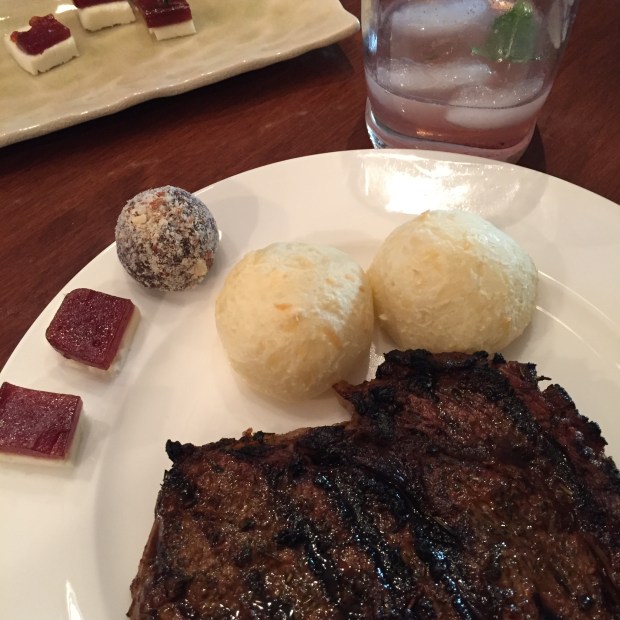
Friday night was Brazilian “Try the World” box night that included:

  • Beef Churrasco : Flavorful marinated steak. I would order more of this spice mix.
  • Pao de queijo: Eggy, cheesy bread with a popover like consistency. Also surprisingly, gluten-free (made with tapioca and potato flour).
  • Romeu and Julieta: Soft cheese with guava paste.
  • Brigadeiro: a sweet confection made with condensed milk, chocolate and ground nuts. Has the consistency of soft, chewy caramel and tastes of fudge.
  • Cookies and coffee: small nutty short bread cookies with dark roasted coffee. Yum.

IMG_3533

Back in the kitchen. I have many travel tastes to bring home! Here is my list so far:

  • Srilankan Khutto (NYC)
  • Chia seed pudding with tumeric and ginger (Breckenridge)
  • Chicken Enchiladas with Red Sauce (Santa Fe)
  • Black beans and rice (Cuba)
  • Ropa Vieja (Cuba)

Stay tuned for recipe experiments to come.

Happy eating,

Hungryphil