Testing Light Mac and Cheese (Martha Stewart)

FullSizeRender

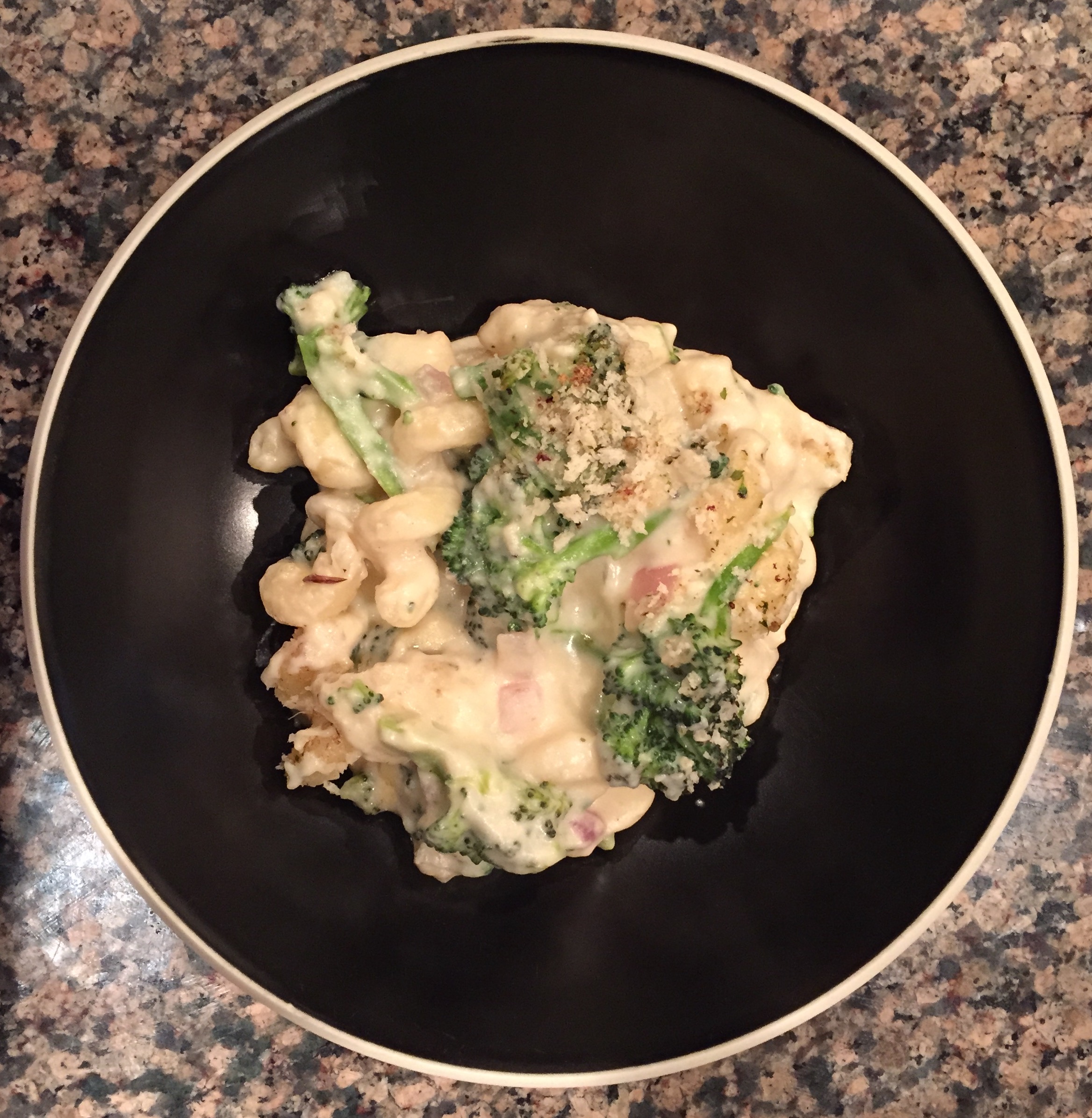
Had broccoli and not much else at home this evening. Found this recipe online searching “broccoli recipes” on the Martha Stewart site. Aside from a few substitutions: cream cheese, skim milk, red onion and a few additions of extra broccoli, hot sauce and nutmeg, I did follow the recipe (surprisingly!).

This recipe, a combination of broccoli cheese soup and pasta with alfredo sauce, is a good base for many experiments to come. Too luxurious to be called “light.” Well… its “lighter” than an original version with whole milk and heavy cheese but not as light as having a bowl of broccoli with whole wheat pasta dressed in olive oil and garlic. Nevertheless, testing and tasting this bubbly mac and cheese recipe was well worth it on this rainy spring evening. That’s my story for tonight. Dinner saved!

But I really need to stop by the grocery store tomorrow………….

Wishing you happy dinner wherever you are,

Hungryphil

http://www.marthastewart.com/964975/lighter-three-cheese-mac#Broccoli%20Recipes|/1011281/Bbroccoli-recipes/@center/276955/seasonal-produce-recipe-guide|964975

Baked Tandoori Catfish, Brown Basmati Rice and Steamed Cauliflower

IMG_1736IMG_1735

I was looking for a quick, uncomplicated, spicy and yummy lunch at home. Most importantly, a lunch that did not involve me wearing the spices for the rest of day. Hmmmmm………

I found my answer in a packet of tandoori spice and the oven.

    1. Catfish fillets (any neutral white fish ready to soak up flavorings will do) coated with
    2. A mixture of (depending on your heat preference) 1 or 2 table spoons Tandoori spice (any brand will do or you could make it but I was looking for the “fast food” way out) + 2 table spoons plain yoghurt + 2 table spoons vegetable oil. Optional: sprinkle with chopped onions, green chilies and cilantro.
    3. Bake in oven 425 degrees for 30 minutes.
    4. Cook brown rice and steam cauliflower or broccoli as sides. No spice or involved cooking needed. The spicy fish can carry the flavor. Cook the rice first. I hate having to wait for the sides to be done.

Oh the joy of lazy cooking with packaged spices without following package directions.

Can a writer, cook?

41MDk6xZlGL._SY344_BO1,204,203,200_

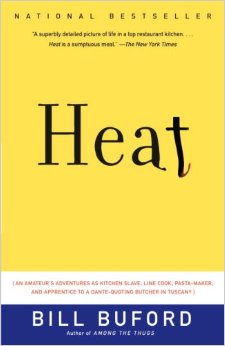
I have long struggled with the supposed duality of thinkers-doers, theory-practice, architect-builder, foodwriter-cook, design historian-designer. I was relieved by object-oriented radical philosopher Ian Bogost’s call for hybrid practitioners: the philosopher-chef, the philosopher-astronomer and the philosopher-mechanic. I am further soothed by Bill Buford’s 2006 Heat. Yes, I writer can cook and vice versa. There is hope for me yet.

Rave reviews of his book include terms like “dirty realism” and my favorite “existential journalism.” His brand of immersed journalism combines personal fascination (obsession) with in-depth social research. I suppose I feel the same awe about him as he felt following the energetic Mario Batali.

Here are four lessons I’ve learned from Heat:

1. In the kitchen as in life the space we take up is precious and worth defending.

  “I was accepted “inside” on a trial basis. “The question is of space,” Mario said. “Is there room for another body?” There wasn’t. There wasn’t room for the people already there. But somehow I squeezed in.”

“In the afternoon, if you can get a perch in the kitchen, you don’t leave it. You don’t answer the phone, run an errand, make a cup of coffee, have a pee, because if you do you’ll lose your space.”

2. Repetition is the key to mastery.

“One day I was given a hundred and fifty lamb tongues. I had never held a lamb’s tongue, which I found greasy and unnervingly humanlike. But after cooking, trimming, peeling, and slicing a hundred and fifty lamb tongues, I was an expert.”

3. Pressure helps develop (kitchen) awareness.   

“ You’ll learn the reality of restaurant kitchen. As a home cook, you can prepare anything any way anytime. It doesn’t matter if your lamb is rare for your friends on Saturday and not so rare when they come back next year. Here people want exactly what they had last time. Consistency under pressure. And that the reality: a lot of pressure.” He (Mario) thought for a moment. “You also develop an expanded kitchen awareness. You’ll discover how to use your senses. You’ll find you no longer rely on what your watch says. You’ll hear when something is cooked. You’ll smell degrees of doneness.”

4. The need to learn is a compulsion. Just give in.

“I found myself needing to understand short ribs…..”

“I needed to learn pasta.”

“ I was now preoccupied by the question of when, in the long history of food on the Italian peninsula, cooks started putting eggs in their pasta dough. Was this a reasonable concern? Of course not.”

So, learning from Bill Buford, I’ll take up and defend space, repeat until mastery, embrace pressure and give in to my need to understand cooking and how we eat both in the kitchen and in front of my laptop.

Looking for Differences by Tom Hennen

I am struck by the otherness of things rather than their same-
ness. The way a tiny pile of snow perches in the crook of a
branch in the tall pine, away by itself, high enough not to be
noticed by people, out of reach of stray dogs. It leans against
the scaly pine bark, busy at some existence that does not
need me.

It is the differences of objects that I love, that lift me toward
the rest of the universe, that amaze me. That each thing on
earth has its own soul, its own life, that each tree, each clod is
filled with the mud of its own star. I watch where I step and see
that the fallen leaf, old broken grass, an icy stone are placed in
exactly the right spot on the earth, carefully, royalty in their
own country.

“Looking for the Differences” by Tom Hennen from Darkness Sticks to Everything. © Copper Canyon Press, 2013. Reprinted with permission.

From the Writers Almanac on April 17th, 2015, http://writersalmanac.org/

This poem, a wonderful example of object oriented thinking, does not directly address food. But it does remind me of the respected “royalty” of each ingredient.

Consuming Desire – Poem by Katrina Vandenberg

I’m not making this up. In Cafe Latte’s wine bar
one of the lovely coeds at the next table
touched John on the arm as if I wasn’t there
and said, Excuse me, sir, but what
is that naughty little dessert?
And I knew from the way he glanced
at the frothy neckline of her blouse,
then immediately cast his eyes on his plate
before giving a fatherly answer,
he would have given up dessert three months
for the chance to feed this one to her.
I was stunned; John was hopeful;
but the girl was hitting on his cake.
Though she told her friend until they left
she did not want any. I wish she wanted
something—my husband, his cake, both at once.
I wish she left insisting
upon the beauty of his hands, his curls,
the sublimeness of strawberries
and angel food. But she was precocious,
and I fear adulthood is the discipline
of being above desire, cultivated
after years of learning what you want
and where and how, after insisting
that you will one day have it. I don’t
ever want to stop noticing a man like the one
at the bar in his loosened tie, reading
the Star Tribune. I don’t want to eat my cake
with a baby spoon to force small bites,
as women’s magazines suggest. And you
don’t want to either, do you? You want a big piece
of this world. You would love to have the whole thing.

“Consuming Desire” by Katrina Vandenberg from Atlas (Minneapolis: Milkweed Editions, 2004). Copyright © 2004 by Katrina Vandenberg. Reprinted with permission from Milkweed Editions.

From the Writers Almanac March 15, 2015 http://writersalmanac.org/page/23/

Eggcellent Easter Recipes (Sorry couldn’t let the pun go…..)

IMG_1724

It has come very recently to my attention (yesterday) that there are many delicious egg centric recipes related to the Easter table. Sure, I was aware of ham, lamb and happy baby spring vegetables, delicious chocolate bunnies and neon yellow peeps…….but I missed out on the associated celebration of the egg, aside from the chocolate eggs. I, a big fan of eggs, feel cheated. In case you are new to this blog, my access to all celebrations whether pertaining to my childhood or not is centered on food. I quite literally consume the Super Bowl (Jim is still trying to teach me the rules of the game), Easter, Eid, Diwali, Thanksgiving , July 4th….you name it. I’m an equal opportunity eater. I know this is a bit reductive and possibly sacrilegious but my intentions are simply to share the joy and means no disrespect. So back to my Easter recipe search. I tried two of the many I found online.

Lemon Buttermilk Saffron Pie

http://www.epicurious.com/recipes/food/views/lemon-buttermilk-pie-with-saffron-51223970

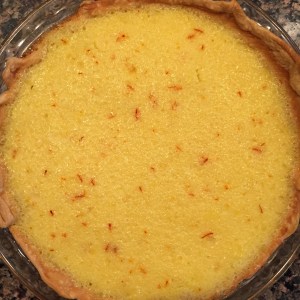
This is an wonderful combination of lemony tartness and flowery sweetness. The saffron makes it both exotic and familiar depending on which part of the globe your taste buds woke up.  It really tastes like spring in all its bright, sweet, floral glory. I’m guessing not very traditional but voting that it should be.

Leek and Feta Tart

Leek and feta tart

This was a savory taste of spring with sauteed leeks in a velvety egg blanket studded with feta. I can imagine endless variations of this tart…… asparagus, tomatoes, potatoes, mushroom, squash…just to name a few.

This recipe was measured in grams and I was too lazy to officially convert, so I just used 3 eggs and about a cup of heavy cream. It worked great. Looked and tasted delicate and refined.

IMG_1725

For both recipes I used store bought pie crust. I had both done in a little over an hour (including baking time). The store bought crust meant I only had to mix the filling. This fact makes me think of the book I just finished reading “The American Way of Eating” by Tracie McMillan. Learned a lot. Fascinating and scary read. She mentions how even when we cook at home we use a lot of processed and packaged food. Makes me rethink the concept of home cooking and my use of Pillsbury pie dough. The book deserves a detailed discussion, maybe on a different post. We should start a foodie/eater book club….does anyone know of one out there already?

https://americanwayofeating.wordpress.com/

The best part about making/ assembling/ baking these two pies was cooking with my 13 year old. She first reluctantly sauteed the leeks and later eagerly measured the buttermilk, the sugar (commented on the amount…good for her), separated eggs, whisked and mixed. There are many social, anthropological and philosophical studies about our unique human practice of cooking. Frankly, I don’t know if the pies actually tastes as magical as I remember or if I’m tasting a rare-unhurried-salty-sweet-spring Sunday afternoon with my growing-into-a-cook, baby.

Maybe it doesn’t matter.

Wishing you many happy celebrations to eat through together,

The Hungry Philosopher

Deshi in the Dorm Kitchen – Chicken Kofta Curry

IMG_1707

Dear Amani,

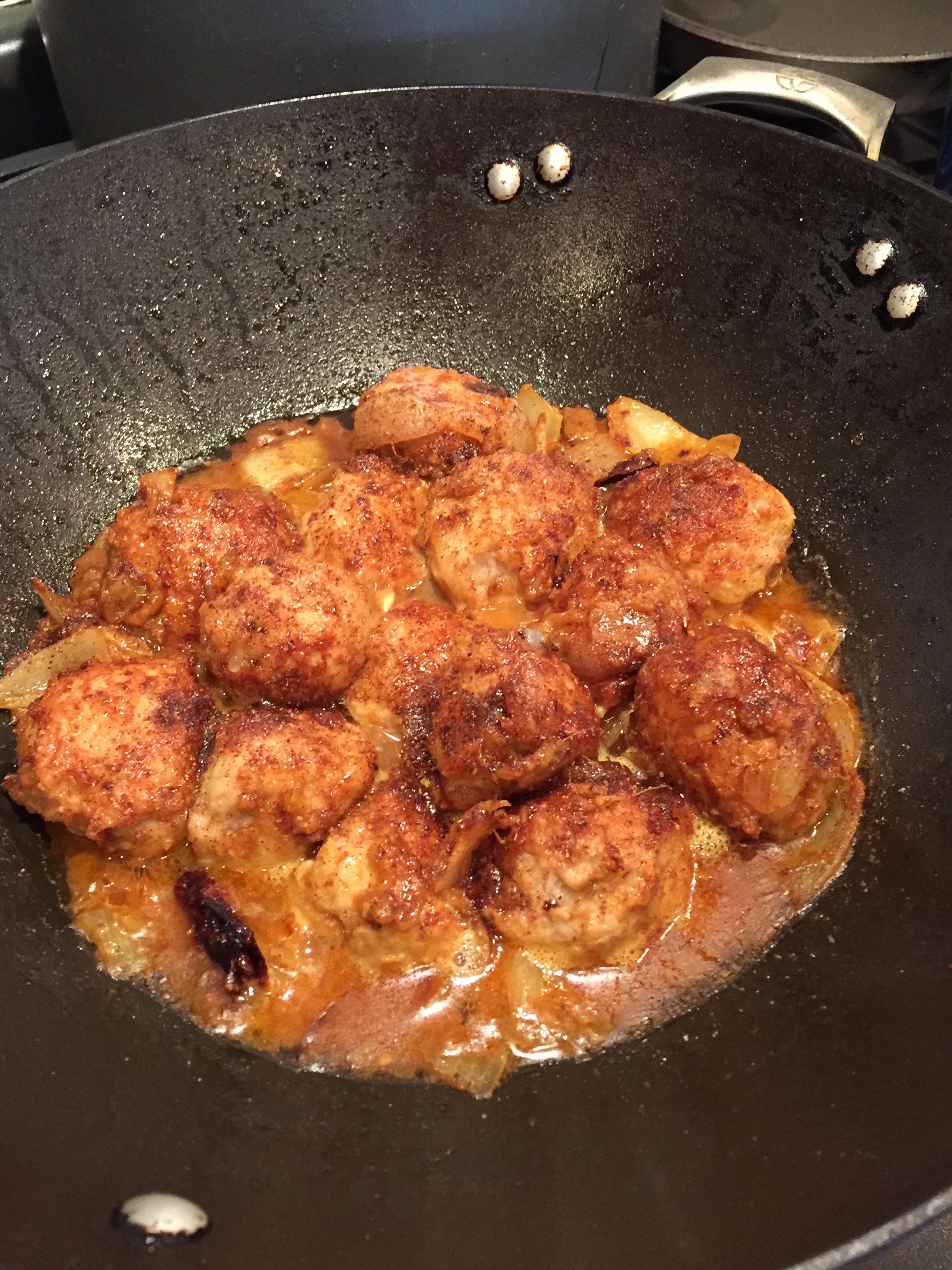
I’m sure this recipe exists in some form somewhere. Here is what I did with a pound of ground chicken. Its a yummy take on the everyday chicken and potato curry.

You’ll need:

1 lb of ground chicken

1 medium onion

2 medium potatoes (I had yellow potatoes)

1 teaspoon curry powder (grocery store brand is fine, I had hot curry powder from our Indian grocery store)

1 teaspoon of garlic paste (crushed, powder, doesn’t matter)

1 teaspoon of ginger paste (powder is fine)

Oil about a 1/4 cup

Here’s what you do:

1. Mix ground chicken with shredded potato (don’t shred your fingers, be careful with the metal grating box….use the large eyes), shred onion on the same contraption about 2 tablespoons worth, 1/2 teaspoon of ginger, garlic and curry powder each. And salt.

2. Form loose meatballs with the mixture. It’ll be messy. If you oil your hands, it’ll be easier to form.

3. Fry lightly in the oil. Turning so all sides get browned.

4. You can stop here or reserve some meatballs separately for room mates who don’t like much spice and for sandwiches or quick bites. Be sure to check done-ness. If not, place in warm oven for 10 minutes. The meatballs need to cook a bit for the potatoes to get soft.

5. If you want to make a curry sauce……..chop the rest of the onion, fry it in the oil (depending on how much oil is left in the pan you might want to drain some of it…until you have about 2-3 tablespoons left in the pan), add the rest the ginger, garlic and curry powder (and salt). Fry until you can smell the spices. Add 1/2 cup of water. A sauce will form very quickly. Put the meatballs back in the pan, coat gently with the sauce and let sit on low for about 15 minutes.

You can add chopped tomatoes, cilantro, cream or coconut milk if you have it. Otherwise, this is an easy 6 ingredient recipe. You can also use any spice instead of the curry powder for example tandoori spice or any barbeque spice rub.

Serve with hot rice or bread. Let me know if you try it.

Love,

Your hungry mom

Chocolates by Louis Simpson (Poem from Writer’s Almanac)

Once some people were visiting Chekhov.
While they made remarks about his genius
the Master fidgeted. Finally
he said, “Do you like chocolates?”

They were astonished, and silent.
He repeated the question,
whereupon one lady plucked up her courage
and murmured shyly, “Yes.”

“Tell me,” he said, leaning forward,
light glinting from his spectacles,
“what kind? The light, sweet chocolate
or the dark, bitter kind?”

The conversation became general.
They spoke of cherry centers,
of almonds and Brazil nuts.
Losing their inhibitions
they interrupted one another.
For people may not know what they think
about politics in the Balkans,
or the vexed question of men and women,

but everyone has a definite opinion
about the flavor of shredded coconut.
Finally someone spoke of chocolates filled with liqueur,
and everyone, even the author of Uncle Vanya,
was at a loss for words.

As they were leaving he stood by the door
and took their hands.
In the coach returning to Petersburg
they agreed that it had been a most
unusual conversation.

“Chocolates” by Louis Simpson from Collected Poems. © Paragon House, 1988. Reprinted with permission.

I started posting these poems as a way to include them in this collection of food, design and philosophy related thoughts. At this point there is quite a collection of poems. I’m struck by the diversity of emotions that food images conjure up. This poem perhaps shows that social and conversational connection of taste that brings us to share in each others thoughts online and in person best. Food talk is “most unusual” maybe because there is no prescribed method or sequence, no ultimate objective standard. If I say I don’t like the taste of macadamia nuts, there can only be explanation but no argument, opinions but no facts. I can say I don’t like them unless baked in white chocolate cookies. You don’t have to agree with me but you can’t disagree with my taste either. Fascinating don’t you think?

Thank you, Writer’s Almanac for sharing these poetic food moments.

from http://writersalmanac.org/

Really Eternal City (Poem by George Bilgere)

After we’d walked for at least an hour,
heading toward the Vatican
on a broiling August day,
I began thinking about how long
the tour we’d signed up for was going to be,
and how many sacred things would be on view,
and how much complicated information
the guide would tell us about the ancient paintings
and Roman numerals and relics
and tombs and holy knuckle bones.

I knew it would all kind of just melt together
and congeal into one big lumpen mass
of guilt and suffering and miracles
and gloomy old men in sandals.

And as I was thinking this
we were passing through a shady little square
where a couple of bare-breasted marble nymphs
were playing in the fountain,
and there were no tour guides anywhere,
there was no suffering or crucifixions,
nor was there even one important name or date
I would have to try to remember.

And the cheap red wine at the sidewalk ristorante
where we ended up spending the afternoon
instead of going to the Vatican
was wonderful, even miraculous,
as was the spaghetti bolognese.

“Really Eternal City” by George Bilgere. © George Bilgere.

From the Writers Almanac, http://writersalmanac.org/page/5/