Confections of capitalism, fantasy, materiality, ideology, atmosphere and more

51QFWHG66TL

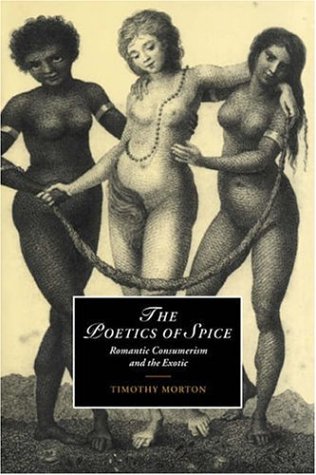
Among the most fascinating attributes of spice is its status as a cultural marker, and a strange one at that, halfway between object and sign, goods and money. Spice can become a sign of signs, and in poetry it serves as a figure for poetic language itself, a special kind of figure that Harold Bloom has called ‘transumptive’. In this role it approximates one of the economic values of spice in  the early modern period, its capacity to be used as a sign of other goods, as a form of money. Moreover, spice in its consumption becomes an index of social value. It is a highly self-reflexive kind of substance-sign: ‘about’-ness is what it is ‘about’. However much spice is brought into the realm of intellectus, it also still remains within the realm of the res as a hard kernel of the Real, a flow of desire. The poetics of space is not only about materiality, however — it is also about poetics. Thus there are two aspects to the poetics of spice, which are in a rather asymmetrical relationship: materiality and transumption.

Timothy Morton from the Poetics of Spice

I will be thinking about this for a long time. I feel the urge to cook with saffron, rose water and pistachios.
Faddists and Face stuffers not welcome

9780520269347

The rudeness of the glutton and the face stuffer is obvious. Equally ill-mannered- though it is politically incorrect to say so — is the food faddist, who makes a point of announcing, wherever he goes, that just this or this can pass his lips, and all other things mush be rejected, even when offered as a gift. …..Both the faddist and the glutton have lost sight of the ceremonial character of eating, the essence of which is hospitality and gift. For each of them, I and my body occupy center stage, and the meal loses its meaning as human dialogue. Though the health-food addict is in one sense the opposite of the burger stuffer and the chocaholic, he too is a product of fridge culture, for whom eating is feeding, and feeding a solipsistic episode, in which others are disregarded. The finicky beak of the health freak and the stretched maw of the junk-food addict are alike signs of deep self-centeredness. It is probably better that such people eat on their own, since even in company they are really locked in solitude.

This quote from the chapter entitled “Real Men Have Manners” by Roger Scruton published in the Philosophy of Food eloquently and vividly explains why we find sharing a table with picky eaters so unpleasant. You know this person. Maybe this year, when someone at the table begins to complain about the amount of butter in the thanksgiving meal you’ll know exactly why you’re irritated by their self-centeredness disguised as discriminating taste.

#grapegate and onions

 -1

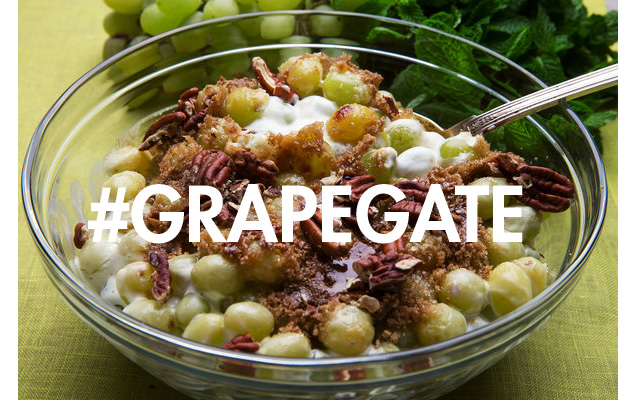
Usually we associate food with harmonious, benevolent, generous sharing. But….the angry response dubbed #grapegate to The New York Times article “The United States of Thanksgiving” (http://nyti.ms/1t9Ebcp) reminds us that food is deeply connected to how we identify ourselves. In this case the article offended the state of Minnesota with its attribution of grape salad as a gastronomic emblem. Alabama is not too happy either. Disagreement certainly fuels reviews, recipes, blogs, food writing, competitions and more. As Minnesota arrives at wild rice consensus we witness a region reclaiming it’s identity. Thanksgiving is not only a time of sharing but more importantly a time to confront tradition, nationally, regionally and personally. Whose recipes make it to the table? How are the recipes personalized? Imagine an Immigrant’s Thanksgiving Table…now there’s a great cookbook idea! As a cook in a chopped and blended family, I have to say, the dinner table is an exhausting culinary and cultural challenge with occasional exhilarating moments of delicious resolution (for us, usually in burgers and brownies).

(Dear Bobby Flay, yesterday I made your pumpkin bread recipe from the Epicurious recipe app. It was fantastic, moist, light, flavorful. I confess, I added dried cranberries making it even better. I feel you would approve. Recipes like rules are meant to be broken, sometimes with thought.)

May we all eat well and grow this Thanksgiving as we confront who we are and want to be together.

http://www.npr.org/blogs/monkeysee/2014/11/19/365194058/grape-salad-is-not-minnesotan-and-other-lessons-in-cultural-mapmaking


Here is a poem from today’s Writer’s Almanac that speaks to the intensity and intimacy of everyday culinary disagreements.

Recollection of Tranquility

The first time we ever quarreled
you were cutting an onion
in the kitchen of our rented cottage.
I remember vividly. We were making creole
for a late night supper with champagne,
and you were taking it seemed forever
to cut the onion.
Each time your dull paring knife
chopped on the counter, I shifted my feet,
and I saw once in a glimpse over my shoulder
a white wedge of onion wobbling loose.
I sighed inaudibly. The butter I stirred
had already bubbled and browned.
I was starting over with a new yellow lump
that was slipping on the silver aluminum
when you brought, cupped in your hands,
the broken pieces, the edges all ragged,
the layers separated, bruised and oozing
cloudy white onion juice.
I complained:
the family recipe stated specifically,
the onion must be “finely chopped,”
for what I explained were very good reasons.
Otherwise, the pungent flavors would be trapped
irrevocably in the collapsed cellular structure
of the delicate root.

You sighed, I guess, inaudibly
and adjusted your glasses carefully
with two fingers (a fidget
I have since come to know
as a sign of mild perturbation)
and explained:
the pungence of onions too finely chopped
would be simmered away. The original sharp
burning crispness could be retained
only in fairly large, bite-sized chunks.
But you wouldn’t fight tradition.
I mopped onion on the counter
with the dull knife, while you set the table
and figured the best way of popping the cork.

“Recollection of Tranquility” by Idris Anderson, from Mrs. Ramsay’s Knee. © Utah State University Press, 2008.

http://writersalmanac.org/

Eating and Dying to be human

bicentennial_man_05

“I am designing a system for allowing androids-myself-to gain energy from the combustion of hydrocarbons, rather than atomic cells.”

Paul raised his eyebrows. “So they will breathe and eat?”

“Yes.”

“How long have you been pushing in that direction?”

“For a long time now, but I think I have designed an adequate combustion chamber for catalyzed controlled breakdown.”

“But why, Andrew? The atomic cell is surely infinitely better.”

“In some ways, perhaps, but the atomic cell is inhuman.”

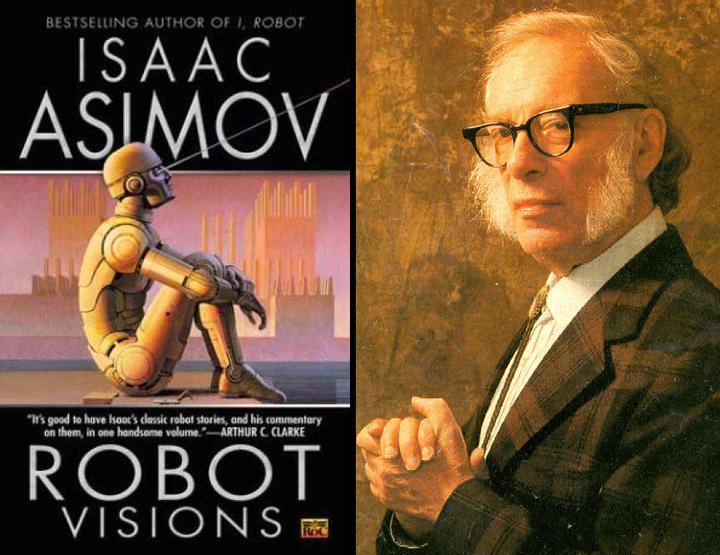
In previous post, I had written about the Golem’s pretense of eating in order to prove her humanity in the Golem and the Jinni by Helen Wecker. Another sci-fi classic version of the same pretense can be found in Isaac Asimov’s Bicentiennial Man, a story of transformation from robot to human that involves creativity, clothing, digestion, breathing and eventually death. Eating is the privilege of the living, organic and artificial, as the story suggests. Everyday, we limit or qualify our energy source, our food. Why don’t we all just take an efficient nutrition pill to sustain ourselves? (Our poor dog has been placed under a diet. He’s been extra needy. He really likes chicken and treats.) Anyway, back to our persistent effort to spice up, gluten free, sweeten, bake, fry, blend, season and plate our source of energy. If we put so much thought into what we put into our (and our pets) bodies as fuel, why don’t we worry about the energy we put into our lamps, heaters, cars, phones…all our stuff? Is it because our phones can’t taste or like chicken as Oreo the dog does? If my toaster worked better with one source of energy versus another would we care? Does the source of energy effect performance of things? I don’t know. Again…I digress. Asimov was on to something and anticipated this post-humanist era of thinking beyond the artificial/organic divide. I wonder if Andrew the prosthetic human ate meat?

As we approach the decadent and delicious feast of Thanksgiving, I wonder how could I feed my stove, refrigerator, stand mixer, blender? How can I show my appreciation for all my primitive robots that make a tasty dinner possible?

I wish I had some chicken

Desire

by Michael Blumenthal

          Paris, May 2005

Let’s just say I seem to be enjoying these three chicken drumsticks
far more than the young man doing sit-ups just across the lawn

beside his girlfriend here at the Jardin de Reuilly is enjoying himself:
after all, he’s huffing and puffing, and I’m sitting here, devouring

my chicken, basking in the spring sun, but now he’s rolling over,
it’s push-ups he’s doing, push-ups right on top of his girlfriend,

and the push-ups are getting slower and slower, just as my chicken
is disappearing, and, before long, the push-ups stop altogether, he’s

merely lying there on top of her, and he seems, even from a distance,
much happier than when he was doing push-ups, then he suddenly

sits up, looks up at the heavens, and stares (with an expression
of pure longing) over at me. Oh, he seems to be saying,

I sure wish I had some chicken.

“Desire” by Michael Blumenthal, from No Hurry: Poems 2000-2012. © Etruscan Press, 2012. Reprinted with permission.

http://writersalmanac.publicradio.org/index.php?date=2014/11/13

MFK Fisher’s Buttered Toast: On Dignity During Wartime Dining

Buttered-Toast

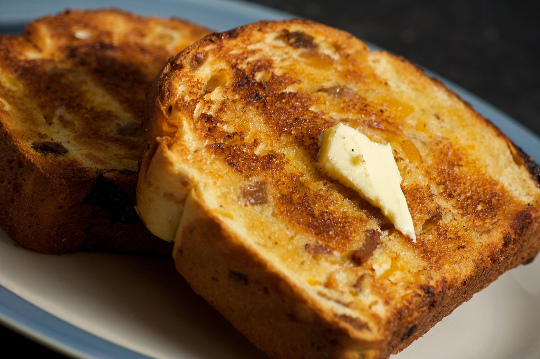
If, with the wolf at the door, there is not very much to eat, the child should know it, but not oppressively. Rather, he should be encouraged to savor every possible bite with one eye on its agreeable nourishment and the other on its fleeting but valuable esthetic meaning, so that twenty years later, maybe, he can think with comfortable delight of the little brown toasted piece of bread he ate with you once in 1942, just before that apartment was closed, and you went away to camp.

It was a nice piece of toast, with butter on it. You sat in the sun under the pantry window, and the little boy gave you a bite, and for both of you the smell of nasturtiums warming in the April air would be mixed forever with the savor between your teeth of melted butter and toasted bread, and the knowledge that although there might not be any more, you had shared that piece with full consciousness on both sides, instead of a shy awkward pretense of not being hungry.

My queen of food writing, MFK Fisher found in shared gastronomic enjoyment human dignity that defied harsh conditions. Her book How to Cook a Wolf is one my favorites because it addresses wartime eating in a such a practical and philosophical way.  For her, food becomes an agent of human dignity instead of an mere instrument of human survival through thoughtful eating.  She concludes the book with the following poignant words:

How-to-Cook-a-Wolf-MFK-Fisher

I believe that one of the most dignified ways we are capable of, to assert and then reassert our dignity in the face of poverty and war’s fears and pains, is to nourish ourselves with all possible skill, delicacy, and ever-increasing enjoyment. And with our gastronomical growth will come, inevitably, knowledge and perception of a hundred other things, but mainly of ourselves. Then Fate, even tangled as it is with cold wars as well as hot, cannot harm us.

To be consumed….to write, to eat.

click-the-image-for-19-more-ernest-hemingways-quotes-on-writing

“Good writing is always about things that are important to you, things that are scary to you, things that eat you up.” —John Edgar Wideman from http://writersalmanac.publicradio.org/

“A writing cook and a cooking writer must be bold at the desk as well as the stove.”
M.F.K. Fisher from http://www.goodreads.com/author/quotes/1408429.M_F_K_Fisher

“One cannot think well, love well, sleep well if one has not dined well.”

– Virginia Wolf from http://www.huffingtonpost.com/2012/10/04/best-food-quotes_n_1937214.html

“Writing is 90 percent procrastination: reading magazines, eating cereal out of the box, watching infomercials.” —Paul Rudnick

Tandoori Fried Chicken with Spiced Waffles and Honeyed Ghee

photo

This recipe is an adaptation from Nigella Lawson’s Southern Fried Chicken

http://www.foodnetwork.com/recipes/nigella-lawson/southern-style-deep-fried-chicken-recipe.html

1. The twist is to add a half a packet (or whole depending on your desired heat level) of Tandoori Chicken Spice (Shan or any brand) to the milk in which the chicken is cooked. A quicker version of this is, frying or baking chicken tenders marinated in yogurt, tandoori spice and coated in flour.

2. Add a half a teaspoon of cinnamon and a half a teaspoon of cardamom powder to your waffle batter that serves four.

3. Mix half a cup of honey with half a cup of ghee (clarified butter) and drizzle over both waffles and chicken for a Deshi twist. Hmmm….a hint of lemon might be good too. Next time, I might add a squeeze of lemon to the honey ghee.

It was sweet, spicy and decadent with the ghee. Next time I would add more tandoori spice (the whole packet instead of just the half). Otherwise, very yummy.

Deshi in the Dorm Kitchen (Chicken Rezala)

Dear Amani,

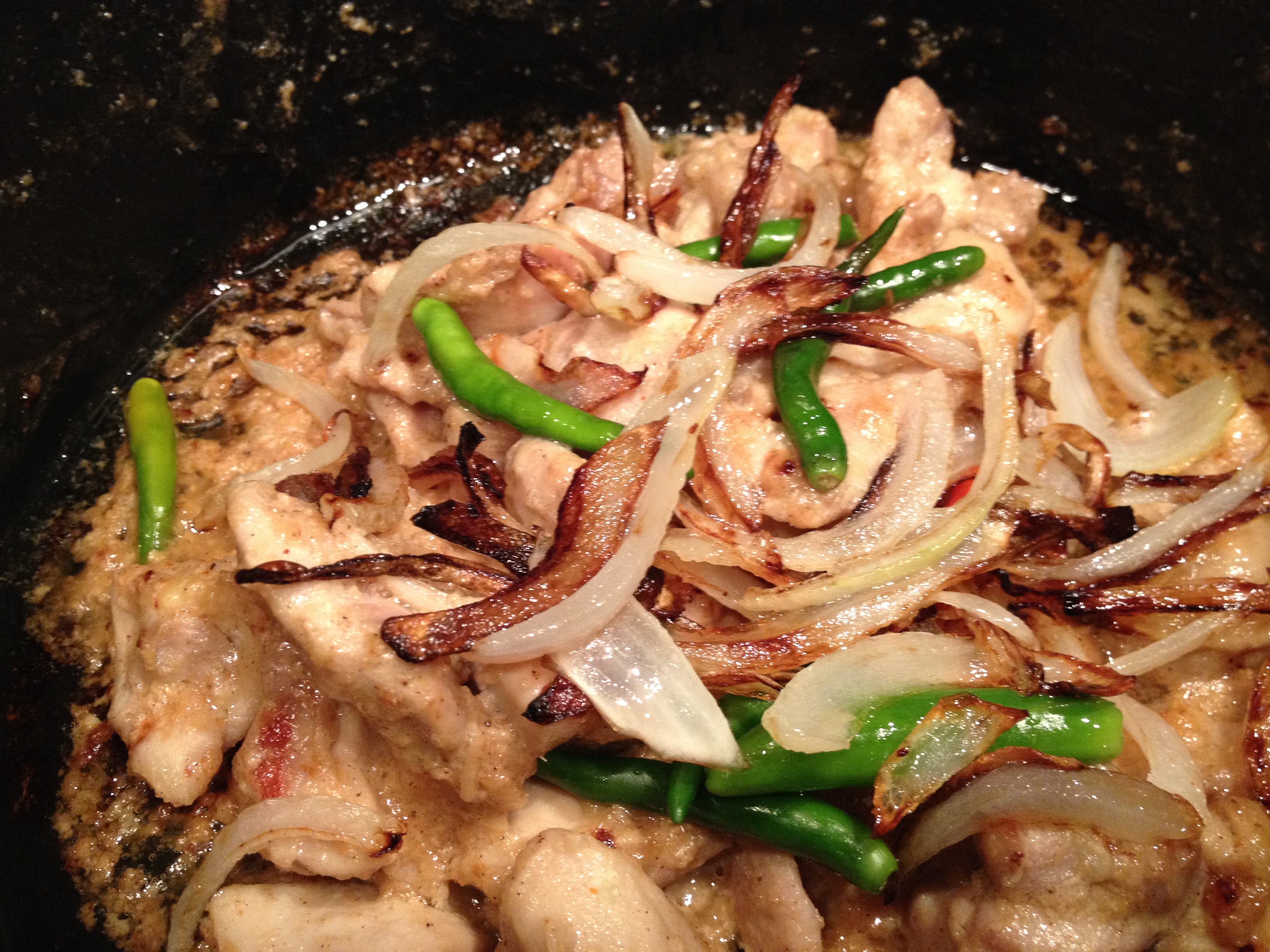
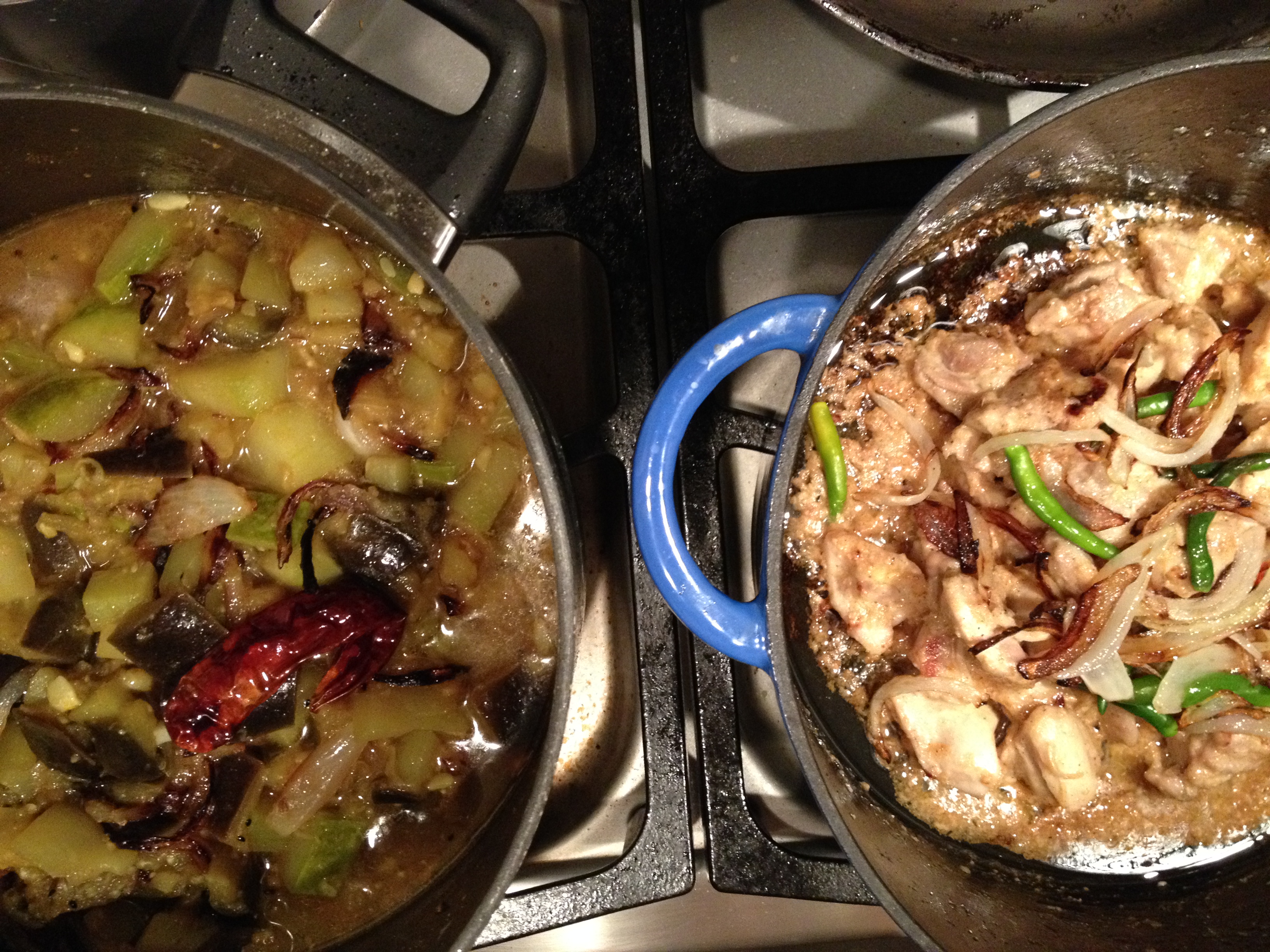
Here is the chicken rezala recipe. When cooked the yoghurt will look a little curdled. Don’t be alarmed. After it cooks down and you add the fried onions (and the oil you fried it in)…chili pepper, sprinkle sugar and squeeze lemon, it all looks good. Very yummy with porata but rice always works. You can add sauteéd mushrooms to stretch the dish and make it more non-deshi friendly.

The mixed vegetable dish is one that your Dadi makes really well. My shortcut and take on her recipe is simply to boil a bunch of vegetable together (be sure to cube the same size). In this case eggplant and squash (lao?). Boil with spices, half a teaspoon of each until the vegetables are tender. Add water almost covering the vegetables.

Cumin, Coriander, Chili powder, Tumeric, Ginger and Garlic (paste)

Salt about 1 teaspoon.

Fry half an onion sliced and one clove of garlic with ghee, butter or oil. If you have “panchforan” and cilantro, add it. If not, no problem. Finish with a sprinkle of sugar and a squeeze of lemon.

Eat well.

Love,

Mom

Photo from Sep 2014 Photo Stream

photo 1photo 2photo 3