The Nourishing Opposite

Yogic psychology says there’s more. Encountering these stuck and painful knots is the path. This perspective teaches us that we aren’t stuck, we’re only identifying with less satisfying “things.” One remedy, Patanjali tells us, is to look for the opposite (II:33). I think of it as the Nourishing Opposite (Fay, 2010) not just any opposite, but something that will actually invite more nourishment into our experience. Pain, then, is a process of pointing out the way to remember and return ourselves to our true nature. In integrating opposites, holding these opposites simultaneously (Bryant, 2009; Miller, 2014), a third higher synthesis occurs (Patanjali 2.48), in which suffering is eased.

Fay, Deirdre. Attachment-Based Yoga & Meditation for Trauma Recovery: Simple, Safe, and Effective Practices for Therapy (pp. 16-17). W. W. Norton & Company. Kindle Edition.

The prescription to nourish the opposite when feeling stuck is the same process as identifying presenting issues and corresponding client goals. In seeking the opposite of what pains us, we seek joy. Treatment plans that include objectives, interventions and modalities chart the path of the nourishing opposite. Together we seek ease for the anxious, joy for the grieving, elevation for the depressed, reality for the delusional, focus for the inattentive. Therapy invites the nourishing opposite.

What pains you? What is this pain’s opposite? Can you invite the nourishing opposite?

As a therapist-intern, I find myself sometimes wobbly having absorbed client anxieties, fears, angers, sadness and confusion. Why am I angry? Is this anger even mine? Is this pain mine? Am I mirroring client feelings? Or maybe my feelings are responding, like a song?

I have been feeling irritable this weekend. What is the nourishing opposite? Feeling agreeable? How do I feel agreeable? Accept what is, accept that for now I’m feeling irritable, sensitive, overwhelmed, cranky without shame.

Writing helps me. Sharing with you nourishes me. I already feel a bit more relaxed, allowing myself to feel irritable and agreeable at the same time.

Now you try it. What feeling is bothering you? What is the opposite? How do you invite the nourishing opposite? How can you sit with the contradiction?

This takes practice, doesn’t it…

May we return to our own nature by listening to our discomfort (over and over again),

Hungryphil

Photography by Nate Dale – New Adventure Production

Nourish Hope

Chronic anxiety is a crisis of hope. It is the fear of a failed future. Depression is a crisis of hope. It is the belief in a meaningless future. Delusion, addiction, obsession — these are all the mind’s desperate and compulsive attempts at generating hope one neurotic tic or obsessive craving at a time.

The avoidance of hopelessness — that is, the construction of hope — then becomes our mind’s primary project. All meaning, everything we understand about ourselves and the world, is constructed for the purpose of maintaining hope. Therefore, hope is the only thing any of us willingly dies for. Hope is what we believe to be greater than ourselves. Without it, we believe we are nothing.

Mark Manson from Everything is F*cked: A Book About Hope

How can we nourish hope within when we have lost, been disappointed, hurt or rejected? This is what the same author suggests,

Don’t hope.

Don’t despair either.

In fact don’t deign to believe you know anything. It’s that assumption of knowing with such blind, fervent, emotional certainty that gets us into these kinds of pickles in the first place.

Don’t hope for better. Just be better.

Be something better. Be more compassionate, more resilient, more humble, more disciplined.

– Mark Manson from Everything is F*cked: A Book about Hope

Wishing the few of you reading this a holiday season being better,

Hungryphil

Metabolizing Sweet Joy

Dear Readers,

I have a confession.

I’ve been converting joy into fear. My desire to help into a fear of hurting others. I haven’t been digesting life or metabolizing my nutrient-rich loving supports in spirit or in body despite this blog’s mission.

Mostly I’m guilty of being unaware of my own indigestion.

The literal and material story is that my A1C reports pre-diabetes, a blame that can easily be laid at the feet of my parents. How could I, mindful eater hungryphil, fail to notice my own decreasing ability to metabolize energy?

In fearing failure, I failed.

The spiritual story is that new to my practicum site of community mental health, I let my desire to help morph into a fear of paperwork- forms, checking the wrong box, not asking enough, asking too much, not converting subjective information into correct numerical value, writing the wrong words etc. etc. The stress turned my dream job into a haunting.

I know, you’re probably thinking like my doctor, this isn’t so deep hungryphil, “just stop eating carbs and sugar, all will be well.” Part of me agrees with you.

But.

Those of you familiar with the work of Louis Hay know that diabetes expresses a:

Longing for what might have been. A great need to control. Deep sorrow. No sweetness left.

In order to counteract this association she recommends that I need to remind myself that:

This moment is filled with joy. I now choose to experience the sweetness of today.

You Can Heal Your Life . Hay House. Kindle Edition.

Yes, I know this maybe voodoo and completely unrelated to the mechanics of genetics and biology. Again, agree.

But.

What if there is more: a spiritual dimension to all that challenges us whether physical or emotional?

This my own intervention plan for the next six months until I get tested again:

  1. Reduce Carbohydrate and Sugar intake following medical advice.
  2. Walk an hour a day. Expend energy reconnecting to my ground by focusing on each step.
  3. Educate myself on how to identify supportive and nutrient-rich good things in food and people. This also means accepting help and guidance from others, for example, trust my supervisor and peers at work. I’m also working with a nutrition coach to introduce me to food that can support me better. Interestingly the first lesson involved a form of “grounding.” Nutrient rich soil produces nutrient rich produce, therefore buy from farmers who nourish the soil. Simple, right? More on this later. Fascinating how our ground and earth matters: emotionally and digestively.
  4. Recognize fears present alongside positive emotions instead of replacing or rejecting.

May I metabolize sweetness into energetic joy. The last months I have let the joys of my life ferment in fear. I will celebrate learning new things instead of focusing on mistakes. I will celebrate my baby growing into higher learning instead of fearing her departure. I will celebrate my warm loving home and husband instead of fearing all that can interrupt.

I will celebrate you, dear readers, my willing community of ears and eyes, as part of my nourishing support.

This moment is filled with joy. I now choose to experience the sweetness of today.

May we all metabolize and accept joy with gratitude (and enjoy a warm glazed chocolate doughnut occasionally).

Hungryphil

Bittermelons and Brownies: How to Eat Eggplant

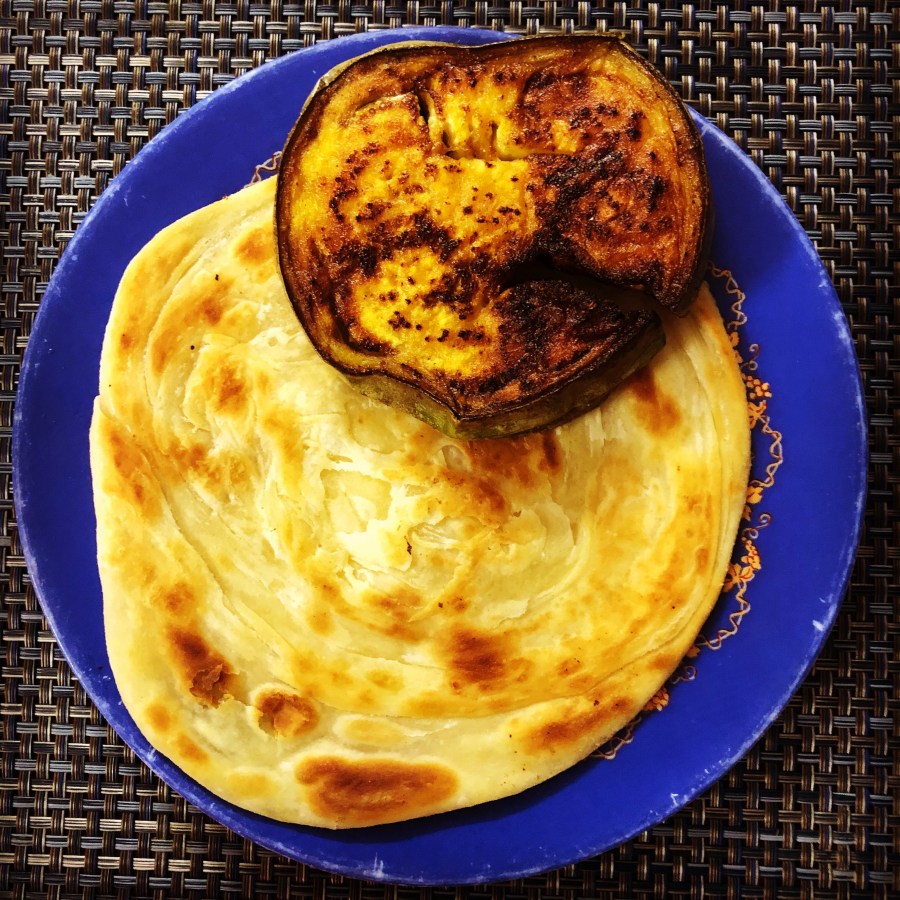
“I liked eggplant long before Atiya ever did,” complains Amani, my eldest. In my kitchen, eggplant fuels simmering sibling jealousy over a pot of shared taste. The rivalry started when they were young with Bengali Eggplant Bhaji. Sliced eggplant fried in a combination of spices and mixed with rice delivers a simple taste though a complex textures: crispy skin, moist flavorful flesh and roasted spiced oil coated rice. Eggplant bhaji with rice introduced warm heat to otherwise mild child-fare of daal or classic chicken and potato curry. “Begun” in Bengali, literally translates to “no virtue.” Unlike the celebrated bittermelon, eggplant’s nutritional authority is sadly suspect in South Asian cultures.

Italian eggplant can be bitter. Most recipes suggest salting and draining sliced eggplant before cooking. I accepted the occasional eruption of bitterness that destroys dinner as punishment for my laziness. Thankfully it doesn’t happen often. I rarely cook eggplant for guests. The unpredictable bitterness of eggplant gives it a dangerous, naughty vegetable vibe. According to my minimal online research, eggplant can be bitter when young and female (more seeds to protect from seed eaters). This thought invites too many jokes about protective moms and bitter young females. Yes, there are boy and girl eggplants. Apparently, identifiable by the navel, a slit or long line suggests a girl eggplant and a round navel, a boy. This determination is easier said than done. Basically, you want a heavy, ripe, boy eggplant with a round belly button. Contemporary sexual connotations of the eggplant emoji, I’m told by my teenager, makes my advice extra unsavory.  I’ll leave the implications of gendered vegetables for another time. Long and lighter in color, Japanese eggplant is rarely bitter. When given a choice, or not making eggplant parmesan, I always opt for the Japanese variety. You note your risk when choosing and cooking eggplant. Like many potential bitter things, it is worth the effort.

Eggplant and mushrooms are like meat for vegetarians. These vegetables have hearty structure and absorb flavors like a sponge. Peeled, chopped and cooked, eggplant can be smooth and creamy. Thinly sliced and fried, eggplant can be light like summer squash. Sliced, in rounds, with the skin, eggplant can have structure and chew. The vegetable has moods (insert inappropriate young female joke here).  In the Food Network Chopped kitchen, eggplant is the rare actor who can play any role. 

A member of the nightshade family with cousins like the tomato and potato (all three go very well together), eggplant can make undue demands on sensitive stomachs. According to Ayurvedic tradition, eggplant aggravates both Pitta and Vata constitutions. One must be not only careful with the taste of the eggplant but also the effects. Eggplant has personality and power you may not be ready to ingest. Purple eggplant flowers are beautiful and in classic eggplant nuance, have thorns. A vegetable with such personality! No wonder my girls fight over it.

Ingredients

  • 1 medium eggplant or 2 Japanese Eggplant
  • 1 teaspoon turmeric
  • ½ teaspoon chili powder
  • 1 teaspoon cumin powder
  • 1 teaspoon coriander powder
  • 1 teaspoon salt
  • 1 teaspoon flour (optional)
  • ¼ cup vegetable oil

1. Slice the eggplant into ¼ inch rounds. Salt generously. Let sit and sweat for ½ hour. Rinse and let dry. If using long Japanese eggplants, skip this step. Or just risk it.

2. Make a spice mix of 1-teaspoon of each turmeric, cumin, coriander and salt, ½ teaspoon of chili. Add flour, if uncomfortable with spiced oil laden eggplant. The key is to mix the spiced oil and soft eggplant with plain white rice. The spiced eggplant oil infuses the rice. Eaten alone, this eggplant dish can feel very heavy and oily. Alternatively, adding flour will make a crispy coating. Add enough water to make a batter that clings to the eggplant slices to floured and un-floured spice mix.

3. Heat enough oil in a pan to cover the bottom. Dip each slice of eggplant in the spice mixture, encouraging the spice to cling, and shallow pan-fry each piece, over medium heat, until soft and brown. If using less oil and no flour, cover and allow steam to soften eggplant. In this case the eggplant with have a less roasted flavor.

The eggplant fried with flour in particular does not keep well. It can taste slimy once refrigerated and reheated.

If you find the eggplant bhaji bitter have an egg sandwich instead.

Like life, you eat eggplant by embracing unpredictable bitterness, absorbed atmosphere of flavors, potential indigestion, and a diversity of expression that ranges from light and creamy to dark and roasty.

Begun Bhaji with paratha

Bittermelons and Brownies: How to Eat Lentils (Daal)

Life boils over like daal. It is eventually, inevitable. You can put a wooden spoon across the top of the pot, add salt (risking chewy lentil soup) and do other tricks, regardless assume you will have to clean the stove after cooking a pot of lentils. Sometimes like a pot of boiling daal our lives spill over despite our best efforts.

The world of lentils is a vast array of colors, shapes and sizes. The health benefit of plant-based diets that includes lentils is well documented. Lentils (along with beans) can also cause uncomfortable gas. To reduce the magic of lentils to what it can do for us flattens the story. Instead I like to consider how we interact with lentils from growing, collecting, distributing, cooking and eating.

My relationship with my pot of daal is always mixed, full of suspicion and familiarity. Daal is like family, always comforting and nourishing yet sometimes boiling over, chewy and messy. The first tastes of both my daughters included mushy rice with light daal or kitchuri. Their taste palate expanded each time I added a tiny bit of vegetable or meat to the neutral rice and lentil base.

Lentils bloom when they meet water and fire. The rush of expansion makes them explode beyond their confinement. It can be both liberating and traumatic. The softening and rise of cooking lentils have a lot to teach us. Transformative events break us down, fuel our growth, make us softer, sometimes spill over, and sometimes create a mess. There is risk, and reward.

As a location in existence my pot of lentils encounter water, heat and me to become daal. Lentils are more than mere vegetable protein, nourishment for humans, in ways that our human centric mind may not fathom. Lentil transform into daal by virtue of all the things that are not lentils, not it. Lentils left alone would remain in its grain state. Everything around it not lentils in a specific combination help alter its state into a soup. A good source of fiber, lentils and legumes absorb flavors. In this way, lentils are similar to flavor absorbing eggplant with the added benefit of fiber.

Eating daal with the right hand is an art form. Learning how to eat soupy rice takes practice. The angle and speed of delivery from plate to mouth requires careful modulation. Culturally, thicker daals are served during winter months, while light lemony daals are enjoyed during the summer months. Khichuri (a dish of rice and lentils) would be served mostly during Monsoon months with fried eggplant.

This was one of my first dishes I learned to make after learning how to cook rice and fry an egg. Thank you Bhabi for teaching me to make daal and bhaji.

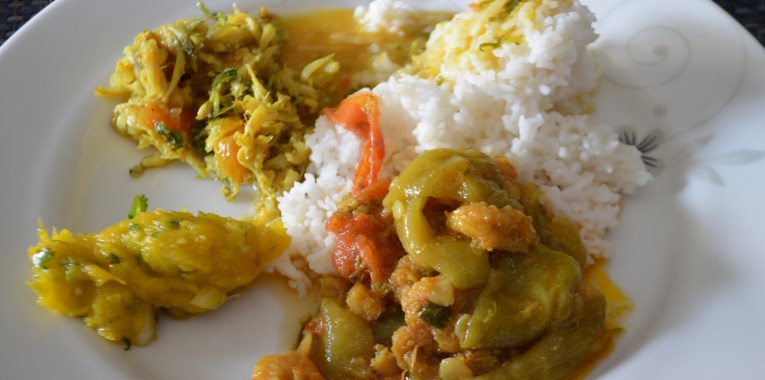
Rice, daal and fried eggplant. This is a good start for a Bengali meal.

Ingredients (You’ll find the proportions that suit your preference)

  • 1 cup Lentils
  • 2-3 cups Water
  • 3 Tablespoons Ghee
  • 1 teaspoon Tumeric
  • 1 Medium Onion or 3 small shallots
  • 1 clove of Garlic
  • 1 teaspoon Cumin Seeds

1. Boil the rinsed lentils over a medium flame (red, split pea, yellow, azuki, kidney, urad etc.) until soft. Add at least double amount of water. Add more water, the bigger the bean. You want the water to cover the beans by at least an inch.

2. Once the lentils are soft, add tumeric and salt. A teaspoon of each for every cup of lentils is usually enough.

3. This where you can get as fancy or keep as simple as you like.  Saute in ghee or the oil of your choice: onion slices for a basic dal.

At this point you can also include: garlic, ginger, tomatoes, cumin seeds, garam masala, coriander leaves, dry chili peppers, bay leaves, depending on what you have and like.

You can also add coconut milk or cream for the heavier beans like kidney or adzuki to give the daal, heartiness. On the other end of the spectrum for a light summer daal you can boil and strain red or yellow lentil fibers add lemon juice, cilantro and mint for a bright broth.

Pour the flavored oil with the spices and fried onions over the soup. Mix in or leave the flavored oil and toasted spices floating above the rich soup. Enjoy with steaming rice or hot flaky bread.

Food Poem – Easy by Roland Flint

While she starts the water and measures the pasta,
he sets the table and peels the garlic.
She cuts up broccoli, strips snow peas, readies fish—
he presses the garlic, fixes her a kir, and him a gin.
She sautés the vegetables while he grates cheese,
readies the candles, and puts flowers on the table.
She puts pasta in the boiling water, and fixes salad,
which he takes to the table with the cheese.
She mixes a salad dressing, he opens the wine
and takes it to the table, where everything is ready,
except for the pasta, so he lights the candles
and puts salad from a big walnut bowl into small ones.
 Now she or he brings the pasta, greens and fish
mixed in, and they sit to talk, drink wine and eat.
Though October, they sit on a small screen porch
in the back of the house where they have lived
for twelve years of their twenty together,
the last six, the children gone, alone.
Once, during dinner, if they stop talking
and listen to the music, they may, without drama,
hold hands a moment, almost like a handshake
by now, most friendly, confirming the contract,
and more. She is a pretty woman of 51, who has
kept herself trim and fit. He is 56 and hasn’t.
 Later, they will clear the dishes and clean up,
and she will bring tea and fresh fruit to bed,
where they will watch a little television or not,
with herbal tea and the fruit. After that, if
they make love or not, they will talk a long time,
her work or his, the budget, the Middle East,
this child or that, how good dinner was, how
easy it is, the times like this, when it’s simple.

 “Easy” by Roland Flint from The Yellow Shoe Poets: Selected Poems 1964-1999. © Louisiana State University Press, 1999.
From Writer’s Almanac Podcast

Wishing you all loving simplicity this weekend,

Hungryphil

Bittermelons and Brownies: How to eat a good bite (lokma)

It used to be general practice for South Asian mom’s to hand-feed their children rice until they developed the dexterity to eat on their own. I continued that practice with my own kids by mixing the various curries with their rice and shaping small sized globes of rice. When they got to be three or four, I would make the bites, the lokmas, and arrange them on their plates, for them to pick up with their right hand and pop into their mouths. As you know, there are rules to learn and practice: right hand, finger tips, no food should touch the palm. The Bengali word for the curry mixed and formed rice bite is LOKMA.  

Mixing and eating with the hand offers two advantages. First, in mixing the rice breaks down and the curries adhere to the rice. Second, each bite can be individually tailored. One bite can have added chilies, one bite can have more vegetable, another can have more meat, maybe you go adventurous and mix otherwise unmixed curries. The possibilities become limitless. By forcing the hand eating experience into fork and plate environment a lot of the flavor is lost in the name of civilization.

Eating curries and rice with a fork is immensely unsatisfying. Here’s why:

Any braised meat or vegetable dish cooked with spices (otherwise known as curry) was historically meant to be eaten with rice (or bread).  Never alone! Rice is the main dish. Everything else, including meats, merely garnish and flavor. This is why in South Asia the question asked of family and friends is “did you eat rice?” instead of “did you eat lunch or dinner?”

Rice is served at the center of the plate ready to receive the courses of bittermelon, daal, vegetable bhaji and meats. The rice, whatever it is, jasmine, basmati or brown, is the final component that softens, absorbs and most importantly FLAVORS curries.  Hence, first problem about eating with a fork is substantive. A fork-ready bite requires a higher proportion of flavoring, bhaji or curry than hand mixing. We can no longer eat enhanced spiced rice.  Instead, the fork is the instrument that converts rice into a side dish at restaurants.

Second problem is formal. We are missing the optimal flavor when eating with a fork. The mixing of curry to rice with a fork is always incomplete. It is difficult to break down the rice enough for the curry to be absorbed. Eating with my hand I can press the rice together with the curry just enough to adhere on its journey to my mouth. That moment of adherence, when the rice forms a compressed bite, is the perfect amount of curry to rice ratio.

Third problem with fork deshi (South Asian)-eating is textural.  The feel of our food is part of the pleasure. The creaminess of rezala (chicken cooked in yogurt and onions) or the bright-spiced oil of fried eggplant mixed into the soft warm rice is a part of the experience. I can feel and pick out the cardamom, cinnamon stick and bay leaves to rest and perch gently on the side of my plate. I can pick up my chili pepper or my lemon quarter to enhance any bite I choose. I can’t eat fish with a fork because I can’t pick out the bones. Fish curry with bones tastes richer than fork-friendly curries using sliced fillets. The fork compromises the taste, texture of curries and the central role of rice. 

BUT, I have to admit, eating with my hand can be messy even when allowed and not frowned upon. And worse, despite all the washing in the world some pungent curries can refuse to leave.  The turmeric and cumin can stain the fingernails. I want to eat my curry not smell like it or wear it. 

The basic revulsion of eating with hands in the West would limit me from mixing each bite for my guests. Maybe I could form bites, like sushi, to be picked up with a fork. The hand eating experience would still be lacking but perhaps the taste can be recovered a bit?

This is quite a problem. How can I get the taste of a well hand-mixed bite of Deshi food with a fork? Can I design a fork/spoon that can form little rice bites? Disappointment, not necessity must be the mother of invention. I have yet to translate that experience of composed rice bites to the American table.  This is my design, cooking and eating challenge.

Take for example my dinner tonight: Chicken and potato curry, basmati rice and roasted vegetables. I mixed and mashed it as best I could with a fork and made bites with a cookie scoop. The bites did not form as well as hand mixing would allow.

But, it does give me an idea of building a 7 course meal with these premixed rice bites. Rice with Bittermelon (bitter), Rice with Dal (salty), Rice with Vegetables, Rice with fish (Garlic), Rice with Chicken (Ginger), Rice with Beef (spicy), Rice pudding (sweet).

Lokma: A bittersweet journey in 7 bites. This will have to be my next food design experiment.

I theorize that Amani’s love of tapas was latent in her childhood plate of radiating “lokmas.” She expects satisfaction from each bite of food and her standards can be high.

Bittermelons and Brownies: How to Eat Brownies

Brownies represent the alter ego of bittermelons. Instead of embracing the bitter, brownies challenge us to endure the abundance of sweetness.  Brownies with a hint of roasted bitterness and bittermelon bhaji with a hint of roasted sweetness operate like a dynamic gastronomic yin-yang. Most taste and encounters with others happen within this range. Sweetness and bitterness, ease and effort, are encounters that asks us to notice our repulsion and attraction to things. Life happens between tastes of bittermelons and brownies, between bitter medicine and sweet poison.

I have yet to meet a person who hates brownies. Unlike bittermelon, brownies are not an acquired taste. The sweet, moist and dense brownie conquers and overcomes bitterness unlike bittermelon bhaji that celebrates it. The beloved brownie does not have the unpleasant bitterness of a thing that cleanses the human liver or the risk of a thing that boils over and requires unpleasant cleanup, like dal.  There are ways to make an experience of brownies, unpleasant. Just imagine biting into a brownie and hearing an unwelcomed crunch, maybe of an errant eggshell shard.

Broken off into small bites with hot coffee or cold milk, or spooned from a bowl, warm and draped in melting vanilla ice cream, casual or elegant, there is no wrong way to eat a brownie. A miracle food in my house, brownies are one of the few foods celebrated by all members of my chopped and blended family.  In the past, in addition to special occasion dessert, a squat tower of brownies served as the platform for birthday candles, as well as traveled, boxed, to school as birthday treats instead of cupcakes.

Brownies represent a magical definition-defying confection between cake and candy. A small square aims to deliver big taste for the elegant and casual American diner. Dense and moist enough to be picked up and bit into without an uncivilized shower of cake crumbles, brownies exist for a society on the go and perfectly represents a designed American cultural experience.   In fact, the brownie was invented as a portable dessert for the ladies meeting at Chicago’s Palmer house to discuss the Chicago World’s Fair. Today a “to-go” version of this confection at the Palmer House comes boxed and wrapped with a ribbon. The packaging also includes a brief history and the original recipe. The taste can be described as dense yet delicate, with a texture between fudge and cake that melts in your mouth. The walnuts that give the confection texture compose the top layer and are coated with a light glaze. The recipe says it’s an apricot glaze but a fruity taste is hardly noticeable.

I chose Michael Ruhlman’s,  Make Ahead Brownies recipe as a guide for Atiya’s 15th birthday brownie for two reasons:  he claims the recipe is as “easy to make as pancakes” and his recipe yields a big half sheet pan. I quickly learned that the abundant size came with other considerations. For example, an equally big bowl and muscles are needed for mixing. I tried mixing the batter in the stand mixer while pouring the melted butter. I ended up with a melted butter shower all over the countertops and floors. It was a messy unpleasant clean up.

The next time I baked these brownies, I learned my lesson and stirred the batter in my largest bowl with my very own elbow grease. This was one of the few cooking instances where technology did not enhance the experience. Beware of technological shortcuts.

The brownies are wonderful: intensely chocolaty, fudgy, dense and delicious at any temperature.

I love the simplicity of the measurements that can be easily halved by the math-challenged like me. Look to Ruhlman’s recipe for details and his introductory narrative.

Ingredients (the amounts are NOT gentle suggests)

  • 2 cups flour

I have Pillsbury brand flour, last year 2016 Gold Brand flour was recalled due to e.coli. How does e.coli get into flour? We take the neutrality of flour as a given. Consider the dangers of anything processed.

  • 2 cups cocoa powder

I was sad but not surprised to learn of chocolate’s high carbon footprint. I used Hershey cocoa power and have no idea about the environmental and social impact of their chocolate sourcing or production.

  • 1 teaspoon salt

The power of salt, like water, can easily be overlooked. It makes me think of the fairytale about a king who asked his three princesses, “How do you love me?” To his satisfaction the first answered, “Like honey, father,” and the second answered, “like sugar, father.” To his great disappointment the youngest princess answered, “like salt, father.” Years later when she served him a meal without any salt, the king understood the value of salt.

  • 8 eggs

There are so many fun books dedicated to eggs now. This recipe comes for Michael Ruhlman’s Egg: A Culinary Exploration of the World’s most Versatile Ingredient.

  • 4 cups sugar

In addition to the notorious history of sugar production tied to slave labor, the detrimental role of sugar for human health, makes it a treat with a high cost.

  • 4 teaspoons vanilla extract

What a magical ingredient! Every time I open a jar, I have to take a whiff of the sweet spice.

  • 1 pound (4 sticks) of butter

How many cups of milk does it take to make a stick of butter? This is definitely a luxurious recipe. One I probably would not make in Dhaka, unless there was a super special occasion like a birthday.

  • 2 cups of chocolate chips

Chocolate chips have an odd birth after the 1938 invention of the chocolate chip cookie at the Toll House Inn by Ruth Wakefield. Legend has it that WWII soldiers from Massachusetts shared their care package cookies with their fellow soldiers and the cookie became popular on warfront and then the home front.

Mix dry ingredients. I like to add two teaspoons of espresso powder.

Mix eggs, sugar and vanilla. Add the melted butter in a small steady stream while whisking or the eggs will get scrambled. You may have to take breaks. I did.

Add dry to wet. Mix gently scraping the sides and the bottom of the bowl.

Pour batter on a parchment lined baking sheet. Bake at 350 degrees for 20-25 minutes.

The sheet of brownie emerges from the oven, unconvincingly done, gooey and soft. The surface will still look wet and slightly cracked. The best thing to do is let it cool. If you cut into it, the chocolate will ooze. This is the HARDEST part about this recipe: waiting. After what seems like an eternity your cooled and better yet, chilled brownie will be easier to cut into squares. Eat, share and freeze for later.

The simple sweet has a complex and even bitter history that reaches back to the chocolate of the Aztecs and forward to a group of women discussing the Chicago World’s Fair to introduce America’s productive power to the world. The story of the brownie is deeper than its shallow flat form. The brownie eaten at birthdays, received in care packages, shared with friends, eaten alone in consolation becomes a part of your story. The decadent and luxurious confection between cake and candy comes at a high cost to the environment and to your health. Brownies only make sense when shared with others as a treat, in small bites of unhealthiness to celebrate the dark sweetness of living.

How to eat brownies?  Make a lot; share even more, like any guilty pleasure.

Bittermelon and Brownies: How to Eat Bittermelons

No taste assaults us more than bitterness. Unlike our mammalian instinctive attraction to sweetness, a love for bitter is learned. It used to be standard practice that every Bengali mid-day meal would begin with bittermelon. Bengali children learn to swallow bitterness, some eventually grow to enjoy it but at some point all have to learn how to endure it. “It will clean your blood,” promised adults. The magical medicinal properties were supposed to offer redemption. From the bittermelon, I learned that things have properties and abilities beyond my experience. Apparently the unpleasant properties in my mouth accompany pleasant and beneficial properties for my body. There is more to what I taste.

In addition to the narrative of healing there were also a threat of future sweetness denied.  “You must eat the bitter to enjoy the sweet,” was not an abstract lesson. Strangely both my daughters enjoy bittermelon bhaji despite my continued aversion. Perhaps the narratives had stronger hold on them or maybe they inherited a high tolerance for bitterness from their father. Beyond the cultural narrative, bittermelon remains more than a vegetable for human consumption, more than all its qualities and properties of bitter, bumpy, seedy, green, organic, domesticated, transported, cultivated, eaten etc. Bittermelon represents a location in existence, in geography, in cultural narrative. When we invite the bitter-melon into our shopping cart, cooking pot and stomach attracted by its potential healing and nourishing powers, we also invite all the other factors that made the bittermelon possible. The bittermelon and I find each other as locations of existence, worlds colliding, along with the worlds of pots, refrigeration, trucks, grocery stores, Asia, Ayurveda, markets, plastic bags, oil, spices, salt, plates, earth, rain etc.

Ingredients (all quantities are gentle suggestions)

  • 2 Bittermelons
  • 2 small red potatoes (enough to be equal the sliced bittermelon)
  • 1 small onion
  • 1-teaspoon turmeric
  • ½ -teaspoon chili powder
  • Salt to taste
  • 3- tablespoons oil, vegetable, canola whatever you have.

1. Collect Ingredients.

You can usually find it in any Asian grocery store in the U.S. (to my surprise our local Kroger started carrying the strange vegetable among other distant geographical things). I wonder about the following questions: Doesn’t this counter the slow food local food movement? Is it wrong to eat Bitter-melon in the U.S. where it is not grown? Where does turmeric grow? Are onions and potatoes local? How are these ingredients grown? What is their history? How did people start eating bitter-melon anyway? How far is your grocery store? How are you getting there? What makes it possible for all the ingredients to be available? What makes it possible to gather all the ingredients on my counter? How many grocery trips? How many farmers, carriers, clerks, and stockers?

Or keep the seeds, your choice.

2. Slice the prickly bittermelon in half lengthwise. Scoop out seeds using a spoon. Thinly slice each half. This might be a good time to use a mandolin. Massage the sliced bittermelon with a generous palm full amount of salt. Let slices sit and sweat for at least a half an hour. Then wash and rinse the sliced bittermelon with cold water, a few times. Let rest in colander and dry. The salt draws out the bitterness. This strange process can be emotionally instructive. As if, we need to draw out bitter emotions in order to wash it away. What happens when salt meets the bitter-melon? What is that relationship about? Similarly, kale, another bitter vegetable, needs to be massaged with oil in order to make edible raw. Does this make kale related to bitter-melon? This process of salting, resting, rinsing and resting (again) takes time and energy but makes the dish taste roasted and experienced instead of angry and bitter. The encounter of Lisa and the Bitter-melon requires a lot of preparation.

3. Julienne potatoes.  Keep skin on. The red potatoes hold on to their structure despite the stir-frying. Yellow or russet potatoes, although delicious, fall apart and are best saved for mashed potatoes. Neutral buttery potatoes have the magical power to temper the bitter and bulk up the dish with smooth sweetness. How does a potato grow in darkness? What is the relationship between the earth and the potato?

4. Thinly slice onion. Consider the all the things involved. Knife, cutting board, onion, hands, eyes, tears, kitchen, house, suburb etc. All these things come together in a particular way for the new thing “thin onion slices.”

5. Heat oil in a large saute pan so you don’t suffocate the vegetables. A crowded pan will make the slices steam and become soggy, instead of developing the delicious roasty bits on the edge. I too feel steamy and soggy when faced with a crowded room. Add sliced onion, turmeric, chili power and salt. Saute until your nose detects the slight roasting of the spices as they merge into the hot oil as one complex flavor.  Onions will become soft. Add a teaspoon of water if the spices begin to stick or burn.

6. Add bittermelon and potatoes. Toss and sauté on high heat until all the vegetables are coated in the spiced oil. As the vegetables begin to soften, lower heat to a simmer, place lid on pan and let the now roasted vegetables continue to soften in the steam, about 10 minutes. If the vegetables are old and dry, having traveled the world to get to your kitchen, the bhaji may need a tablespoon or two of water to help steam and soften.

7. Once vegetables soften, raise heat and fry once more without lid. This will dry and roast the now tender vegetables allowing the spiced oil to cling. Do not stir so much that the vegetable break up into a mush. The pieces of potato and bitter melon should keep their form. Restless stirring does not make things cook faster.

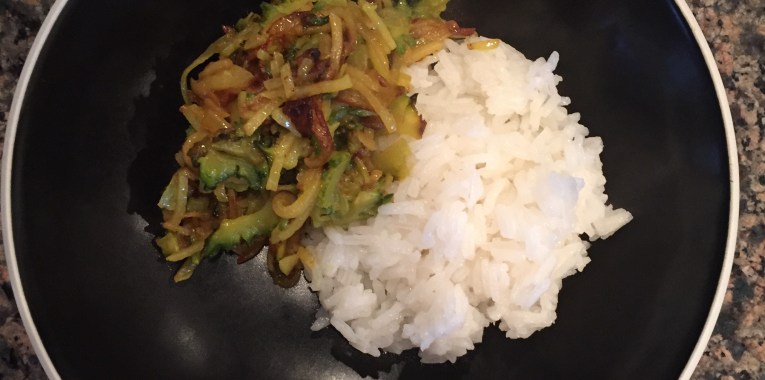
8. Serve with steaming hot plain white rice. This will probably feed 4-6 depending on your love of bitterness.

All this is only part of the story about when bitter-melon and I meet. As the bhaji enters my internal system it begins to remake me, as I had remade it. The mechanics of that internal world is a mystery to me. Even if someone were to explain the all the narratives of nutrition, digestion, biological structure and systems, it still would not begin to explain the existence of the grown, hollowed, sliced, salted, fried and digested vegetable. Everything has mysterious existential depth, even bitter things.

Bittermelons and Brownies: A recipe to grow myself

Everyday I find myself astonished and humbled by the infinite recipes for eating and living. My experience in architecture, philosophy, yoga and food has blended into a strange kaleidoscopic lens adjusting awareness, responsibility and joy in every interaction. I see cooking as transformative, as an event that helps me to take the other in, to consume, to enjoy and to cherish. My revised recipe for living now involves three considerations borrowing from yoga mindfulness and object oriented philosophy.

 (X)  Everything is a location in existence.

You, as a thing, are a dynamic location. You are a unique point in the stippled picture of the universe, never isolated, always responding. As is, everything else.

I borrow this from the practice of yoga that warns us against the misguided and egocentric belief that we are proudly autonomous or sadly disconnected.

X+  Everything is more than it appears.

You, as a thing, are more than your actions, emotions, body, race, religion, thought, features, likes, dislikes, you and everything you think you know is more than your assessment. You are hidden. As is, everything else.

Object oriented thinking and Graham Harman taught me to celebrate the darkness and depth of things. There is a philosophical generosity in accepting the unknown and resisting the drive for full disclosure.

 X + ( –X)  Everything is conditioned on what it is not.

Food is the visceral example of this. What is not you, sustains you. You are weird. As is, everything else.

Timothy Morton, the author of the Poetics of Spice (2006), Dark Ecology  (2016) and much more in between, talks about the “weird,” turning, twisting, looping non-linear causality and coexistence of things.

You, as a thing, are as a location in existence, more than what you seem and are conditioned by everything that is not you, and everything you encounter does the same.

Everything is a Point. Hidden. Weird.  Including, you. And, me.

Thing: {(X), X+, [X+(-X)]}

Keep reading. This is the master recipe I’ll be using in all food stories to come and to help me care about things I don’t understand. Let me tell you how to eat bittermelons and brownies, and a few things in between.