
Fishing for Joy: A Personalized Restaurant Rating System (PRE-9)

I remember very little about that childhood trip from Dhaka to Rajshahi, except for how a piece of turmeric stained white flaky fish glistening in the sunshine transformed atmospheric overwhelm into delicious comfort. Fresh caught Rui fish skillfully hacked into thick steaks, generously slathered in red-yellow speckled spices, dropped into pans of sputtering hot mustard oil before being unceremoniously delivered to the backseat window of our Toyota. At that moment, the bustle of a crowded ferry crossing over the Jamuna River receded as all my greedy attention converged onto a taste that carried my senses inward and allowed me to swallow the chaos like a goddess. Since then, every bite of seasoned fried fish opens an emotional escape hatch from the restless boredom of waiting under a blanket of thick humid heat vaporizing into rancid smells. Retrospectively, belatedly, by surprise I recognize myself in that memory. That savored piece of fish flavors all my bites by comparison. Only now, I see it as a memorable event of self-soothing joy. The remembered satisfaction of my 10-year-old self fortifies my tastebuds with the possibility of a deliciously defiant celebration of difficult circumstances. In therapeutic terms, my fried-fish memory is an empowering and embodied resource of joy.

A Yelp review of this intimate gastronomically induced “everything-everywhere-all-at- once” happy place is shockingly inadequate. At the same time, heavily reviewed establishments can also become equally hidden by the burden of spot-lit conceptual overexposure. In both cases, the charge of meaning falls on the restaurant alone: the chef, the staff, the servers, the space, the food. The depth of experience that I bring as an eater remains unaccounted in the reduction to seemingly objective stars guiding other eaters. As I am guided by others or guide others, “I” disappear. No doubt, crowdsourcing to identify a potentially pleasurable gastronomic experience in unfamiliar territory can be deeply satisfying. If over a 1000 people bestowed a restaurant with 4 stars, the collective choice conjures an aura of objective truth. The restaurant might be good, but can it host transformative joy for me?

When I want to know a restaurant I follow reviews, when I want to connect with others, I add my review. When I want an opportunity to understand myself, I am called to craft my own review. The truth of each restaurant experience is a matching game between my personal rating and the ratings offered by others. And so, unique experiences deserve subjective AND objective approaches that speak intimately and publicly, at the same time. My mouth is a crossroad where I meet myself in taste and meet others in words. Savoring my piece of fish, I welcome the outward noise from which it is caught, dressed, prepared, and served, and follow it inward through my senses and into its future incarnations and connections by comparison and expression. This delicious and deliberate internal journey becomes the “this reminds me of …..” connection with others. In this way, I bring my childhood experience on the riverbank to translate into fried fish with my fellow architecture students in the mountains of Mexico, fried fish at a roadside eatery with my parents between Mecca and Medina, or Mahi fish tacos at my local North Carolina taco stand with my family. The quality of one food experience reveals itself only in the context of all my food experiences. Each bite evokes all bites, like an omniscient tasting power practiced through wide deliberate eating. Savoring and swallowing a bite is the ultimate embodied act of integrating familial, cultural, historical, and political experiences. This may be why hunger strikes have been historically used to reject undigestible familial and social conditions.

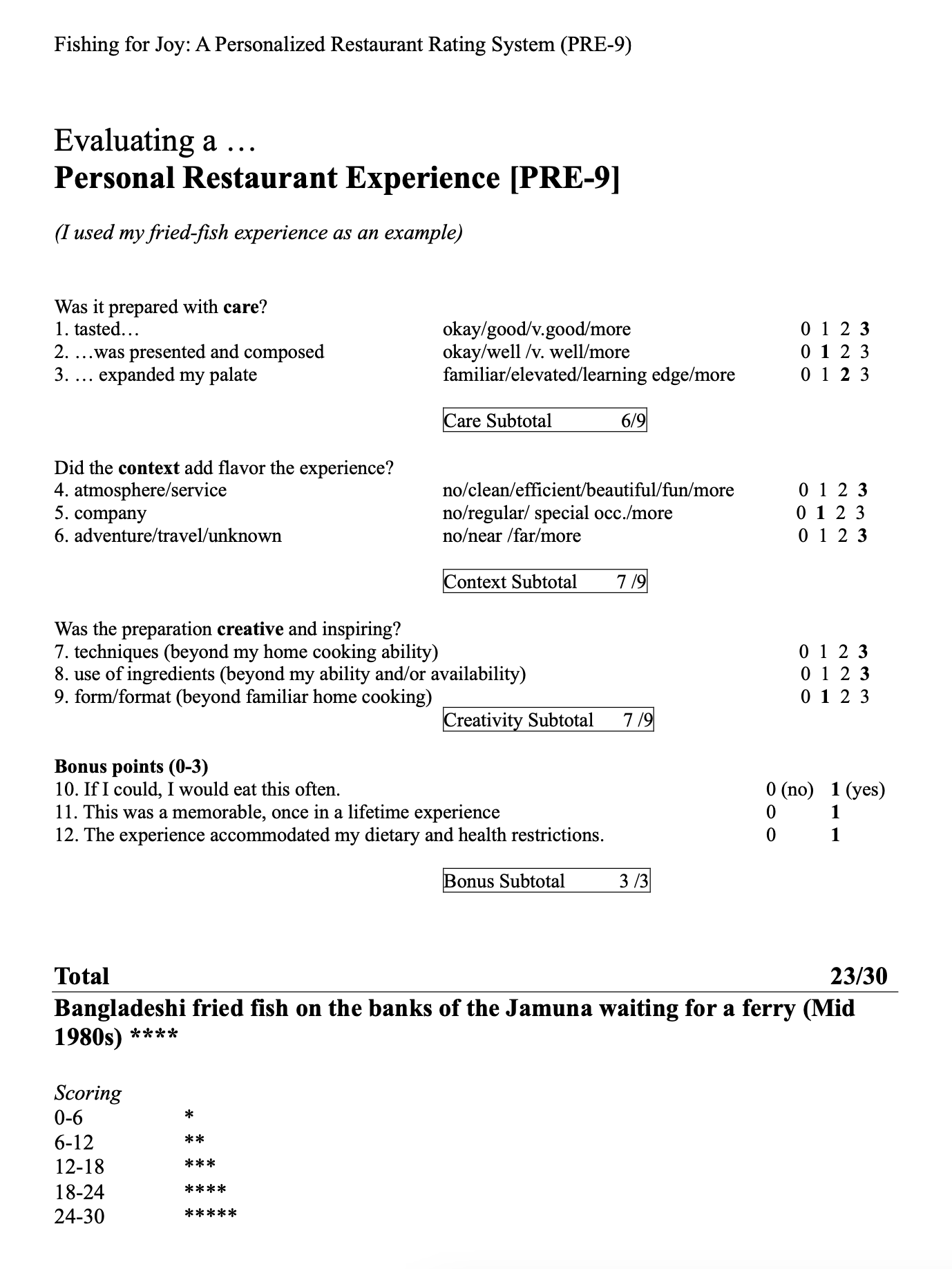
To discover and seek out more transformative fried-fish moments, I rely on my grief and anxiety counseling background. In my field of practice there are examples of measures that objectively rate subjective emotional experience, like satisfaction, depression, anxiety, self-worth etc. To fully appreciate the value of my childhood riverbank fried fish I borrowed the PHQ-9 format that measures depression. It seemed poetically justified to honor the format that identifies isolating depression to help identify connecting joy. The PHQ-9 measures sleep, energy, appetite, concentration, movement, pleasure as well as suicidal thoughts. Anhedonia, a symptom of depression is when what previously brought you joy no longer does so. Imagine having your favorite meal and feeling numb. I hope you don’t recognize this feeling, if you do, please stop reading and reach out. To identify the opposite state of anhedonia, the state of joy and pleasure fully experienced and expressed, a different scale would be needed. To measure my Personal Restaurant Experience (PRE-9) I identified my highest food values: care, context, creativity. Your criteria for gastronomic joy will be different. Other criteria can be leftover potential, zero waste, local, affordable, region specific, history specific, sustainable, strong aversions, strong preferences, dietary restrictions, etc. The scale gives me an instrument of mindful deliberation that can stretch the range of restaurant considerations from humble street food to Yelp-celebrated based on my own criteria for joy.

As an avid home cook, I value care taken to prepare a meal. Underdone, overcooked, under seasoned, over seasoned, poor ingredients or sloppy plating indicate a sad lack of care and pride in the preparation. My riverbank fried fish was prepared with skill evident in the efficiency of the whole process from carving to serving. As a design sensitive soul, I taste the context and environment just as much as the flavors. On the criteria of context my fish-fry was both a product of hustling context and a daringly delicious escape from it. Ideally, a restaurant meal would go beyond my own cooking abilities and knowledge, the skills and use of ingredients would inspire me, and the format would joyfully surprise me. The best meals challenge my assumptions about everything, surprise me, teach me, elevate me, and empower me to see the potential of humble things celebrated with careful joy. The bonus points of my rubric account for how the gastronomic experience serves joy in general. If the experience was memorable, repeatable, and invited me to follow the taste in my mouth and find the words to share that taste, it was worthy.

In retrospect, the piece of turmeric stained fried fish challenged me to accept the savory gift of nourishment within an unsavory crush of restless waiting. It had enticed me out of the protective shell of the car back seat and helped me experience feeling trapped as a sensational adventure instead. Transformative dishes open me to myself and my world, an ultimate act of embodied self-awareness that digests life itself. The PRE-9 expresses my deliberated search for joy through food and invites you to do the same. It prompts us to seek out universe-condensing bites of existence as antidotes to anhedonia particularly when life feels overwhelming.

Here are two no-recipe recipes: One for Bangladeshi Mach Bhaja (spice-fried fish) and one for a personalized evaluation of a restaurant experience.

Mach Bhaja [Fish Fry]

  1. Preferably a fatty big river fish but any fish works: tilapia, flounder, salmon, cod.
  2. Preferably steaks but filet is fine too. Scored skin on the filets offer extra flavor.
  3. Preferably fresh wet spices. A paste of turmeric powder, Kashmiri chili powder and salt works. Choose any spice combination and amount that settles your soul.
  4. Preferably mustard oil but olive oil or canola are fine too.
  5. Paint fish pieces with spices. Let the painted fish rest for up to an hour.
  6. Heat enough oil to cover the bottom of the pan until shimmering hot.
  7. Turn the vent on high. Without the benefit of an open sky and bustling market, the smells of hot mustard oil, spice, and fried fish can linger like guests past their welcome.
  8. Carefully place fish pieces in hot oil. Do not overcrowd the pan. If you do, you won’t get the roasted spice sear, fish will boil instead. Because of the water and spices, the fish will angrily splatter. Use a splatter screen or risk oil scars. Just assume there will be clean up afterwards.
  9. Lower heat to medium, let fish hard sear on one side. Flip and sear other side. In Bangladesh, fish tends to be cooked almost like meat. You are welcome to gently lift and place the fish onto paper towels to soak up the excess oil or serve with the clinging spiced oil. In Bangladesh, the spiced oil is a welcome sauce to coat and flavor the accompanying rice. To the Western palate accustomed to soft, poached, flaky salt- water fish, the hard fried fish may feel overcooked and oily.
  10. Eat immediately with steaming hot white rice, green chilies, and lime wedges.
Invitation to “know thyself”

Three months ago I launched an online life-consulting practice: The Self-Curious Project. In this short time, I had at least 50 meaningful and honest conversations that taught me more than any academic program. So many questions worth exploring:

  • how do I not feel anxious about moving far from home?
  • how do I make friends and ease my social anxiety?
  • how do I stop nervous talking?
  • how do respond to “what will people say?”
  • how do not feel like a failure?
  • how do I live up to my parent’s expectations?
  • how do I get over a break up?
  • how do I deal with my grandmother’s death?
  • how do I adjust to grown-up children and their choices?
  • how do I feel more confident?
  • how do I like how I look?
  • how do I let go of my past hurt?
  • how do I move on and forward?
  • how do I………..

The answer depends on what each person brings with the question, in their mind, heart and body. My work with them involves making space for the uncomfortable thoughts, feelings and sensations. To make it safe to feel those feelings without judgement and with support.

My training in architecture, philosophy, social work and yoga perfectly align to this mission of supporting embodied self-curiosity. I can guide their conceptual understanding (philosophy), their awareness of inner-space within an outer world (architecture), their life circumstances and context (social work) and their moving shape (yoga). Having my own practice affords me time to explore the dynamic life of each person without rushing, without the pressure of insurance forms, without one-size-fits all conceptual impositions, without pathologizing functioning human experience. After each session, instead of notes, I write each client a summary email, recounting meaningful moments during the session, skills practiced, and yes, I give homework. There is always action. Learning without empowering action is a pointless waste of precious energy, time, space and connection. Self-acceptance requires a relentless practice of self-curiosity. It is not an event, a therapeutic breakthrough, a quick fix. Hence, the need for a witness, coach, consultant, counselor, or therapist.

Sitting with clients has taught me to slow down, to carefully listen for answers hidden in their own questions. Sometimes I feel like an archeologist, helping excavate hidden hopes and treasure. It is magical to see a person recognize themselves in their own fears and joys. I welcome the tears and I welcome the smiles. It is all the dazzling array of life examined, accepted, and thus worthy.

This blog is my self-curious playground. Thank you for reading, keeping me company and being my listener. The self-curious project is about you, fed by what I learn about myself here. It is the professional face of my personal inspirations. As readers of my private curiosities, I invite you to visit: https://theselfcurious.com/.

I offer a complimentary 30-minute consultation mostly because I enjoy connecting with people, and also so you can make an informed choice of whether self-exploration is worth your time and money. Signing up for a time-slot is easy. If not, email me.

Let’s have a architectural, embodied, philosophical and therapeutic conversation about what it’s like to be you. If I don’t see you there, no worries, hope to still see you here. I’m so thankful for your presence.

Stay in goodness. Stay in ease.

Lisa

Making space for mindful time in 3 simple steps

Feeling rushed by obligations and buried in chaos?

Morning space and time may help you set a confident pace for your day. Crafting mindful mornings is an art that needs intentional space for full expression. As a loss and life adjustment consultant trained in architecture and philosophy here is how I make room for my morning mindfulness routine.

Step 1: Clear one seat. Not a room. Not a big space. Just one comfortable chair, yoga mat, bed, step, any place where you can get comfortable. Don’t get sidetracked into cleaning an entire room. This adds yet another obligation to your load. My seat is a simple orange upholstered wide sofa in my study that I try to keep clear and open.  

Step one is about identifying and giving yourself a space, location, and foundation for you-time.

Space for Time

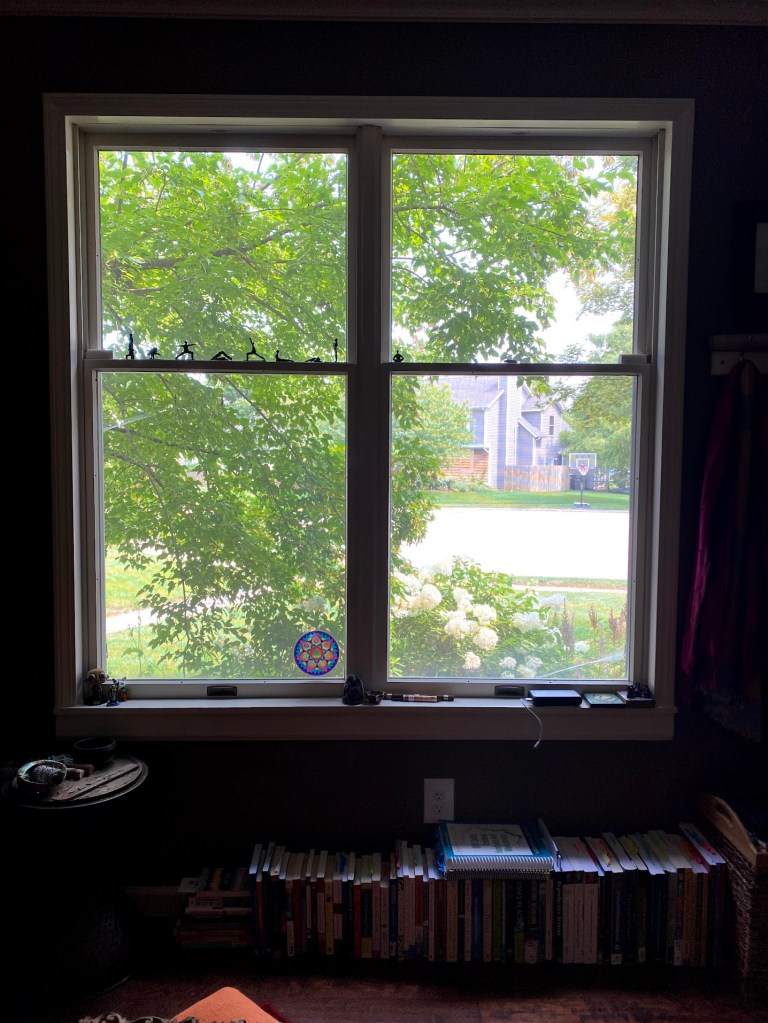
Step 2: Clear space for one view. It can be a window, a picture, a candle. My window looks onto a suburban cul-de-sac, so I added little things I find beautiful, funny and calming on the window sill. Again, focus on just one view, spaces on your side and behind you can be filled with laundry, dishes, papers, toys, the mess of life. The key here is to curate a supportive perspective unique to you.

Step two helps you build emotional connections and boundaries, walls and windows that set and clarify your perspective from your chosen seat.

Step 3: Choose something to touch. Something soothing like a blanket, a pillow, or a stuffed animal.  Choose something to hear like music, wind-chimes or nature sounds. Choose a comforting smell like incense, perfume, fruit, candles. I keep jasmine incense, a soft pillow to hold, and bird feeder outside my window. All three remind me of my time growing up in Bangladesh. For me, holding the warm cup of tea on my soft pillow while incense swirls in front of the window and birds chirp outside is calming.

Step three aims to support sensory comfort and safety through your personal choices.

Something to hold

How would you design your space for time?

Try sitting in your space for mindful time for 21 days. See if you notice any shifts in your self-confidence and let me know.

Are you healthy (mentally)?

As a therapist, I focus on presenting issues, the problems that compel a person to sit with me. Sure, I balance these functional impairments by looking for strengths and support. Still, the focus is on identifying and repairing damage, secondary and tertiary prevention.

I came across a list of indicators for positive ego strength while studying for the licensing exam. It was refreshing to look at a list of positive mental health criteria instead of DSM5 criteria for disorders.

I found myself checking my own emotional/ ego strength. Some items on the list are easier for me than others. Check to celebrate your own strengths and ability to live a full life.

  • Acknowledging their feelings – including grief, insecurity, loneliness, anxiety
  • Not getting overwhelmed with their moods
  • Pushing forward after loss and not being paralyzed by self-pity or resentment
  • Using painful events to strengthen themselves
  • Knowing that painful feelings will eventually fade
  • Empathizing with others without trying to reduce or eliminate their pain
  • Being self-disciplined and fighting addictive urges
  • Taking responsibility for actions
  • Holding themselves accountable
  • Not blaming others
  • Accepting themselves with their limitations
  • Setting firm limits event if it means disappointing others or risking rejection
  • Avoiding people who drain them physically or emotionally
  • Tolerance of pain associated with loss, disappointment, shame or guilt
  • Forgiveness of others with feelings of compassion rather than anger
  • Persistence and perseverance in pursuit of goals
  • Openness, flexibility, creativity in learning to adapt

From Social Work ASWB Masters Exam Guide by Dawn Apgar, 2018.

Relief in Social Distancing?

My initial concern, as a counselor, with social distancing in this time of COVID-19 was the increased potential for social isolation.

I worry about the elderly, the children in abusive or unsafe homes, the victims of partner violence, the ones living alone, the ones sick or afraid.

One of my first remote sessions caused me to think a bit differently about our situation.

What if, social distancing allows for a moment of respite not only from the judgment of others, but also from self-expectations? What if, in sheltering in place, we allow ourselves the grace of non-productivity grounded in social caring?

For one client, anxiety and anger melted away over the past week of interrupted activity. No issues to report. Nothing to discuss. Just ease sitting on the couch and watching television.

How powerful is simply pausing and distancing.

Thinking of this self-imposed quarantine as a vacation instead of social rejection, isolation or imprisonment may help explain my client’s sense of ease.

Of course, many cannot afford times without work, travel, social interaction. With social distancing, how can we get food and shelter to those who need it? How will small businesses survive? How can people working hourly shifts, work? How can children learn and grow? How long can we distance for the sake of collective health? Can we continue this sense of solidarity from a distance when we are able to approach each other again?

Alongside these broad social questions, maybe an important spiritual lesson to slow down is being taught to us. Our lives depend on it. Maybe beyond threats of COVID-19.

How are you experiencing social distancing?

Is it a relief? a suffering? a break? a welcomed pause? an uncomfortable uncertainty? are you worried about your parents, family who may seem further away and more vulnerable? Are you playing more games with your kids? Eating more meals together?

Are you distancing the events on your calendar, softening expectations, shortening to-do lists? Are you able to hear yourself better as other move away? Are the voices that rumble “you are not doing enough” distancing too? Do you find yourself weirdly at ease?

I do.

Wishing you health and self-aware ease,

Hungryphil

Guiding self-awareness

Can self-awareness be taught? Yes and no. I prefer the idea that self-awareness can be guided, safe guarded. As someone guiding efforts of increased self-awareness and self-actualization, I see my role as holding space and sometimes modeling, similar to teaching a yoga class. The sequence I call out is not the experience. Parallel to every call to move into a pose is a reminder to stay within one’s own body and breath. Therapy and counseling is no different. Leading someone to an emotional or physical point that hurts, stretches, aches requires careful awareness in order to avoid additional pain and injury. There is a balance between guiding one to their edge and protecting their choice to grow, move, change, ache, beyond hurt.

Therapists are always weighing the balance between forming a trusting alliance and getting to the real work so the patient doesn’t have to continue suffering. From the outset, we move both slowly and quickly, slowing the content down, speeding up the relationship, planting seeds strategically along the way. As in nature, if you plant the seeds too early, they won’t sprout. If you plant too late, they might make progress, but you’ve missed the most fertile ground. If you plant at just the right time, though, they’ll soak up the nutrients and grow. Our work is an intricate dance between support and confrontation.

Gottlieb, Lori. Maybe You Should Talk to Someone: A Therapist, HER Therapist, and Our Lives Revealed . HMH Books. Kindle Edition.

This dance requires emotional muscle memory and compassion that comes from having attempted personal variations on the same dance of confronting life’s challenges. There is personal investment for both therapist/social worker and client. It is a much deeper conversation beyond assessment and diagnosis that demands full participation by both. The creation of meaning demands this attention and presence. I cannot be present in your life, if I am not present in my own. Therapist and patient, Lori Gottlieb describes this struggle to move beyond the easy and removed task of giving advice towards self-actualization as a person and as a therapist.

… in the sense that therapy is a profession you learn by doing—not just the work of being a therapist, but also the work of being a patient. It’s a dual apprenticeship, which is why there’s a saying that therapists can take their patients only as far as they’ve gone in their own inner lives. (There’s much debate about this idea—like my colleagues, I’ve seen patients reach heights I can only aspire to. But still, it’s no surprise that as I heal inside, I’m also becoming more adept at healing others.)

Gottlieb, Lori. Maybe You Should Talk to Someone: A Therapist, HER Therapist, and Our Lives Revealed . HMH Books. Kindle Edition.

Healing must be collective. Learning how to balance self-aware ease in myself as a precondition to guide others is a formidable task. Deep breaths and try again.

May we heal from life together,

Hungryphil

Catch a glimpse of yourself in the space around you
Photography by Nate Dale – New Adventure Production

Anticipating Restriction

Anticipating the lean back
Photography by Nate Dale – New Adventure Production

You know the feeling when you wait for the person in front of you on an airplane to lean back and restrict you even further in to the the tight small seat?

You know that feeling, right? Wishing and hoping they won’t but at the same time realizing that they are perfectly right do so. Should I lean back too? Let the seat backs cascade down the aisle? This anticipation of discomfort to come is not the best feeling. (For a fuller account of airplane discomfort you can read, Inflight Therapy: For those traveling far and within on amazon kindle.)

For now the question is simple, how do you brace for impact, for being leaned into, for constriction, for discomfort?

As Thanksgiving travel and associated anxiety approaches in a few months, what are your strategies for coping? Music, breathing exercises, reading, meditating? Anticipating and thinking of coping skills ahead of time can reduce our anxiety response. Accepting and addressing the discomfort to come helps ironically ease it. Just recognizing discomfort without a related alleviation attempt, I imagine would increase anxiety. So, it might be worth taking the time to think ahead to this moment and find your empowered coping strategy. Resist the lean, at least emotionally 🙂

Wishing you ease,

Hungryphil