
Yoga helps,
- “the seeker excavate the tensions of inner life in a self-directed manner”
(Look inside)
- us be responsible for our own spiritual health
(Be responsible for your own peace)
- “relocate the unseen within us, invites us to introvert, to open our eyes to why we are who and how we are.”
(See your hidden motivations)
- “elevates the capacity for internal observation to the level of a virtue previously occupied by notions of “godliness”.”
(Accept Self-examination as cosmic responsibility)
In doing so, yoga exposes the power of internal authority through self-awareness.
In my opinion, and setting aside the accidents of its publishing fame, the yoga sūtra-s deserves our continued attention as a wildly exciting text for four interweaving reasons.
Firstly, it breaks with most previous paths of spiritual growth in its attempt to help the seeker excavate the tensions of inner life in a self-directed manner, without reliance on gurus or corporate bodies of authority. It is openly ambivalent to religious attitudes, going so far as to equate breath-awareness (1.34) with religious devotion (1.23) as a technique of evolution. From the outset, it contains no self-validating list of lineages, no creation story or deference to divine power: the text is a non-denominational and impersonal list of quiet discoveries.
Secondly, the sūtra-s generally (if we remix pāda three) move away from the magical thinking directed at cutting deals with unreachable gods and invisible spirits for a better life — an approach that continues to pervade our current spiritual milieu, from the remote prayer experiments of evangelical Christians to the “think methods” popular in this new age of The Secret.
Thirdly, Patañjali offers a substantive and startlingly modern map of psychomentality, dividing out conscious faculties for our observation, and alluding to how the unconscious shadows that seem to motivate our actions might be illuminated. I render saṃskāra and vāsanā as “trace” and “pattern”, following Feuerstein, who describes saṃskāra as a “sublimilinal activator”, and vāsanā as a “chain of similar karmic activators” (1998, 241). Bursting forth from the Vedic tradition, which sought to pacify the external forces of adṛṣṭa (“unseen” gods and energies), Patañjali relocates the unseen within us, invites us to introvert, to open our eyes to why we are who and how we are. This puts the notion of “trapped memory” front and centre, allowing a clear reckoning of karma: our traces, habits, and grooves. Patañjali suggests that we can slowly free ourselves of the unseen. This relentless excavation of hidden thought as the source of our pain, this dive towards whatever is unconscious, represents a clear displacement of his ancestors’ obsession with the whims of external gods.
This leads to the fourth gesture: the opening chapter of the yoga sūtra-s elevates the capacity for internal observation to the level of a virtue previously occupied by notions of “godliness”. The sincere human no longer needs to adhere to a perfect ideal, whether social or philosophical, to attain wisdom. She simply needs to watch her experience unfold, and to enrich her action with tender watching.
These four gestures amount to a broad gift: the text places implicit value on the power of internal authority.
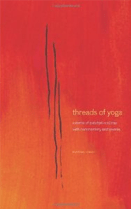
Remski, Matthew. Threads of Yoga: A Remix of Patanjali-s Sutra-s, with Commentary and Reverie (pp. 42-43). BookBaby. Kindle Edition.
Book Image from http://matthewremski.com/wordpress/books/threads-of-yoga/



 The Hungry Philosopher