

I remember very little about that childhood trip from Dhaka to Rajshahi, except for how a piece of turmeric stained white flaky fish glistening in the sunshine transformed atmospheric overwhelm into delicious comfort. Fresh caught Rui fish skillfully hacked into thick steaks, generously slathered in red-yellow speckled spices, dropped into pans of sputtering hot mustard oil before being unceremoniously delivered to the backseat window of our Toyota. At that moment, the bustle of a crowded ferry crossing over the Jamuna River receded as all my greedy attention converged onto a taste that carried my senses inward and allowed me to swallow the chaos like a goddess. Since then, every bite of seasoned fried fish opens an emotional escape hatch from the restless boredom of waiting under a blanket of thick humid heat vaporizing into rancid smells. Retrospectively, belatedly, by surprise I recognize myself in that memory. That savored piece of fish flavors all my bites by comparison. Only now, I see it as a memorable event of self-soothing joy. The remembered satisfaction of my 10-year-old self fortifies my tastebuds with the possibility of a deliciously defiant celebration of difficult circumstances. In therapeutic terms, my fried-fish memory is an empowering and embodied resource of joy.
A Yelp review of this intimate gastronomically induced “everything-everywhere-all-at- once” happy place is shockingly inadequate. At the same time, heavily reviewed establishments can also become equally hidden by the burden of spot-lit conceptual overexposure. In both cases, the charge of meaning falls on the restaurant alone: the chef, the staff, the servers, the space, the food. The depth of experience that I bring as an eater remains unaccounted in the reduction to seemingly objective stars guiding other eaters. As I am guided by others or guide others, “I” disappear. No doubt, crowdsourcing to identify a potentially pleasurable gastronomic experience in unfamiliar territory can be deeply satisfying. If over a 1000 people bestowed a restaurant with 4 stars, the collective choice conjures an aura of objective truth. The restaurant might be good, but can it host transformative joy for me?
When I want to know a restaurant I follow reviews, when I want to connect with others, I add my review. When I want an opportunity to understand myself, I am called to craft my own review. The truth of each restaurant experience is a matching game between my personal rating and the ratings offered by others. And so, unique experiences deserve subjective AND objective approaches that speak intimately and publicly, at the same time. My mouth is a crossroad where I meet myself in taste and meet others in words. Savoring my piece of fish, I welcome the outward noise from which it is caught, dressed, prepared, and served, and follow it inward through my senses and into its future incarnations and connections by comparison and expression. This delicious and deliberate internal journey becomes the “this reminds me of …..” connection with others. In this way, I bring my childhood experience on the riverbank to translate into fried fish with my fellow architecture students in the mountains of Mexico, fried fish at a roadside eatery with my parents between Mecca and Medina, or Mahi fish tacos at my local North Carolina taco stand with my family. The quality of one food experience reveals itself only in the context of all my food experiences. Each bite evokes all bites, like an omniscient tasting power practiced through wide deliberate eating. Savoring and swallowing a bite is the ultimate embodied act of integrating familial, cultural, historical, and political experiences. This may be why hunger strikes have been historically used to reject undigestible familial and social conditions.
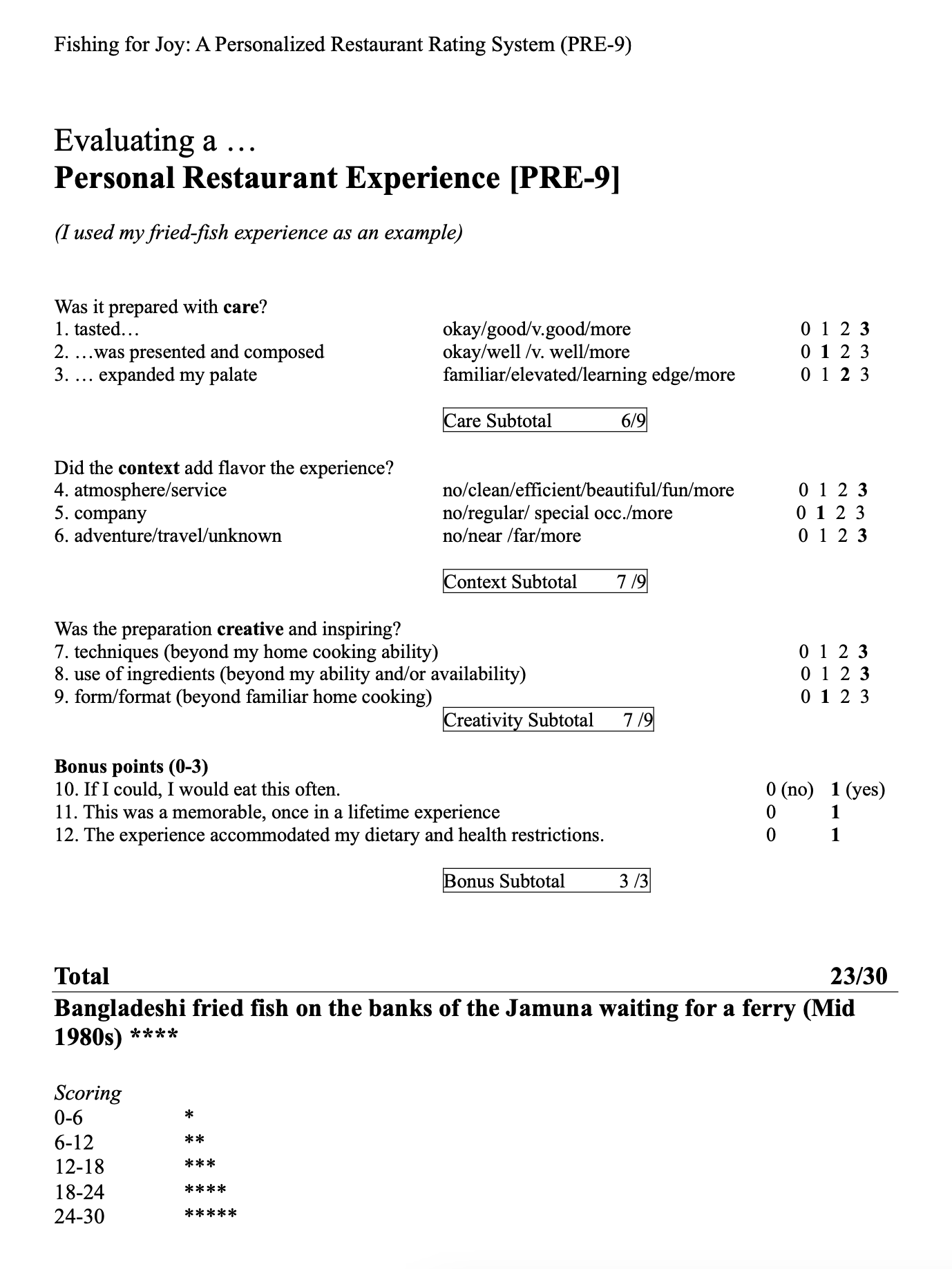
To discover and seek out more transformative fried-fish moments, I rely on my grief and anxiety counseling background. In my field of practice there are examples of measures that objectively rate subjective emotional experience, like satisfaction, depression, anxiety, self-worth etc. To fully appreciate the value of my childhood riverbank fried fish I borrowed the PHQ-9 format that measures depression. It seemed poetically justified to honor the format that identifies isolating depression to help identify connecting joy. The PHQ-9 measures sleep, energy, appetite, concentration, movement, pleasure as well as suicidal thoughts. Anhedonia, a symptom of depression is when what previously brought you joy no longer does so. Imagine having your favorite meal and feeling numb. I hope you don’t recognize this feeling, if you do, please stop reading and reach out. To identify the opposite state of anhedonia, the state of joy and pleasure fully experienced and expressed, a different scale would be needed. To measure my Personal Restaurant Experience (PRE-9) I identified my highest food values: care, context, creativity. Your criteria for gastronomic joy will be different. Other criteria can be leftover potential, zero waste, local, affordable, region specific, history specific, sustainable, strong aversions, strong preferences, dietary restrictions, etc. The scale gives me an instrument of mindful deliberation that can stretch the range of restaurant considerations from humble street food to Yelp-celebrated based on my own criteria for joy.
As an avid home cook, I value care taken to prepare a meal. Underdone, overcooked, under seasoned, over seasoned, poor ingredients or sloppy plating indicate a sad lack of care and pride in the preparation. My riverbank fried fish was prepared with skill evident in the efficiency of the whole process from carving to serving. As a design sensitive soul, I taste the context and environment just as much as the flavors. On the criteria of context my fish-fry was both a product of hustling context and a daringly delicious escape from it. Ideally, a restaurant meal would go beyond my own cooking abilities and knowledge, the skills and use of ingredients would inspire me, and the format would joyfully surprise me. The best meals challenge my assumptions about everything, surprise me, teach me, elevate me, and empower me to see the potential of humble things celebrated with careful joy. The bonus points of my rubric account for how the gastronomic experience serves joy in general. If the experience was memorable, repeatable, and invited me to follow the taste in my mouth and find the words to share that taste, it was worthy.
In retrospect, the piece of turmeric stained fried fish challenged me to accept the savory gift of nourishment within an unsavory crush of restless waiting. It had enticed me out of the protective shell of the car back seat and helped me experience feeling trapped as a sensational adventure instead. Transformative dishes open me to myself and my world, an ultimate act of embodied self-awareness that digests life itself. The PRE-9 expresses my deliberated search for joy through food and invites you to do the same. It prompts us to seek out universe-condensing bites of existence as antidotes to anhedonia particularly when life feels overwhelming.
Here are two no-recipe recipes: One for Bangladeshi Mach Bhaja (spice-fried fish) and one for a personalized evaluation of a restaurant experience.
Mach Bhaja [Fish Fry]
- Preferably a fatty big river fish but any fish works: tilapia, flounder, salmon, cod.
- Preferably steaks but filet is fine too. Scored skin on the filets offer extra flavor.
- Preferably fresh wet spices. A paste of turmeric powder, Kashmiri chili powder and salt works. Choose any spice combination and amount that settles your soul.
- Preferably mustard oil but olive oil or canola are fine too.
- Paint fish pieces with spices. Let the painted fish rest for up to an hour.
- Heat enough oil to cover the bottom of the pan until shimmering hot.
- Turn the vent on high. Without the benefit of an open sky and bustling market, the smells of hot mustard oil, spice, and fried fish can linger like guests past their welcome.
- Carefully place fish pieces in hot oil. Do not overcrowd the pan. If you do, you won’t get the roasted spice sear, fish will boil instead. Because of the water and spices, the fish will angrily splatter. Use a splatter screen or risk oil scars. Just assume there will be clean up afterwards.
- Lower heat to medium, let fish hard sear on one side. Flip and sear other side. In Bangladesh, fish tends to be cooked almost like meat. You are welcome to gently lift and place the fish onto paper towels to soak up the excess oil or serve with the clinging spiced oil. In Bangladesh, the spiced oil is a welcome sauce to coat and flavor the accompanying rice. To the Western palate accustomed to soft, poached, flaky salt- water fish, the hard fried fish may feel overcooked and oily.
- Eat immediately with steaming hot white rice, green chilies, and lime wedges.
 The Hungry Philosopher
I love how you frame eating not just as nourishment but as an act of joy, resilience, and connection. regard animasi
LikeLiked by 1 person
Thank you for your kind words. Food can be such an embodied and emotional lens into the world. And delicious!
LikeLike