Eating and Dying to be human

bicentennial_man_05

“I am designing a system for allowing androids-myself-to gain energy from the combustion of hydrocarbons, rather than atomic cells.”

Paul raised his eyebrows. “So they will breathe and eat?”

“Yes.”

“How long have you been pushing in that direction?”

“For a long time now, but I think I have designed an adequate combustion chamber for catalyzed controlled breakdown.”

“But why, Andrew? The atomic cell is surely infinitely better.”

“In some ways, perhaps, but the atomic cell is inhuman.”
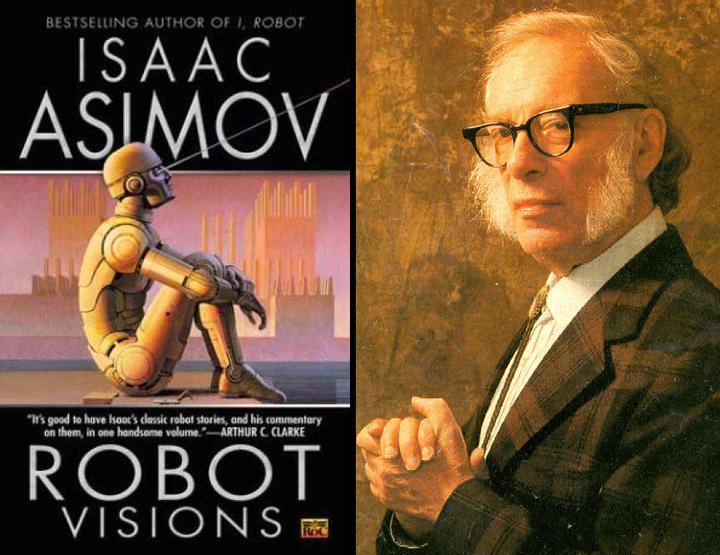
In previous post, I had written about the Golem’s pretense of eating in order to prove her humanity in the Golem and the Jinni by Helen Wecker. Another sci-fi classic version of the same pretense can be found in Isaac Asimov’s Bicentiennial Man, a story of transformation from robot to human that involves creativity, clothing, digestion, breathing and eventually death. Eating is the privilege of the living, organic and artificial, as the story suggests. Everyday, we limit or qualify our energy source, our food. Why don’t we all just take an efficient nutrition pill to sustain ourselves? (Our poor dog has been placed under a diet. He’s been extra needy. He really likes chicken and treats.) Anyway, back to our persistent effort to spice up, gluten free, sweeten, bake, fry, blend, season and plate our source of energy. If we put so much thought into what we put into our (and our pets) bodies as fuel, why don’t we worry about the energy we put into our lamps, heaters, cars, phones…all our stuff? Is it because our phones can’t taste or like chicken as Oreo the dog does? If my toaster worked better with one source of energy versus another would we care? Does the source of energy effect performance of things? I don’t know. Again…I digress. Asimov was on to something and anticipated this post-humanist era of thinking beyond the artificial/organic divide. I wonder if Andrew the prosthetic human ate meat?

As we approach the decadent and delicious feast of Thanksgiving, I wonder how could I feed my stove, refrigerator, stand mixer, blender? How can I show my appreciation for all my primitive robots that make a tasty dinner possible?
I wish I had some chicken

Desire

by Michael Blumenthal

          Paris, May 2005

Let’s just say I seem to be enjoying these three chicken drumsticks
far more than the young man doing sit-ups just across the lawn

beside his girlfriend here at the Jardin de Reuilly is enjoying himself:
after all, he’s huffing and puffing, and I’m sitting here, devouring

my chicken, basking in the spring sun, but now he’s rolling over,
it’s push-ups he’s doing, push-ups right on top of his girlfriend,

and the push-ups are getting slower and slower, just as my chicken
is disappearing, and, before long, the push-ups stop altogether, he’s

merely lying there on top of her, and he seems, even from a distance,
much happier than when he was doing push-ups, then he suddenly

sits up, looks up at the heavens, and stares (with an expression
of pure longing) over at me. Oh, he seems to be saying,

I sure wish I had some chicken.

“Desire” by Michael Blumenthal, from No Hurry: Poems 2000-2012. © Etruscan Press, 2012. Reprinted with permission.

http://writersalmanac.publicradio.org/index.php?date=2014/11/13

MFK Fisher’s Buttered Toast: On Dignity During Wartime Dining

Buttered-Toast

If, with the wolf at the door, there is not very much to eat, the child should know it, but not oppressively. Rather, he should be encouraged to savor every possible bite with one eye on its agreeable nourishment and the other on its fleeting but valuable esthetic meaning, so that twenty years later, maybe, he can think with comfortable delight of the little brown toasted piece of bread he ate with you once in 1942, just before that apartment was closed, and you went away to camp.

It was a nice piece of toast, with butter on it. You sat in the sun under the pantry window, and the little boy gave you a bite, and for both of you the smell of nasturtiums warming in the April air would be mixed forever with the savor between your teeth of melted butter and toasted bread, and the knowledge that although there might not be any more, you had shared that piece with full consciousness on both sides, instead of a shy awkward pretense of not being hungry.

My queen of food writing, MFK Fisher found in shared gastronomic enjoyment human dignity that defied harsh conditions. Her book How to Cook a Wolf is one my favorites because it addresses wartime eating in a such a practical and philosophical way.  For her, food becomes an agent of human dignity instead of an mere instrument of human survival through thoughtful eating.  She concludes the book with the following poignant words:

How-to-Cook-a-Wolf-MFK-Fisher

I believe that one of the most dignified ways we are capable of, to assert and then reassert our dignity in the face of poverty and war’s fears and pains, is to nourish ourselves with all possible skill, delicacy, and ever-increasing enjoyment. And with our gastronomical growth will come, inevitably, knowledge and perception of a hundred other things, but mainly of ourselves. Then Fate, even tangled as it is with cold wars as well as hot, cannot harm us.

To be consumed….to write, to eat.

click-the-image-for-19-more-ernest-hemingways-quotes-on-writing

“Good writing is always about things that are important to you, things that are scary to you, things that eat you up.” —John Edgar Wideman from http://writersalmanac.publicradio.org/

“A writing cook and a cooking writer must be bold at the desk as well as the stove.”
M.F.K. Fisher from http://www.goodreads.com/author/quotes/1408429.M_F_K_Fisher

“One cannot think well, love well, sleep well if one has not dined well.”

– Virginia Wolf from http://www.huffingtonpost.com/2012/10/04/best-food-quotes_n_1937214.html

“Writing is 90 percent procrastination: reading magazines, eating cereal out of the box, watching infomercials.” —Paul Rudnick

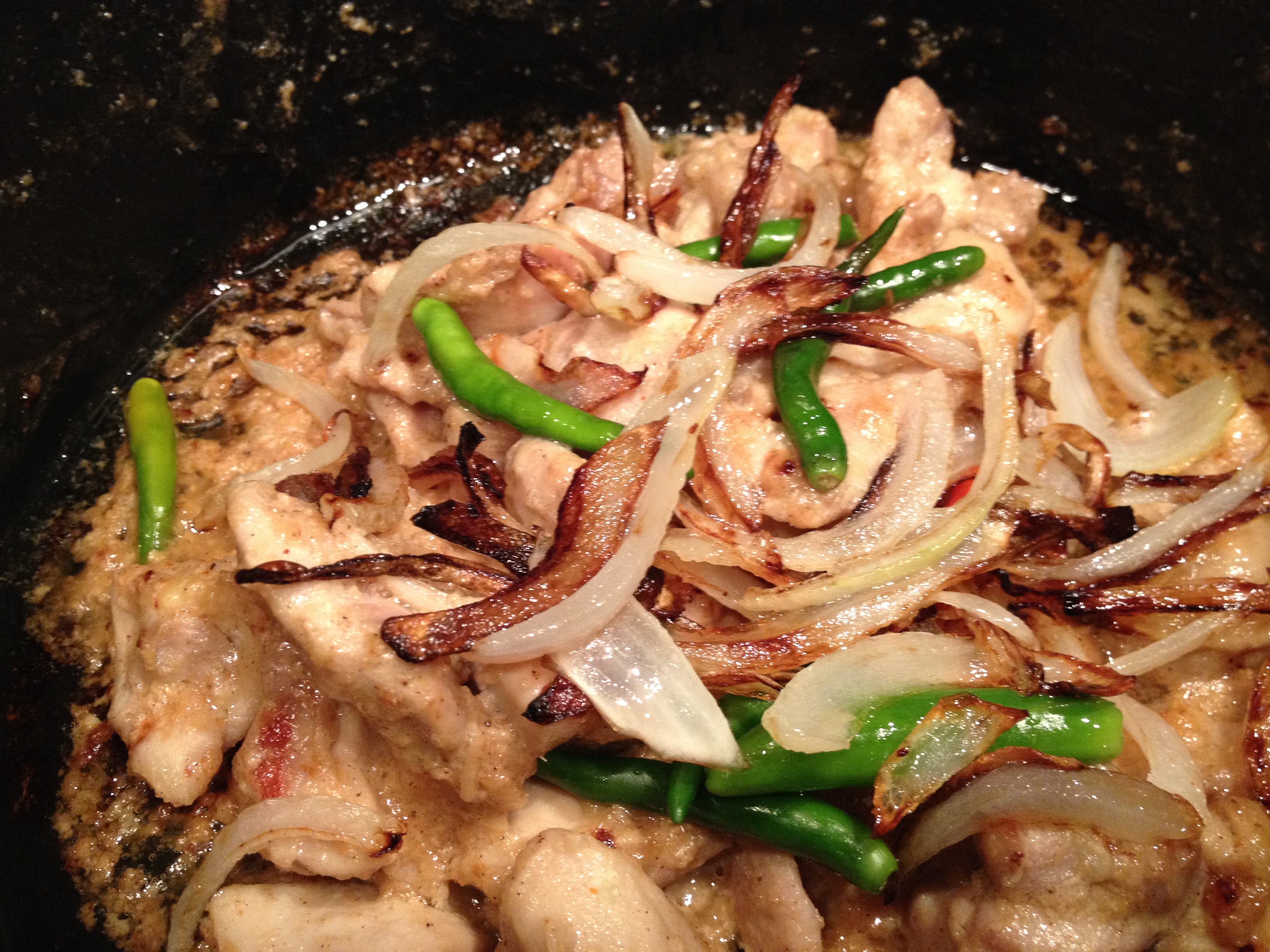
Tandoori Fried Chicken with Spiced Waffles and Honeyed Ghee

photo

This recipe is an adaptation from Nigella Lawson’s Southern Fried Chicken

http://www.foodnetwork.com/recipes/nigella-lawson/southern-style-deep-fried-chicken-recipe.html

1. The twist is to add a half a packet (or whole depending on your desired heat level) of Tandoori Chicken Spice (Shan or any brand) to the milk in which the chicken is cooked. A quicker version of this is, frying or baking chicken tenders marinated in yogurt, tandoori spice and coated in flour.

2. Add a half a teaspoon of cinnamon and a half a teaspoon of cardamom powder to your waffle batter that serves four.

3. Mix half a cup of honey with half a cup of ghee (clarified butter) and drizzle over both waffles and chicken for a Deshi twist. Hmmm….a hint of lemon might be good too. Next time, I might add a squeeze of lemon to the honey ghee.

It was sweet, spicy and decadent with the ghee. Next time I would add more tandoori spice (the whole packet instead of just the half). Otherwise, very yummy.

Deshi in the Dorm Kitchen (Chicken Rezala)

Dear Amani,

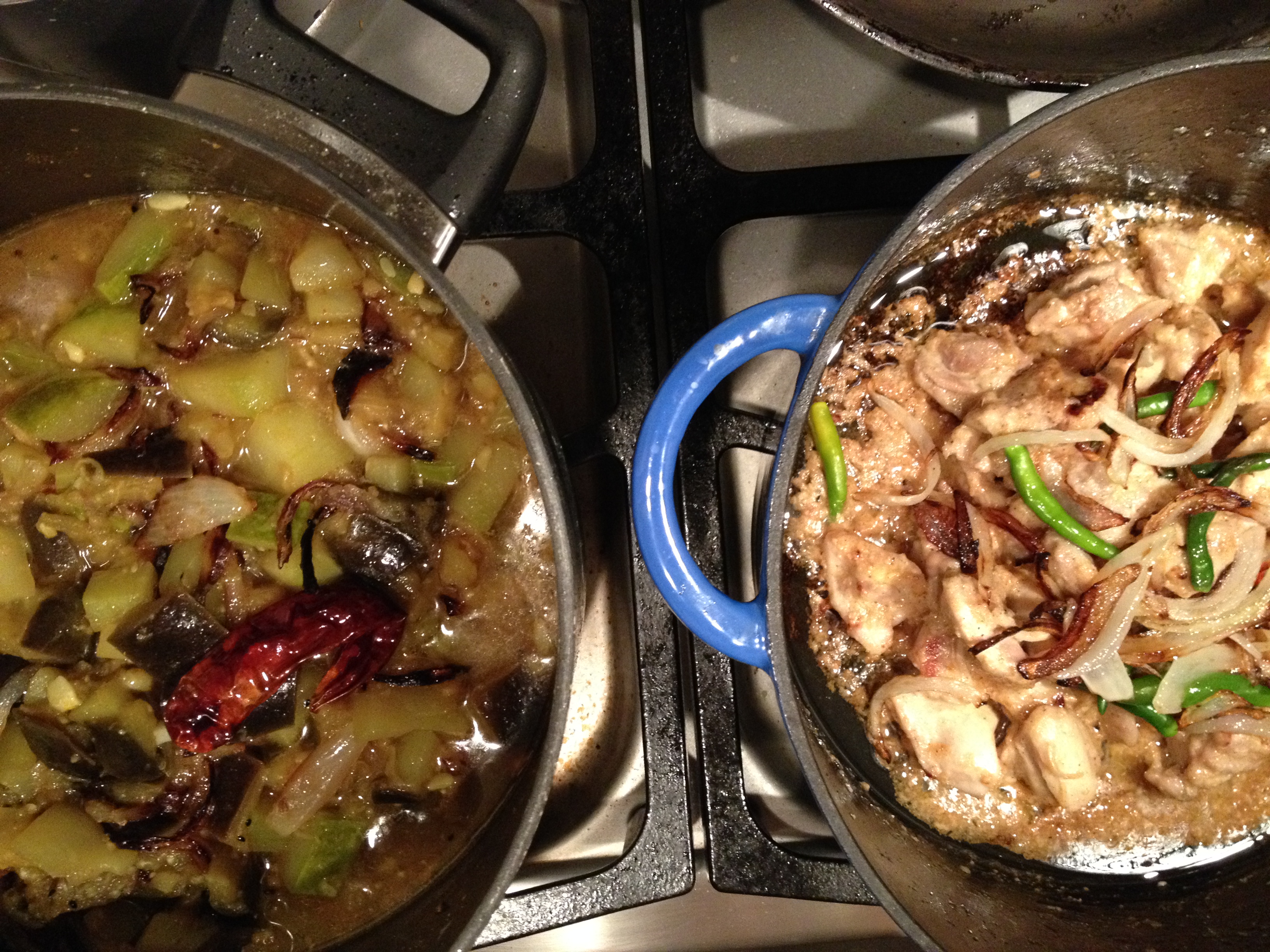
Here is the chicken rezala recipe. When cooked the yoghurt will look a little curdled. Don’t be alarmed. After it cooks down and you add the fried onions (and the oil you fried it in)…chili pepper, sprinkle sugar and squeeze lemon, it all looks good. Very yummy with porata but rice always works. You can add sauteéd mushrooms to stretch the dish and make it more non-deshi friendly.

The mixed vegetable dish is one that your Dadi makes really well. My shortcut and take on her recipe is simply to boil a bunch of vegetable together (be sure to cube the same size). In this case eggplant and squash (lao?). Boil with spices, half a teaspoon of each until the vegetables are tender. Add water almost covering the vegetables.

Cumin, Coriander, Chili powder, Tumeric, Ginger and Garlic (paste)

Salt about 1 teaspoon.

Fry half an onion sliced and one clove of garlic with ghee, butter or oil. If you have “panchforan” and cilantro, add it. If not, no problem. Finish with a sprinkle of sugar and a squeeze of lemon.

Eat well.

Love,

Mom

Photo from Sep 2014 Photo Stream

photo 1photo 2photo 3

Seductive Consolations of Food

How could I have written all these posts without having mentioned Elizabeth Gilbert’s Eat, Pray, Love? So here it is…… an excerpt describing her first moment of recognized contentment in Italy after a good meal. Note: I said good satisfying meal, not overindulgent-stuffing-our-disappointments-down-with-candy-ice-cream and chips. One must be careful about gastronomic self-soothing. I’m sure many of us can relate. Enough said.

Eat,_Pray,_Love_–_Elizabeth_Gilbert,_2007

The first meal I ate in Rome was nothing much. Just some homemade pasta (spaghetti alla carbonara) with a side order of sauteéd spinach and garlic. (The great romantic poet Shelley once wrote a horrified letter to a friend in England about cuisine in Italy: “Young women of rank actually eat– you will never guess it — GARLIC!”) Also, I had one artichoke, just to try it; the Romans are awfully proud of their artichokes. Then there was a pop-surprise bonus side order brought over by the waitress for me for free — a serving of fried zucchini blossoms with a soft dab of cheese in the middle (prepared so delicately that the blossoms probably didn’t even notice they weren’t on the vine anymore). After the spaghetti, I tried the veal. Oh and also I drank a bottle of house red, just for me. And ate some warm bread, with olive oil and salt. Tiramisu for dessert.

Walking home after the meal, around 11:00 PM, I could hear noise coming from one of the buildings on my street, something that sounded like a convention of seven-year-olds — a birthday party, maybe? Laughter and screaming and running around. I climbed the stairs to my apartment, lay down in my bed and turned off the light. I waited to start crying or worrying, since that’s what usually happened to me with the lights off, but I actually felt OK. I felt fine. I felt the symptoms of contentment.

Ruhlman’s Rule # 1: Think

Cooking is philosophical activity…..as the hungry philosopher, I  rest my case. It also helps to have Michael Ruhlman’s Rulman’s Twenty: 20 Techniques, 100 Recipes, A Cooks Manifesto that opens with the chapter, “Think: Where Cooking Begins.”

books

It’s underrated. If you have a recipe, do you have to think? When you open a book that says, “Combine A and B, add C, stir, and bake for 20 minutes at 350℉/180℃,” do you simply follow the instructions?

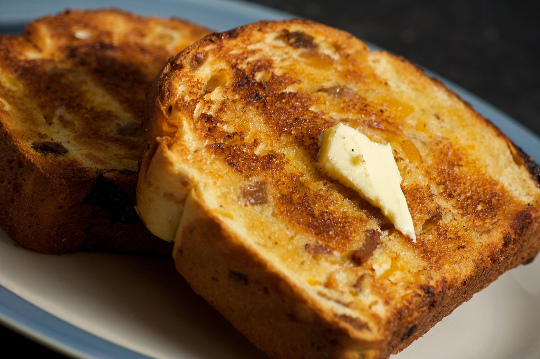
Cooking doesn’t work that way. Cooking is an infinitely nuanced series of action, the outcome of which is dependent on countless variables. What’s the simplest dish you can think of? Let’s say buttered toast. Can you write a perfect recipe for it? There is no exact way to convey how to make buttered toast and account for all variables. The temperatures of the butter has a huge impact on the final result, as does the type of bread, how thick it’s cut, and how hot your toaster gets. Because all the variables in cooking can never be accounted for, whether you’re cooking from a book or cooking by instinct, it stands to reason that the most important first step in the kitchen is simply to think, even if all you’re making is buttered toast.

Thinking in the kitchen is underrated.

Thinking.

Before you begin. Stand still. Think.

Eating to be Human

15819028

The tea she poured into the water -closet sink when no one was around. The toast and boiled egg she wrapped in a piece of waxed paper and gave it to the first hungry child she passed on her way to the bakery. She didn’t in fact have to do this; she discovered she could in fact, eat. On one of her last nights at the Rabbi’s, curiosity and boredom had overcome her lingering trepidation, and she decided to ingest a small piece of bread. …….The act of eating proved useful at the bakery, as she learned to make adjustments based on taste, and to eat a pastry occasionally as others did. But it was hard not to feel each prop– the cloak and the toast and the quickly eaten pastries — as a small pang, a constant reminder of her otherness.

Appetite (Poem)

Appetite

by Maxine Kumin

I eat these
wild red raspberries
still warm from the sun
and smelling faintly of jewelweed
in memory of my father

tucking the napkin
under his chin and bending
over an ironstone bowl
of the bright drupelets
awash in cream

my father
with the sigh of a man
who has seen all and been redeemed
said time after time
as he lifted his spoon

men kill for this.

“Appetite” by Maxine Kumin, from Selected Poems: 1960-1990. © Norton, 1990. Reprinted with permission. (buy now)

http://writersalmanac.publicradio.org/index.php?date=2014/09/06