Corn Picking 1956 — Afternoon Break [Food Poem by Tom Hennen]

I needed a heavy canvas jacket riding the cold red tractor, air
an ice cube on bare skin. Blue sky over the aspen grove I drove
through on the way back to the field, throttle wide open, the
empty wagon I pulled hitting all the bumps on the dirt road. In
the high branches of the aspens little explosions now and then
sent leaves tumbling and spinning like coins tossed into the air.
The two-row, tractor-mounted corn-picker was waiting at the
end of the corn rows, the wagon behind it heaped so high with
ears of corn their yellow could be seen a mile away. My father,
who ran the picker, was already sitting on the ground, leaning
back against the big rear wheel of the tractor. In that spot out
of the wind we ate ham sandwiches and doughnuts, and drank
hot coffee from a clear Mason jar wrapped in newspaper to
keep it warm. The autumn day had spilled the color gold every-
where: aspen, cornstalks, ears of corn piled high, coffee mixed
with fresh cream, the fur of my dog, Boots, who was sharing
our food. And when my father and I spoke, joking with the
happy dog, we did not know it then, but even the words that
we carelessly dropped were left to shine forever on the bottom
of the clear, cold afternoon.

From the Writer’s Almanac
Deep in Our Refrigerator – Food Poem by Jack Prelutsky

Deep in our refrigerator,
there’s a special place
for food that’s been around awhile…
we keep it, just in case.
‘It’s probably too old to eat,’
my mother likes to say.
‘But I don’t think it’s old enough
for me to throw away.’

It stays there for a month or more
to ripen in the cold,
and soon we notice fuzzy clumps
of multicolored mold.
The clumps are larger every day,
we notice this as well,
but mostly what we notice
is a certain special smell.

When finally it all becomes
a nasty mass of slime,
my mother takes it out, and says,
‘Apparently, it’s time.’
She dumps it in the garbage can,
though not without regret,
then fills the space with other food
that’s not so ancient yet

from: http://www.poemhunter.com/poems/food/page-1/37365112/

IMG_2055

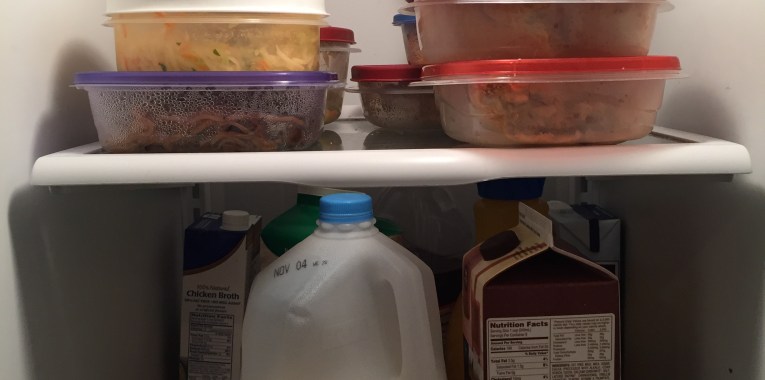
I have long struggled with this question about when to let go of left over food. There are times, as I am filling a container, I know that the contents will not be eaten. Ever again. I can either throw it out right then and avoid clogging up the refrigerator or I can with a guilty heart keep the unwanted leftovers to throw out another day. As if, the waste becomes justifiable when allowed to form mold that absolves us of guilt. Of course, It’s the mold’s fault I have to throw it out, not my own wastefulness. All of us make these decisions when asked at a restaurant “do you need a container” or when we cooked too much or not very well. Confessedly, there are many times I’ve thrown out edible but unfortunate cooking experiments hoping to make the evidence of my failure disappear as quickly as possible. Other times I’ve saved a meal so I might transform it into a different meal. Most often the celebrated left-overs get divided into lunch containers and taken to work or frozen. Left over delight lunch becomes own very own homemade buffet experience. Often I ask Jim to share left over baked goods at work. Some foods are easier to share or easier to waste than others. Each dish, meal has its own waste potential that varies according to who eats it. I haven’t found my rule or criteria, yet.

What criteria do you use to throw food out? To waste? What’s in your refrigerator now?

O Cheese – Food Poem by Donald Hall

In the pantry the dear dense cheeses, Cheddars and harsh
Lancashires; Gorgonzola with its magnanimous manner;
the clipped speech of Roquefort; and a head of Stilton
that speaks in a sensuous riddling tongue like Druids.

O cheeses of gravity, cheeses of wistfulness, cheeses
that weep continually because they know they will die.
O cheeses of victory, cheeses wise in defeat, cheeses
fat as a cushion, lolling in bed until noon.

Liederkranz ebullient, jumping like a small dog, noisy;
Pont l’Évêque intellectual, and quite well informed; Emmentaler
decent and loyal, a little deaf in the right ear;
and Brie the revealing experience, instantaneous and profound.

O cheeses that dance in the moonlight, cheeses
that mingle with sausages, cheeses of Stonehenge.
O cheeses that are shy, that linger in the doorway,
eyes looking down, cheeses spectacular as fireworks.

Reblochon openly sexual; Caerphilly like pine trees, small
at the timberline; Port du Salut in love; Caprice des Dieux
eloquent, tactful, like a thousand-year-old hostess;
and Dolcelatte, always generous to a fault.

O village of cheeses, I make you this poem of cheeses,
O family of cheeses, living together in pantries,
O cheeses that keep to your own nature, like a lucky couple,
this solitude, this energy, these bodies slowly dying.

“O Cheese” by Donald Hall from Old and New Poems. © Ticknor & Fields, 1990.

From the Writer’s Almanac, September 20th, 2015

http://writersalmanac.org/page/5/

(Food Poem) The Health-Food Diner by Maya Angelou

The Health-Food Diner
No sprouted wheat and soya shoots
And Brussels in a cake,
Carrot straw and spinach raw,
(Today, I need a steak).

Not thick brown rice and rice pilaw
Or mushrooms creamed on toast,
Turnips mashed and parsnips hashed,
(I’m dreaming of a roast).

Health-food folks around the world
Are thinned by anxious zeal,
They look for help in seafood kelp
(I count on breaded veal).

No smoking signs, raw mustard greens,
Zucchini by the ton,
Uncooked kale and bodies frail
Are sure to make me run

to

Loins of pork and chicken thighs
And standing rib, so prime,
Pork chops brown and fresh ground round
(I crave them all the time).

Irish stews and boiled corned beef
and hot dogs by the scores,
or any place that saves a space
For smoking carnivores.

From:

http://www.poemhunter.com/poems/food/

Splitting an Order – Food Poem by Ted Kooser

I like to watch an old man cutting a sandwich in half,
maybe an ordinary cold roast beef on whole wheat bread,
no pickles or onion, keeping his shaky hands steady
by placing his forearms firm on the edge of the table
and using both hands, the left to hold the sandwich in place,
and the right to cut it surely, corner to corner,
observing his progress through glasses that moments before
he wiped with his napkin, and then to see him lift half
onto the extra plate that he had asked the server to bring,
and then to wait, offering the plate to his wife
while she slowly unrolls her napkin and places her spoon,
her knife and her fork in their proper places,
then smoothes the starched white napkin over her knees
and meets his eyes and holds out both old hands to him.

“Splitting an Order” by Ted Kooser from Splitting an Order. © Copper Canyon Press, 2014. From the Writer’s Almanac

http://writersalmanac.org/page/2/

Cherry Tomatoes – Food Poem by Anne Higgins

IMG_0760

Suddenly it is August again, so hot,
breathless heat.
I sit on the ground
in the garden of Carmel,
picking ripe cherry tomatoes
and eating them.
They are so ripe that the skin is split,
so warm and sweet
from the attentions of the sun,
the juice bursts in my mouth,
an ecstatic taste,
and I feel that I am in the mouth of summer,
sloshing in the saliva of August.
Hummingbirds halo me there,
in the great green silence,
and my own bursting heart
splits me with life.

“Cherry Tomatoes” by Anne Higgins from At the Year’s Elbow. © Mellen Poetry Press, 2000. from the Writer’s Almanac

http://writersalmanac.org/page/5/

Eating Well = Living Well

51YDudEyXbL._SY344_BO1,204,203,200_

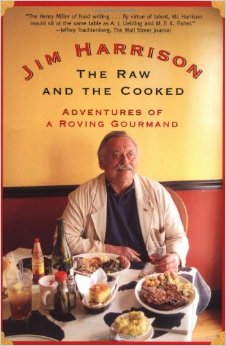
“Let’s all stop a moment in our busy day and return to some eternal verities. It’s quite a mystery, albeit largely unacknowledged, to be alive, and quite simply, in order to remain alive you must keep eating. My notion, scarcely original, is that if you eat badly you are very probably living badly. You tend to eat badly when you become inattentive to all but the immediate economic necessities, real or imagined, and food becomes an abstraction; you merely “fill-up” in the manner that you fill a car with gasoline, no matter that some fey grease slinger has put raspberry puree on your pen-raised venison. You are still a nitwit bent over a trough.”

One of my favorite quotes from:

Jim Harrison, The Raw and The Cooked: Adventures of a Roving Gourmand, New York: Grove Press Books, p. 29.

Cover Image from Amazon.com

Food Poem – What We Might Be, What We Are by X. J. Kennedy

If you were a scoop of vanilla
And I were the cone where you sat,
If you were a slowly pitched baseball
And I were the swing of a bat,

If you were a shiny new fishhook
And I were a bucket of worms,
If we were a pin and a pincushion,
We might be on intimate terms.

If you were a plate of spaghetti
And I were your piping-hot sauce,
We’d not even need to write letters
To put our affection across,

But you’re just a piece of red ribbon
In the beard of a Balinese goat
And I’m a New Jersey mosquito.
I guess we’ll stay slightly remote.

“What We Might Be, What We Are” by X.J. Kennedy from Exploding Gravity. © Little Brown, 1992.

From the Writer’s Almanac, June 28, 2015

http://writersalmanac.org/page/3/

Food Poem – Linguini by Diane Lockward

It was always linguini between us.
Linguini with white sauce, or
red sauce, sauce with basil snatched from
the garden, oregano rubbed between
our palms, a single bay leaf adrift amidst
plum tomatoes. Linguini with meatballs,
sausage, a side of brascioli. Like lovers
trying positions, we enjoyed it every way
we could-artichokes, mushrooms, little
neck clams, mussels, and calamari-linguini
twining and braiding us each to each.
Linguini knew of the kisses, the smooches,
the molti baci. It was never spaghetti
between us, not cappellini, nor farfalle,
vermicelli, pappardelle, fettucini, perciatelli,
or even tagliarini. Linguini we stabbed, pitched,
and twirled on forks, spun round and round
on silver spoons. Long, smooth, and always
al dente. In dark trattorias, we broke crusty panera,
toasted each other—La dolce vita!—and sipped
Amarone, wrapped ourselves in linguini,
briskly boiled, lightly oiled, salted, and lavished
with sauce. Bellissimo, paradisio, belle gente!
Linguini witnessed our slurping, pulling, and
sucking, our unraveling and raveling, chins
glistening, napkins tucked like bibs in collars,
linguini stuck to lips, hips, and bellies, cheeks
flecked with formaggio—parmesan, romano,
and shaved pecorino—strands of linguini flung
around our necks like two fine silk scarves.

“Linguini” by Diane Lockward from What Feeds Us. © Wind Publications, 2006. Reprinted with permission.

http://writersalmanac.org/page/2/

From the Writer’s Almanac June 22nd, 2015

Food Poem- Grandma Shorba’s Ragamuffin Stew by Freya Manfred

During World War II, Grandma Shorba
handed plates of bread and meat to strangers
who asked for work in exchange for food.
After chopping wood and mending fences,
the lean, stoop-shouldered men went on their way.
“May God watch over them,” Grandma said.

I was glad I didn’t have to follow them
down the long train tracks silvering west.
I didn’t want to sleep beside a strange campfire
around the bend, in the next world.
But I worried how they’d survive, and asked
my parents if they could live with us.

My begging only made everyone nervous.
Maybe Grandma’s stories of The Good Samaritan
and the Loaves and Fishes weren’t true?
If I’d been in charge, I’d have asked those men to stay—
but Gramma, who trusted God,
fed them, then sent them on their way.

“Grandma Shorba’s Ragamuffin Stew” by Freya Manfred from Speak, Mother. © Red Dragonfly Press, 2015.

From the Writer’s Almanac, June 10, 2015

http://writersalmanac.org/