The joys of Consuming (and capitalizing) Chance

9780762777501_custom-9edd7709f697db1925bf2326982638be2e94ee59-s2-c85

http://www.npr.org/books/titles/151450134/how-the-hot-dog-found-its-bun-accidental-discoveries-and-unexpected-inspirations

Here’s my book report of the week on “How the Hot Dog Found its Bun” by Josh Chetwynd. The book takes us on a historical food tour of  discovery that adds magic and meaning to mundane small meals like hotdogs, nachos, Caesar salad, Cobb salad, Mcdonald’s Filet o’ Fish and Tempura. Each is a lesson in cultural collisions (like Tempura, Chimichangas, nachos and Chicken Tika Masala), business (in the case of the Mcdonald’s fish filet sandwich) , morality (in the case of graham crackers, PEZ the anti-smoking mint), efficiency (like cookies and cream ice-cream or nutella) and such. All these short “origin” stories are worth the read alone.

For me, the theme of serendipity, chance and luck that tied the stories loosely together made for a larger philosophical claim: To  be open and willing to convert the disruption of falling sales on Friday or unexpectedly late restaurant patrons, into something new and delicious. To turn a mistake (Molten Lava Cake) into something cherished. To defy the discomfort of an accident and turn it into luck. Its a difficult lesson to hold on to at the moment when we’re searching for a way out of an embarrassing mistake or of being unprepared, as window into something delicious. We do this everyday when we substitute ingredients with what we have sitting in the fridge. Yesterday, I sprinkled feta cheese over my chicken enchiladas with salsa verde…..the tart sharpness of the feta was so yummy with the hot bite of green chilies, cilantro and tomatillos. In my mental recipe database, what was accidental just turned into intentional……and my very own discovery. Small victories and joys.

Here is something I learned about the history of serendipity from the book besides a wonderful collection of surprising food stories.

Behind these lucky discoveries are usually acts of serendipity, a concept first coined by Horace Walpole in 1754. He’d read a book about Serendip (modern-day Sri Lanka) called The Three Princes of Serendip and was fascinated by the title characters, who “were always making discoveries, by accident and sagacity, of things which they were not in quest of.” Using that quote as a definition, he started describing some of his work as serendipity.

What makes serendipity so fascinating is the combination of the lucky find and the smarts (or to use Walpole’s fancier term sagacity) to capitalize on the breakthrough. As Albert Einstein once said about discovery: ” The really valuable factor is intuition….There is only the way of intuition, which is helped by a feeling for the order lying behind the appearance.” The intuition to turn what looks like a blunder into something special comes up often throughout this book.”

Wishing all of you Good-Luck (as chance favors the prepared..according to Luis Pasteur) and happy reading,

The Hungry Philosopher

Happy 86th Birthday Sliced Bread! (and, Poem on the Fridge) on Writer’s Almanac

article-2358285-0C904E7B00000578-136_634x354

http://www.dailymail.co.uk/femail/article-2358285/The-greatest-thing—A-look-history-sliced-bread-jeweler-inventor-celebrates-85th-anniversary.html

http://writersalmanac.publicradio.org/

Poem on the Fridge

by Paul Hostovsky

The refrigerator is the highest honor
a poem can aspire to. The ultimate
publication. As close to food as words
can come. And this refrigerator poem
is honored to be here beneath its own
refrigerator magnet, which feels like a medal
pinned to its lapel. Stop here a moment
and listen to the poem humming to itself,
like a refrigerator itself, the song in its head
full of crisp, perishable notes that wither in air,
the words to the song lined up here like
a dispensary full of indispensable details:
a jar of corrugated green pickles, an array
of headless shrimp, fiery maraschino cherries,
a fruit salad, veggie platter, assortments of
cheeses and chilled French wines, a pink
bottle of amoxicillin: the poem is infectious.
It’s having a party. The music, the revelry,
is seeping through this white door.

“Poem on the Fridge” by Paul Hostovsky from Selected Poems. © Futurecycle Press, 2014. Reprinted with permission. (buy now)

Small Chairs and the Olive Garden Diet of Discomfort

attachment

Sometime during the late 1980s — no one can pinpoint the exact date — Ron Magruder, the president of the thriving Olive Garden chain of Italian restaurants, received a telephone call from a dissatisfied customer. The call had been patched all the way up to Magruder because it was so……different. The caller, named, Larry, wasn’t complaining about the food or the service or the prices. Instead Larry was upset that he could no longer fit into any of the chairs in his local Olive Garden.

“I had to wait more than an hour and half to get a table,” Larry told Magruder. “But then I found that there wasn’t a single booth or chair where I could sit comfortably.”

Magruder, a heavyset man easily moved to enthusiasm, was sympathetic to Larry’s plaint. And, as president, he could do something about it. He had his staff contact the company that manufactured the chairs for the chain and order a thousand large sized chairs. He then had these distributed, three each, to every Olive Garden restaurant in the nation. It was, as Magruder later told the eminent restaurant business journalist Charles Bernstein, a perfect example of his management philosophy: “We’re going to go the extra mile for any customer, no matter what the situation.”

………the chapter “World Without Boundaries” ends with the conclusion of this story.

About after two months after he first heard from Larry, the customer who had complained about how small all the chairs were in his local Olive Garden restaurant, Ron Magruder, the chain’s president, received another call. It was Larry again. He was calling in response to a follow up query from one of Magruder’s staff. The staff had been busily making sure that all of the chain’s restaurants now had at least three chairs that could accommodate the more amply endowed and had wanted Larry to report what he thought of their efforts.

Well, he was happier now. Indeed, Larry’s message was entirely conciliatory — even thankful. But it wasn’t because of the bigger chairs. It was because of the old small chairs. Largely because of them, Larry explained, he had been spurred to finally confront the extent of his weight problem. Why, in the seven weeks since he had spoken to Magruder, he had lost almost fifty pounds.

The tight little chair — that had been what Larry needed after all.

What a “Gift of the Magi” kind of story!

From a design perspective, the role of small and big chairs in supporting American eating habits are worth noting and from a personal perspective, the story made me change out of my “fat jeans” and into my uncomfortable jeans as incentive to loose those pounds gained over winter. I wonder if this new diet of uncomfortable snug clothing (or chairs) will work? It did for Larry.

The story comes from Fat Land (2003) by Greg Critser.


“Here too the gods dwell”……….

Heraclitus was warming himself by a stove when a group of visitors arrived hoping to meet the great philosopher and was surprised to see him in such mundane circumstances. Responding to their obvious disappointment, Heraclitus famously announces, “here too the gods dwell.” His simple statement locates meaning…..”here”…….by the stove, by the fire, where we feed and warm our bodies. Heraclitus, reminds his visitors and us that the philosophical self-examined life is not lead apart from everyday needs. In doing so, he shatters the ideality and the celebrity of the tranquil philosopher.  Heraclitus’ statement has been closely examined by many scholars, most notably by Martin Heidegger.

I simply invoke this statement as an ancient recognition that the “mundane” is the un-thought, unexamined, unattended, unfelt and that everything, everyone, everyplace harbors the meaningful. A philosophical life is not one of removed, meditative, tranquility apart from human struggle. On the contrary, a philosophical life begins with the simple gesture of warming oneself and attending to the warmth, the fire, the pleasure, the heat, the glow, the light that makes us see, ourselves among and against things in the world.

We can find moments of self-examination and awareness even when we buy a blender or when we boil a pot of pasta. It is ordinary and mundane when I buy the cheapest or most expensive blender with no thought to how it affects my life, it is philosophical when I consider where the blender will live in my home when not in use, why I need it, how often will I use it. Boiling a pot of pasta is ordinary if it becomes an mechanical exercise of producing an efficient dinner. It becomes a human moment when I consider the heat, the water, the pot, the family, the pasta itself, dinner time, the host of variables that converge when I make dinner. This attention doesn’t mean, I’m pausing to ponder….it just means that when I’m boiling pasta, I’m boiling pasta…..I’m attentive and in the moment. Food can be easily be relegated to mundane meaninglessness. That’s why, to me, Heraclitus’ statement that “here too (by the stove) gods dwell” seems so poignant.

Counting calories, intellectualizing, carefully designing menus to meet allergies, nutrition, brand etc, is not the attention I’m talking about. Anthony Bourdain describes the moment of awareness and successful eating in Medium Raw (2011), as follows,

If cooking professionally is about control, eating successfully should be about submission, about easily and without thinking giving yourself over to whatever dream they’d like you to share. In the best-case scenario, you shouldn’t be intellectualizing what you’re eating while you’re eating it. You shouldn’t be noticing things at all. You should be pleasingly oblivious to the movements of the servers in the dining area and bus stations, only dimly aware of the passage of time. Taking pictures of your food as it arrives — or, worse, jotting down brief descriptions for your blog entry later — is missing the point entirely. You shouldn’t be forced to think at all. Only feel.

I am guilty of taking pictures and blogging…..but I also remember many moments, the best moments when I completely forgot to do so and just enjoyed what was placed before me. Philosophical self-awareness includes the Bourdain receptive sense of giving yourself over to your needs and wants as it meets what is given. It may seem like a contradiction, how can one be both self-aware and self-negating? But that edge between thinking and feeling, control and reception is the philosophical moment of living of life of meaning, whether buying a blender or boiling a pot of pasta. Think and feel. Heraclitus, wasn’t just thinking. He was feeling the heat.


Eating Glocal


photo 1 3.44.05 AM

photo 2 3.44.01 AM

My lunch in Dhaka, Bangladesh today. It was surprisingly good. Fried chicken meets South Asia…chopped, stir  fried with onions, green chilies, cilantro and served with rice. Did it taste like something from KFC? Not really. But, the packaging insisted otherwise. By the end of the meal I was almost convinced that it was an “authentic” KFC experience. Share your experiences of eating “glocal.” What did you have? Was it good?

The Self-Examined Appetite

“To put it concretely, I am suggesting that critical self-awareness about food relates in fundamental ways to central issues of personal meaning in the life course of any person. From childhood onward, our ability to control what we eat, or whether we eat at all, is the single, most basic aspect of life in which we have full power to assert autonomy. When a young child refuses food, or spits out something disliked, he or she is taking a first important step toward self-determination. Viewed in this philosophical light, every child’s highchair can be seen as the site of a small-scale struggle for existential freedom.”

This is one of my favorite quotes from How We Eat by Leon Rappoport (ECW Press, 2003).

The quote also reminds me of an earlier blog post (forgive the self-reference) about Yummy Wet Noodles.

Rappoport argues that food habits as a form of self examination negotiate competing ideologies of hedonism, spiritualism and nutritionism. Each food choice contains our philosophical comportment towards pleasure, morality and health. This choice changes in response to our existential struggles. For example,  when we are young we look more to the pleasure of eating, as we age we become more attuned the needs of our dying body and in between, we struggle with social conformity. The child in a highchair throwing or sharing food is taking the first steps towards autonomy, in how he/she responds to what is given. How we eat, as the title of the book suggests, determines how we individually and autonomously receive the world and its offerings. In examining our food habits we examine our style of being in the world.

There were so many highlights in the book that I want to briefly mention. Related to childhood autonomy there is a section that follows the in utero development of taste, as well as breast milk as the medium of early tastes. There is also a discussion about gendering of food and the determination that chicken and oranges are bi-sexual. Marketing is a strange reductive activity. The discussion of war rations as possibly predictive of future trends, as well as historical references to Betty Crocker and others, made the book both entertaining and fascinating.

In the spirit of self-examination (and confession) I had a breaded chicken sandwich for lunch today. It was definitely a weak decision fueled by pleasure over spirituality or nutrition. I was looking for something, quick and easy in my freezer. It was easy to eat on the porch on a beautiful Indiana summer day while I read my book on how to eat. It made me think of my kids and nephews, who could live on chicken nuggets. I remember the moments when I popped a few in my mouth as I handed them their plate. Its a familiar taste. Certainly not a gourmet meal. Being self-reflective about what we eat doesn’t require a constant stream of deeply critiqued and crafted meals, it just requires receptivity, to yourself and your connection to others. Maybe, the chicken sandwich wasn’t a weak decision after all.


A Food tourist takes a walk on the Socratic Side

IMG_1047

The Wok Shop in San Francisco


I’ve been on three food tours so far. First, Georgetown, D.C, second, San Francisco China Town and last week Chicago. I’ve learned a lot, tasted a lot, and enjoyed a lot. Food tourism might just be my new sport. There are a few practical advantages of a food tour besides the obvious excitement of eating cultural history.

First, a tour allows me to sample small dishes in various places without feeling guilty or sorry for the waiter.

Second, it allows me to follow someone around and focus on eating not locating.

Third, it allows me to meet interesting people happy to talk about their food experiences.

All good reasons to go on a food tour.

If you have dietary limitations, allergies or just don’t like trying new things, I would still encourage you to go. Here’s why: while food navigates the tour, the walk and associated stories themselves are well worth it. These discoveries are just as enjoyable as finding a new delicious taste. Like listening to owner of Wok Shop in San Francisco passionately defend the superiority of traditional Woks or looking at the Tiffany Domes in the Chicago Cultural Center while Jazz music floats in the air. These are moments when design and food, the aesthetic and the gastronomic touch in fantastically beautiful and delicious ways. Its better than walking through museums because we use all of our senses as the privilege of the objective eye diminishes. Food tours offer a taste of what might be a 21st century philosophical walk of consumption and shared meaning. The conversations during a food tour center around personal and shared nostalgia, vacation plans, personal taste preferences, favorite sports teams and so much more. The information shared is both public and intimate.

On a domestic level, The Philosopher’s Table by Marietta McCarty aims to help us engage in philosophical dinner conversation. Each dinner involves diners around a table with a question to consider and corresponding food. http://www.thephilosopherstable.com/

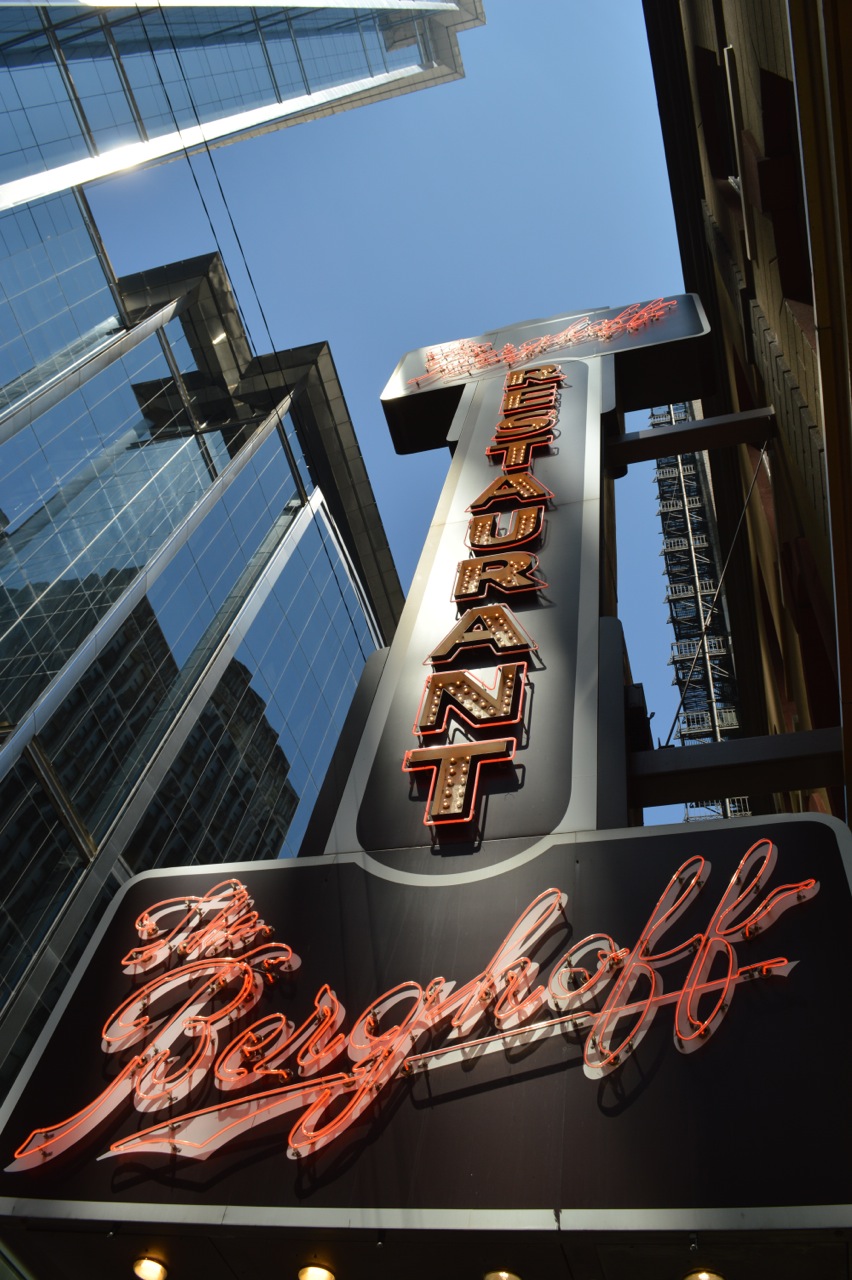
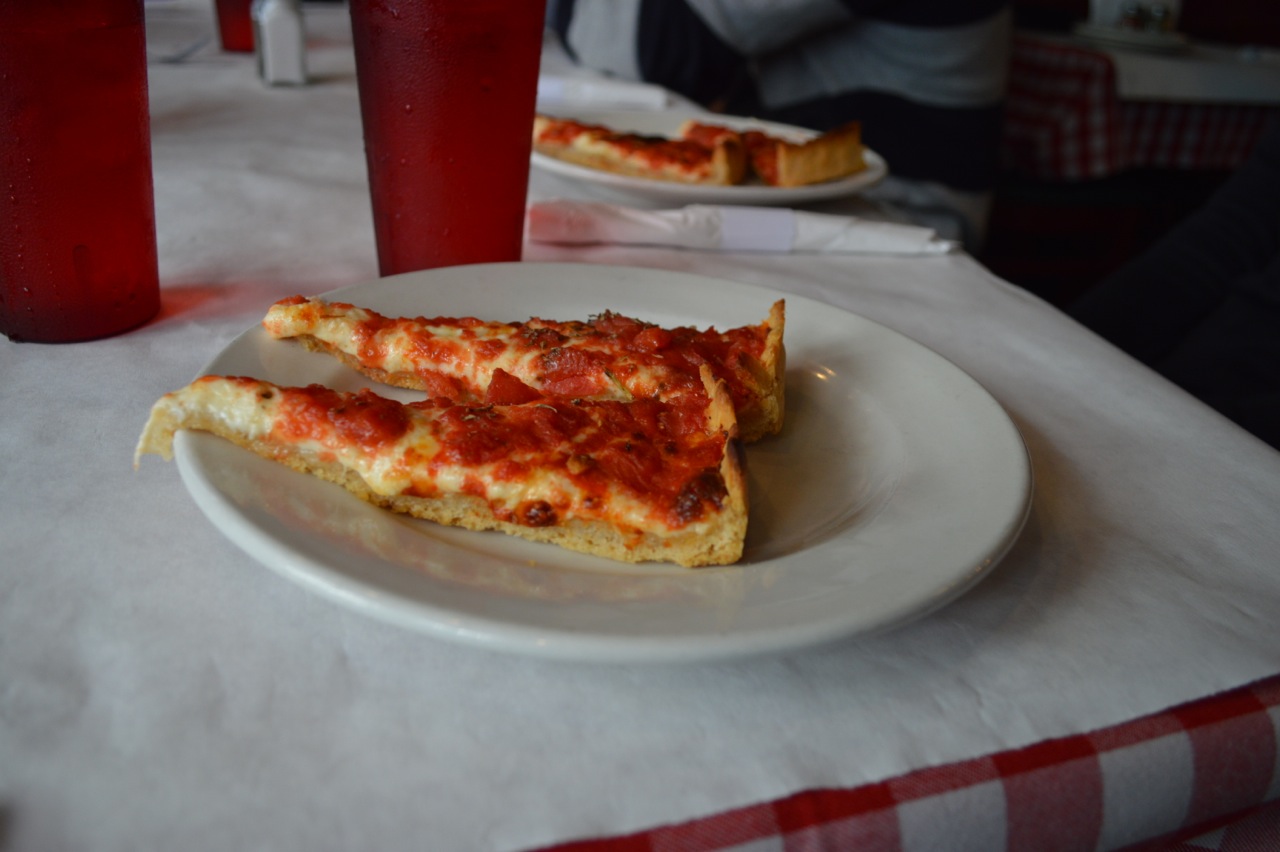
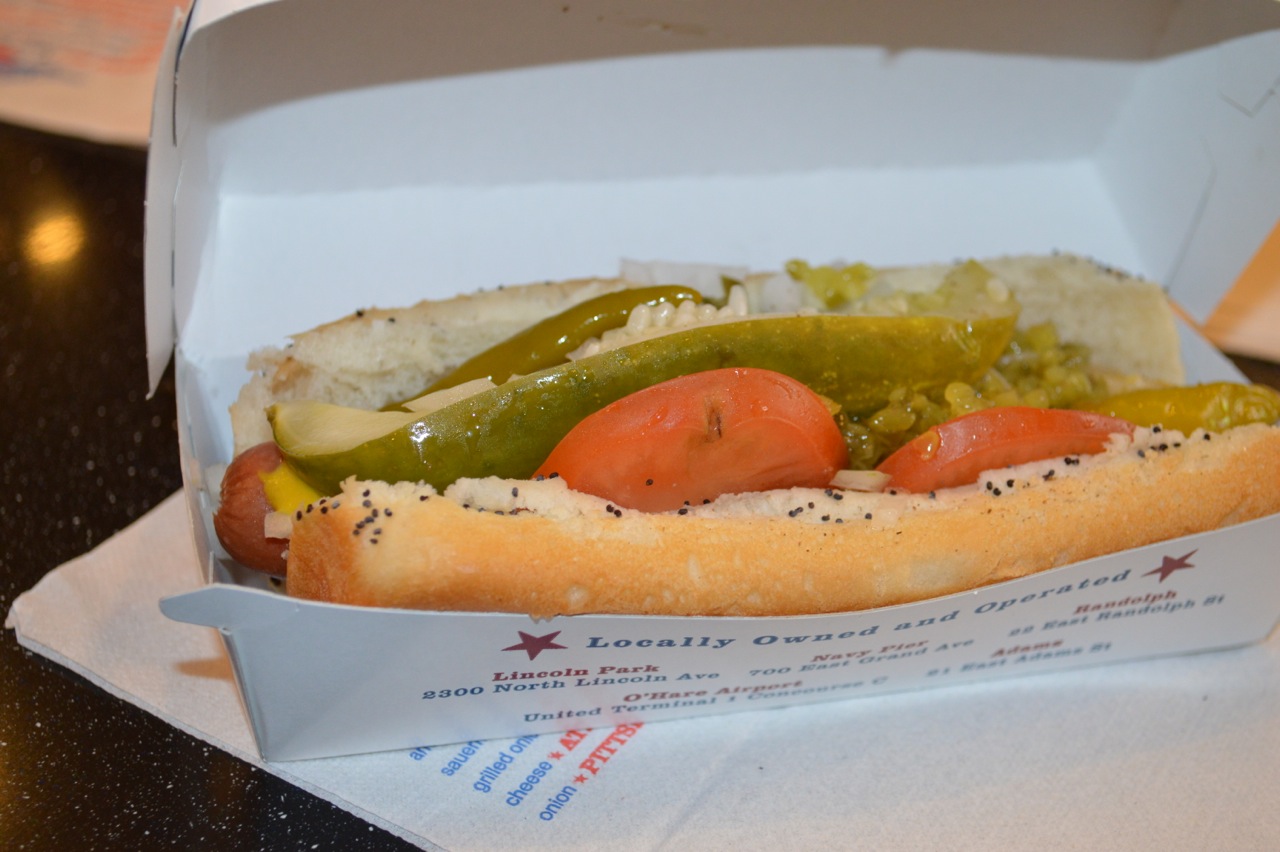
Here are a few images from my tours as provocation………to go on a tour and take a walk on the Socratic side.

DSC_0093  DSC_0097  DSC_0118  DSC_0120

Taste of Chicago: Tastebud Tours http://tastebudtours.com/tours/chicago-tours/


← Back

Thank you for your response. ✨


Bertha’s Brownies at the Palmer House

DSC_0055

Behind this 19th century ornate peacock gate is an equally glamorous design and food history. A wedding present for Bertha Honore from Potter Palmer, the Palmer House Hotel is a piece of Chicago history. The ceiling includes murals of Venus, the goddess of love, framed by Neoclassical Empire style of glam and glitz. It burned down in the great Chicago fire of 1871, only to be rebuilt bigger and better afterwards.

DSC_0048Sure, the Empire style Hall by Bertha Palmer is an architectural treasure and a Chicago historical landmark. Referenced in Devil in the White City, the Palmer House is an exemplar of the gilded age before the crash, the depression, before the World Wars and the ravages of the 20th century. The historical legacy of the Palmer House is unquestionable and excite architectural and cultural historians. However, unbeknownst to most of us, we have an even deeper connection to the Palmer House. A gastronomic connection. I hope you can sense my tone of reverence as I say…..the Palmer House is the birthplace of the ….wait for it…..

The Brownie.

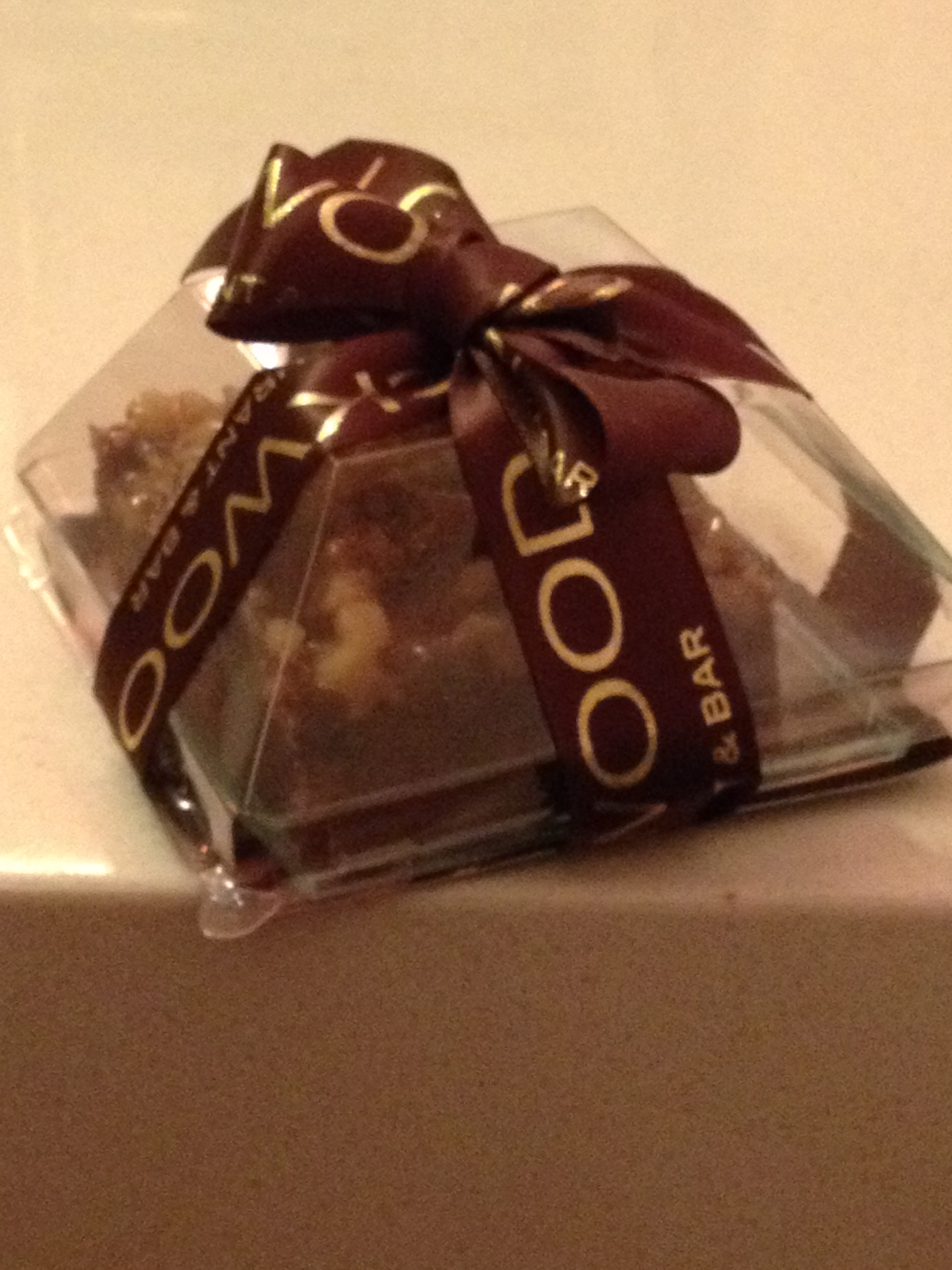
Yes. Let this knowledge sink into your consciousness and memories of chocolatey, dense, moist deliciousness. It is probably the most coveted dessert in our home, rivaling its cousin warm chocolate chip cookies. The brownie is America’s Proustian Madeline that conjures memories of childhood pleasure and freedom. A “to-go” version of this confection at the Palmer House comes boxed and wrapped with a ribbon. The packaging also includes a brief history and the original recipe. The taste can be described as dense yet delicate, with a texture between fudge and cake that melts in your mouth. The walnuts that compose the top layer have a light glaze. The recipe says its an apricot glaze but a fruity taste is hardly noticeable. It is a familiar (as in brownie mix brownies) but elegant experience between candy and cake. The “to-go” version is perhaps the best way to eat this little morsel since it was designed to be a part of a boxed and portable, working lunch for ladies discussing the 1893 Chicago World’s Fair. The Brownie represents a designed American cultural experience.  We say as American as Apple Pie but I think the saying should be as American as Brownies. This Fourth of July, I’ll have to bake brownies. Let’s start a new trend and vote for the Brownie as America’s dessert. “Bite into a piece of history”………indeed!

photo

photo 1photo 2


Reading stolen pages in the Kitchen

I read in and around my kitchen habitually. And, took the privilege for granted. Until, I came across an essay in The Bangladesh Reader (Duke, 2013) about Rashundari Debi, a housewife who taught herself to read and even more miraculously who published “My Life,” the first Bengali autobiography written by a woman in 1897. This is an excerpt about her hiding pages taken from her son’s book:

When the book had been taken inside, I secretly took out a page and hid it carefully. It was a job hiding the it, nobody must find it in my hands. That would lead to severe rebukes and I would never be able to put up with that. It was not at all easy to do something that is forbidden and then to face the consequences. Times were very different then, and I was an exceptionally nervous person. Such days! Where could I hide it that nobody would come across it? Eventually, I decided that it must be a place where I would always be present but which nobody else visited much. What else could it be but the kitchen? I hid it under the hearth.


Food, Color and Happiness

A-Moving-Riot-of-Color

Truck Image from: http://www.saglobalaffairs.com/features/1445-a-moving-riot-of-color.html

A blogger from Tasmania, Australia, Harry wrote an entry entitled The Happiest City in the World that referred to Rajshahi, Bangladesh, voted the happiest city on earth by the World Happiness Survey in 2006. What accounts for the happiness in such a difficult social, political and economic context? He asked. His blog entry was again published in The Bangladesh Reader (Duke, 2013) for its vivid description of his dinner and travel experience in Bangladesh. For me, hungryphil, the association of dinner and colorful trucks with general happiness supports my suspicion regarding the inherent sociality and creativity of consumption, both food and design. Here is an excerpt from Harry’s blog:  http://www.agentleplace.com/the-happiest-city-in-the-world-2/:

Dinner last night, had at Aristocrat roadhouse halfway between Rajshahi and Dhaka, was a perfect illustration of this. After my favourite Bangladeshi meal, dhal makhani, was served I watched as each of my Bangladeshi colleagues served each other before serving themselves and, having noticed the plate of the person next to them emptying, stopped eating mid-mouthful to add yet more naan to their culinary neighbour’s plate. Such displays of caring and gentleness cycled around the table throughout the meal, naturally amongst the customary pleas of ‘No, no, that’s too much.’ But it would be rude to deny the friendship and, after approaching proficiency in eating with my hands (right hand puckered into the shape of a badminton shuttlecock as it gathers up the food and elephant trunks it into your mouth; left hand avoiding direct food contact but used to spoon yet more dhal onto your plate and the plates of those around you) we rolled down the ornate Aristocrat stairs and into the waiting minibus. It was time to see more of Bangladeshi’s colour, and the road was as good a place as any to observe it.

Bangladeshi trucks must be of the most colorful in the world. With a framing coat of canary yellow, each panel is painted with utopian scenes of snow-capped mountains, meandering rivers, enchanted forests and fairytale palaces; verdant greens, royal blues, crimson reds and burnt oranges. No pastel shades for vibrant Bangladesh. Even the central hub of the rear differential is painted, usually mimicking that of half a large soccer ball. Whereas the trucks are simply glaringly colourful, the passenger rickshaws are both colorful and ornate. Gold, silver and bronze are added, as is the standard shocking pink. The flat-tray rickshaws don’t escape colour either: the slatted sides are painted in alternating blocks of yellow, red, blue, green and orange. Even the twin-light Victorian-style Rajshahi lampposts get the colour treatment with one bulb shining pink, the adjacent one green.

I wonder how I might conduct a study that attempts to find correlations between food sharing, use of color and happiness. In a land of poverty, sharing transforms into a self-negating and revolutionary act. The performance of serving and attending to fellow diners is both an obligation and right of the host. One always offers to fill up another’s plate. If only this sentiment translated into all our actions. Similarly, the brightly decorated trucks attempt to ameliorate the confusion of Bangladeshi roads and aggressive driving. As if the well dressed deserves the right of way. Hmmm. Color masks and highlights the threat of the Bangladeshi roads, just as dinner gestures of sharing masks and highlights scarcity. Is this another expression of what Dan Gilbert names synthetic happiness? The willful construction of joy. Synthetic happiness, Glibert argues is as potent as the natural happiness we experience when we get what we want. http://www.ted.com/talks/dan_gilbert_asks_why_are_we_happy

Could it be that food and design are both activities of synthetic happiness through which we fabricate shared joy despite our human condition? Is that the lesson of the World Happiness Survey?