Hungryphil eats the FEAST

Last month I wrote an article for Edible Indy Magazine inviting everyone to experience the Feast of the Hunter’s Moon at Fort Ouiatenon. Of course for your benefit my dear readers (with no self interest at all) I had to try the fry bread and other other delicacies for myself. It was a difficult task on a foggy, cool, Sunday morning but I prevailed and ate through the Feast (as I said only as research). Here is what I ate, learned and saw:

Forfar Bridies

The pastry crust was buttery soft and flaky. The meat filling (I don’t know what it was and don’t want to know) was moist and flavorful with an almost  soft meatball mouth feel. Surprisingly filling and delicious.

Beautiful Furry, Shiny and Colorful Things

Noodables

A vegetable pasta sort of dish. Not my favorite but a very tasty vegetarian option. [ Very few things can compete with fried dough]

Desperation Pie

A cream, egg and flour pie made during the winter when all else is well……dead. Hence, called desperation pie. The best part of this story is that desperation pie is Indiana’s state pie. I’ll leave you to draw your own conclusions.

Popular Turkey Legs offered by the Audubon Society

No comment needed.

Dances, Processions and Learning

Feast organizer Leslie Martin Conwell (seen below in the red dress) did a wonderful job explaining, welcoming and opening the festivities on Sunday morning, while looking stunningly regal.

img_3047

People Making Stuff

Fascinating, tedious and difficult stuff like lace, roast chicken and woven gourds

Delicious Varieties of Fried Dough

As I said before what could be better on a cool, foggy morning, strolling through the complex past while eating fried dough with a cup of spiced cider?

Amazing to think how contested, (as evident by all the flags flying) a small patch of land can be. At the Feast of the Hunter’s Moon we got a chance to enjoy the sweet on the banks of the bitter.  We human beings are so odd in our sharing and killing of each other. Capable of such creativity, deliciousness and brutality. The Feast reminds us that amidst the grand histories of war there was a parallel labored history of beautiful and tasty things that defied death and conflict. If you haven’t already experienced this historical moment in Tippecanoe county, go ahead and mark your calendars for the 50th anniversary of the Feast, October 2017.

I wish cultural exchanges were only and all about sweet fried bread.

Extending to all of you imaginary virtual bread,

hungryphil

Wobblyogi Wednesday: Reading Autobiography of a Yogi

Last week I watched the documentary and read, the Autobiography of a Yogi by Paramahansa  Yoganada (1945). A book so life changing that it was handed out to each guest at Steve Jobs’ funeral. Widely read across the world and translated, it had a deep impact on Hollywood celebrities and everyday people alike. Among yoga reading lists, it tops the list.

This was the first yoga book I that disappointed me.

I wanted to like it. How often do we get a first person account of yoga mastery? The authenticity and sincerity of his voice are undeniable. And, yet, the too numerous to count accounts of yogis who can’t be photographed, who don’t sleep, who don’t eat, who have premonitions, who heal, who appear elsewhere, who can foretell the future, who tame lions and in general exhibit superhuman powers seem unhelpful to me, a suburban dance mom just trying to survive dinner and correct carpooling. I particularly disliked his use of yogic powers to help his sister gain weight so she might be attractive to her husband.

Maybe I don’t have the faith needed to believe in such extraordinary feats, maybe I just don’t see the value of these yogic powers for me and my family. Maybe I’m too much of an American yogi, corrupted by everyday banality, science, and technology. I just want to sit and breathe without feeling rushed or pulled apart. Perhaps, I aim too low.

I did enjoy learning about Yogananda’s struggles to establish his yoga centers, his travels and search to learn and share. I wish he wrote more about navigating his disappointments about schooling, organizational and management issues, money issues, travel constraints and living in America.

As you can imagine my favorite quote involves Yogananda describing the daily routine of his self-supporting guru, Sri Yukteswar,

Daily life at the ashram flowed smoothly, infrequently varied. My guru awoke before dawn. Lying down, or sometimes sitting on his bed, he entered a state of samadhi. It was simplicity itself to discover when Master had awakened: abrupt halt of stupendous snores. A sigh or two; perhaps a bodily movement. Then a soundless state of breathlessness: he was in deep yogic joy.

Breakfast did not follow; first came a long walk by the Ganges……..A bath, then the midday meal. Its preparation, according to Master’s daily directions, had been the careful task of young disciples. My guru was vegetarian. Before embracing monkhood, however, he had eaten eggs and fish. His advice to students was to follow any simple diet which proved suited to one’s constitution.

Master ate little; often rice, colored with turmeric or juice of beets or spinach and lightly sprinkled with buffalo ghee or melted butter. Another day he might have lentil-dal or channa curry with vegetables. For dessert, mangoes or oranges with rice pudding, or jackfruit juice.

Visitors appeared in the afternoon.

Even yogis with super powers had to eat (except for the lady yogi who went without eating).

Like yoga itself, we all have to find books that speak to us and resonate with our own experiences. I often find that I learn about myself from books I struggle with the most.  This was the case for Autobiography of a Yogi. Read it for yourself to decide if it works for you. There are no reviewed shortcuts to mindful awareness.

Wishing you happy reading,

The wobblyogi


Food Poem – Ice Cream Stop by Shel Silverstein

The circus train made an ice cream stop
At the fifty-two-flavor ice cream stand.
The animals all got off the train
And walked right up to the ice cream man.
“I’ll take Vanilla,” yelled the gorilla.
“I’ll take Chocolate,” shouted the ocelot.
“I’ll take the Strawberry,” chirped the canary.
“Rocky Road,” croaked the toad.
“Lemon and Lime,” growled the lion.
Said the ice cream man, “‘Til I see a dime.
You’ll get no ice cream of mine.”
Then the animals snarled and screeched and growled
And whinnied and whimpered and hooted and howled
And gobbled up the whole ice cream stand,
All fifty-two flavors
(Fifty-three with Ice Cream Man).

“Ice Cream Stop” by Shel Silverstein from Falling Up. © Harper Collins Publishers, 1996.

From the Writers Almanac:  http://writersalmanac.org/

Image from: http://www.pbs.org/food/the-history-kitchen/explore-the-delicious-history-of-ice-cream/

Food Poem – My Mother Was a Brilliant Cook by Maria Mazzioti Gillan

You know I had to post this! It connects the craft of cooking with contentment. May we all find a craft that helps us be so at home.

The first time my mother went out
to eat was on her 25th wedding anniversary
at Scordato’s in Paterson, and the second time
was for her 50th anniversary
at the Iron Kettle House in Wyckoff.

My mother said, “I could have cooked
this meal better myself.”
But I knew she was happy,
though she would have never admitted it.

Once my mother came to Paterson
from Italy in steerage,
she was content to stay there.
She was a brilliant cook,
and didn’t need to go to restaurants.
She loved her house, poor as it was,
and never stayed in a motel or took a vacation
or wanted to.

She was content to offer platter after platter
of food to her family gathered
in her basement kitchen, and to watch them
laughing and talking together,
while she stood behind them
and smiled.

“My Mother Was a Brilliant Cook” by Maria Mazziotti Gillian from What Blooms in Winter. © NYQ Books, 2016.

From the Writer’s Almanac

Wobblyogi Wednesday – No Front Door to Yoga

This week I’ve been reading Yoga as Medicine: The Yogic Prescription for Health and Healing by Timothy McCall.

It makes a very useful reference book because each chapter about a given condition, briefly explains the condition,  offers a particular yoga practitioner’s approach to the condition, scientific evidence, strategies that practitioner uses and finally other approaches.

For example, chapter 8 about anxiety and panic attacks talks about, Rolf Sovik’s ( a yogi with a doctorate in clinical psychology researching breathing and anxiety treatment) approach in treating a patient at the Himalayan institute whose panic attacks resembled a heart attack.

The chapter offers an overview and range of panic attacks and then shows how yoga fits in, first in general, followed by scientific evidence and cases, then in terms of 12 particular poses like meditation, sandbag breathing, crocodile breathing and tree pose. The chapter ends with bullet points about other holistic approaches to asthma and panic attacks like psychotherapy, increasing omega-3 fatty acids in the diet, using aromatherapy, like lavender and German chamomile, regular aerobic exercise etc.

The combination of big picture explanation, case studies of treatment, scientific studies and specific strategies makes the book worthwhile. In terms of anxiety treatment and maybe yoga in general, I found it interesting that everyone needs to find their own “door” into treatment, through the mind or body,

“It’s worth noting that another study by Jon Kabat-Zinn found that patients whose anxiety manifested mainly in mental symptoms like constant worrying tended to find hatha yoga preferable to mindfulness meditation, whereas those whose symptoms of anxiety tended to manifest mainly in the body preferred the less body-oriented meditation. As Jon says, “people need different doors to come into the room, so to speak, of self-awareness and self knowing. Some people just can’t go through the mind door. They get the body door instantly.”

There is no front door to yoga. We all have to find our own entry. The house of yoga is a like a semi-open structure with a wrap around veranda and french doors all around, layers of openings that work differently for every practice.

May we each find our door today.

Thanking you for reading this,

the wobblyogi


First World Food Warning: Taco trucks at every corner

Usually, I post benign, seemingly non-political musings about food as social glue. I know this is old news but I’m fascinated by a perceived immigrant threat represented through food. In this case, the threat that increased latin immigration in the U.S will result in food trucks at every street corner turned into a joke, as most enjoy tacos regardless of political views on immigration.

The threat that increased latin immigration in the U.S will result in food trucks at every street corner was projected as, cultural and culinary. That’s funny in a deeply meaningful kind of way, right?

Think of it, french fries, hot dogs, pretzels, spaghetti, pizza, all are cultural “impositions” in the U.S. I’m not even going to address European imposition on Native American culture. I don’t know how because the imposition was so overwhelming and complete.

The problem with this argument is that in most cases no one is “forcing” another to eat a certain type of food. I may want to impose samosas on an unsuspecting American culture. But how would I? Sell samosas everywhere, perhaps every street corner? But here is my problem. Selling. People would have to buy and want samosas at every street corner for it to work. [Unless people are starving and samosas are the only option. This is why the scarcity of water is so scary. There is no choice, we need water to survive.]

Historically the imposition works the other way to “Americanize” immigrant foods. For example historian, Jane Ziegelman writes of Italian immigrants in 97 Orchard: An edible history of five immigrant families in one New York Tenement,

In the hostile environment first encountered by Italians, food took on new meanings and new powers. The many forms of discrimination leveled at Italians encouraged immigrants  to seal themselves off, culturally speaking, from the rest of America.[…….] Harsh critics of Italian eating habits, Americans tried through various means to reform the immigrant cook. The Italians were unmoved. Despite the cooking classes and public school lectures, and despite the persistent advice of visiting nurses and settlement workers, the immigrants’ belief in the superiority of their native foods was unwavering.

Don’t we all think that our food tradition is better? Regardless, compulsion in cuisine, whether by immigrants or natives, seems difficult. There has been historically failed efforts to force new foods or limit certain food types (like the Futurist effort to ban pasta in Italy or the parent struggle to make kids eat vegetables) Still, in democratic, capitalist America, the taco truck warning does seem laughable and serious at the same time.

The fact that Marco Gutierrez, founder of the group Latinos for Trump, a Latino! issues the threat is extra confusing.

“My culture is a very dominant culture, and it’s imposing and it’s causing problems. If you don’t do something about it, you’re going to have taco trucks on every corner.”

Should I be worried about imposing my Bengaliness on my unsuspecting American, ethnically European friends and family? I, the hungryphilosoper, am so confused. This first world food problem certainly requires more consideration.

For now, here was one response to the “food fight”: Guac the vote.

https://munchies.vice.com/en/articles/latinos-are-co-opting-the-taco-trucks-on-every-corner-threat-to-guac-the-vote

Thank you, dear Latin people for your contribution to my personal taste buds…I and my South Asian peeps very much appreciate the chili peppers.

Off to find a taco and wish there was a truck on the corner,

Hungryphil


Inorganic Recipes from Artist Charles A. Gick

IMG_3706.JPG

Don’t miss this extraordinary exhibition about ordinary things, like dirt and spoons. Here is why…

This local studio to gallery recipe grows out of a Catholic farming family in Indiana. Artist and inorganic chef, Charles Gick, has been perfecting the cracked earth recipe since his childhood on the farm, drawing with a stick on summer mud. The exhibition is a culmination of his first tastes of meditative marking, multi-medium expression and elemental reverie. His work is as primal as the first cave etchings and as contemplative as the black paintings in Rothko Chapel. Cracked earth, both atmospheric and sculptural, becomes the ground for offerings and incomplete messages that either hover above or sit unanchored. On the slabs of cracked mud we taste the farm in the collective labor that stretches between the trucks of earth, the mixing of wet mud, the drying until cracked. Through this strange and shared effort of working the earth Gick cultivates a meditative space. The broken earth’s hunger for the clouds reminds us of a simple farming truth: blooming requires others. Gick distills the bittersweet taste of this farming truth by framing raw, earthworm etched, air-dried, messy dirt with intentional clean clarity, like all sophisticated farm-to-table dishes that celebrate the ingredients. His skill as an inorganic chef finds full expression in his ability to balance the raw and the refined. Not only is he able to balance sorrow and delight, longing and union, vulgar and elegant, he is also able to offer these tastes in multiple mediums and forms. His work includes performance, painting, sculpture, photography, design and video, so people with diverse aesthetic palates can find something to savor. The slabs of cracked earth become meditative totems, prayers for clouds. It materializes, an ethereal longing for the other. Enjoy these recipes for cracked earth, empty… and full… and taste your own muddy and cloudy longings.

Ingredients

Makes 2 (16’X16’ Slabs)

  • Local dirt 10 tons
  • Water 850 gallons

Equipment

  • 1 Truck with a hydraulic lift bed to transport, deliver, and dump dirt
  • 3-5 Human beings to mix and transport the mud
  • 1 spade and 1 shovel to scoop dirt from dirt pile and place into buckets
  • 1 – 3’x3’ wire sifter to shift out dirt clods
  • Wheelbarrow to transport dirt to fill the buckets
  • 3 electric drills with dry wall mixing blades to mix the dirt and water
  • 25 – 5 gallon buckets to mix and hold the mud
  • A large cart on casters to transport the buckets of mud
  • 1 floor scraper to clean the floor of splattered mud
  • 2 commercial floor drying fans (additional small fans can be used as needed) to help expedite the drying and cracking process
  • 16 sheets of 4’ x 8’ – 5/8” plywood
  • 24 – 8’, 2”x6” pine
  • 8 – 16’, 2”x6” pine
  • 150 linear feet of pine screen bead board
  • 1 miter saw
  • 1 cross saw
  • 1 coping saw
  • 1 miter box
  • 150 – 7/8” metal brads to secure the screen bead board to edges of platform
  • 40 – 3” wood screws to secure the outside corners and end pieces of platform
  • 400 – 1-1/4” or longer wood screws to secure plywood to platform
  • 4 tubes of silicone calking and 1 calk gun to seal seams of plywood
  • 2 – 3 gallons of paint to paint the surface of the platform
  • Paint roller and paint tray
  • Wet/dry vacuum and a mop and bucket and broom to clean dust and water off of the gallery floor
  • 1 – 10’ x 100’ 6mil black poly sheeting to protect the gallery floor from moisture from pouring mud onto platforms
  • 4 – 16’, 1”x6” pine boards for the outer walls of mud mold
  • 2 – 8’, x 1”x6” pine boards to build a dam while pouring mud

Directions

  1. Build platform: First lay down a 20’X20” square of heavy plastic to protect gallery floor from the mud and water. It is imperative to be a considerate guest artist. Build platform, a 14’X14’ base with evenly spaced joists that can bear the weight of mud. Screw the 16’X16’ plywood top to cantilever over the base. Be sure to make the seams minimal. Each seam is an invitation for a water leak. Apply chalking over each seam in a futile nature-defying attempt at waterproofing.

Next add the 1” X 6” wood strip around the platform perimeter creating a frame to hug and constrict the mud. Apply black Gorilla Tape at the seam to prevent the escape of water to the floor. Now the platform is ready to receive the mixed wet mud.

  1. Mix mud: Ask politely for the dirt to be delivered and dumped outside. Shovel or spade scoopfuls of mud to be sifted and shaken. Much like baking a satiny smooth cake the sifting allows the removal of big clumps. If banana bread like texture is desired, leave dirt un-sifted. Note the difference in the two cracked earth slabs: The one holding the cloud dome is less sifted and has more texture while the slab under the earth and sky coat has less.

Using a wheelbarrow, transport dirt to the interior space closer to a water source. This transfer may also offer relief from hot Indiana summer days. Scoop dirt into 25 – 5 gallon buckets. Using a drill, mix 2 to 3 gallons of water to each bucket until a thick cake batter state is achieved. Relying on a table with castors and the energy of 3 people, push 25 buckets close to the platform in the gallery. Walk up onto platform as needed. Construct a sidewalk concrete pour-like dam that will permit a slow and controlled pour. Each dammed section will be limited by the stretch of your body. Pour mud until a thickness of 5” is reached. Repeat until the full 16’X16’ square pan is filled.

  1. Let dry: Do not be alarmed when water rises to top. The rising water allows for a brownie like crusty surface (a ¼ inch of water floating on top is fine). If a heavy spot of water develops use wet-dry vacuum to pull the water away without touching the surface.

Use commercial fans to hasten the drying process. Rotate fans around every couple days. Be sure to face fans in the same single direction so that air travels across the surface, like wind over the landscape. Do not create tornado conditions. Allow for 2 weeks of drying time.

For vulnerable and soft areas, mix thicker mud to make a stronger mold. Also note that the gallery will become humid as water escapes into the air, creating an invisible domesticated cloud.

The poured wet mud of 5 inches will shrink down to 3 inches. The mud will become hard enough to walk across and hang up watches or place a cloud dome. Limit walking to protect brownie-like crust. Once mud pulls away from the platform wall about a ¼ to ½ inch, lift the 1”X6” form away without hurting or pulling the slab. Now the cracked earth is ready, hovering over the platform, broken and waiting to receive.

Serve the Slabs of Cracked Earth with:

The Earth and Sky Coat

The Cloud Dome

Charles A. Gick’s Recipe for Empty

  1. Locate 20 square feet of wall space
  2. 241 unfilled teaspoons will make 2-1/2 pints of absence. Gallons of restless meditations can gently perch on each cusp. Breathe deeply to give life to each possibility.
  3. Form a 5’ diameter circle filled with 8 concentric rings of emptiness

Charles A. Gick’s Recipe for Full

  1. Locate 20 square feet of wall space
  2. 241 teaspoons of sifted dirt will make 2-1/2 pints of presence

Find a willing gallery director, not afraid of heights or dirt, to stand on a lift, hold cup under each spoon, sprinkle dirt over each until a tiny mountain forms within each cradle, let the dirt granules comfortably settle. Do not apply wind to the fragile dry earth. Hold your breath. The teaspoons cannot hold anymore.

  1. Form a 5’ diameter circle filled with 8 concentric rings of fullness

‘My fathers’ globe knocks on its nave and sings.’
‘This that we tread was, too, your fathers’ land.’
‘But this we tread bears the angelic gangs
Sweet are their fathered faces in their wings.’
‘These are but dreaming men. Breathe, and they fade.’

Excerpt from I fellowed sleep by Dylan Thomas

For recipes and tastes like, how to cage a cloud, how to sew an earth & sky coat and more, visit Charles A. Gick’s Dirt & Flowers: and other things we eat and breathe… at Wabash College.

Recipe developed by Charles A. Gick and written by the Hungryphilosopher

Wobblyogi Wednesday – Dueling Doshas

According to Ayurvedic tradition there are three different constitutions: Vatta, Pitta, Kapha. Dietary and lifestyle prescriptions depend on each individual’s classification. For example the guidelines for a pitta constitution (according to the Complete Book of Ayurvedic Home Remedies) is as follows…. “Pitta individuals should avoid sour, salty, and pungent substances, which aggravate bodily fire. However, sweet, bitter, and astringent tastes are beneficial for pittas.”

There are several online quizzes that might help you find your dosha. Most of you reading this most likely know yours already. And, also as you experienced, following the guidelines for each dosha can be involved and daunting. Now, imagine the complexity of a dual constitution.

I am always suspicious of categories. We are all more messy. It is important to remember ayurveda and all of yoga involves guidelines not rules, suggestions not prescriptions. In the end the responsibility to listen to my body, is my own. Right? But, what if my body and mind and saying different things, have opposing needs? According to one quiz, my mind is vatta and body, pitta. So…I’m both anxious and “hangry.” To soothe my pitta, I’m supposed to eat less spice. That is not going to happen. I crave spice. On the other hand, maybe with this knowledge, I might be more amenable to sour, bitter and sweet tastes. I digress. There is a lesson to be learned from dueling doshas.  Context and seasons, play a large role in dual-dosha constitutions, and any constitution. Context, context, context.

“For individuals with a dual constitution (two doshas approximately equal), a little extra care is needed, but you can figure it out. For example, a vata-pitta individual needs to avoid vata-increasing foods in the fall and winter (but without increasing pitta too much) and minimize pitta provoking foods in the summer (but without aggravating vata). Stated in positive terms, favor vata-balancing foods in the fall, pitta-pacifying foods in the summer.”

We may at times suffer dual, conflicting needs, particularly, when we have immediate health or emotional concerns. Our mind may be anxious and in need of an active practice while our body may be fatigued and unable. Conversely, our body may feel active and energetic while our mind craves stillness.  In such cases, recognizing the split needs alone can be reassuring. Always balancing our needs.

In the end, that is what holistic wellness is about, balancing. Not sequential attention. Dueling-doshas show us that constitutionally we are balancing internally, as well as with external conditions, all the time.

Active words like practicing and balancing used in the context of yoga is not mere terminology but a commitment to mindful awareness regardless of assumptions of success.

Do we ever know if we are balanced? Does it matter?

May you stay in ease as fragmented, open, aware, dueling and split,

Wobblyogi


Simplicity – Chef Alexandre Couillon

IMG_0113.jpg

“When you get a star you question everything. I looked to Celine and said “What should we do?”…..Here was our chance to do something different. And, that’s where the idea of demolishing everything began…to start from scratch, to say, “we are going to build a real restaurant.” We started to put a lot of things in the dishes with no particular construction. We were trying to be different. We tried tomato ice cream with potato chips. We made shallot orange jams, tomato juice drinks…We were doing all this in one dish. It was ten dishes in one. We were lost.

….Simplicity is what gives us so much emotion. The goal was to imagine that there was no separation between the sea and the kitchen. That’s what I was missing. That is the path of the future.We started to simplify dishes…to refocus our cuisine.”

Image from: http://www.critique-gastronomique.com/

Quote from: Chef Alexandre Couillon of La Marine from The Chef’s Table, Season 5

The Gesture – Chef Alain Passard

“In cuisine, in music, in sculpture, in painting, it’s everything. Either we like the gesture, either we like the hand, or we don’t. Me, I love it. It might be the sense I like the most. Maybe even more than the sense of taste. And this hand…if we want it to be more beautiful, we must work seven hours, eight hours, ten hours in the kitchen everyday. This makes the hand more precise, more accurate and more elegant. That’s the trick.”

The three Michelin star chef, Alain Passard of Arpege explains the fine-tuned sense of gesture in being a great chef.  Advice, I think applicable to any creative and innovative practice: CULTIVATE THE HAND!

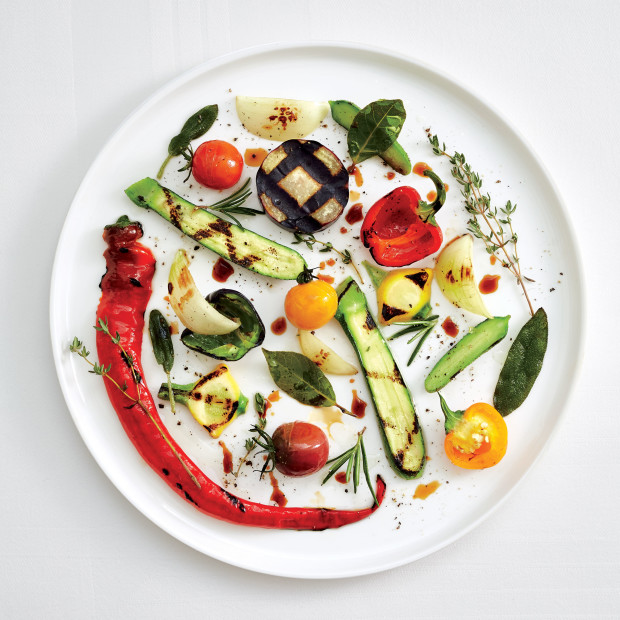
alain-passard-ratatouille-aux-legumes-grilles-620x620

Alain Passard’s Ratatouille

From the Mind of A Chef, season 5.

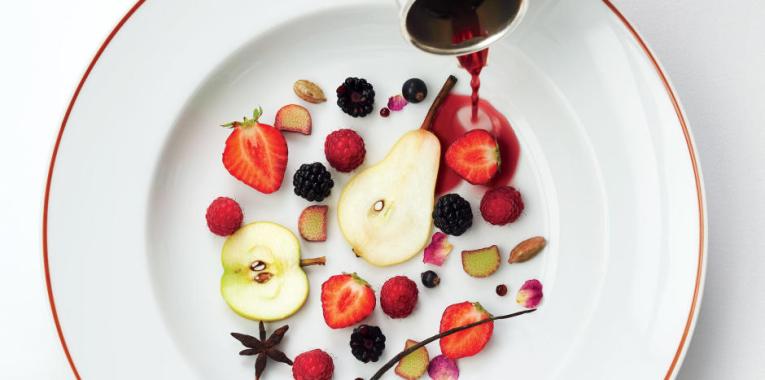
Fruit Salad Image from: http://www.bonappetit.com/people/chefs/article/larpege

http://www.bonappetit.com/recipe/fruit-salad-with-thousand-flavor-syrup