Food Poem – Butter by Elizabeth Alexander

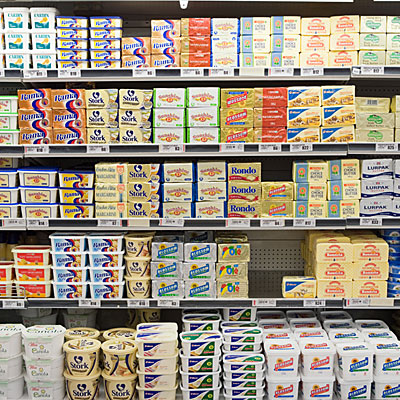
butter-store-400x400
My mother loves butter more than I do,
more than anyone. She pulls chunks off
the stick and eats it plain, explaining
cream spun around into butter! Growing up
we ate turkey cutlets sauteed in lemon
and butter, butter and cheese on green noodles,
butter melting in small pools in the hearts
of Yorkshire puddings, butter better
than gravy staining white rice yellow,
butter glazing corn in slipping squares,
butter the lava in white volcanoes
of hominy grits, butter softening
in a white bowl to be creamed with white
sugar, butter disappearing into
whipped sweet potatoes, with pineapple,
butter melted and curdy to pour
over pancakes, butter licked off the plate
with warm Alaga syrup. When I picture
the good old days I am grinning greasy
with my brother, having watched the tiger
chase his tail and turn to butter. We are
Mumbo and Jumbo’s children despite
historical revision, despite
our parent’s efforts, glowing from the inside
out, one hundred megawatts of butter.
I’ll admit it.
I used 3 or 4 pounds (who knows … I lost count) of butter the last week. I’m glowing from the inside.
Maybe you are too.

“Butter” by Elizabeth Alexander. From Body of Life, published by Tia Chucha Press.

From http://www.poetryfoundation.org/poem/185537

Image from: http://www.health.com/health/gallery/0,,20509217,00.html


Diapers, Chickens and Smart- Hard Design Thinking

14818877769_f33dc4fedd_o

Chef Gabrielle Hamilton of Prune, writes in Blood, Bones and Butter of how running a restaurant prepared her for parenthood,

“I thought of telling them how changing a diaper reminds me, every time, of trussing a chicken. How sleepless nights and long grueling hours under intense physical discomfort were already part of my daily routine long before I had children. How labeling every school lunch bag, granola bar, juice box, extra sweater, and nap blanket with permanent Sharpie is like what we’ve been doing every day for thirty years, labeling the foods in our walk-ins. How being the chef and owner of a restaurant means you already by definition, mastered the idea of “systems,” “routines,” and “protocols” so that everyone who works for you can work smart-hard rather than work stupid-hard. So that by the time you are setting up your household and preparing yourself for adding children, you have a tendency toward this kind of order, logic and efficiency.”

This is a good description of design thinking across seemingly unrelated activities: parenting and running a restaurant. It also describes how working prepares us to parent rather than the other way around. I so enjoy her vivid imagery and hyphenated characterizations like, long herbal-tea-soaked conversations of “spirituality.” It is worth reading as a full course or in small bites of sentence fragments to be washed down with our own food memories. She describes such a rushed and gritty culinary education coupled with an equally elegant and comforting childhood. She lives in at least two worlds simultaneously: the spinning world of the ferociously hungry traveler and the opulent world of the aesthete. I’d like to eat at her restaurant, Prune and taste both worlds. Here are a few sentences from the chapter describing her restaurant philosophy,

“To be picked up and fed, often by strangers, when you are in that state of fear and hunger, became the single most important and convincing food experience I came back to over and over, that sunny afternoon humming around my apartment, wondering how I might translate such an experience into the restaurant I was now sure I was about to open down the block.”

further on she describes the table atmosphere in detail that would make her stage designer father beam with pride,

“There would be no foam and no “conceptual” or “intellectual” food; just the salty, sweet, starchy, brothy, crispy things that one craves when one is actually hungry. There would be nothing tall on the plate, the portions would be generous, there would be no emulsions, no crab cocktail served in a martini glass with its claw hanging over the rim. In ecstatic farewell to my years of corporate catering, we would never serve anything but a martini in a martini glass. Preferably gin.”

I clap with glee at the irony of her profoundly intellectual, anti-intellectualism. What a designer!

MFK Fisher’s Buttered Toast: On Dignity During Wartime Dining

Buttered-Toast

If, with the wolf at the door, there is not very much to eat, the child should know it, but not oppressively. Rather, he should be encouraged to savor every possible bite with one eye on its agreeable nourishment and the other on its fleeting but valuable esthetic meaning, so that twenty years later, maybe, he can think with comfortable delight of the little brown toasted piece of bread he ate with you once in 1942, just before that apartment was closed, and you went away to camp.

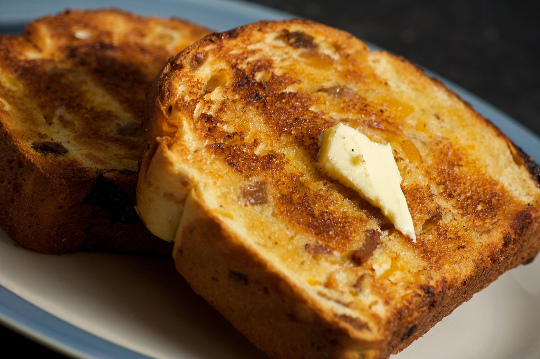
It was a nice piece of toast, with butter on it. You sat in the sun under the pantry window, and the little boy gave you a bite, and for both of you the smell of nasturtiums warming in the April air would be mixed forever with the savor between your teeth of melted butter and toasted bread, and the knowledge that although there might not be any more, you had shared that piece with full consciousness on both sides, instead of a shy awkward pretense of not being hungry.

My queen of food writing, MFK Fisher found in shared gastronomic enjoyment human dignity that defied harsh conditions. Her book How to Cook a Wolf is one my favorites because it addresses wartime eating in a such a practical and philosophical way.  For her, food becomes an agent of human dignity instead of an mere instrument of human survival through thoughtful eating.  She concludes the book with the following poignant words:

How-to-Cook-a-Wolf-MFK-Fisher

I believe that one of the most dignified ways we are capable of, to assert and then reassert our dignity in the face of poverty and war’s fears and pains, is to nourish ourselves with all possible skill, delicacy, and ever-increasing enjoyment. And with our gastronomical growth will come, inevitably, knowledge and perception of a hundred other things, but mainly of ourselves. Then Fate, even tangled as it is with cold wars as well as hot, cannot harm us.

Eat me – Shopsin’s Philosophy

41pV4Fd04hL

Eat Me: The Food and Philosophy of Kenny Shopsin is most definitely one of my favorite, cooking, food writing, philosophy and design books. Its witty, thoughtful, informative, blatantly honest and at times appropriately NYC gritty. I enjoy the images, as much as the words, that are profoundly mundane and real. Shopsin’s philosophy  implicitly fuels his life, cooking, business and becomes explicit, almost belatedly,  in his epilogue about the art of staying small,

“Running a restaurant for me is about running a restaurant. It is not a means to get someplace else. I wake up every morning and work for a living like a farmer. Running a restaurant is a condition of life for me. And I like everything about this life. I like waking up in the morning knowing I am going to the restaurant to cook, that something unexpected will happen to me in the kitchen, and that no matter what, I will learn something new. I like the actual process of cooking. I like shopping for the food that I cook, and I like my interactions with the people I meet while shopping. I like my customers, and I like working with my kids. It is a simple existence, but for me the beauty is in that simplicity. These are the things that bring me pleasure — and they bring me great pleasure on an extremely regular basis.

Living this way, pursuing your own happiness, is addictive and it’s the way I have tried to conduct my life. What this means is doing what it takes to make yourself feel good each day, not to make yourself less good today in the hopes that your life will be good in ten years because you’re working really hard now or because your property will be worth more money then. The way I figure it, if you make everyday of your life as happy as you can, nobody can take that away from you. It’s in the bank.”

Shopsin’s insistence on experience, on being in the present, on owning one’s pleasure, on loving a complete process, all point to his pragmatic life affirming philosophy just as his extensive menu is evidence of his lust for experimentation, learning and innovation. Next time, a quote about his thoughts on creativity. In the meantime,  read the book and its recipes. Its about food, philosophy and design that is perfect reading for hungry philosophers everywhere.


“Here too the gods dwell”……….

Heraclitus was warming himself by a stove when a group of visitors arrived hoping to meet the great philosopher and was surprised to see him in such mundane circumstances. Responding to their obvious disappointment, Heraclitus famously announces, “here too the gods dwell.” His simple statement locates meaning…..”here”…….by the stove, by the fire, where we feed and warm our bodies. Heraclitus, reminds his visitors and us that the philosophical self-examined life is not lead apart from everyday needs. In doing so, he shatters the ideality and the celebrity of the tranquil philosopher.  Heraclitus’ statement has been closely examined by many scholars, most notably by Martin Heidegger.

I simply invoke this statement as an ancient recognition that the “mundane” is the un-thought, unexamined, unattended, unfelt and that everything, everyone, everyplace harbors the meaningful. A philosophical life is not one of removed, meditative, tranquility apart from human struggle. On the contrary, a philosophical life begins with the simple gesture of warming oneself and attending to the warmth, the fire, the pleasure, the heat, the glow, the light that makes us see, ourselves among and against things in the world.

We can find moments of self-examination and awareness even when we buy a blender or when we boil a pot of pasta. It is ordinary and mundane when I buy the cheapest or most expensive blender with no thought to how it affects my life, it is philosophical when I consider where the blender will live in my home when not in use, why I need it, how often will I use it. Boiling a pot of pasta is ordinary if it becomes an mechanical exercise of producing an efficient dinner. It becomes a human moment when I consider the heat, the water, the pot, the family, the pasta itself, dinner time, the host of variables that converge when I make dinner. This attention doesn’t mean, I’m pausing to ponder….it just means that when I’m boiling pasta, I’m boiling pasta…..I’m attentive and in the moment. Food can be easily be relegated to mundane meaninglessness. That’s why, to me, Heraclitus’ statement that “here too (by the stove) gods dwell” seems so poignant.

Counting calories, intellectualizing, carefully designing menus to meet allergies, nutrition, brand etc, is not the attention I’m talking about. Anthony Bourdain describes the moment of awareness and successful eating in Medium Raw (2011), as follows,

If cooking professionally is about control, eating successfully should be about submission, about easily and without thinking giving yourself over to whatever dream they’d like you to share. In the best-case scenario, you shouldn’t be intellectualizing what you’re eating while you’re eating it. You shouldn’t be noticing things at all. You should be pleasingly oblivious to the movements of the servers in the dining area and bus stations, only dimly aware of the passage of time. Taking pictures of your food as it arrives — or, worse, jotting down brief descriptions for your blog entry later — is missing the point entirely. You shouldn’t be forced to think at all. Only feel.

I am guilty of taking pictures and blogging…..but I also remember many moments, the best moments when I completely forgot to do so and just enjoyed what was placed before me. Philosophical self-awareness includes the Bourdain receptive sense of giving yourself over to your needs and wants as it meets what is given. It may seem like a contradiction, how can one be both self-aware and self-negating? But that edge between thinking and feeling, control and reception is the philosophical moment of living of life of meaning, whether buying a blender or boiling a pot of pasta. Think and feel. Heraclitus, wasn’t just thinking. He was feeling the heat.
 

Bertha’s Brownies at the Palmer House

DSC_0055

Behind this 19th century ornate peacock gate is an equally glamorous design and food history. A wedding present for Bertha Honore from Potter Palmer, the Palmer House Hotel is a piece of Chicago history. The ceiling includes murals of Venus, the goddess of love, framed by Neoclassical Empire style of glam and glitz. It burned down in the great Chicago fire of 1871, only to be rebuilt bigger and better afterwards.

DSC_0048Sure, the Empire style Hall by Bertha Palmer is an architectural treasure and a Chicago historical landmark. Referenced in Devil in the White City, the Palmer House is an exemplar of the gilded age before the crash, the depression, before the World Wars and the ravages of the 20th century. The historical legacy of the Palmer House is unquestionable and excite architectural and cultural historians. However, unbeknownst to most of us, we have an even deeper connection to the Palmer House. A gastronomic connection. I hope you can sense my tone of reverence as I say…..the Palmer House is the birthplace of the ….wait for it…..

The Brownie.

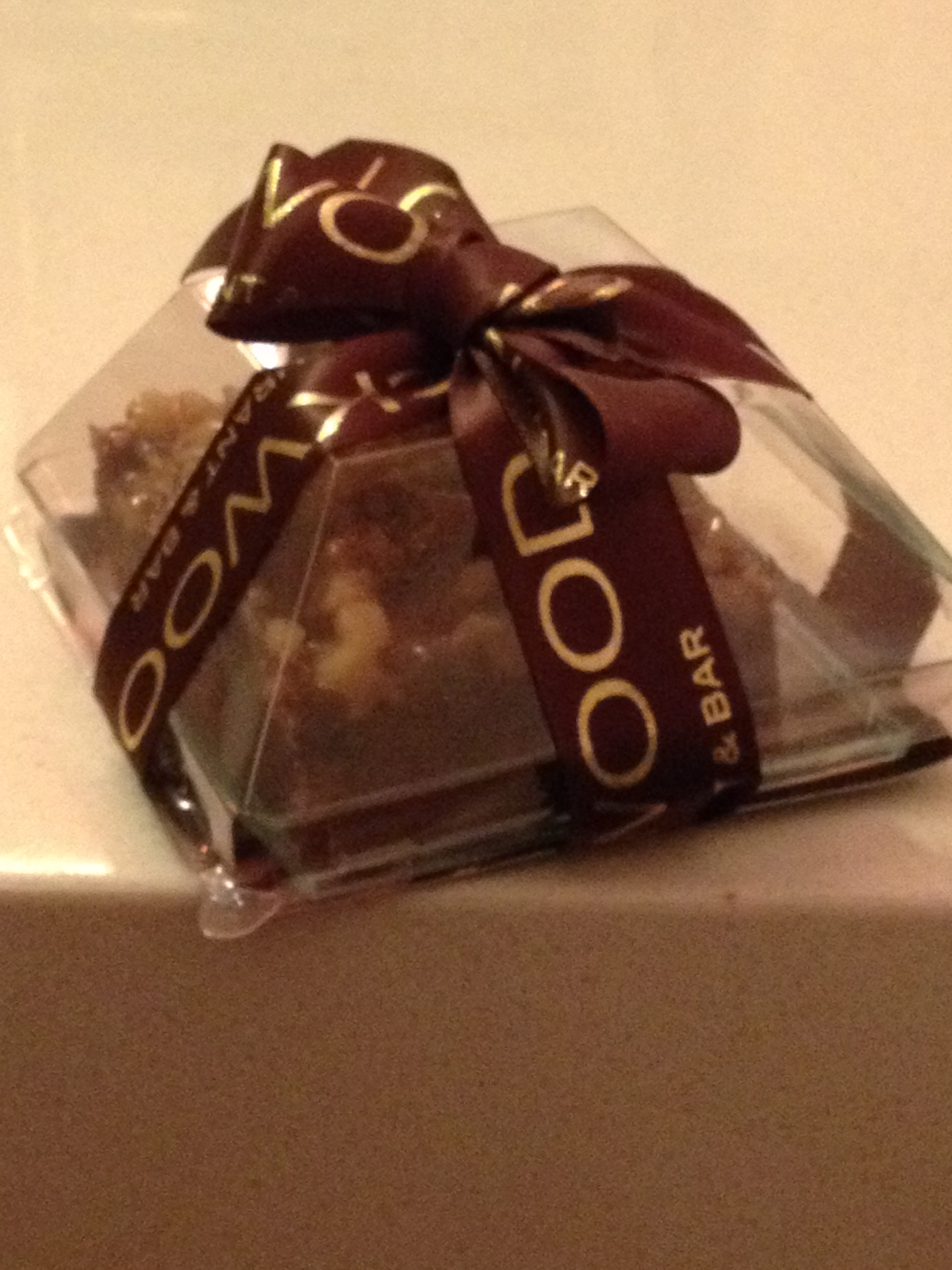
Yes. Let this knowledge sink into your consciousness and memories of chocolatey, dense, moist deliciousness. It is probably the most coveted dessert in our home, rivaling its cousin warm chocolate chip cookies. The brownie is America’s Proustian Madeline that conjures memories of childhood pleasure and freedom. A “to-go” version of this confection at the Palmer House comes boxed and wrapped with a ribbon. The packaging also includes a brief history and the original recipe. The taste can be described as dense yet delicate, with a texture between fudge and cake that melts in your mouth. The walnuts that compose the top layer have a light glaze. The recipe says its an apricot glaze but a fruity taste is hardly noticeable. It is a familiar (as in brownie mix brownies) but elegant experience between candy and cake. The “to-go” version is perhaps the best way to eat this little morsel since it was designed to be a part of a boxed and portable, working lunch for ladies discussing the 1893 Chicago World’s Fair. The Brownie represents a designed American cultural experience.  We say as American as Apple Pie but I think the saying should be as American as Brownies. This Fourth of July, I’ll have to bake brownies. Let’s start a new trend and vote for the Brownie as America’s dessert. “Bite into a piece of history”………indeed!

photo

photo 1photo 2


Family of Taste Profiles

“I was slowly discovering that if you watched people as they ate, you could find out who they were.”

New York Times food critic Ruth Reichl wrote this observation in her autobiographical Tender at the Bone: Growing up at the Table (1999). It is an extended version of the dictum, “you are what you eat.”  What I like about her comment is the path of discovery in following people as they eat and talk about what they eat and how food reveals their innate sense of joy. I remember spoon-feeding my children their first tastes when they were five or six months. How anxiously I would wait for their reaction. Is she going to spit it out, turn her head away, giggle or cry? I was really watching them grow into individuals with preferences and needs beyond mere survival. I still watch them exercise their preferences as they sit at the table.

My oldest, now in college, for her birthday generally chose Italian food with steak, pasta, bread and cream sauces of salty, sweet and slightly spicy flavors. Mexican flavors would be a close second, a different composition of similar mouth feel. In Bengali food she enjoyed yoghurt based meat dishes….again the creamy, salty, spicy and sweet flavors. She demands a lot from her bites…refreshing, hearty, familiar and surprising. She is an adventurous and aware eater and a joy to cook for and with. She was always a social person and she is now happy to use her comfort in the kitchen to gather people, just as she struggles to gather distinct flavors in each bite. Life for her is a plate of contrasting flavors that requires each bite be delicately composed of all components in happy competition. She is a happy driven competitive person herself who sets near impossible standards of the perfect bite or moment.

My youngest, now entering her teenage years for her birthday generally chooses a seafood restaurant that breaks routine with the welcomed extravagance of lobster and butter sauce. Fried seafood, raw oysters, baked oysters, all creatures of the sea sing to her. She likes the reassurance when her expectations are met. The unknown scares her a bit. She will try anything as long as I describe it as best I can. She savors the consistency of familiar tastes like dal and rice or eggs and toast, of tastes she associates with happy moments like hot spaghetti after a cold swimming lesson. She likes bento boxes of ordered simplicity and well arranged dishes. She will not happily order cow’s tongue tacos at the local Mexican restaurant like her sister but she will try it from her plate. She knows that she’s learning about what she likes and is willing to test herself. She’s trying so hard to grow up and expand beyond her comforting tastes. But for now, she still needs a day of “home food.” For her, I need to write a recipe book to satisfy her craving for consistency when she moves away from my table.

When my eldest visits, I imagine what experiments we can try, what new restaurants we can explore. For my youngest, I revisit familiar tastes as gateways into times we spent together. To my table my children bring the best inclinations of new adventures and fond memories. I watch how they eat as way to witness how they are growing and how they taste the world.

Some of their tastes will change, others will not. I hope to share their table often enough to know the difference.