Cookie Monster and Oscar’s Guide to Life

As long as I can look back and say “There’s no way I could have been grouchier,” it was good day.

Oscar the Grouch, The Pursuit of Grouchiness

I aspire to Oscar’s about the author page… “Oscar the the Grouch doesn’t need to explain himself to you. He lives in a trash can on Sesame Street.”

My hero.

Early bird gets worm. But cookie tastes better than worm. So me sleep in.

Cookie Monster, The Joy of Cookies

Life, for me is a balance between the unapologetic self-acceptance of Oscar the Grouch and the laser focused cookie pursuit of the Cookie Monster.

These wise monsters demonstrate Dialectical Behavior Therapy Skills of Radical-Self-acceptance and Meaning-making.

If there is a why, then a person can figure out the how.

Victor Frankl

Oscar the Grouch and the Cookie Monster know their “whys.”

I’m still working on mine. How about you?

Wishing you enough cookies to share and a smelly trash can to rest in,

Hungryphil

Cooking is my coping skill

Like you, Hungyphil has many dimensions and manifestations: Wobblyogi and now Angstytherapist. This blog started as a way to retain and share food experiences, it grew to add yoga and mindfulness, and now counseling and therapy. Like the Very Hungry Caterpillar, Hungry Philosopher is munching away at life one leaf at a time. Not sure if a butterfly will ever emerge through these efforts but it sure is fun to try.

the-very-hungry-caterpillar-1-728.jpg

So, how am I going to combine food, mindfulness, AND therapy? Here is my first attempt.

The last four months I did my internship at a partial hospitalization program (PHP) and an intensive outpatient program (IOP) for kids between the ages of 8-18. I’ll be sharing more from that experience in the coming weeks. All sorts of sad and hurt ranging from homicidal thoughts, incest, suicidal thoughts, self-harm, anxiety,  depression and trauma brought these kids to the programs. One of the main tasks of the programs were helping them develop distress tolerance and coping skills that could would work for them individually.

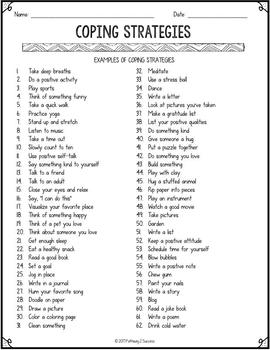
Here is a sample list of coping skills from https://www.teacherspayteachers.com/Product/100-Free-Coping-Strategies-2955800:

original-2955800-3.jpg

Number 59 is Blog. I also use eating, cooking, reading, writing, yoga, meditation and drawing. Coping skills sounds very much like general and generic things I just like to do.

They are.

So how can things I just like to do help me ease anxiety and depression?

Its a simple principle.

When life tastes bitter, add activities, tastes, sights and smells that you love. Change the recipe.

Easier said than done. Let’s talk more about it. For now,

What are your coping skills?

Wishing you self-aware ease,

Angstytherapist-wobblyogi-hungryphil

Sing The Black Sheep Gospel

The following is dedicated to all my artists, poet, philosopher, weirdo friends who like me often feel like they don’t belong. Here’s to you!

I particularly like number 5 🙂

1. Give up your vows of silence which only serve to protect the old and the stale.

2. Unwind your vigilance, soften your belly, open your jaw and speak the truth you long to hear.

3. Be the champion of your right to be here.

4. Know that it is you who must first accept your rejected qualities, adopting them with the totality of your love and commitment. Aspire to let them never feel outside of love again

5. Venerate your too-muchness with an ever-renewing vow to become increasingly weird and eccentric.

6. Send out your signals of originality with frequency and constancy, honouring whatever small trickle of response you may get until you reach a momentum.

7. Notice your helpers and not your unbelievers.

8. Remember that your offering needs no explanation. It is its own explanation. Go it alone until you are alone with others. Support each other without hesitation.

9. Become a crack in the network that undermines the great towers of establishment.

10. Make your life a wayfinding, proof that we can live outside the usual grooves.

11. Brag about your escape.

12. Send your missives into the network to be reproduced. Let your symbols be adopted and adapted and transmitted broadly into the new culture we’re building together.

Turner, Toko-pa. Belonging: Remembering Ourselves home (Kindle Locations 1106-1109). Her Own Room Press. Kindle Edition.


How to Eat Like a Yogi

A long time ago there was a yogini, Giri Bala who lived without food – Yogananda tells us in the in the Autobiography of a Yogi. At age 12 responding to her mothers-in-law taunts that she eats too much, Giri Bala with the help of her Guru stopped eating in order to prove that humans are sustained by spirit not matter.

To me, Ayurveda, as a holistic medicine practice, is related to yoga as another practice of cultivating connection with the universe, others and within. I am drawn to the view of eating as a cosmic event where elements collide.

There are too many conflicting accounts of yoga principles to account for here. The details are less important or interesting. The idea that I am a location where streams of cosmic energies like earth, water, fire and air whip up into a special climate is fascinating. My encounters with others shape my physical, emotional and spiritual environment, my personal reformed and reflected universe.  For example, spicy food can fuel my anger, yet energize another.

This is certainly not a medical prescription, for weight loss, Ayurveda is a way to use food as a spiritual practice.

Here are the principles worth considering:

  1. The principle of Power: Everything has qualities and powers.
  2. The principle of Balance: Like qualities increases like qualities and balancing requires inviting the opposite quality.
  3. The principle of Doshas: Eat things with qualities and powers that balance your constitution (inside)
  4. The principle of Seasons: Eat things according to the season (outside)

When we pay attention, we know when we’ve eaten too much or too little, we recognize that something is fighting us in our stomachs resulting in gas or heartburn, we know when something smells or feels wrong in our mouth. If we mindfully eat and digest, we feel when we need something heavy and grounding and when we need something light and soothing. Usually, we don’t eat mindfully or pay attention to our bodies, we eat with our eyes, our memories, our expectations and worse, our stress.

Your stomach is your internal universe that transforms matter into energy. What is it craving now?

Being Extra: the sauce of life

I am an extra.

I am a non-speaking character in a coffee shop background sipping coffee and staring at my laptop. There are raindrops on the windows, a blade of grass moving in the wind outside, cars moving past on the road, murmuring conversations, a large orange sculpture, a concrete floor, a sneeze, a ding, words, a child’s cry, salt and pepper shakers, iphones, mugs, music wafting above the hum of mid-morning conversations, a green shirt, smell of eggs and coffee, fingers on the keyboard, people behind the counter waiting, people behind the counter making lunch, yellow road signs, an itch on the neck, words on the wall, wood tables, metal chairs, stripes and me.

I don’t despair being an extra. Extras in books, movies or television are never credited with names, just actions, like, “shop keeper” or “crying child.” I am a silent actor in your story, a voiced actor in mine. You can only see my actions, my role as an extra. You don’t see my inner monologue, my struggles, my joys, my worries or my guilt. Recognizing that I am an extra in the world, a silent actor is surprisingly empowering. As you walk by my table where I type, I can trip you or smile, I may not change your story but I color it with my actions. I don’t have to be the main protagonist. The main character depends on the extra. That is the secret: we are all extras. Being extra. I came to see myself as an extra and found an extraordinary life. I stopped trying to be named, stopped trying to be the main character, a proper noun.

Philosophy, art, religions all try to address our longing to connect to something larger, more meaningful than us. This is another attempt. An extra attempt.

We all share the small things, like coffee cups, salt, phones, chairs and walls and the big, like cities, roads, landscapes, clouds, and water. How we focus shape how our individual perspectives live and interact. You are an extra in the stories of almost everyone you meet today. You can probably count the people in your life who are essential on your fingers.

You are an extra.

Moving beyond identity politics, religion, gender, into object-hood into being extra. Being both more and less. Being Extra.

Depending on your outlook you could interpret the title “Being Extra” as either as being more, extraordinary or being waste, extraneous. We are always both: extraordinary and extraneous. It depends on your taste.

I arrived at this question when reading Adolf Loos’ modernist manifesto Ornament and Crime. All sauces he said was ornamental. The modern man eats roast beef. From my South Asian perspective, beef was ornamental, mostly used as a flavoring for curries and only the main component twice a year, weddings and celebrations when a sacrifice was offered. Always ritualized and associated with a momentous occasion.

Adolf Loos’ food example to explain modern architecture and design stuck in my thoughts.

What are your favorite sauces? Your favorite extras? Do you add spicy hot sauce to your dishes, maybe sweet-salty honey mustard, or maybe tart-sweet bbq sauce? How do you flavor your life?

Dessert is always extra, more than, beyond functional, ornamental and as a habit, dangerously unhealthy. Maybe that’s why we crave it. A British Toffee Pudding Cake draped in sweet toffee sauce is definitely extra. Here is a recipe.

Wishing you extra,

Hungryphil


Advice from a Recovering Academic

It was Valentine’s Day, 2013. I had waited all day in fear, as fellow tenure-bound colleagues celebrated with online posts conveying relief and joy. When I finally got the evening call from the dean of liberal arts, “I’m sorry, there just wasn’t enough,” he said. That was it, a quick and sudden death of my academic career. And, then came the tsunami of self-judgment that ripped through my soul. “I was not enough,” it viciously screamed.

During the previous fall semester, the school of visual and performing arts and the college of liberal arts had approved my petition for tenure. I had lulled myself into false confidence. And, so the university committee’s decision was a shocking end to my academic aspirations. Throughout the difficult year of 2014, I had applied for jobs, interviewed and been rejected. Multiple times. I was still not enough.

The following year, I was in a fog debating my commitment to academia. If only I published a book, I would be enough. But it didn’t feel right. I would present at conferences as an independent scholar. I felt like a player without a team, without a home-base. These foggy days were also full of possibility. I started a blog to help me find my non-academic voice. I volunteered widely. I explored whether I’d like to go to culinary school or high school teaching, all the while wondering whether I could ever find my way back to an academic post. Thanks to my husband, I wasn’t starving during this period of anxious self-exploration, a luxury I’m lucky to enjoy.

At one point, my goal was to become a food writer. So I blogged more regularly, wrote short pieces for a magazine and as an afterthought to soothe my wrung out academic heart I worked through a yoga teacher certification program.

I stopped asking what could I have done more. Instead, I relaxed into the thought that I had done the best I could. I had done enough. But there was still anger and hurt.

It was a month into teaching yoga that my heart’s grip on that lead-heavy pebble of hurt began to loosen. I was thinking and reading about the power of narrative, of being able to notice without attachment or judgment, of being able to cultivate a witness consciousness. I wasn’t trying to apply these thoughts to my tenure hurt that in my mind I had already addressed and contained. But somehow, as I slept, these perspectives traveled through my mind and heart to find and envelope that hard pebble of hurt. I woke up with a new thought. A thought I can’t believe I hadn’t seen before.

There were clues all along. I had been hired to the new position of Design Historian. I was not trained in design history. I came to the post with a Ph.D. in philosophy and an undergraduate in architecture. I taught and developed my curriculum from the perspective of material philosophy. I was an outsider in every way.

Clue #1: The US government, in my application for a work visa, asked for clarification regarding my academic background as it related to design history. To this request, my Ph.D. advisors replied with a defense of philosophical analysis in creative pursuits and my new supervisors reassured them of my ability to teach the classes. Here was my first missed clue from the universe. I was to first defend philosophy, not expand the critical parameters of design history. I had dismissed my commitment to philosophy all too quickly to find a home in design history and in the U.S.

Clue #2: Quite a few years into the position, my department head warned, that I was investing too much time in curriculum development. Focus on research and publishing he encouraged. How was I to split my energy in two different directions? Here was my second missed clue: my teaching and research agendas were already fueling each other if only I had noticed my internal narrative instead of trying to adjust to a misperceived outside agenda.

Clue#3: An editor was interested in my book project comparing the philosophies of two early twentieth-century immigrant designers. It was about difference at the heart of American design. Because much had already been written about one of the two, the editor asked that I focus the book on the one, less discussed designer. Again, instead of listening to my inner narrative, I complied. Ironically, once I had done so, the book was categorized under a different editor, who no longer found the book publishable. My third clue offered by the publishing world exposed the commercial limits of my philosophical pursuits.

There were many other moments, besides political citizenship, academic bureaucracy and commercial demands, when the universe was nudging me to notice my internal narrative. Finally, the unexpected shove, that spun me out of my orbit. As I floated unanchored, searching for a spot to land, I began to notice my own emotional, intellectual and physical landscape. I had told an imaginary other’s story, instead of my own. This change in perspective was the beginning of healing. I was beginning to recover my own narrative beyond the dreaded tenure document.

Here is my advice as a recovering academic, find ways to ruthlessly and courageously defend your inner narrative. Yoga, prayer, meditation, walking, whatever helps you hear the inner voice that leads you to question everything. Do it. Listen to the clues, sit with the anxieties, be slow to react, watch your own responses, notice, notice and notice. Academic, research thyself.

I am still stung by the question, “What do you do?”

“I’m a recovering academic,” I mumble under my breath, as I say, “aspiring social worker with a side of yoga.”

It is enough.

I am Dr. Enuf 🙂 and so are you.

Hungryphil

How to make a proper cup of tea

“Hold the sadness and pain of samsara in your heart and at the same time the power and vision of the Great Eastern Sun. Then the warrior can make a proper cup of tea.”

– Chogyam Trungpa Rinpoche

In her book The Wisdom of No Escape, American Tibetan Buddhist, Pema Chodron discusses the above quote as follows,

The quotation really made an impression on me. It was completely true: if you can live with the sadness of human life (what Rinpoche often called the tender heart of genuine heart of sadness), if you can be willing to feel fully and acknowledge continually your own sadness and the sadness of life, but at the same time not be drowned in it, because you also remember the vision and power of the Great Eastern Sun, you experience balance and completeness, joining heaven and earth, joining vision and practicality. …..One can hold them both in one’s heart, which is actually the purpose of practice. As a result, one can make a proper cup of tea. …..

Making a proper cup of tea means that you thoroughly and completely make that tea because you appreciate the tea and the boiling water and the fact that together they make something that’s nourishing and delicious, that lift’s one’s spirits.

When I feel in small daily chores, like washing dishes, folding laundry or making tea, a sense of ritual, a sense of awareness, a sense of sadness and light, the chore becomes a moment of presence. This is so difficult to remember when we are rushing and impatiently waiting for water to boil.

Every morning I make myself tea. I use a red kettle that whistles instead of an electric water kettle or the microwave.  This process takes a few extra minutes. The clicking turn of the gas stove, the small explosion of blue and orange light,  the cool feel of metal as I release the water waiting at the faucet, the weight of the kettle as I lift it and place it over the colorful circular flame, the blossoming heat that grabs the kettle, the hissing steam and eventually screaming whistle, all together compose a strangely active yet calming morning ritual.  How can I expand this sense of ritual, as awareness and presence, to the rest of my day? This is the challenge of the proper cup of tea, especially on days I find myself waiting for water to boil.


An Architect, a Philosopher, and a Social Worker walk into…

An OSCE (Objective structured clinical exam). For, “social work?” you might be asking. Indiana University uses the OSCE exam to assess student’s clinical assessment ability. It is a way to document and measure how responsive, intentional, empathetic and helpful, I can be as a social worker.  Of my first four classes in the MSWD program, this was my most challenging. And, in beautiful irony, one where I learned the most.

Throughout the semester we were given scenarios to practice and play out with our peers. The contexts (after all social work is all about context) varied, for example ranged from client escaping domestic violence arrives at a homeless shelter, to diabetic client admitted into the ER or woman gives birth to a baby with marijuana in her system. The final exam involved serving a homeless veteran suffering from PTSD.

In learning how to listen to others, I learned so much about my own strengths and resistances. I learned how I think and how I might think differently. Here is an example:

In responding to the interviewed veterans statement “I feel overwhelmed and unable to do anything…..” I had three minds working at the same time………

My architect, beautiful problem solver mind wanted to fix it as soon as possible, as uniquely as possible for the client. Where and when do you feel overwhlemed? What do you need to not feel overwhelmed? What makes you feel better? What does being overwhelmed look like?

My philosopher, existential examiner mind, wanted to understand the condition as shared human struggles of alienation and dread. Why do you feel overwhelmed? What kind of overwhelming sensation is it? Why are you unable to do anything? What stops you?

My budding social worker, empowering listener mind, needed to wait for the specific, unique and individual experience of ‘being overwhelmed’ without assuming that the experience needed to be fixed, or that it was universally shared. In either case, I am reducing the person to a problem needing to be solved or a diminished example of a larger event. I needed to hear the expression ‘ being overwhelmed’ as if for the first time, with the curiosity to ask, how do YOU feel overwhelmed? How does it feel for you to be unable to do anything? Tell me more. It required the humility to drop all assumptions about the word “overwhelmed” and its meaning. This is hard for a recovering academic. I want the security of knowing things!

Certainly, these three disciplinary perspectives can overlap and reinforce each other. In best circumstances it should, I should work to find the client a home, I should work to connect the client with help related to PTSD but first and foremost I should be the client’s advocate, holistically, contextually. As a social worker, I am tasked to understand and intervene in a particular context in which this human being, here and now in front of me, is not fully self-realized.  I sigh as I type this. This seems an impossible task. Who among us can claim such completion. As long as we feel we are moving, even if slowly, in the positive direction, all is well. Case-work is not to just designing the shoes or giving directions but walking a few steps with. As an architect and philosopher, I designed and analyzed. I haven’t been trained to be with others.

This practice-based education pushes me in ways I hadn’t imagined. In a way teaching yoga better prepared me. In learning how to teach yoga, I learned to move with others, to sequence sensations and feelings, to encourage each person to find their own pose, to notice what their body needs regardless of what I am proposing.

So I suppose the title of this blog post should be: an architect, a philosopher, a yogi and a social worker walk into an interview……. to support human dignity and individuality.

Hmmmm….how does the hungry philosopher, eating and cooking fit into this? I’m quite sure it does, just haven’t thought about it yet 🙂

I learned a lot. I’m both afraid of and looking forward to semester 2. Sometimes this disciplinary dependence on others feels overwhelming and confusing to me. Muddy.

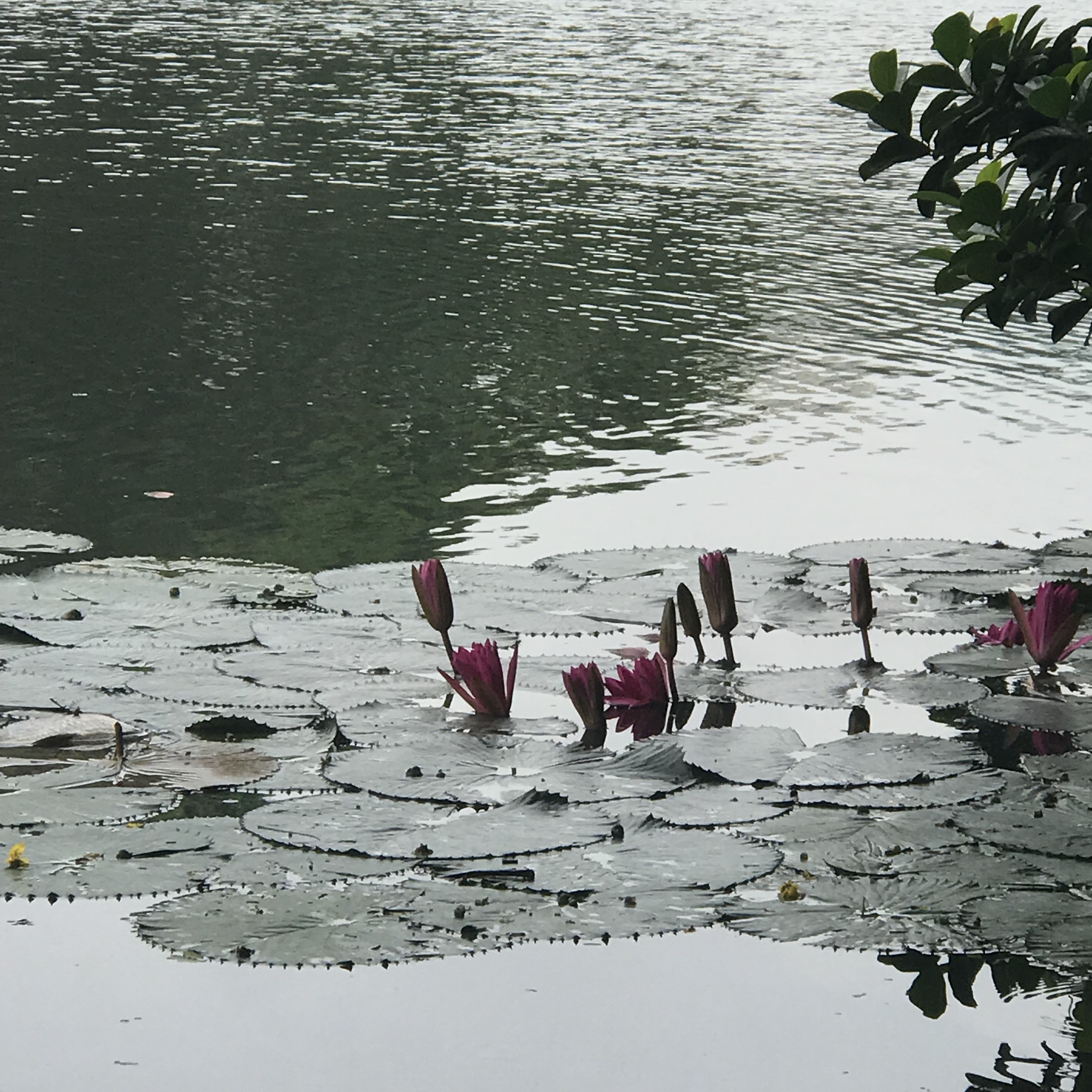
I’ll take yoga teacher Susan Lasater’s words to heart……………… may I be like “the lotus at home in muddy waters.”

May you be too!

Hungryphil

IMG_5986

Attending, listening Yoga-style

“The art of listening is the marriage of ear and space.” – Remski interpretation of Patanjali’s sutra 3.41

In my Theory and Practice Course for Social Work, we are learning the art of interviewing. Step one involves achieving a compassionate and empowering balance between attending and reflecting. Here is an ancient yogic way to develop the super power of deep listening by being mindful of our tendency towards “automatic self-referral” as explained by Matthew Remski,

Internal space is also utilized to broaden the gap between “your story” and “my story”. This space is most commonly disrupted by communication habits that fail to nurture the gap of otherness. For instance, if one friend begins to tell another friend of her marriage problems, the second friend can begin to “hold space” for the first by simply reflecting the feelings she hears. This allows the first objective of communication — being heard — to be fulfilled. But if the second friend begins to “false-empathize” with the first by immediately saying, “Oh I know what you mean: let me tell you what my partner did”, she has blocked the space of otherness through a pattern that Miles Sherts (2009) calls “automatic self-referral”. The first friend will not feel heard, and her feelings will become more isolated and compressed, a combination that invites suppression.

Remski, Matthew. Threads of Yoga: A Remix of Patanjali-s Sutra-s, with Commentary and Reverie (p. 180). BookBaby. Kindle Edition.

I’m still working on this super power. Maybe you are too.

Happy listening to “the gap of otherness,”

Hungryphil


Sway, Sweat and Sip in Costa Rica

Think back to memories where you were so immersed in the experience that either you couldn’t or wouldn’t stop to take a picture. For this reason, cherished memories of my recent trip to Costa Rica doesn’t make for a good social media post.

For my own sake, I’ll try my best to share and reflect on a few moments. Prepare to use your imagination…

Gentle swinging in a hammock: It was warm and quiet except for the chirping birds of all colors and sounds. The hammock was soft and enveloping, enclosing me like a cocoon. (It wasn’t on of those horrid ones that flip over as you try to find your balance. So awkward.) Above through lacy vibrant green leaves, the sky was cloudy blue. Rain was approaching. There were a few moments when I did feel a few raindrops but by then I was too relaxed to be bothered. Of my two session hammock afternoon, the first involved quiet rocking with friends reading books in other hanging hammocks, while the second session, after my tea break, I was joined by my beloved, who swayed across from me as we talked about our time in Costa Rica. I have never enjoyed a hammock supported afternoon so much.

Temezcal Sweat Lodge: Darkness, stones, heat, ancestors, sweat, doors, herbs, sweat, intentions, chanting, sweat, wash off, cool pool, return, darkness, hot stones, steam, sweat, confusion, darkness, screaming, fetal position, sweat, cool, heat, forgiveness, love, sweat, cleansing, heat, steam, sweat, friends, ease, OM.

Sacred Cacao Ceremony with Tibetan Healing Bowls: Mindful sipping for unsweet hot-chocolate-like liquid in a circle with friends, rest, sound resonating through us. Sipping, rest, heart pulsated with stronger beats, melted emotions for some, reassurance for some, just relaxing for some, talking stick, offerings, invoking ancestors, parents. Who knows whether the ceremony was authentic or not? What ceremony is? As a tourist, authenticity of experience is always suspect. Does it matter, if it leaves you feeling good and joyous?

I learned to mindfully sway, sweat and sip during my trip to Costa Rica.

Thank you, Community Yoga for organizing the retreat, Thank you Vida Asana for being a welcoming place and host.

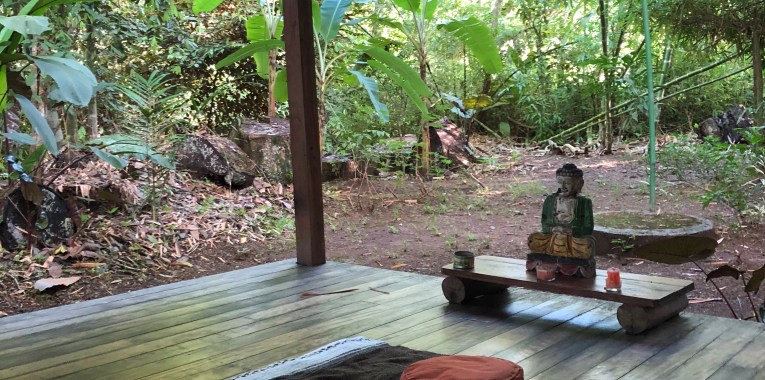
Here are some moments with pictures of beautiful things, places, and people.