Justaddwater: Bringing molecular gastronomy home

koz-susani-design-justaddwater-nutrition-ecosystem-designboom-10

The January issue of the popular design magazine Metropolis has a short story about the designed nutrition and flavor system branded “justaddwater.” The designers call this a nutrition ecosystem that adjusts to the needs of the user, recommends and prepares appropriate meals (with the inclusion of flavor pills and fresh ingredients). Its like a strange mix of convenient keurig machine and a responsive nest climate controller. It takes the cooking out of cooking and offers a healthy replacement for precooked meals or fast food. For a restricted diet, it certainly would be helpful. Here is a quote from designboom.com,

‘justaddwater’ is a step toward transferring the food revolution of molecular gastronomy from exotic and high-end restaurants into the home, expanding the trend from elite consumers, to the more mainstream market. its values lie in bringing new appreciation to what we put into our bodies — gratifying one through gastronomic pleasure, while respecting food, its associated rituals and nutritional values. above all, it aims at doing this through a renewed design language, merging the artificial with the natural in a way that is beneficial and does not pose any friction.

The websites below have demonstrations and more information about this future direction in food design. What do you think?

http://www.kozsusanidesign.com/

http://www.brit.co/just-add-water/
koz susani design harvest justaddwater nutrition ecosystem

Koz Susani Design imagines food of the future

Rain. Sorry, lunch is cancelled.

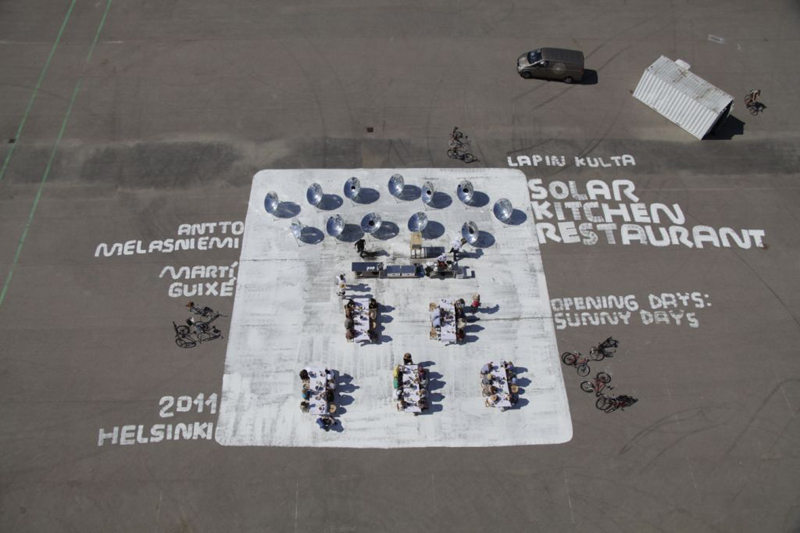
solar_kitchen_helsinki_3_guixe_project

http://www.designboom.com/design/marti-guixe-antto-melasniemi-solar-kitchen-restaurant

Marti Guixe and Antto Melasniemi’s Solar Kitchen Restaurant for Lapin Kulta is a fantastic exploration our tolerance for uncertainty coupled with our acceptance of complex natural and artificial processes. Since the meals are cooked with solar power, a cloudy day or rain can significantly affect the taste, timing and delivery of the meal. The restaurant invites consumers willing to be flexible participants of an orchestrated but not determined event. It challenges consumers models of mass and mechanical efficiency and product predictability with the joy of considered and uncertain localized experience. The factors that would make my lunch delicious would include not only the prowess of the chef, the freshness of the ingredients but also the weather and the strength of the sun. My lunch becomes a recognized cosmic event! Probably, not the best idea for a school cafeteria….or maybe the perfect idea to demonstrate the complex web of natural and artificial things that makes lunch possible.

Kenny Shopsin’s Creative Process

As promised earlier, here is an excerpt from Eat Me: The Food and Philosophy of Kenny Shopsin about creativity.

“Cooking, for me, is a creative process, and I believe that people who are creative are creative for one of two reasons: Either they are going for truth and beauty, or they create as a way to dilute the venom produced by the subconscious minds. I cook for the second reason. When I cook, I am in a cathartic, recuperative process that calms me down and brings me from a neurotic state to a relaxed, functioning state.” ……

“I am not an Alice Waters type of cook who is inspired by ingredients and builds from there. The inspiration is mine — it comes from within me. But as a creative person, ingredients are the tangible medium I work with, so when I am inspired, when I am in the therapeutic, creative process of cooking, I start looking around, and the more ingredients I have, the more creative I can be.”

Cooking as creative therapy is certainly familiar to many us. When my children were young, cooking was a major creative outlet that I could share with my family everyday. I fondly remember my oldest sitting on the counter discovering new tastes as I was discovering new techniques and ingredients. Cooking became a visceral form of philosophy for me. I like Shopsin’s compulsive sense of creativity as a self-recovering urge. And, that his relationship with ingredients is collaborative rather than instructive. The emphasis on more….abundance, multiplicity, contradiction, duality (ying-yang bowls) reflects in his recipes. He is not searching for the true and the authentic. He talks about his “culinary fictions” that are dishes not authentically ethnic, like Carmine Street Enchiladas, but “feels” to him Mexican, Brazilian or Greek.

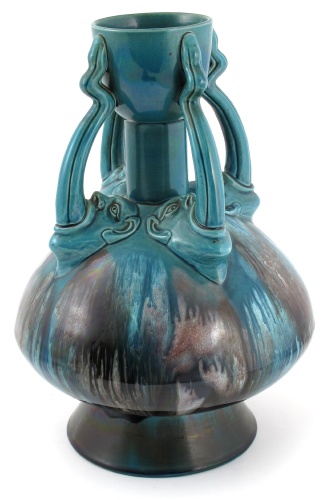
From a design historian point of view I see him adopting the early 20th century Aesthetic Movement stance that aspired to convey the sense and feel of  a culture, to mix and match as the designer or artist saw fit. It was a philosophy that embraced the joy of life and the freedom of artists, appropriately championed by Oscar Wilde. It was an era that produced incredibly standardization resistant, subjective and creative things like this, tongue vase by Christopher Dresser. IF

I feel like Kenny Shopsin would appreciate this vase. Although I don’t think we’ll find it at Walmart anytime soon.


Eat me – Shopsin’s Philosophy

41pV4Fd04hL

Eat Me: The Food and Philosophy of Kenny Shopsin is most definitely one of my favorite, cooking, food writing, philosophy and design books. Its witty, thoughtful, informative, blatantly honest and at times appropriately NYC gritty. I enjoy the images, as much as the words, that are profoundly mundane and real. Shopsin’s philosophy  implicitly fuels his life, cooking, business and becomes explicit, almost belatedly,  in his epilogue about the art of staying small,

“Running a restaurant for me is about running a restaurant. It is not a means to get someplace else. I wake up every morning and work for a living like a farmer. Running a restaurant is a condition of life for me. And I like everything about this life. I like waking up in the morning knowing I am going to the restaurant to cook, that something unexpected will happen to me in the kitchen, and that no matter what, I will learn something new. I like the actual process of cooking. I like shopping for the food that I cook, and I like my interactions with the people I meet while shopping. I like my customers, and I like working with my kids. It is a simple existence, but for me the beauty is in that simplicity. These are the things that bring me pleasure — and they bring me great pleasure on an extremely regular basis.

Living this way, pursuing your own happiness, is addictive and it’s the way I have tried to conduct my life. What this means is doing what it takes to make yourself feel good each day, not to make yourself less good today in the hopes that your life will be good in ten years because you’re working really hard now or because your property will be worth more money then. The way I figure it, if you make everyday of your life as happy as you can, nobody can take that away from you. It’s in the bank.”

Shopsin’s insistence on experience, on being in the present, on owning one’s pleasure, on loving a complete process, all point to his pragmatic life affirming philosophy just as his extensive menu is evidence of his lust for experimentation, learning and innovation. Next time, a quote about his thoughts on creativity. In the meantime,  read the book and its recipes. Its about food, philosophy and design that is perfect reading for hungry philosophers everywhere.


(De)sign for Homemade

_76293904_logo_afpmesturet2_624

http://www.bbc.com/news/magazine-28313666

A recent law aiming to protect the quality of French food requires restaurants to identify dishes that are cooked to order (not frozen or pre-made). Philosophically, the question of what makes something “homemade” is worth considering as is the new logo (a casserole dish with a house roof) that will alert consumers.

The basic claim was that “homemade” supports local produce and labor needed to cut, chop and peel the local produce in addition to supporting the culinary craft. The negotiated law however, allows frozen and packaged produce and according to critics undermines the initial intent. The law differentiates and requires restauranteurs to identify industrially produced from locally crafted food. But the differentiation itself is proving difficult. Hence, the controversy.

How do we personally identify a home-made dish? Last night we had grilled salmon with lemon, garlic butter, salad and bread sticks. The salad was prepackaged, as was the bread sticks, we grilled the salmon and the mixed the butter with lemon zest, lemon juice and a clove a garlic. We also had brownies and ice-cream for desert made from a prepackaged mix. Was that a homemade meal? I don’t know. Our tolerance for industrial food products, perhaps particularly in the U.S. has risen to an almost naturalized level. When we go out, do we expect a custom made dinner? When so many of our favorite restaurants are represented in the freezer section of the local grocery stores, the myth of a local customized dinner is not only shattered but celebrated. What is the line between convenience and craft? Shouldn’t there be a line? The battle over standardization and industrialization against craft and localization takes place on our dinner plate every night. Who are we as 21st century consumers?

What is at stake in the “homemade” logo is the responsibility of thoughtful, aware and discerning consumption. I wonder if someone is planning to study consumer behavior related to the new logo. Will customers choose the identified “homemade” more? Would you or I?


Small Chairs and the Olive Garden Diet of Discomfort

attachment

Sometime during the late 1980s — no one can pinpoint the exact date — Ron Magruder, the president of the thriving Olive Garden chain of Italian restaurants, received a telephone call from a dissatisfied customer. The call had been patched all the way up to Magruder because it was so……different. The caller, named, Larry, wasn’t complaining about the food or the service or the prices. Instead Larry was upset that he could no longer fit into any of the chairs in his local Olive Garden.

“I had to wait more than an hour and half to get a table,” Larry told Magruder. “But then I found that there wasn’t a single booth or chair where I could sit comfortably.”

Magruder, a heavyset man easily moved to enthusiasm, was sympathetic to Larry’s plaint. And, as president, he could do something about it. He had his staff contact the company that manufactured the chairs for the chain and order a thousand large sized chairs. He then had these distributed, three each, to every Olive Garden restaurant in the nation. It was, as Magruder later told the eminent restaurant business journalist Charles Bernstein, a perfect example of his management philosophy: “We’re going to go the extra mile for any customer, no matter what the situation.”

………the chapter “World Without Boundaries” ends with the conclusion of this story.

About after two months after he first heard from Larry, the customer who had complained about how small all the chairs were in his local Olive Garden restaurant, Ron Magruder, the chain’s president, received another call. It was Larry again. He was calling in response to a follow up query from one of Magruder’s staff. The staff had been busily making sure that all of the chain’s restaurants now had at least three chairs that could accommodate the more amply endowed and had wanted Larry to report what he thought of their efforts.

Well, he was happier now. Indeed, Larry’s message was entirely conciliatory — even thankful. But it wasn’t because of the bigger chairs. It was because of the old small chairs. Largely because of them, Larry explained, he had been spurred to finally confront the extent of his weight problem. Why, in the seven weeks since he had spoken to Magruder, he had lost almost fifty pounds.

The tight little chair — that had been what Larry needed after all.

What a “Gift of the Magi” kind of story!

From a design perspective, the role of small and big chairs in supporting American eating habits are worth noting and from a personal perspective, the story made me change out of my “fat jeans” and into my uncomfortable jeans as incentive to loose those pounds gained over winter. I wonder if this new diet of uncomfortable snug clothing (or chairs) will work? It did for Larry.

The story comes from Fat Land (2003) by Greg Critser.


Eating Glocal


photo 1 3.44.05 AM

photo 2 3.44.01 AM

My lunch in Dhaka, Bangladesh today. It was surprisingly good. Fried chicken meets South Asia…chopped, stir  fried with onions, green chilies, cilantro and served with rice. Did it taste like something from KFC? Not really. But, the packaging insisted otherwise. By the end of the meal I was almost convinced that it was an “authentic” KFC experience. Share your experiences of eating “glocal.” What did you have? Was it good?

A Food tourist takes a walk on the Socratic Side

IMG_1047

The Wok Shop in San Francisco


I’ve been on three food tours so far. First, Georgetown, D.C, second, San Francisco China Town and last week Chicago. I’ve learned a lot, tasted a lot, and enjoyed a lot. Food tourism might just be my new sport. There are a few practical advantages of a food tour besides the obvious excitement of eating cultural history.

First, a tour allows me to sample small dishes in various places without feeling guilty or sorry for the waiter.

Second, it allows me to follow someone around and focus on eating not locating.

Third, it allows me to meet interesting people happy to talk about their food experiences.

All good reasons to go on a food tour.

If you have dietary limitations, allergies or just don’t like trying new things, I would still encourage you to go. Here’s why: while food navigates the tour, the walk and associated stories themselves are well worth it. These discoveries are just as enjoyable as finding a new delicious taste. Like listening to owner of Wok Shop in San Francisco passionately defend the superiority of traditional Woks or looking at the Tiffany Domes in the Chicago Cultural Center while Jazz music floats in the air. These are moments when design and food, the aesthetic and the gastronomic touch in fantastically beautiful and delicious ways. Its better than walking through museums because we use all of our senses as the privilege of the objective eye diminishes. Food tours offer a taste of what might be a 21st century philosophical walk of consumption and shared meaning. The conversations during a food tour center around personal and shared nostalgia, vacation plans, personal taste preferences, favorite sports teams and so much more. The information shared is both public and intimate.

On a domestic level, The Philosopher’s Table by Marietta McCarty aims to help us engage in philosophical dinner conversation. Each dinner involves diners around a table with a question to consider and corresponding food. http://www.thephilosopherstable.com/

Here are a few images from my tours as provocation………to go on a tour and take a walk on the Socratic side.

DSC_0093  DSC_0097  DSC_0118  DSC_0120

Taste of Chicago: Tastebud Tours http://tastebudtours.com/tours/chicago-tours/


Go back

Your message has been sent

Warning
Warning
Warning
Warning

Warning.


Bertha’s Brownies at the Palmer House

DSC_0055

Behind this 19th century ornate peacock gate is an equally glamorous design and food history. A wedding present for Bertha Honore from Potter Palmer, the Palmer House Hotel is a piece of Chicago history. The ceiling includes murals of Venus, the goddess of love, framed by Neoclassical Empire style of glam and glitz. It burned down in the great Chicago fire of 1871, only to be rebuilt bigger and better afterwards.

DSC_0048Sure, the Empire style Hall by Bertha Palmer is an architectural treasure and a Chicago historical landmark. Referenced in Devil in the White City, the Palmer House is an exemplar of the gilded age before the crash, the depression, before the World Wars and the ravages of the 20th century. The historical legacy of the Palmer House is unquestionable and excite architectural and cultural historians. However, unbeknownst to most of us, we have an even deeper connection to the Palmer House. A gastronomic connection. I hope you can sense my tone of reverence as I say…..the Palmer House is the birthplace of the ….wait for it…..

The Brownie.

Yes. Let this knowledge sink into your consciousness and memories of chocolatey, dense, moist deliciousness. It is probably the most coveted dessert in our home, rivaling its cousin warm chocolate chip cookies. The brownie is America’s Proustian Madeline that conjures memories of childhood pleasure and freedom. A “to-go” version of this confection at the Palmer House comes boxed and wrapped with a ribbon. The packaging also includes a brief history and the original recipe. The taste can be described as dense yet delicate, with a texture between fudge and cake that melts in your mouth. The walnuts that compose the top layer have a light glaze. The recipe says its an apricot glaze but a fruity taste is hardly noticeable. It is a familiar (as in brownie mix brownies) but elegant experience between candy and cake. The “to-go” version is perhaps the best way to eat this little morsel since it was designed to be a part of a boxed and portable, working lunch for ladies discussing the 1893 Chicago World’s Fair. The Brownie represents a designed American cultural experience.  We say as American as Apple Pie but I think the saying should be as American as Brownies. This Fourth of July, I’ll have to bake brownies. Let’s start a new trend and vote for the Brownie as America’s dessert. “Bite into a piece of history”………indeed!

photo

photo 1photo 2


Reading stolen pages in the Kitchen

I read in and around my kitchen habitually. And, took the privilege for granted. Until, I came across an essay in The Bangladesh Reader (Duke, 2013) about Rashundari Debi, a housewife who taught herself to read and even more miraculously who published “My Life,” the first Bengali autobiography written by a woman in 1897. This is an excerpt about her hiding pages taken from her son’s book:

When the book had been taken inside, I secretly took out a page and hid it carefully. It was a job hiding the it, nobody must find it in my hands. That would lead to severe rebukes and I would never be able to put up with that. It was not at all easy to do something that is forbidden and then to face the consequences. Times were very different then, and I was an exceptionally nervous person. Such days! Where could I hide it that nobody would come across it? Eventually, I decided that it must be a place where I would always be present but which nobody else visited much. What else could it be but the kitchen? I hid it under the hearth.